I started reading the US in three books per state in January of 2014, nearly three years ago. I just finished reading Kansas, the 17th of 51 states (and the District of Columbia).
This is going to take a while.
I started reading the US in three books per state in January of 2014, nearly three years ago. I just finished reading Kansas, the 17th of 51 states (and the District of Columbia).
This is going to take a while.
I have another blog. It’s called Andrea Reads America, and it chronicles my reading tour of the United States. Until yesterday, I had abandoned it.
I didn’t like spending time there anymore. The blog’s theme was outdated, the look was stale, and the thought of overhauling the site overwhelmed me. I finished reading the state of Iowa in March — five months ago — but I felt so blah about Andrea Reads America‘s look, I didn’t even want to visit the site, much less write for it. I was uninspired to publish an Iowa writeup.
Which means I also stopped my reading project.
It’s funny how invisible obstacles build up in your psyche like that. I wasn’t conscious of the fact that my site’s look blocked me from continuing my reading tour of the US. But as the Iowa book summaries gathered dust in my composition book, without making progress towards the keyboard and the screen, I wandered away from reading America.
I’ve read a couple of excellent books in the interim — it has not been a complete loss to have abandoned the project. But after finishing a few good books outside of Andrea Reads America, I started wandering aimlessly in my reading. I’ve become indecisive about selecting novels. I’ll pick something up, and put it down. Pick something else up, put it down.
A couple of days ago, I started missing my reading project. I needed direction. And after reading a few sailing books, I longed for land: for the prairies of the central US.
I didn’t feel good about starting with Kansas while the Iowa writeup still lingered, though. And I didn’t feel good about publishing the Iowa writeup with my site looking the way it did. So Friday night, I finally overhauled Andrea Reads America. I gave it a new theme, Libretto.
It’s simple. I like it.
Yesterday, after giving Andrea Reads America a makeover, I took my laptop and my dusty notes to my chair under the dogwood tree, and I unblocked myself. I wrote my Iowa post.
And now? I’m on the prairies, reading Kansas.
Also of note: I discovered when I was writing the Iowa post that we have wifi under the tree!
I remember in grade school we would sometimes get puzzles or logic problems to work on. My favorites were rebuses, the pictograms that represented a word or phrase. For some reason, this one always stuck with me:
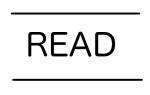
I think it stuck with me because though I solved the puzzle — Read between the lines — I didn’t understand the expression. I knew what it meant at an academic level, but I had never experienced reading between the lines before. I didn’t know how to do it or when it was necessary.
It wasn’t until much later in life, when I started reading Hemingway, that I finally felt the Aha! moment of picking up on allusions, of filling in the blanks the author leaves empty, of understanding what the author is telling you without telling you.
Hemingway is a master of this. His words tell one story — a story that often seems simplistic and superficial when the lines are the only thing you’re reading. It’s the words he leaves out that tell a deeper, more complex, more human story, as in the frustrated love between Jake and Brett in The Sun Also Rises, or the unspoken story behind the dialogue in “Hills Like White Elephants.”
I remember the sensation of it all clicking for me when I picked up on the unwritten story in a book. I don’t recall the book — it may have been Life of Pi — but I remember thinking, “This is what it means to read between the lines.” It was one of those moments when your scalp prickles and you get a rush of heat in your chest. And when it all clicked, when I finally understood, I thought of that pictogram from grade school, as I still do whenever I think of reading between the lines.
The bigger mystery to me now is how does a writer achieve this phenomenon, of creating a story behind the words? It requires deliberate, precise choices: this act of omission, this art of leaving negative space. It is a rare and precious skill.
I spent this weekend devouring a novel. I can’t remember the last time I started a book on a Friday and finished it on a Sunday. It made me so happy to feast on fiction again!
After being let down by a book I had been excited to read, I went into this one with little hope. I allowed myself a little bit of excitement about the hay bale on the cover, and cautious optimism for stories of farm land and farm life. I had no expectation that this book would grip me, and the thought never crossed my mind that I would pick it up and not want to put it down until I finished it. I took time this weekend to tape off the baseboards in our living room, to go to the grocery, to bake hamburger buns, and to make chocolate covered strawberries with our daughter. Aside from those things, I read.
And it felt amazing.
I don’t want to build the book up, lest it might let someone down. The main point is that this book thrilled me, and it felt really good to be thrilled by a book again. It’s been a long time. Even with that caveat, I’m guessing you’ll want to know what book it was :-). It was Jane Smiley’s A Thousand Acres.
I’ve been waiting for autumn to arrive, and it is here. I’m sitting on the couch in sweatpants, with a wool blanket over my lap and a kitten curled up next to me. The wind whips at our house, and it whistles over the chimney like when you blow air across the top of a glass bottle.
It’s been raining for days. Soccer was cancelled. It’s too wet to mow the lawn. For the first weekend in months, there was not. one. thing. on the calendar. Instead of doing house projects — painting trim, ripping out shrubbery — like we usually do during down time, you know what I did instead? I read an entire book yesterday.
It was a good day.
Today I’m making chicken noodle soup and helping our daughter bake bread. I’m going to wear slippers all day long. And I’ve started my next book, this time set in Illinois. A perfect October book: Something Wicked This Way Comes by Ray Bradbury.
It begins with a thunderstorm. I already love it.
I am super excited. I’m about to start on an entirely new and foreign-to-me part of the country on my Andrea Reads America reading project: Idaho. What I’m most giddy about is that there is an author I’ve been hearing about for years — on book podcasts and in my book-nerd circles — and I’ve been waiting to get to Idaho so I can finally read her. The author? Marilynne Robinson.
Robinson is probably best known for Gilead, which won the Pulitzer Prize for Fiction in 2005, but Gilead is set in Iowa and I haven’t gotten to Iowa yet. Instead, I’ll be reading Housekeeping, which is set on a glacial lake in Idaho, Robinson’s home state. Like Gilead, Housekeeping glitters with awards and nominations, including nominations for both the Pulitzer and the National Book Award.
I’m dying to download Housekeeping, which is apparently set on a glacial lake and is a dark and intense read. I know nothing about Idaho, and even less about glacial lakes in Idaho, and so I’m eager to not only read a (hopefully) phenomenal book, but a (hopefully) phenomenal book set in a harsh, unknown-to-me climate.
I’m dying to download the book, but I’m refraining. I’m delaying gratification until I’ve finished my write-up for the Hawaii books I read. I’ve been sitting on these Hawaii notes for months, and it is time to compile and post them. Housekeeping — and Idaho — will be my reward for publishing, and for finally getting back on track with Andrea Reads America. I can’t wait!
 Butterfly Mind