The first time I went to Spain was 22 years ago. It was July and sweltering, and I was pregnant with our son. We went to Barcelona with a friend who grew up there. We stayed with his Dad. We ate late-night gazpacho and fresh sardines from La Rambla on his terrace. Visiting a friend who was from Barcelona, who shared with us his favorite childhood pastries and his everyday meals and who welcomed us into his home, was one of the most magical travel experiences we’ve had.
Last week, I got to experience something similar, this time in cities I never knew I wanted to visit. My team at work traveled to Spain to meet up with a colleague who lives north of Madrid, and who couldn’t get away to travel. We had originally planned to meet up in Madrid, and he said, You should go to Segovia instead. It’s smaller and cheaper but has everything you want. Plus there’s an aqueduct! I can take you to good restaurants there. And you can come visit my city on your activity day and I’ll show you around!
So we went to Segovia. And his home town of Aranda de Duero. This time we were bundled up, and there were Christmas lights, and I drank all the Spanish wine my heart desired.

From the airbnb where we worked, we walked a block to get to the aqueduct, then we followed the aqueduct for 5 minutes or so to the heart of the city. On our first day, after working for a few hours, we took a stroll around Segovia under a crisp November sky. The ochre colors and earthy textures of the buildings and the landscape soothed my soul. I really loved it there.


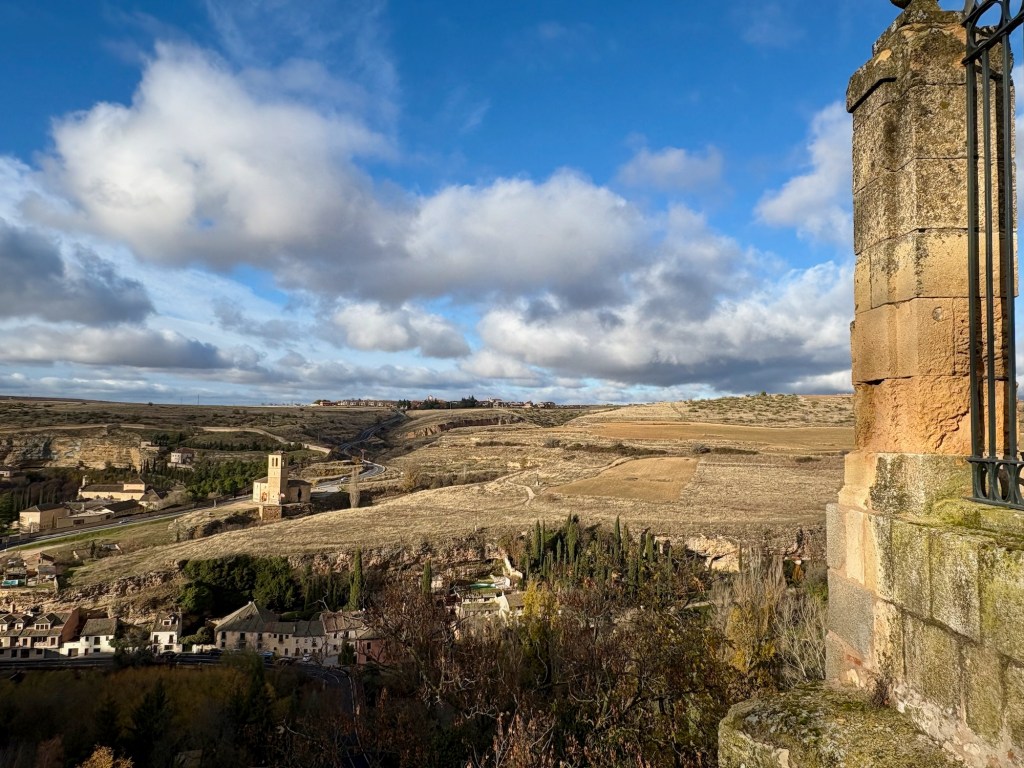


As promised, Raúl took us to his home city of Aranda de Duero, the capital of the Ribera del Duero wine region, on our activity day. Raúl drove us from Segovia in his minivan, and as we approached the city, we saw miles and miles of browned grape vines propped in neat rows above the rocky soil.
Beneath the city of Aranda de Duero is a vast network of wine cellars, or bodegas, 10-13 meters under the ground. They are everywhere. Associations called peñas, which seemed similar to Elks lodges in the US, have their own bodegas where they meet, hang out, celebrate. We visited three. The first was an underground escape room, Ribiértete, which we managed to escape after copious wine. I won’t tell you any more in case you ever decide to go.

The second belonged to a friend of Raúl’s who was kind enough to show us around his bodega. He swiped a key card across the panel of a large wooden door, and it opened into a stone staircase underground.

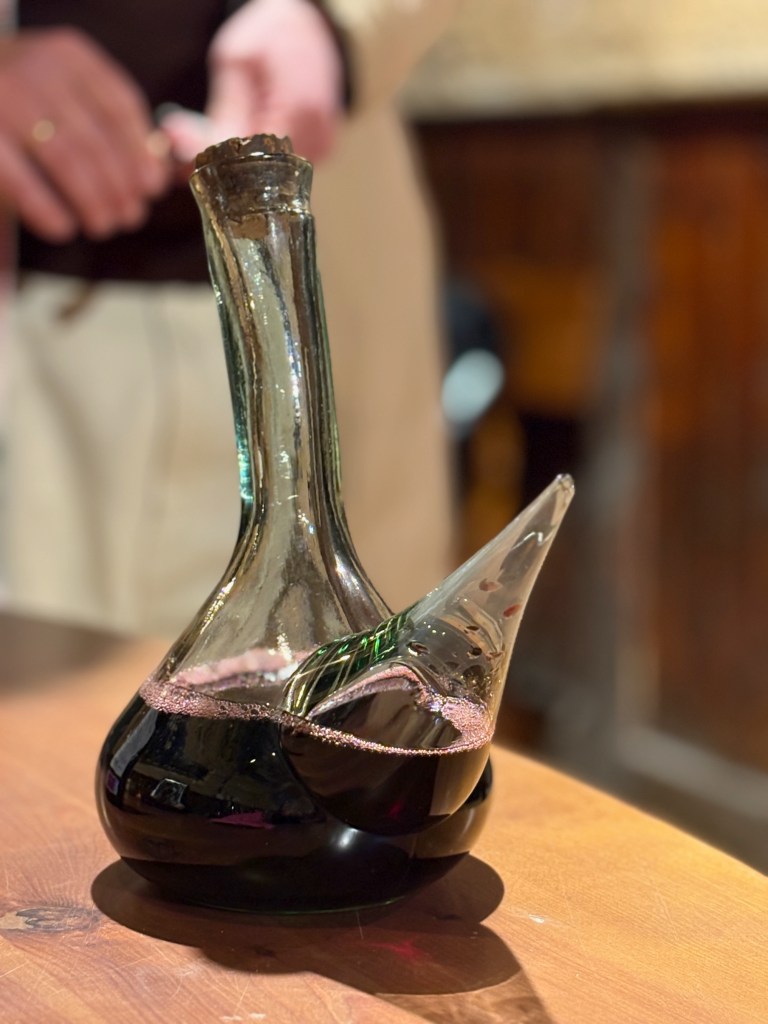
Raúl had stuffed our pockets with bottles of wine from his own house, and I carried his porron in my backpack. Once we were underground and his friend had shown us around his bodega, Raúl pulled out a bottle, filled a porron, and he and his friend demonstrated how to drink out of it. You pour the wine in an arc into your mouth without touching the spout. It is not as easy as it would seem to do this without pouring wine in your nose or dribbling it all over your clothes. Luckily I wore black. I asked why this way? As soon as I said it, I realized, ahh! When done correctly, nobody’s mouth touches the porron. This makes for easy cleanup: no wine glasses to wash.
It took a lot of practice to get the technique right, but after 3 or 4 bottles throughout the day, we all mostly got there in the end.


After the escape room and the Bodega la Navarra, we went in search of tapas. Raúl’s favorite place was packed, so we walked around the block to another, where we got tortilla de patatas, the Spanish omelette with potatoes that I can’t get enough of, and some sort of small salty fish. I don’t know what it was but it was delicious. Probably anchovies. We were six people, and there was enough for each of us to have one or two bites of each, and then we headed back to the first tapas place to see if any people had cleared out.
We managed to find a standing table and ordered a larger assortment of tapas. The one I still dream about was a toast with warm goat cheese and caramelized onions. Oh my god. It was one of the best things I’ve ever eaten. There was something else with small pickles sandwiching anchovies and an olive on a toothpick. Google tells me that tapas that are skewered like this are called pintxos, and this particular one was possibly a Gilda. They are described online as “piquant”. I agree. It was briny and vinegary and crunchy and delicious. And everywhere had olives de anchoa (anchovies). I couldn’t get enough of these either. Raúl took us to his favorite olive shop at the end of our day and I bought a giant can to bring home.
After tapas, as we walked along the streets of the town’s center, Raúl pointed out doors everywhere — “That goes to a bodega. And that one. That one, too, and that one.” As he neared his peña’s bodega, he pointed across the square, “That’s my wife’s association.” He waved his card over the door, and we descended another set of stone stairs.

We filled the porron and carried it with us as Raúl took us on a tour of his association’s bodega. One room was full of pictures of the members of the peña, lined up like in class photos at school, different events they’d hosted, and big life events, like new babies. I kept saying, “I can’t believe this is your life Raúl.” It was one of the neatest things I’ve ever experienced.


I never knew I wanted to go to Segovia or Aranda de Duero, and now that I’ve been, I’m so grateful I got the chance. It would not have been the same without our friend and coworker as a guide. It was magical. Thank you, Raúl!



















 Butterfly Mind