I recently finished a book, Clear Thinking by Shane Parrish, that had a surprising twist at the end. It’s a self-development book I read for work, so was reading in the context of how I show up at my job, and particularly for the purpose of developing decision-making skills. I expected your typical business-y productivity book (which it is, though it’s wiser and more insightful than most I’ve read), so I was surprised at the end of the book to see a chapter called “The Happiness Experts.” What does happiness have to do with good decision-making?
Parrish distills good decision-making down to two things: knowing how to get what you want, and knowing what’s worth wanting — what really matters. The consideration of happiness helps us make decisions based on what really matters.
The happiness experts he seeks wisdom from at the end of the book are elders in their 70s, 80s, and 90s: people have lived a long life, who are facing death, and who have the perspective of many years of living to know what really matters. One of the items those elders list as important* is to savor daily pleasures instead of waiting for big events. We spend the vast majority of our lives in the mundane day-to-day. If we want to tip the balance towards more happiness, the every-day is the place to find it.
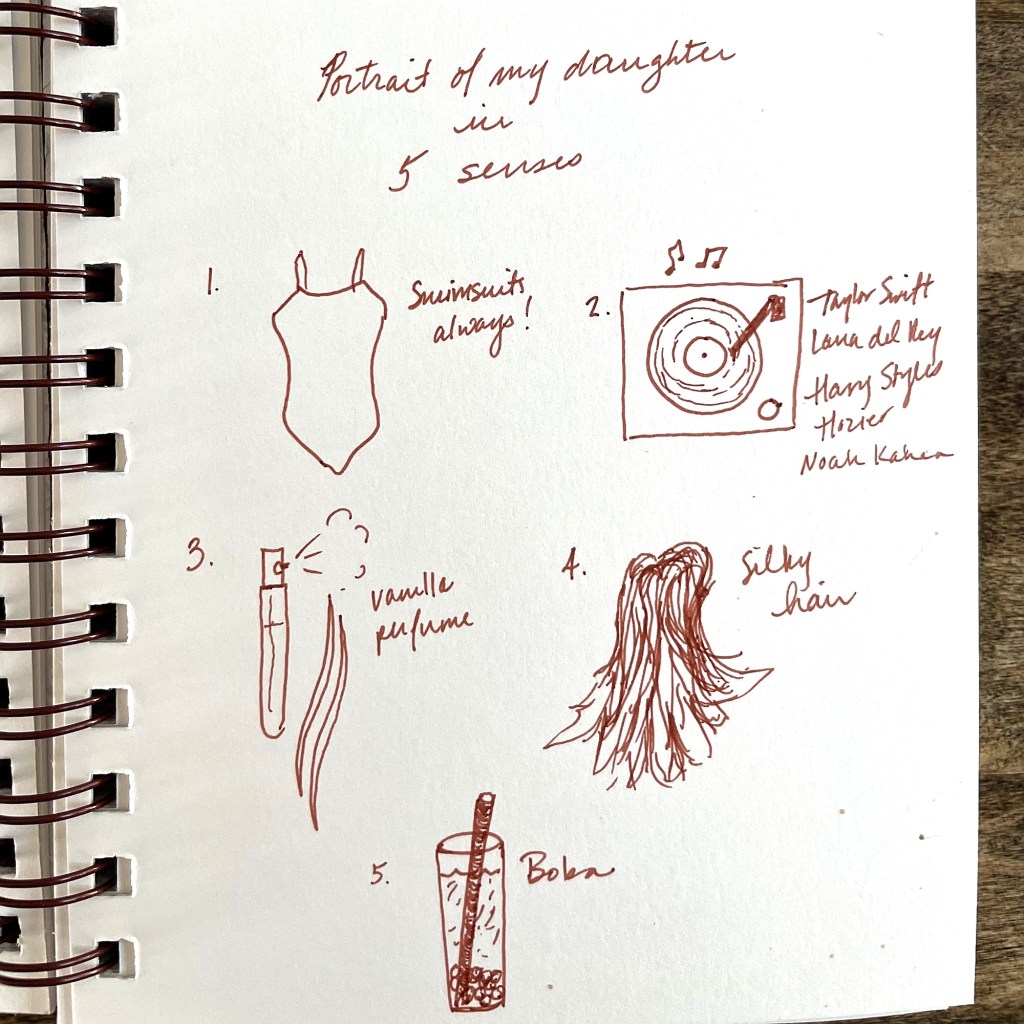
I am all in on this. I love the mundane. I love lounging around in my leisure time and laughing with my husband and kids. I love writing and drawing with my pretty inks. I love sitting by a crackling fire and reading novels. I love standing at the back window and watching the birds, squirrels, and bunnies. I love walking around my neighborhood and seeing the trees and mountains, smelling the air, and listening to wind in the leaves. I love finding beauty in the shape of an ink bottle, delight in my peanut butter and honey toast, awe in nature, curiosity in people-watching, comfort and coziness in my slippers, a surge of love when I smell our daughter’s vanilla perfume, hear her shoulder her swim bag, or taste the latest flavor of bubble tea she’s drinking.
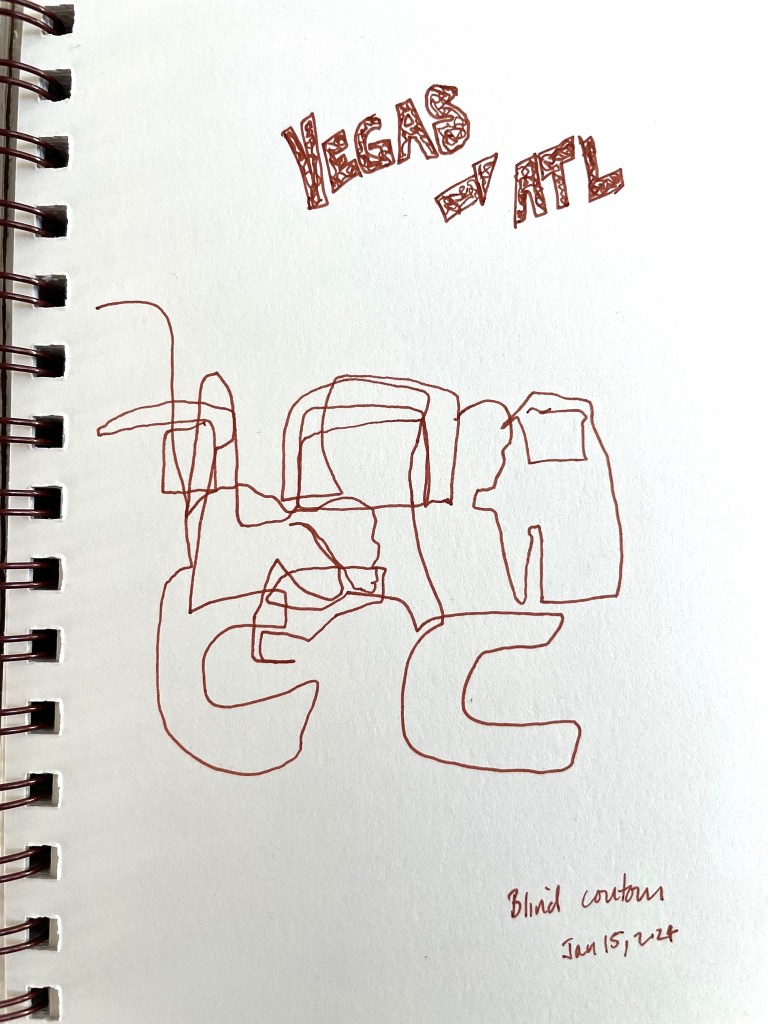
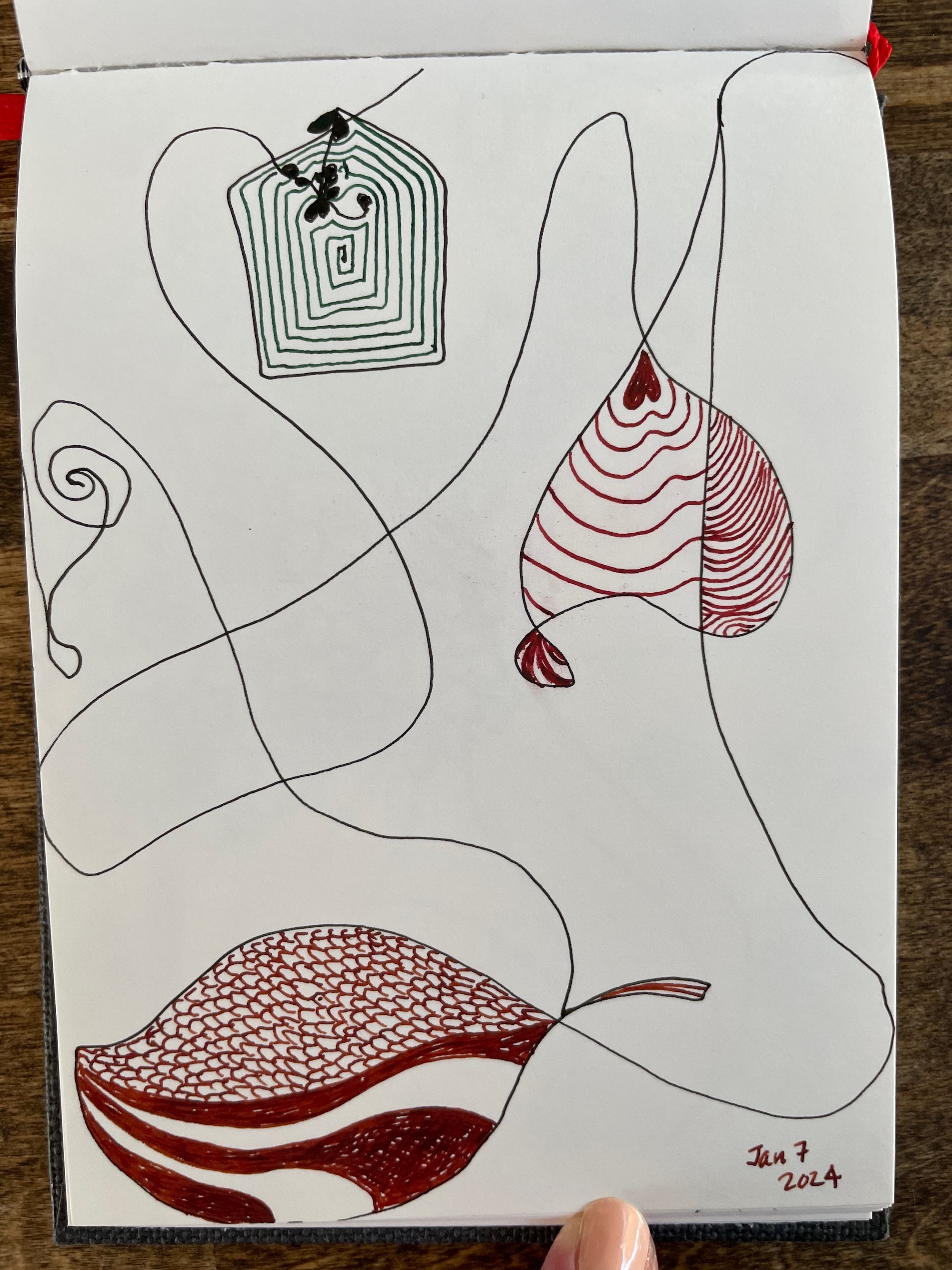
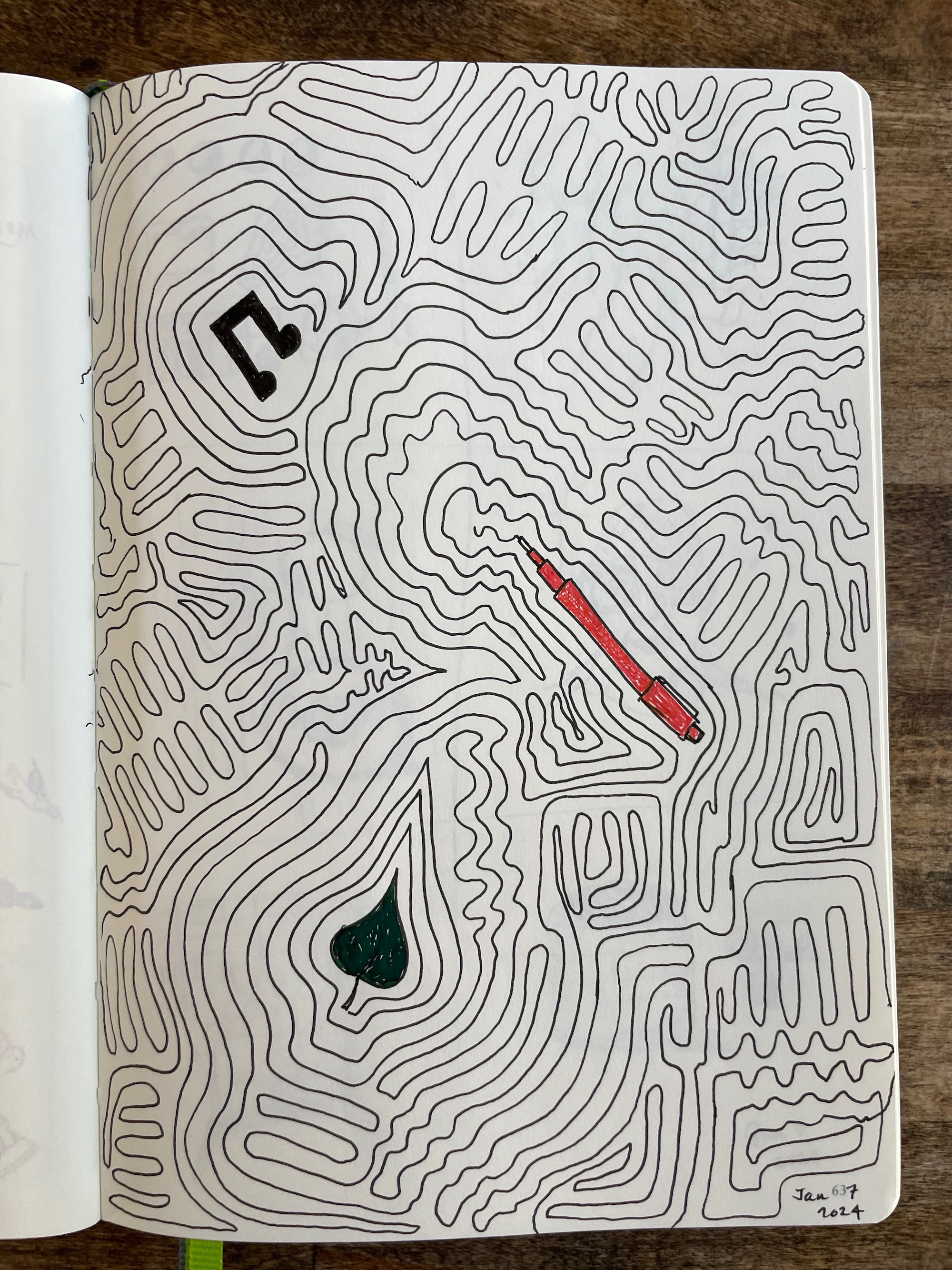
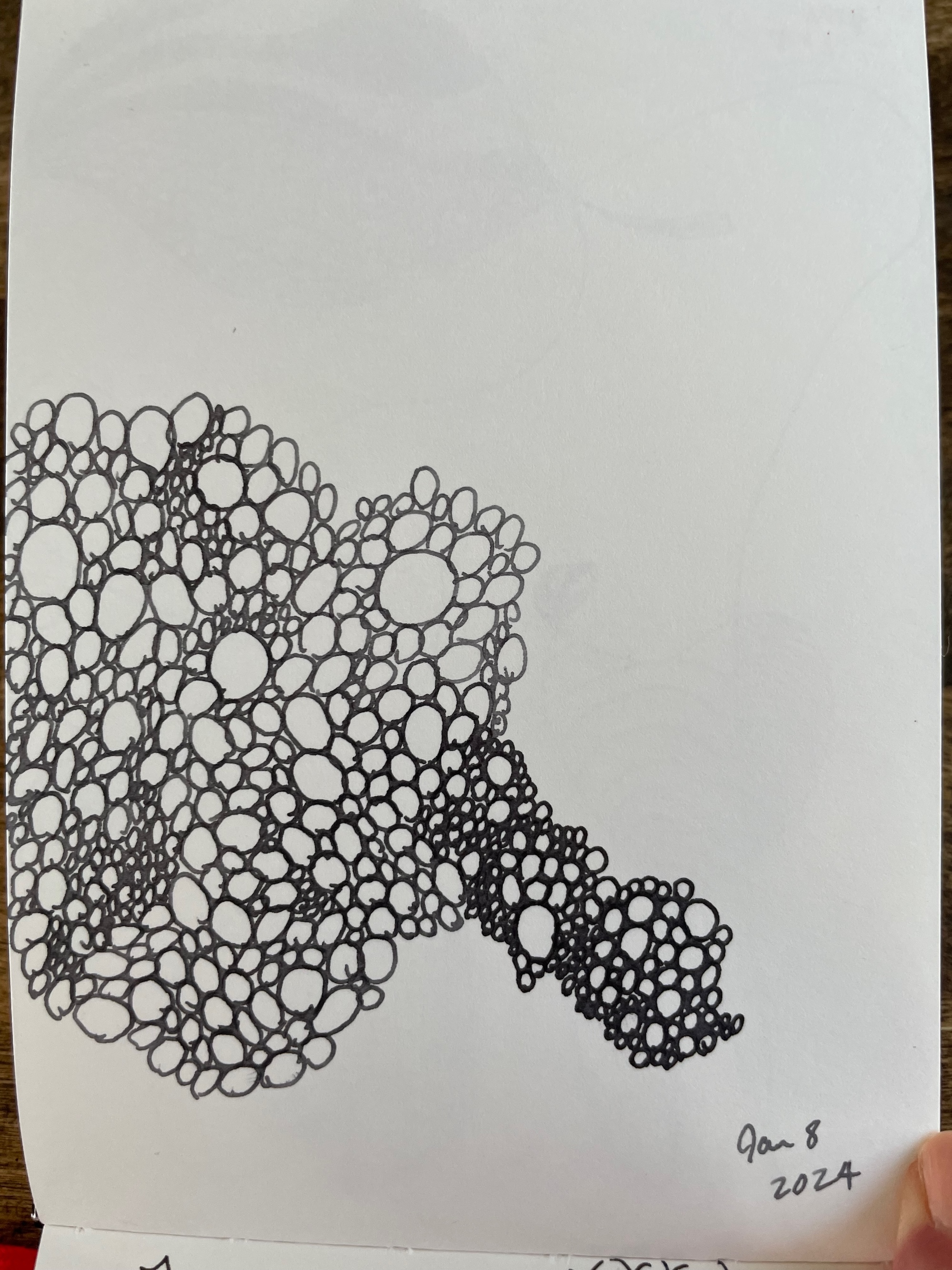
The second week of the 30 days of drawing challenge I joined was all about delights. Needless to say, I had fun with this week. I had two long flights so I had lots of time to play with, and I spent more than 10 minutes on some of the drawings. I was absorbed in the activity of making marks on the page, and it brought me pleasure, and I had time, and I had no reason to stop. I feel good about that decision.
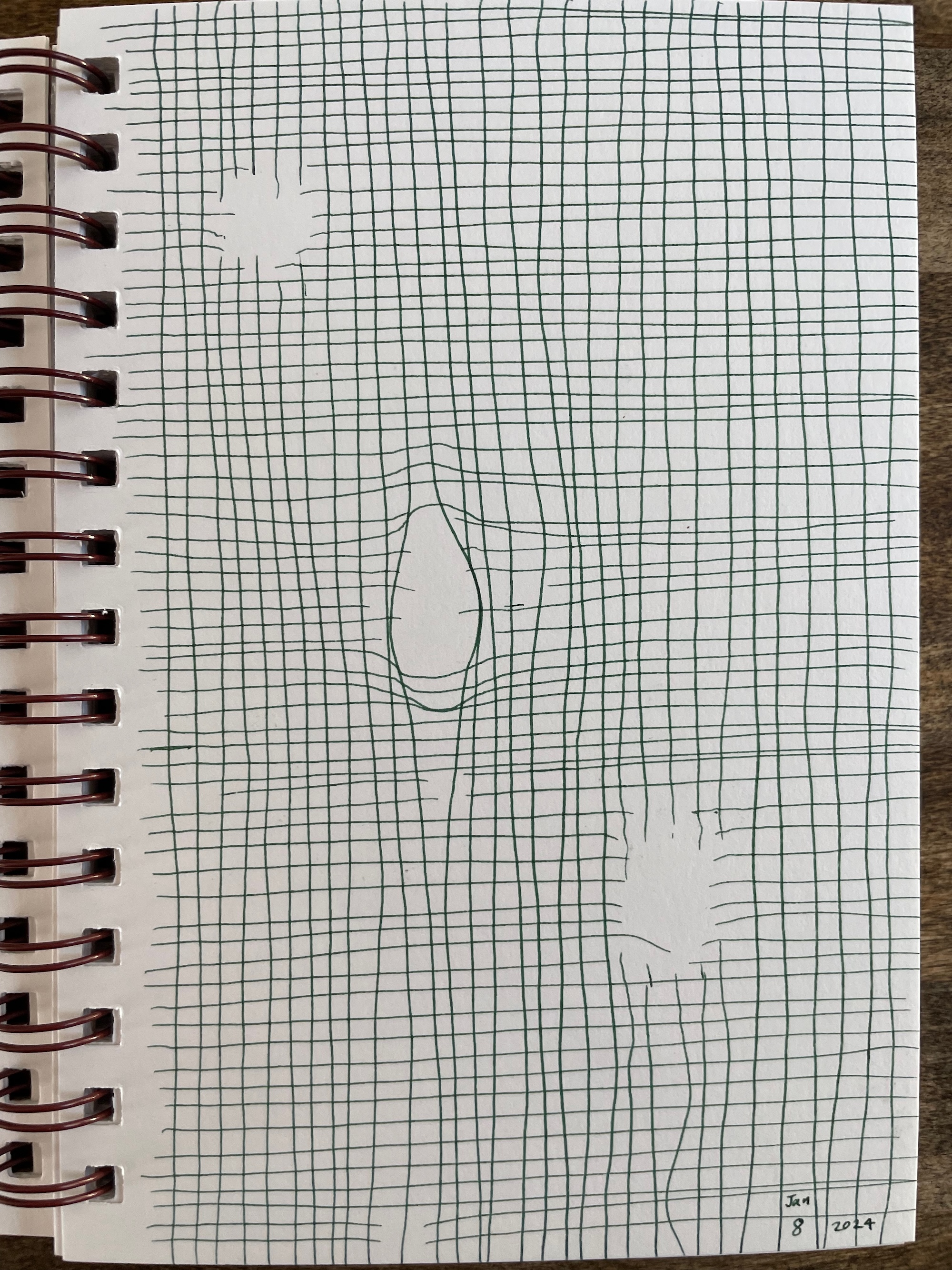
Day 7: something that delights meDay 8: delicious delightsDay 9: delight in natureDay 10: blind contourDay 11: clothes that delight (my slippers)Day 12: delight through our senseA week of drawing delights
*Other items on the list of things elders say matter in life are saying things now to people you care about, spending maximum time with your children, working in a job you love, and selecting your mate carefully.
Bloganuary writing prompt
What do you enjoy doing most in your leisure time?
Of the two intentions I set for 2024, I am succeeding at one of them: I draw nearly every day. My friend and team lead, Kristina — the one who got me hooked on drawing to begin with — sent me an Instagram message to tell me about a January, 10-minutes a day, anti-perfectionist 30-day drawing habit… community? course? Substack? I don’t know what to call it, but it’s run by Wendy MacNaughton, the illustrator of Salt, Fat, Acid, Heat. After first saying, “but I’m not a subscriber!,” then landing a free 30 day trial*, I said hell yes! And I started drawing, fearlessly. Because the whole point is to have fun and stop editing yourself.
As with many online drawing lessons I’ve dipped my toes into, this one introduced us first to line. Or at least I thought it did. I can’t find a corresponding lesson, but I have this drawing of different kinds of lines that I’m sure came from WendyMac’s lessons:
Different kinds of lines
From there, I set a timer for 10 minutes for each assignment, turned off my brain, and drew based on the prompts she gave. It reminded me a lot of the talk I gave at WordCamp US, and then again at WordCamp Europe: Publish in 10 minutes per day. The keys are 1) to have a prompt to work from, and 2) to reject perfectionism. Set a timer, let it rip, don’t worry, and boom, you have a blog post (or a drawing).
One of the keys to having fun creatively is to not be precious or embarrassed by what you’ve made. So in that spirit, I’m posting the drawings from my first week with WendyMac. The theme of the week was doodling. Doodling is fun. It’s low pressure, there’s no comparison to reality, and it’s easy to flow with. I’ve found I really enjoy lines, and I like to doodle on airplanes. I turn on some music, or the fireplace video if available, and let my pen wander. Doodling passes the time while also putting me in a flow state. I found some entrancing doodlers on Instagram, and I am inspired.
The first assignment of the 30-day habit was to draw, in 10 minutes, what I want to do more of and less of in 2024. My More list is basically stuff I like to do for fun: listen to music, enjoy nature, travel, go for walks or hikes. And now, draw.
Below are my doodles. I have so much to learn 😂. For starters, I’ve learned about paper, and about not drawing on both sides of lightweight paper. I’ve also learned that 10 minutes is not very long. I think that’s the trick to it: 10 minutes is a short amount of time. It’s the starting that matters. Committing to 10 minutes helps you get started. There were a couple of days in week 2 where I said screw the 10 minutes, I’ve started, and I’m having fun, and I’m going to keep going. But the 10 minutes is also to give constraints and say, hello, this isn’t a masterpiece and don’t spend 2 weeks on it. Just 10 minutes. You don’t need to be perfect. Loosen up. Have fun.
Day 1: intentionsDay 2: doodle into drawingDay 3: doodle futureDay 4: circlesDay 5: get griddyDay 6: doodle finale
My biggest challenge in life seems to be having too many things I want to do and not enough time to do them all. Because of this, I rarely get bored, but it also means I’m constantly making decisions: do I do this or do I do that. Do I read or do I write. Do I write or do I draw. Do I exercise or do I journal. Do I blog or do I transcribe diaries. Do I hike or do I read. Do I read or do I garden.
My latest hobby is drawing, and I have specific ambitions with that. I want to play with pen and ink drawing to make pretty entries in nature journals. I like flipping through my little sketchbook and seeing pictures instead of reading lots of words, and I love the meditative act of drawing.
Of course, this means more physical books to store on a shelf. My shelf of diaries and written word journals is now overstuffed: I cannot fit any more notebooks, composition books, or now, sketchpads on it.
To help me overcome the constant challenge of choosing what to do with my time, and also, to help me accomplish my goal of creating a beautiful nature journal, with botanical sketches and drawings of little birds, I’m going to set only two intentions for 2024:
Draw. Take online drawing courses, do tutorials, draw with graphite, dabble in colored pencils, and progress to pen and ink. Early in the year, start a nature journal where I draw something that strikes me or fills me with wonder at least once per week, preferably once per day.
Transcribe 20 of my old diaries so I can empty some shelf space for sketchbooks. I found an app that can transform handwriting to typed text, and I will use that so that I can keep images of my handwritten pages while also transforming it to searchable text. When I found the app, I had originally set a goal to transcribe 45 journals in the year, but then I started one to test how long it would take, and I’ve been working on the one for over two weeks, so 45 is probably a little too ambitious. Twenty seems doable.
That’s it. I don’t need to set any intentions around reading or gardening or exercising or blogging because I’ll do all of those things no matter what. Drawing is a new habit that I want to nurture, though. I get absorbed in it, and it’s fun, and it’s very satisfying to see myself improve as I practice. I want to make space for it in 2024.
This year, the magnetism of the tarot tugged at me more than usual. I’ve played with self-reading for a few years, but I struggled to make meaning of what I was doing.
This year, I wanted to really learn the tarot. I’d never owned or really even looked at the traditional Rider-Waite-Smith cards, which are the most well-known and referenced tarot images, so I bought myself the Radiant version of the deck. The deck came with a proper guide book I could learn from rather than the tiny paper insert that often comes with a small box of tarot cards. I also bought the book Tarot for One by Courtney Weber, and I started listening to the Tarot Heroes podcast. Those resources, along with the guidebooks from my existing decks, help me understand traditional interpretations of individual cards, deck-specific interpretations, and how to think of the tarot in general.
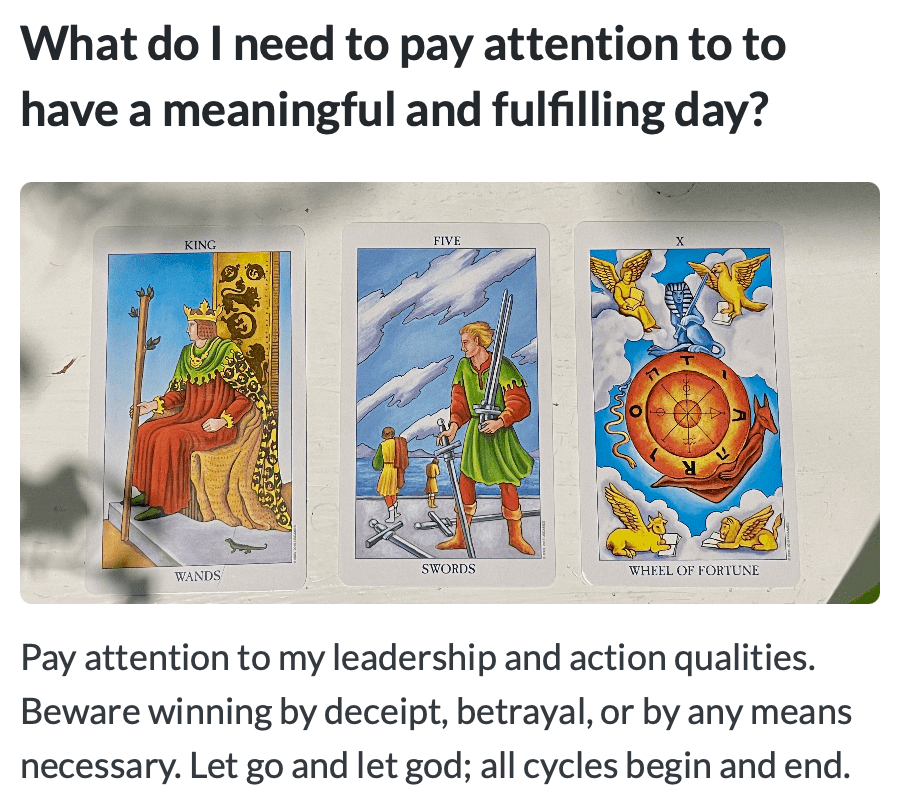
But what brought it all together, what helped me start to internalize the cards and really make meaning of them in a fun way that adds zest to my life, was to not just pull cards every day, but to journal about them. Pulling tarot cards helps me set an intention each day and focus my attention towards that intention. For example, as I shuffle I might ask, “What should I pay attention to today to have a fulfilling day at work?” Journaling about the cards helps me learn them: I pull cards, look them up, consider what I see and what guidebooks say, and write my thoughts and interpretations. At the end of the day, I look at my journal entry from the morning and reflect on the day as it relates to the cards. This last step helps me understand cards that might not have made sense at the beginning of the day (and maybe they still don’t at the end of the day! And that’s okay! This is a hobby, it’s all for fun, this is not life or death.)
I love two things about the journaling process. First, journaling reinforces the message of the cards so that throughout the day, I pay attention to events or my mindset in relation to my intention. Writing about the cards helps me remember them. For example, when I pull cards I might ask, “How can I approach today so that I have a happy day?” If one of the cards indicates “Be open to saying yes,” writing that out will help me remember that message during the day. If something comes my way that my knee-jerk reaction is to say No to, maybe I’ll pause and consider whether Yes is actually a better answer. Second, by keeping a journal, I can reference previous entries to see what happened when I pulled a certain card last time, or I can identify patterns. This helps me learn the how the cards show up in my life, what they mean for me, and what lessons keep showing up that I might need to learn.
A coworker asked for any tips on how to get started with tarot journaling, so here are some of the ways I journal.
How I journal
I started by journaling on paper, but this method missed a really important part of the tarot, which is the visual element of the cards. Tarot cards are tiny pieces of art in which every component has meaning: suit, numbers, colors, posture, sight-line, atmosphere, clothing, plants, animals, tools. In a paper journal where I just wrote words, my journal entries lacked that visual representation. So I switched to a digital journal using the Day One journaling app*. I pull cards first thing in the morning, take a photo of them, then drop the photo into a new entry in my Tarot journal on the app. I title the post with whatever intention I focused on when I pulled the card, then I write my thoughts about what the cards mean. At the end of the day, I check back in and write a summary of the day and how the cards seemed to relate.
*An added benefit of keeping a digital tarot journal is that it makes it much easier to search for specific cards from past readings.
Different kinds of entries
Daily encounter This is a three card pull: the first card represents me and how I’m showing up, the second card represents an encounter that day, and the third card represents the outcome. When I first started my tarot journey this year, I’d pull these three cards, read about them in the guide book, and write out those meanings in my journal. I pretty much copied the books verbatum, and then at the end of the day, tried to correlate the card meanings with what my experience was like that day. After a while, I realized this copy paste style was akin to memorization rather than understanding, so I switched to pulling single cards and studying the art on them to find my own meaning. Now, when I pull my daily encounter spreads, I jot down what the cards mean to me and then revisit at the end of the day.
Single card Sometimes three cards are too much to digest, or I find myself not really paying attention to what I think about them and instead just regurgitate what the guidebooks say. In those periods, I’ll pull one card for the day with the sole intent of learning that one card — I’m not even necessarily asking a question about the day. I’ll put the card next to my laptop and look at it closely while I describe it in my journal. I’ll describe the colors, the facial expressions and body language, and the overall feeling it gives me. Then I’ll write what I think it is saying as a piece of art. Throughout the day or at the end, I’ll jot down moments that felt like the energy of the card.
Bigger spreads It’s rare that I do spreads any more complex than three cards except on my birthday. On my birthday, I’ll usually do a solar year spread where I pull one card to represent the whole year, and then 12 cards: one for each month. I photograph the spread and tag it in my journal so that when the month changes over, I can easily find the spread and see what to look forward to that month.
Reference Sometimes I want to take notes that are general to the tarot, and that I use as reference entries to help in my own interpretation of cards. For example, I have an entry that describes the suits (swords, cups, pentacles, wands) and an entry for numerology. I imagine one day I might have one for colors, and I have a couple of reference entries from exercises in Tarot for One. I tag these with a Reference tag in my journal app, which makes it easy to find them when I want to jog my memory.
Have fun!
My favorite thing I learned this year about the tarot is that it originated as a card game: they were playing cards. When asked for advice he’d give beginners, Jeff Petriello, co-creator of the Pasta Tarot deck said on the Tarot Heroes podcast, “Oh my god, have fun! That is absolutely the biggest thing to remember…These cards were used as playing cards for centuries… so it’s really important to remember to play with them. They have a whole history in play so I really try to encourage beginners to have that spirit.” His advice helped me not take anything seriously, and to just play around with my cards and in my journal.
April was a good month for me for reading. I devoured two publications that experiment with form and structure: the novel Ducks, Newburyport and the online magazine Pipewrench. As I mentioned in a previous blog post, Ducks, Newburyport is a 1,000-page sentence. Pipewrench magazine is structured like a dinner party: the main essay is the guest of honor, and the companion pieces, named for the guests at the dinner party who wrote them (the Musician, the Poet, the Educator) are like conversations at the table that explore the main essay’s themes from different perspectives.
Both publications are unlike anything I’ve ever read. They take risks that in the wrong hands could crash and burn. Their creators jumped off the cliff and soared.
I recently learned that appreciation of beauty and excellence is a strength (YES! I wish I’d known 30 years ago), and when I took the VIA strengths test yesterday, I found it is my top strength. This makes me feel better about not being able to create such writerly wonders myself but instead sit back and enjoy when others do.
I also recently learned that awe and wonder boost happiness. I can confirm that this is true because after I experience the excellence of literary risk-takers like these, I am filled with joy and appreciation. I am delighted by their perfect execution even now, a month after reading them.
The reverberations I still feel after reading Ducks, Newburyport and Pipewrench make me think a lot about what makes a work, or even a simple conversation, rich and deep and fulfilling. Some writing is enjoyable and fun and makes me turn pages quickly, but I don’t feel fulfilled afterwards. The story does not stick. Some paintings are pretty to look at, but they don’t inspire me to engage with them, to think, to feel, while others captivate me and inspire me to come back to them again and again.
We use the word “deep” a lot — a deep conversation, a piece of writing that goes deep. I think a common element of things that resonate and stick are that they go deep. But what does that mean? What distinguishes shallow from deep? The answer to this question is elusive to me.
I think one way an author creates depth is by layering. You hear about cooking, “You must season at every step!”, and this is something I think exists in art as well. A piece of writing that resonates goes deeper than just the surface layer of the story itself, and every layer is thoughtful and well-executed: characters, subject matter, word choice, themes, exploration of humanity, leaving enough out so that the reader engages to fill in the blanks. In works that reverberate, all of these layers are perfectly executed and interact with each other to provide richness and complexity. In the examples of Ducks, Newburyport and Pipewrench magazine, I mentioned structure. Until I read these I would have never said I cared about how a piece of writing is structure. And then these both did something with structure that surprised me, that I wasn’t sure how they would work, and as I read, I realized their structure played as essential a role as the plot, word choice, and characters to pull off what the creators were hoping to achieve. I’m still delighted by this.
For me, perspective also contributes to depth. Art that resonates often gives me a new perspective, a deeper look into how someone else sees and and experiences the world. Getting at the motivators of human behavior is endlessly fascinating to me, and different perspectives, when done well, show us those drivers. Seeing those drivers for behavior help us expand beyond the story and the specific characters on the page to broader humanity, giving us empathy not just for the characters on the page, but for our fellow humans.
I think a contributor to my experience of works that reverberate is that they challenge me. I don’t want to read or look at a piece of art so difficult that it blocks me from consuming it, but I do like to be challenged. With Ducks, Newburyport, the lack of terminal punctuation challenged me as a person who likes tidiness and order and a clear stopping point. With Pipewrench, reading the experiences of the grief of being Black in America challenged me as a white woman who contributes to the systems that cause that grief. Challenge breaks down barriers. It makes me see things in new ways. One of my favorite things about abstract art is that it challenges us as the viewers to interpret it our own way, to see what we will see in it. I find this exciting. It’s a way to fire new synapses, to think in new ways. Challenge allows us to constantly recreate our world-view.
I guess that’s another contributor to depth: universality. This feels cliché to even bring up because it’s in every writing book ever. But it’s true, writing that reverberates can be expanded beyond the story or the characters on the page. Well-crafted works of art make us think big thoughts about humanity and the world and the universe, about forces bigger than ourselves, about Nature, about cruelty and hope and what we can do to be better in the world.
Yesterday, I wrote not one 10-minute write, but two free writes of I don’t know how much time, one in the morning, and one at the end of the day. For the first time in ages, I was excited to scatter thoughts on a page: not for a purpose, not for a blog post. Just to write for the sake of writing. I prioritized it over work, over reading, over to-do lists, cleaning, and chores.
I understand that aesthetics are important. In the the past, I have given my site a makeover when I felt uninspired about blogging. To actually want to open my laptop and write a post, I have to enjoy spending time on my site. I have to be pleased by the way the words and images look on my little online home. My space has to be pretty. It has to be a place I want to hang out.
Otherwise, I’ll stop going.
It didn’t occur to me the same would be true for pen and paper. A couple of years ago, I switched to 59¢ composition books. It was getting too expensive to fill fancy journals at the rate I was writing. I still wrote on paper afer the switch. No biggie. Except then I didn’t.
I’ve lost track of how long it’s been since I wrote in one of my supermarket composition books. I don’t even know where my active one is. On vacation I wrote in a Moleskine, but only because it was in my purse, and I didn’t feel like opening my laptop. It wasn’t because the Moleskine was calling me.
This journal, though. Yesterday morning, I couldn’t wait to get out of bed and make coffee so I could write on the pretty pages. At the end of the day, rather than taking work to our daughter’s guitar lessons, I took my new journal. I wrote again instead of picking work back up.
I wanted to spend time in the lovely leaves Bridget Collins created, spilling ink, and wondering with each turn of the page what botanical delight I’ll come across next.








 Butterfly Mind