I walked in a soft gray drizzle this morning. Shiny green leaves dripped, and honeysuckle scented the path. As I walked, I listened to Krista Tippet’s On Beinginterview with Robin Wall Kimmerer. They talked about the intelligence of plants. Kimmerer wrote a gorgeous book, Braiding Sweetgrass, which I read after it arrived unexpectedly in the mail one day from my friend Gracie (thank you Gracie!), and she wrote Gathering Moss, which I didn’t read, but which apparently inspired Elizabeth Gilbert’s The Signature of All Things, which I did read and I loved, and now I want to read Gathering Moss because moss is soft and green and clever and resilient.
As I walked among glistening grass and dewy daisies, Kimmerer described the day she showed up at the forestry school in college. When she arrived, she said she wanted to study botany because she wanted to know why goldenrod and asters look so beautiful together. Kimmerer had grown up exploring forests and learning from the natural world rather than about the natural world, and this was the perspective she brought to her academic career.
As you can probably imagine, she was told you don’t study beauty in science; to do that you should go to art school. But she was not deterred, and as she studied, she was able to find an answer: goldenrod and aster are opposite colors on the color wheel, which is pleasing to our eyes and we consider beautiful, and also, when positioned near each other as Kimmerer so often saw goldenrod and aster growing, those vivid colors attract more pollinators than if the two plants grew apart. And pollinators are part of a flower’s story; life wants to live, and pollinators help keep plants going.
So each of those plants benefits by combining its beauty with the beauty of the other.
And that’s a question that science can address, certainly, as well as artists. And I just think that Why is the world so beautiful? is a question that we all ought to be embracing.
I sit by the window this morning with a fuzzy fleece blanket over my lap, a cat snuggled against my legs, and a warm cup of coffee in the sill. I can feel cold radiate from the window glass. The sky is a dusky pink as the sun rises, and the naked branches of deciduous trees stand out in black against the blush.
Though most of the trees are bare now, a few final holdouts stand tall, fully clothed in burnt orange leaves. Silver-white frost furs the grass and the brown stems of my sleeping garden. The tassles of the miscanthus grass finger the air like frothy golden hands.
Outside is stillness except for the echoing honk of a Canada goose. People are indoors; all the cars in sight are covered in frost. The morning may seem like an emptiness waiting to be filled. But to me it is perfect in its quiet accumulation of ice particles, autumn colors, and pink light. In its emptiness, it is already full.
Snow clings to the boughs of the tall evergreens out back, glittering white chitons on the feather branches that droop under its wet weight. The deciduous trees, naked and twiggy, look like someone pulled a liner brush globbed with titanium white paint across the top of every branch.
The flower bed sleeps under a thick layer of fluffy white batting. Brave ornamental grasses burst through the blanket and wave in the building breeze. The snow has ended and the rain will soon begin.
Grasses have become my new favorite plants in the garden. Prior to last year, I wanted every plant to have flowers. And I don’t mean the delicate, feathery seed head plumes of grasses, I mean bold, colorful, petally, showy flowers, gobs of them. I wanted flowers everywhere, nevermind the riot they create.
I’ve never been good at subtlety. Everything I do is obvious, and my garden is no different. My husband and daughter go for foliage, but foliage never interested me. Foliage is not flowers, leaves are not obvious, and I figured if I don’t even notice it other than as background, what good is special foliage unless it is feeding caterpillars?
Last year that changed. I would look out back at my carefully planned flower beds and see that I’d planted according to flower color, but hadn’t taken foliage into account. When I looked at the overall effect, it wasn’t one of harmony like I expected. Sure, the flowers were harmonious in pinks and lavendars, but the foliage was all wrong. Silver blue rounded leaves of the rue, which appeared as blue-grey mounds from the deck, clashed with the yellow green leaves of salvias, milkweed, and veronica. Because the foliage makes up the bulk of the vista from far away, it just looked bad.
Around the same time I noticed this, I saw a Mexican feather grass at the nursery. It was delicate, and wispy, and graceful, and I thought how pretty it would look in the wind. I thought all of this and I could not live without it.
I bought it, and planted it, and watched it every day from the porch, in the soft morning light, in the harsh direct sun of mid-day, in the slanting golden light of day’s end, on calm days when the slightest puff of air would wave the tops of its tresses, and on windy days that blew its green strands like the wind on a boat ride blows my hair across my face.
And that was when I truly came to appreciate foliage.
After that feather grass, I bought almost every ornamental grass I could get my hands on. On the $5 clearance rack, Lowes had grasses call Wind Dancers. Wind Dancers! I bought four. I bought native switchgrasses, prairie dropseeds, blue fescues, Karl Foersters. I bought blue grammas, and purple loveseeds, and more of the golden green Mexican feather grasses. Each winter, I started little bluestem from from seed, and I put them in the ground as little green sprouts in spring. Little bluestem is blue green all summer and then turns a blazing copper in fall.
Each grass has its own flower plume near the end of summer. Some look like golden feathers, others like airy clouds. All bob daintily atop slender stems. But what I love best about the grasses are the way they capture light and the way they move. Their narrow blades catch the golden glow of the evening sun, and it’s so beautiful I could cry. In their response to air movement, they make the invisibile visible. They sway and dance in light air; they flutter and flap and bend when it’s heavy. They show swirls of wind we would not otherwise see.
Grasses do not call attention to themselves. Their beauty comes from their grace and quiet strength. When all the showy flowers have faded in the garden, and the leaves of trees and perennials have shriveled and dropped, the grasses simply change to a color that better reflects the low light of shorter days. They sway like strands of gold poking up through the snow, and dance to show how the invisible air moves, and they bend but do not break when battered by gales and weighted by burdens of snow and ice.
From the podium, I looked out into an audience of about 60 people. Their eyes focused on me, and from their facial expressions – a smile in the second row, fascination in the fourth – I saw that they were absorbed. Nobody sipped coffee, or coughed. Nobody shifted position. I continued reading.
“The air was heavy, thick with heat and mud. We skirted exposed oyster beds in the shallow water, moving slowly enough that we could hear the oysters snap and pop.”
My mouth was dry, but I was reading better than all of my practice sessions, and I didn’t want to throw my momentum by taking a sip of water. All weekend I tried to suppress my nerves as we cheered our son’s team at a soccer tournament in Charlotte. I did not succeed in hiding my stress from my husband, though, and he asked what was wrong.
“I’m just nervous about my reading on Sunday.” I attempted a smile.
“I wondered,” he said. “You seemed really nonchalant about the whole thing.”
And I was nonchalant. At first. Talking in front of a crowd doesn’t bother me. I used to give informational meetings several times a week in front of total strangers when I worked for The Leukemia & Lymphoma Society. But as the Valley Voices reading approached, and I practiced my piece over and over and over again, finding another fault with each and every read-through, I realized that reading your own work, for which you’ve mined every word, for which you’ve excavated your soul, is a very different thing than giving a sales pitch for your employer. Sharing your own work on a blog already makes you feel vulnerable, even though you get to be secreted away in the privacy of your home when others read it. So to stand in front of a crowd and expose your creation out loud? It makes you feel squishy and naked, with every flabby flaw exposed.
My husband asked, “Why are you so nervous now, when you weren’t before?”
“Because I heard the other writers read at rehearsal, and they were really good.” I studied the cobalt blues in the hotel hallway carpet. “I don’t have any confidence in mine.” I didn’t say it, but I thought, maybe mine was was the only nonfiction submission they received. Maybe that’s how it slipped in.
“You’re just sick of looking at it, and you’re nervous about reading. Don’t beat yourself up.” He hugged me. “It was selected, Andrea. The judges liked it. That’s why you’re there.”
My mouth was parched. Only two pages to go. I felt a little faint. I looked up again and saw the same rapt attention. I had passed the place where I thought the piece sagged, and the audience was still with me. Their silence was electric. I could feel that I was reading well. Thank God. It didn’t suck.
When I finished, I croaked out a small “Thank you,” then sat in my chair, quaking, relieved that I was done. I was able to enjoy the other writers’ work, and was grateful for the beauty in their poetry, and the laughter they surprised out of me with their humor.
After the reading, I was speaking with one of the judges, thanking her for reading all of our work, when a woman tapped my shoulder and told me, “I loved your piece. I was right there with you. I could smell those marshes, and I’ve never been there.”
“Thank you. Thank you so much for telling me that.” I beamed at her.
Later, one of the organizers of the event gave me a big smile and told me I had read well.
“Thank you, Jane! My God, I was so nervous. I couldn’t believe it even made it in.”
“Why not?”
“Because it doesn’t have a point! It’s just pretty. No tension, no drama, no climax.” None of the elements of a successful story.
She looked surprised. “It doesn’t have to have all of that. I was with you on that boat, I was engaged the entire time. I could hear the motor, I could smell the marsh. I experienced that boat ride with you. We all did.”
On the way home, I mulled the problems I had seen in my piece. I painted a picture, yes, but is setting enough without a story? Is “pretty” enough without a punch at the end? I chewed on Jane’s words, “It doesn’t have to have all that.”
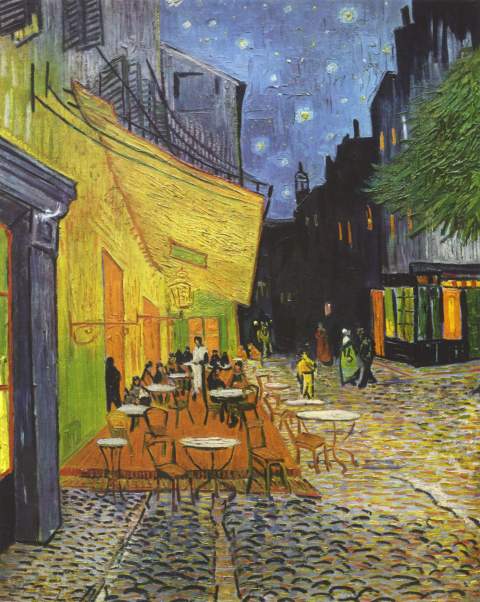
And then, I thought about visual art. I pictured nudes reclining, and a still life of golden pears, and how the beauty in well-rendered scenes moves me. I thought about Van Gogh’s oil painting of a café terrace at night. Its rich blues and vibrant yellows, the halos of the stars, the luminescence of light from the cafe spilling onto the dark cobbled street. There is an inherent tension between the welcoming café glow and the inky darkness of night, a drama in the contrasts, if you really want to analyze it. But mostly, I just find the painting pretty. There is a beauty in it that doesn’t need a story. A beauty in it – the contrasts of light and dark, of blue and yellow, a couple walking toward the cafe, a triangle of green fir on the edge of the painting – that is a story.
It occurred to me then that with all the ugliness in the world around us, sometimes, pretty is enough.
The Café Terrace on the Place du Forum, Arles, at Night, c.1888 by Vincent van Gogh
Last weekend, when the sun finally shone bright after weeks behind steel clouds, and the air was warm enough for short sleeves, our daughter and I waited on the front stoop for Grandma and the cousins to arrive. The sun was like warm honey on our skin, and for the first time since October, I peeled my socks off. I wiggled my naked toes in the yellow light and realized, my toes are out!
“Let’s paint our toenails,” I said. “You want to?”
We sat on the concrete steps and clipped and buffed and listened to the clink of glass polish bottles as we explored the bright pink cosmetic bag of color. I found a red like a Corazon rose, propped my right foot beneath me, and painted new life onto my toenails.
Two days later, winter returned. My toes went back into their socks, their electric happiness hidden, like a surprise party waiting for the honoree to arrive. At the end of the week, our guests departed, bundled against the cold.
When Saturday came around again, so did the sun. We opened the house back up to let another day of warmth inside, and the kids asked to take a walk to the duck pond. After telling them, “In a minute” for about an hour, we finally threw on flip flops and told them to grab their ball. We walked out the door to dark grey clouds looming, shrugged our shoulders, and went anyway.
A huge raindrop splatted on my cheek as we arrived at the pond. Five minutes later, the clouds burst, and I ran under the gazebo with my go-cup of wine. The wind blew rain in sheets across the pond, and when thunder boomed, the kids and their dad ran laughing to the shelter. Our teeth chattered as the temperature dropped, and our son said, “Can we go home now?”
“Uhhhh, I’m not leaving in this.” My husband gestured to the torrents of rain coming down. “You can go if you want.”
Our son took his ball and stepped out into the downpour, and a few seconds later, our daughter followed. Soon they disappeared up the hill towards home, while their dad and I shivered under the gazebo, the wind blowing spray onto us despite the roof over our heads. When it finally seemed to let up, I said, “You wanna make a run for it?”
We walked out into the now light shower, hunching our shoulders against the chill. Thunder boomed, a new deluge began, and we ran in the rain, our squeaky flip-flops splashing, our heads down. My red lacquered toes flashed bright against the wet gray sidewalk.
My husband shouted, “I like your toenails!”
And we smiled at their fun color in the spring rain.
 Butterfly Mind
