Between “severe weather” days, delayed starts, and early releases, the kids haven’t had a full week of school since winter break.
Spring will be here soon, right?
I prepared this yesterday, giggling to myself, when I thought for sure the kids would have a snow day today. They only got a two hour delay. Now I feel bad, like I jinxed their fun. I’ll make hot cocoa this morning to make up for it.
We sat at the dining room table last night, eating an appropriately collegiate dinner of burritos, and watched a winter scene unfold through our townhouse windows. Out our back window, I watched quarter-sized snowflakes fall straight down in the black night, sticking to snow stacks in the trees, lending their wet weight to already laden branches. My husband, with a view out the opposite window, watched college students laugh and throw snowballs in the picturesque park out front, kids again in the newly fallen snow. Our own kids’ snow gear dripped in our entryway, in the warmth inside our home.
“I feel like we’re in a Norman Rockwell painting,” I said.
“I don’t want to move from here,” said my husband.
We finished our dinner quietly, enjoying winter’s arrival. Just that morning it had been messy and wet out, loud rain splatting the windows, incessant liquid sounds that made me gloomy. The snow, though. The snow was silent. Light. Peaceful.
After dinner, the kids scattered to the basement, and my husband started shoveling while the snow was fresh. “Those plow piles will be solid chunks of ice in the morning.”
I washed dishes in contented solitude, smiling at the life-sized snowman in the park. The sudsy water was warm on my hands, and it felt good.
My husband came in, stomping snow off his boots, his face fresh from shoveling, his eyes merry. “Who wants to go for a walk?”
It was 8 o’clock at this point. Dark out.
There are three things that our kids will almost always say yes to – swimming in the summer, sledding in the winter, and walking at night. Any time of year.
“I do!!!” We all shouted.
We brought nothing with us. We just bundled up in coats and snow boots and walked out the door. The plows had gotten to the roads, but the sidewalks were buried in six inches of snow. We squeaked through the fresh fall, the kids and their dad laughing and throwing snowballs at each other as we walked, our son taking every opportunity to fall into the soft, untouched fluff. Wet poofs fell out of the trees onto our sleeves, into the necks of our coats.
When the sky opened above us as the trees thinned out, I was awed by the scene and wondered, “Why don’t we walk more at night?” The upper atmosphere scowled an ominous grey, but the lower clouds reflected the brightness of the snow – fluffy, powder grey clouds contrasted against a charcoal night. Twiggy trees coated in white snow stood stark against the dark sky, scratched into the landscape like branched etchings on black metal.
We walked toward the neighborhood duck pond, and heard the distant sounds of laughter and sleds swooshing downhill. The hills! We had commented all summer, as we walked around the duck pond nestled in the bowl of surrounding hills, “Those would be great sledding hills in the winter.” And sure enough, as we approached, we saw the dark hills dotted with young people, their gleeful squeals drifting over the snow.
I loved their youth. The fact that they were sledding at night. “I wish we would have brought our sleds,” my husband said. I did too. My mother-in-law, who lives in Sarasota, has commented several times that she feels like she started aging before her time there. Her community is filled with her elders, few of her contemporaries, and even fewer youth. Businesses, services, ads in the paper all cater to the senior population, and she is reminded every day of what is coming in life – broken hips, Alzheimer’s, nursing homes. The slow, stooped grocery store shuffle. The inevitable progression towards death.
Here, in this college town, I feel the opposite. I relish the vibrance of these young, eager college students. They are full of energy and ideas, passion and vitality. I remember what it was like to be that age, and how full an age it is. Full of friends and laughter, wildness and freedom. Full of life and living. Watching them, listening to them, I feel their vigor. I wouldn’t trade my age for theirs – I relish the lessons I’ve learned, I savor peace and quiet – but their youth makes me feel young and fresh, and I love this town for that.
I looked around and saw another group of students standing around a massive snowball that was as tall as they were. It had a huge patch of dirt on one side, where they had rolled it to gather more sticky snow, and had pulled up some turf along with it. A twenty-something woman stood on top of the snow ball, laughing, before she jumped down and they all started pushing it down the hill. “Look kids,” I said, and pointed. I expected it to “snowball” just like in the cartoons, and maybe it would have if the hill had been bigger. As it was, it was too heavy and just stalled out.
I moved away from the merrymaking, the voices and laughter quickly muffled by the snow I put between us, and I stood by the duck pond, listening. The edges were beginning to ice up. I heard crackling, and burbling, and could not place the sounds. Was water gurgling into the pond? Or was the ice crackling as ripples washed under it? The dark made it more mysterious, and I liked the wintry sound regardless of its source. I smiled at our kids as they tried to listen, too.
As we walked home, trudging up a hill, kicking snow and watching it catch the light of the streetlamps as it flew out in front of us, the kids still throwing snow balls at Dad, our son still “falling” into the soft fluff, a young man came flying downhill on a bicycle, sliding sideways through slush piles in the street, barely staying upright as he navigated a steep, slippery bend in the road. He grinned like a maniac, or maybe like a kid, laughing with each treacherous slip of his wheels, riding his bicycle at night.
Life in a college town. With Kids. is a piece I wrote when we first moved to Blacksburg, and I unknowingly took our kids out to eat at a bar. No booster seats, no kid menus. But plenty of beer and bar food.
After three years in Minnesota, I keep wondering when winter will arrive in Blacksburg. It’s January now. Shouldn’t I be warming my mug so its cold, greedy clay won’t suck all the heat from my coffee? Or pulling our down comforter up to my ears rather than kicking it off in the middle of the night? Shouldn’t I be wearing long johns, and furry boots, snow gloves and a knee length down coat?
Shouldn’t I be worried that my eyes will freeze open?
It is a strange sensation, this waiting. I keep checking the forecast, wondering when it’s going to get cold. I will see highs in the 50s, 40s, and even 30s and think, “It’s not here yet.” The bone chilling cold of highs in the single digits, and lows below zero, has not yet come.
It wasn’t until we hiked the Cascades again today, and I heard the constant, deafening roar of rushing water – the river throwing itself against rocks, a billion wet droplets slapping cold stone, torrents surging downstream, moving, moving, always moving – that I thought, hesitantly at first, then with growing glee, maybe this is winter here.
For the sounds we heard in Minnesota, outdoors, in January, were not liquid. January sounds were stiff, crisp. Quiet.
In Minnesota, at first, we thrilled at the foreignness of the deep freeze. It was adventurous! New! I could go grocery shopping and not rush home for fear of the food spoiling!
We reveled in the richness of winter life in the Twin Cities. Snow sculptures, intricate as marble carvings – of viking ships, lions, Tom Sawyer’s fence – endured, larger than life, for days at the state fair grounds, for temperatures didn’t climb high enough to melt them. Ice sculptures of diamond dragons, and crystal palaces, glittered in Rice Park, unafraid of a melting sun. Art shanties, modeled after ice fishing huts, sat merrily, confident in their safety, atop a frozen lake that we walked on. That cars were parked on. That cracked under our feet – a deep, ominous pop – as a pickup truck drove by us on the 15-inch thick ice. The only evidence of the chilling liquid beneath was the darkness we saw as we looked down a fisherman’s hole in the ice.
And the glacial fear in my heart.
Our second winter in St. Paul, I bought a pair of snow shoes. I’d bundle up, as plump with clothing as Randy in A Christmas Story, and crunch into the silent wilderness of Ft. Snelling State Park, located on an island surrounded by the Mississippi and Minnesota Rivers. When the snow was fresh and powdery, my snow shoes wouldn’t even crunch. They’d make more of a “poof” sound with each step. On those days, I’d poof, poof, poof over to the Mississippi River, and I would gaze in wonder at its stillness. For the surface of the mighty Mississippi, in January, was solid. Frozen. There were deer tracks in the snow that had fallen on it.
In Minnesota, I remember the relief, the dissolving, the thawing of my protective shell that came with the first time I would hear water drip outside. It was a beautiful sound, the sound of fat drops of water plopping to the ground. It was a sound full of life, and hope, and warmth after so much brittle cold.
So when we hiked today, and I heard the gushing of water in Little Stony Creek, and I watched its crystal-clear liquid cascade between mossy stones, I realized, this is January. This is our winter now. I relished every splash, every bubble, every sign of fluid. I snapped dozens of photographs of this streaming January water, with renegade droplets freezing like jewels on overhanging leaves, forming icicles that glistened with the full glory of winter’s crystalline beauty.
As we approached the waterfall, and the icicles grew thicker, and the air grew colder, and I had to put my camera away because my fingers were growing numb, I knew that winter will go deeper here. I know temperatures can plummet. I’ve seen pictures of the Cascades frozen over.
But there will also be Januaries like this one, where there are liquid and ice, and you don’t have to form a protective shell to make it through.
You would think that in November, when the trees are stripped bare, and the mountains are gray with twiggy branches, and the ground is brown with dead leaves, you would think that the color green would be hard to find. At least, that’s what I thought, until with green on my mind for a photography project, I found it everywhere. We hiked the Cascades yesterday, an Appalachian waterfall about 30 minutes west of Blacksburg, and the stream-side trail was resplendent in winter greens. We saw mosses, lichens, rhododendron, hemlock – life, ever green, persisting beneath the naked skeletons of deciduous trees. We saw ferns, bridges and stone signs tinted green with algae, pools of green where the crashing down of waterfalls aerated the water, green M&Ms in our trail mix. And always at hand to capture words, my tiny green Moleskine, its lined pages scratched with haiku.
Yesterday was our eight year old son’s special day*, where he got to pick a meal and a family activity for the day. Knowing his tendency towards lounging all day in PJs, I bribed him. I told him, “If you pick an active family activity, like, I dunno, hiking Dragon’s Tooth, I’ll make cinnamon rolls for breakfast.” Lucky for us, his sweet tooth pulls more weight than his lazy bones.
We’ve taken our kids on several hikes around Blacksburg, and they always love the first third of the trail. Then it all looks the same to them, and the boredom sets in, and they begin asking for snacks, telling us their legs hurt, wondering, “Are we almost at the top? Are we almost done?” Neither of us care about pushing our kids to be any certain way except the way that they are – we won’t push them to be scientists just because their dad is, or pastry chefs just because I like donuts and cupcakes and croissants – but we really, really, really do hope that they will enjoy and appreciate the outdoors. So we try to make it fun for them, taking them to waterfalls, pointing out cool spider webs, oohing and ahhing over golden leaves, showing them boulders they can climb. Playing 20 questions if it comes to that.
And most importantly, finding new trails that will keep them excited about the woods.
When I hiked Dragons’ Tooth with two girl friends a couple of weeks ago, a 2.4 mile trail (4.8 round trip) that involves nearly a mile of scrabbling over rocks, I knew the kids would love it. Their most recent hike was a really steep 2.3 mile hike (Angel’s Rest) with great views at the top and a beautiful trail to boot, but after a demanding 4.6 mile round trip, I think they were done with hiking for a while. We knew we had to pull out the big guns to get them excited again, so I showed our son photographs from the Dragon’s Tooth. Pictures of metal ladder rungs bolted into rocks, shots of sheer rock faces with the white blazes of the Appalachian Trail painted on them, photos of trail that was nothing but jagged ledges of stone. And the prize at the end of the hike? The Dragon’s Tooth itself – a massive sheet of rock, jutting 35 feet out of the ground like an ancient snarled tooth. That, and trail mix with M&Ms.
Our kids ran a good portion of the first half of the trail. They could not wait to get to the rocky part. And once we hit the boulders, and the sheer faces marked with the AT’s white blazes, and the rocky ledges, our kids may as well have been at Disney World. They were high as kites scrambling over those rocks, picking their own paths, hopping from boulder to boulder, then sprinting up the steep trail to the next technical patch. Our son declared, at least four times, “Dragon’s Tooth is the Best Hike Ever!”
The best part for me, though, was not just how much the kids loved the rocks (though that helped). It was the conversation. The morning was grey and raw, we had the trail to ourselves, and everything looked different than our normal hikes – more mysterious because of the mist and the dampness. On our way up, I pointed out some pink leaves that were still hanging on – papery ovals quivering in the deserted forest, ready to fall at any moment – and our son observed them, trying to pinpoint their exact color, when he finally proclaimed that they were peach. Not the darker orange color of peach flesh, but the delicate pinkish orange of their skin. He was specific about this.
When I exclaimed over lichens, plump and green like I had never seen them before – they were the same shape as the dessicated lichen discs we often see, and I wondered if they were those same black lichens, only hydrated – our daughter said, “They look like those noodles I like – the ones stuffed with chicken and cheese? Ravioli! They look like green ravioli.” And indeed, that was exactly what they looked like. I jotted this down for a future haiku.
On our descent, after both kids had climbed partway up the Dragon’s Tooth (our daughter wanted to climb higher, our son said he would never climb the tooth itself again – getting down off of it was too “freaky”) and after the four of us had eaten nearly two pounds of trail mix, the kids were subdued. They loved the rocky parts on the descent, but they were quieter as they scaled them. Once we were back down to the regular old hiking trail, we feared the tiredness and boredom would set in.
So we talked about farts. For probably 15 minutes. We talked about animals farting in the woods, and our son asked why we never smell them. So we said, “You can’t smell their farts if they’re not even around. Have you seen any animals today?”
“Yeah, chipmunks.”
“Well, chipmunks are pretty small. We probably wouldn’t be able to smell them anyway if they farted.”
Meanwhile, our son explored a hole in a tree, sticking his head inside to see what he could see.
“Be careful,” I said. “A chipmunk might stick his butt out and fart on you.”
And then we talked about chipmunk farts and what they probably sound like (a short pffft or bzzt, according to Dad). We talked about a bear’s fart after hibernation, and how godawful it would smell after being held in for three months. To which our son replied, “I fart in my sleep, why wouldn’t a bear?” Yes, this is true. We talked about bird farts, and how we can’t smell them because they’d be even tinier than chipmunk farts, and besides, birds are dainty and would fart high in the sky, where nobody would ever know.
And so on.
After the fart conversation died, I slowed down with our daughter and held her hand while we strolled through the leaf litter. She told me, “I know what function means now.”
“Oh yeah? What’s it mean?”
“It’s the job something does. Like on a plant, the seed’s function is to grow a new plant. The stem’s function is to hold up the plant and bring water to its different parts. The leaves’ function is to make food, and the flower’s function is to make seeds.”
And then she told me about the life cycle of a plant, all the while warming my big hand with her little one, impressing me with her first grade knowledge of botany. I thought I’d stump her when I asked what part of a plant a pine needle might be, but after thinking about it a minute, she answered “I think it’s a leaf because it comes off of the stem.” Right-o, Smart Tart.
We ambled our way back to the parking lot, glad we had hit the trail early, because now the lot was full. I smiled to myself. After hearing our son say somewhere along the way, “I love those peach leaves, and the little baby pine trees, and the ravioli on the rocks. Basically, I just love all the things that nature makes,” I had to agree with him that Dragon’s Tooth was the Best Hike Ever.
The Dragon’s Tooth, Catawba, VA
Peach leaves
Ravioli Lichens
Ladder rungs on AT
Rocky trail
Dragon’s Tooth in the clouds
*We instituted Special Days last year after feeling bad for dragging the kids around on errands, or feeling like we could never all agree on what to do on a Saturday afternoon. So now, we rotate. Each weekend, one of us gets a special day. On a person’s special day, in addition to getting to choose the brunch menu, a special dinner, or a dessert on their day, the special person also gets to choose a family activity. This motivates my husband and me to set aside a chore-free, errand-free time for the four of us to hang out, and it has been a huge hit with the kids. They’ve had a lot of fun trying new foods, going to the antique car show for Dad, going to the conservatory for me, and especially, not having to go to Home Depot or the shoe store when it’s their turn to be special. I highly recommend it.
Growing up on the coast of Georgia, I’m no stranger to hurricanes. And after three years in Minnesota, I’ve become acquainted with snow as well. But a hurricane with snow? That I’ve never seen.
Last night, as I lay in bed listening to the roaring wind, worried like I was during this summer’s derecho that the trees around here are too big and inflexible for a tempest like this, I couldn’t help but compare the wind through these noble giants with one of my most stirring memories, of palm trees in a hurricane. You see, my birthday is in early September – smack dab in the peak of hurricane season – and it seems that almost every year, around my birthday, we were all glued to the radio or TV, either watching a hurricane that, thankfully, wasn’t tracking towards us, or on pins and needles for the next trajectory update, wondering if we would need to evacuate. I remember Hugo in 1989 barreling towards my parents home on Tybee Island, and me trying to help my dad hammer plywood over their plate glass windows that faced the sea. I was 15 that year.
But my most vivid, and strangely, fondest birthday-hurricane memory is of Hurricane David. 1979. My fifth birthday. When we actually did evacuate. We lived on St. Simon’s Island at the time, and I don’t remember any of the preparations, any of the worry, any of the stress that my parents must have felt, watching a category 5 hurricane make its way directly towards their island home. They had an eight-year-old and a four-year-old, and their four-year-old was supposed to be having a birthday. I don’t remember the fleeing, or even where we went (maybe two hours north to Savannah, which I think bore more of the brunt of David than St. Simon’s did). What I do remember, though, besides not having a birthday cake, is watching out the window of the motel room we finally settled in when the driving became too dangerous. The storm didn’t scare me then – I had none of the grown-up worries that a hurricane brings – and I was fascinated by the palm trees out the window, and how far they could bend. The room was dark, and rain slashed in diagonal sheets outside that rectangle of a picture window, and the palm trees bowed like yogis in a back bend, their mops of hair whipping in the wind.
It’s that image – of being in a dark motel room, with forest green and burgundy bed spreads, our source of light being the rectangle of window framing the slate gray stormscape, and me being entranced by the slashing rain and crescent palm trees – that has imprinted itself indelibly in my memory, and that I forever associate with hurricanes.
What’s funny to me is that our kids’ hurricane memories are going to be so polar opposite of mine. Instead of a tropical storm with palm trees, their earliest hurricane memory is going to be in the mountains, from an Appalachian Halloween Frankenstorm with freezing temperatures, and that they played in the wind and snow of. From Hurricane Sandy, who swooped in after a marathon weekend of raking leaves from 80 foot tall deciduous trees. After three years and multiple blizzards in Minnesota, where they never once had a snow day, with Sandy they got a day off of school for a hurricane that made landfall in the northeast, hundreds of miles from home.
But what might be most memorable to them is that since it was only October and I hadn’t yet stocked up on hot cocoa mix (I thought we left October snow behind when we moved away from Minnesota!), they got a taste for real, homemade, from scratch hot chocolate that, thanks to a barrage of helpful tips on Facebook, I was able to make with the cocoa and sugar and milk that I did have. When they came in from the snow, rosy cheeked and panting, and I offered them hot chocolate, their bright eyes and smiles could have lit up New York City. I hope their earliest hurricane memories will be as fond, and exciting, and unforgettable as mine.
I have had the good fortune of never being directly hit by a hurricane, and so I have the luxury of having fond and exciting, and safe, memories. My heart goes out to all of the Hurricane victims, past and present who do not have that luxury. My prayers are with you.
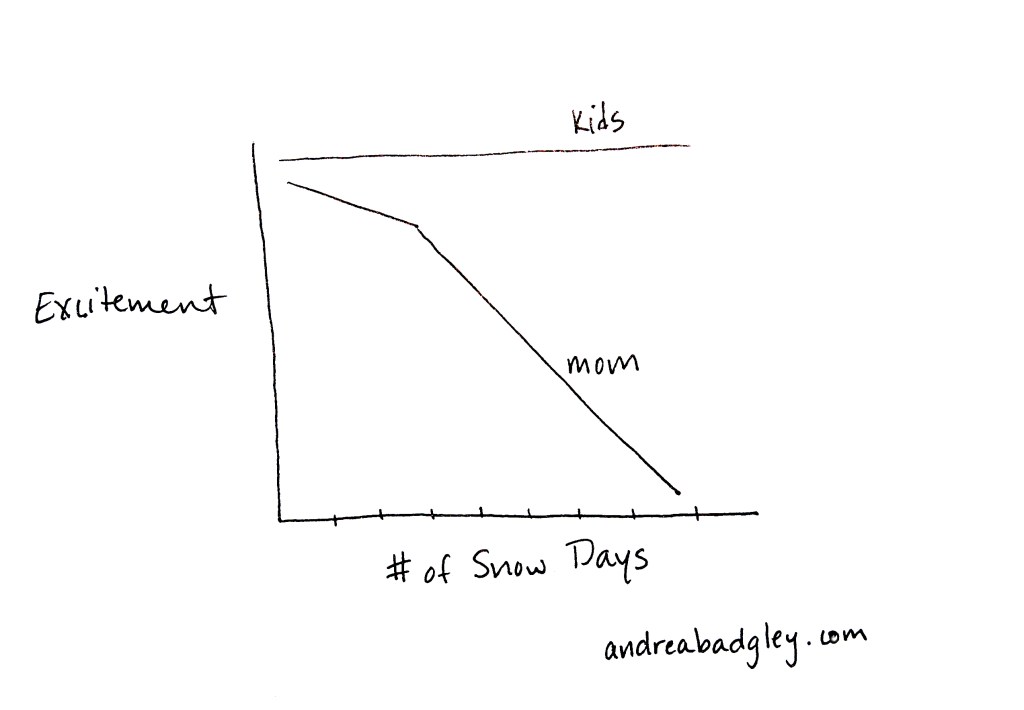 Between “severe weather” days, delayed starts, and early releases, the kids haven’t had a full week of school since winter break.
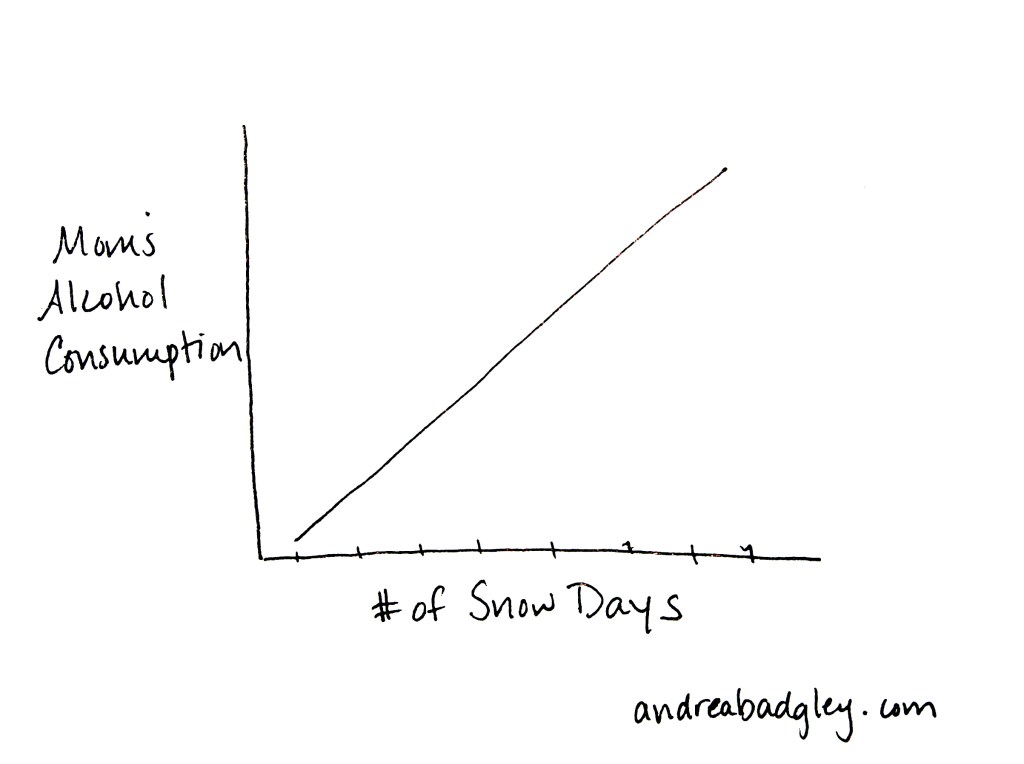 Spring will be here soon, right?


 Butterfly Mind