I am having a spectacular reading year, and I couldn’t be happier about it. Sally Rooney released a new novel in September. I checked my library every week after its release to see if they had a copy yet. When it finally showed up in my Libby app, the wait list was already eight weeks long. After two weeks, I didn’t want to wait anymore, so I made the rare decision to buy the book. I reserve fiction purchases for books my library doesn’t own, but I also sometimes buy novels I know I will love and will likely read again.
Intermezzo by Sally Rooney fell in the latter category. I recognized the second chapter as a short story she published this year in TheNew Yorker and that I heard on their Writers Voice podcast, which is where I learned she would have a new novel out this year. I listened to the story on a morning walk on our Fourth of July trip to Missouri to see Brian’s cousins. I remember exactly where I was when I heard it: the steep hill next to the condo’s pool, the fresh cement sidewalk white in the sun, another steep hill down to the Lake of the Ozarks. “Opening Theory” is a story with characters I was instantly captivated by. I wanted to spend more time with them: a ton was unsaid in the story, and I wanted to go deeper with Ivan and Margaret.
I finished Intermezzo in four or five glorious days of reading, and I finished with a smile on my face and the deep satisfaction of having just read something that rings all my bells. Rooney builds the characters’ layers slowly, or maybe it’s more accurate to say she unpeeled them like onions. Either way, she created complex characters who I understood and had compassion for by the end of the book. I love her for it. My week was happy last week because I got to read this book.
And this was just one book of many greats this year! Another joy is Karen Russell, who didn’t publish a new novel in 2024, but who Louise Erdrich read a story from on The New Yorker‘s Fiction podcast. I enjoyed the reading and Erdrich’s delight and respect for the story. She appreciated Russell unabashedly, and I remembered that “The Ghost Birds,” one of my favorite short stories I’ve ever read, is by Karen Russell. I loved her collection of short stories, Vampires in the Lemon Grove, and particularly the title story, which is sweet and funny and also a little ghastly. Russell is quirky and fresh, and she sets scenes that are memorable. I’d never read Swamplandia!, so I picked it up after I heard Erdrich read her, and I do not regret it.
Speaking of quirky and memorable, Miranda July had a new book out this year, which I also loved. As did Lauren Groff, with her The Vaster Wilds, which is unlike any book I’ve read, and was phenomenal. I plan to slowly read everything Lauren Groff has ever written.
And I revisited favorites this year, like Daphne du Maurier’s My Cousin Rachel and Jamaica Inn, Larry McMurtry’s Lonesome Dove, Hemingway’s Garden of Eden, and Ann Patchett’s State of Wonder. I read some thought-provoking nonfiction, like Safiya Sinclair’s How to Say Babylon about growing up as a Rasta girl in Jamaica, William Irvin’s Guide to the Good Life about the art of stoic joy, Jonathan Eig’s MLK, Jr. biography King: A Life, and Bianca Bosker’s Get the Picture which made me appreciate art even more, and helped me learn how to connect with it, and made me want more art in my life.
I bought a new e-reader this year. I read outside in the Blue Ridge mountains on quiet summer mornings. I read a couple of books in actual book form.
I hit some reading doldrums in 2023, and it bummed me out. I didn’t end up reading as much as I’d have liked, or as much good stuff. This year is so much better. I don’t know what made the difference, but whatever it is, I want to keep doing it. Maybe it’s because I started 2024 with something fresh and excellent: Raphael Bob-Waksberg’s Someone Who Will Love You in All Your Damaged Glory. This was a gift from our son, and I loved every page. With 2025 coming up soon, I’ll try to find just the right book to set the tone for the year.
Henry Dumas: Arkansas-born poet and short story author
Arkansas was kicking my butt, y’all. It began well, with me devouring Charles Portis’s True Grit in two days, but when I finished the book, I realized a good half of it took place in the Oklahoma territory. Should I count it for Arkansas on my Andrea Reads America tour? (Andrea Reads America = three books set in each state, with works by men, women, and authors of color)
On top of the True Grit dilemma, Arkansas was the state that spawned my Where are the ethnic authors? post. After reaching out to faculty in the University of Arkansas English department, I still didn’t have any works of fiction set in the state of Arkansas and written by Arkansas authors of color. I considered relaxing my fiction rule to read the professor-recommended nonfiction titles; I considered reading an Arkansas-set novel written by a novelist who has lived her whole life in New York.
I took a break from Andrea Reads America to read The Goldfinch while I ruminated on what to do about the Arkansas dilemma(s).
When I finished The Goldfinch, I was doped on excellence. I drifted through life in that post-amazing-novel daze where you haven’t yet blinked back into reality; I knew whatever followed was going to suffer, like those poor ice skaters who crash when they follow a gold-medal performance.
And what followed was Maya Angelou’s I Know Why the Caged Bird Sings. I’ve read the book before, and I know it is good, but it did not satisfy me this time. I wanted fiction. I wanted landscape. Caged Bird is nonfiction; it is soulscape. I thought, well, maybe I need something funny, something totally different from the literariness of The Goldfinch; maybe I need something light, something totally different from the seriousness of I Know Why the Caged Bird Sings.
I found a murder mystery series set in Arkansas and written by Arkansas author Joan Hess (she satisfies my woman author criterion!), and I drove to our library to pick up one of the titles in the series, Misery Loves Maggody. I tried to like it, I really did. But the characters were caricatures – exaggerated and expected – and the settings, dialogue, and scenes were cliché after cliché after cliché. The murder didn’t even happen until more than 100 pages in. But more disappointing than any of that was that since I did not detect authenticity in the characters, I did not trust the setting either; the setting could have been a silly spoof of any Southern town – I didn’t get a feel for Arkansas from it.
In other words, Misery Loves Maggody didn’t work for me either.
I was a teensy bit frustrated at this point. Just a tinch. I still needed a non-Caucasian author, and I still needed a woman. One of the Arkansas professors suggested Janis Kearney, the Presidential Diarist for Bill Clinton. She is an African-American writer from Arkansas who wrote a biography of Daisy Bates, an Arkansas civil rights activist. She also wrote a memoir, Cotton Field of Dreams. Awesome, right? Woman and not white. Works set in Arkansas. Problems solved, right?
Neither were available at our county or University libraries. And as I’ve mentioned before, despite being an avid reader, I rarely buy books.
On the drive home after yet another trip to our county library, where I discussed the option of an interlibrary loan of Cotton Field of Dreams with the librarian ($3 fee, could be a few weeks before it shows up, maybe I should just order it), it occurred to me: why don’t I run a search for short stories? Surely there’s at least ONE short story out there by an ethnic author. That’s all I need. Just one.
So I searched.
I searched, and I found.
Henry Dumas. Born 1934 in Sweet Home, Arkansas. Called “an absolute genius” by Toni Morrison. Wrote poetry and – get this – short stories. Fiction! And? And! When I searched the University catalogue, his short story collection, Ark of Bones, with – praise the Lord – stories set in Arkansas, pinged “Available, 3rd Floor, Newman Library.”
The next day, after a trip to the 3rd Floor, Newman Library, I plopped down on our couch with Ark of Bones, and I nearly cried for joy. The stories are alive, and they are different from anything I’ve read in a very, very long time. If ever. They are dark and smoky, masculine and earthy, filled with mojo and magic; they read as if they come from a long line of souls buried deep in the earth. I imagine Henry Dumas was an intense man; he certainly had a reverence for the dignity of his race.
Most importantly, in what is surely the crowning accomplishment in his writing career, he rescued me from a post-Goldfinch spiral and an anti-Arkansas frustration. I am grateful to him for that. And I am grateful to the works that didn’t work: I would not have found Henry Dumas without them.
I decided to keep True Grit for Arkansas. It’s too great a book to leave out.
I am reading America: 3 books from each state in the US with the following authorships represented – women, men, and non-Caucasian writers. To follow along, please visit me at andreareadsamerica.com.
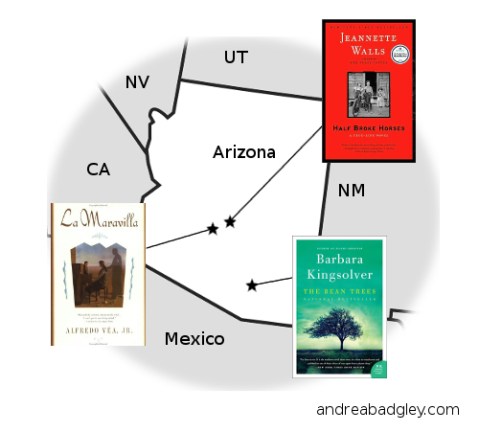
As a coastal person, I was uncomfortable reading Arizona. The dry cracked land, the absence of emerald-green, and the silence where dripping should be were disorienting to me. I think my soul might dry up and blow away if I were to move to the desert. But where I feel withered and desolate, the people who are native to the land find magic – the sky is so big that shamans walk among the stars, and the first summer rain is so significant it signals the beginning of a new year.
Aside from The Bean Trees, the books I chose for Arizona were challenging for me. I don’t know if the landscape made my mouth too dry, or if the books I chose weren’t my kinds of books, or (and this is my hunch) if it’s because I read them in winter, when I would normally curl up with The Shipping News and cold snowy books, but I found myself wishing for something else, a different kind of place. A place of blues and greens, not of reds and browns. I will say, though, that what Arizona lacks in water, it makes up for in characters. The three books I selected from Arizona were filled with scrappy, no-nonsense folks for whom parched land, prickly plants, and flash floods cultivated a toughness that I don’t have, but I admire.
They also cultivated in me a hunger for Tex Mex food.
Novel: Half Broke Horses
Author: Jeannette Walls, born Phoenix, AZ
Setting: 1920s through 40s Arizona
Categories: Historical fiction
Half Broke Horses, set in Texas and Arizona, is a true life novel of Lily Casey Smith, author Jeannette Walls’s sassy, swaggering pioneer grandma. Fans of Walls’s memoir The Glass Castle will appreciate going deeper into the Walls family history with Half Broke Horses, which takes us back to the beginning, when Walls’s grandmother, Lily, broke horses on her family ranch as a girl, and as a young teen rode 500 miles, alone, on her horse, Patches, from Texas to Arizona to take a teaching job in the 1920s. Walls calls this a novel because it was necessary that she fill in details and recreate dialogue, but the voice and wild events, like Lily’s grand entrance in her ranch town’s premier of Gone With the Wind, to which she wore a dress she made from curtains, are authentic and amusing. Lily is spunky and resourceful, a pioneer woman, and I loved her sass:
“Don’t you ‘little lady’ me,” I said. “I break horses. I brand steers. I run a ranch with a couple dozen crazy cowboys on it, and I can beat them all in poker. I’ll be damned if some nincompoop is going to stand there and tell that I don’t have what it takes to fly that dinky heap of tin.” (Lily Casey Smith to a flight instructor who pooh-poohed her when she wanted to take flying lessons from him)
Half Broke Horses is filled with great lines like this, some that characterize Lily, as the one above, and others that characterize the land and the varmints who called it home:
As I sat by my little fire at night, the coyotes howled just like they always had, and the huge moon turned the desert silver.
Arizona, with its wide open spaces and no one peering over your shoulder, had always been a haven for folks who didn’t like the law or other busybodies to know what they were up to.
I didn’t think this was as compelling as The Glass Castle, but I appreciated Walls’s ability to paint the Arizona landscape, and sear me with the desert suns’ heat, and show me a woman with sand, whose grit ensured her survival in an unforgiving place.
Novel: La Maravilla
Author: Alfredo Véa, Jr., born 1952 near Phoenix, Arizona
Setting: 1950s-1960s, outside of Phoenix, AZ
Categories: Native American Fiction, Hispanic Fiction
Set in the late 1950s and early 1960s beyond the fizzled out end of Buckeye Road – beyond where asphalt turns to dirt after Buckeye Road has left Phoenix – La Maravilla is a novel of the displaced fringes who congregate along this sandy road in the Arizona desert: negritos and indios, prostitutes and transvestites, Arkies and Okies, and Beto, a young boy who lives with his Mexican healer grandmother and his Yaqui Indian grandfather. Beto’s mother has abandoned him there in her quest for a shiny, new, dust-free life in California. Beto’s home at the end of Buckeye Road and his Mestizo-Yaqui-Filipino-American heritage reflect the author’s own background: Alfredo Véa, Jr., an American author with Mexican, Native American, and Filipino heritage grew up with his grandparents in the Buckeye barrio outside of Phoenix, just as Beto does.
Peppered with Spanish and Yaqui phrases; brimming with frijoles, burritos, and an elaborate Mexican fiesta complete with sixty pounds of pork and beef that simmered all morning “with fifty cloves of garlic, ten chopped onions, cups of crushed comino and a handful of cilantro;” and populated with a Catholic Mexican curandera (healer), the Mighty Clouds of Joy Negro Church, and Huichol, Yaqui, and Tarahumara Indians who go out into the desert to fly on spirit journeys, and eat peyote, and initiate Beto into these ways as part of his manhood ceremony, La Maravilla serves a rich, flavorful, satisfying banquete of Arizona culture:
The woman in black looked up into the high, endless sky. The skin of the hand that shaded her eyes was browned and softened by the tannins of her life.
Neither Manuel nor Josephina was the same person in their different languages.
The Arkies were kind of like Mexicans, the boy felt; they could suffer and do hard work and they always fed everybody’s kids.
Ghosts are like tumbleweeds. No one pays attention to the plant when it’s green. No one even knows what it’s called. But when it’s dead it receives a name and people who see the weeds rolling across open fields are suddenly stricken with loneliness.
I wish I could mourn for him like those crazy Mexicanos. The bake death and eat it. They roll it in sugar and put it on sticks for the children to lick at.
I admit that there were long portions of the book that dragged for me; I admit that were I not reading this for my Andrea Reads America project, I might have abandoned the book; and I admit there were many times when I wondered where Véa was going with this, and why he inserted this scene and that character. I’m still not sure I know, and I think the book could have been distilled for more potency, but like many books that I’m not sure I like when I’m struggling through them, my mind has returned many times to La Maravilla. I loved Véa’s use of Latino and Yaqui words, how they gave the narrative an authentic feel for being among the characters. Like Two Old Women, the other book I’ve read so far by a Native American author (Alaska), La Maravilla is filled with wisdom, spirituality, and a deep respect for elders, family and sticking together as a community.
Novel: The Bean Trees
Author: Barbara Kingsolver, lived 20 years of adult life in Tucson, AZ
Setting: late 1970s Tucson, Arizona
Categories: Fiction, American Fiction
Set in 1970s Tucson, Arizona, The Bean Trees is the story of Taylor Greer, a plucky, lovable twenty-something who drives away from her rural, dead-end Kentucky home town in her ’55 Volkswagen bug with “no windows to speak of, and no back seat and no starter.” She leaves Pittman County, where folks “had kids just about as fast as they could fall down the well and drown,” and heads west where, at a pit stop somewhere in Oklahoma, a small Cherokee child is deposited in the front seat of her car by a native woman – the child’s aunt – who tells Taylor to the child away from here. The old woman will not take no for an answer as she turns and walks away to face the child’s father – and abuser.
Like so many of Kingsolver’s works, The Bean Trees is a gratifyingly readable book; I think I finished it in three or four nights. Filled with funny Kentucky colloquialisms and the dry desert air of Tucson, The Bean Trees can feel light in its page-turning readability, but flowing beneath that lively tone are undercurrents of weighty issues. True to form, Kingsolver weaves in the strong pulse of nature,
At three o’clock in the afternoon all the cicadas stopped buzzing at once. They left such an emptiness in the air it hurt your ears. Around four o’clock we heard thunder.
If you looked closely you could see that in some places the rain didn’t make it all the way to the ground. Three-quarters of the way down from the sky it just vanished into the dry air.
Everything alive had thorns.
and heart wrenching themes of social justice:
Mrs. Parsons muttered that she thought this was a disgrace. “Before you know it the whole world will be here jibbering and jabbering till we won’t know it’s America… They ought to stay put in their own dirt, not come here taking up jobs.
When people run for their lives they frequently neglect to bring along their file cabinets of evidence.
Set in a border state and dealing with issues of immigration and human cooperation, The Bean Trees is a story of friendship, and heart, and symbiosis. It is a story of plants and people thriving in poor soil and thorny country, not because they are tough, or better adapted, or because they are strong enough to do it alone. They survive because they open themselves to being helped, and to helping each other out.
For Further Reading in Arizona
Books that have been recommended to me but I have not yet read: Concrete Desert by Jon Talton Almanac of the Dead by Leslie Marmon Silko Mojave Crossing by Louis L’Amour Goats by Mark Jude Poirier Bisbee/17 by Robert Houston The Devil’s Highway by Luis Alberto Urrea (nonfiction) Crossers by Philip Caputo
I am reading America: 3 books from each state in the US with the following authorships represented – women, men, and non-Caucasian writers. To follow along, please visit me at andreareadsamerica.com.
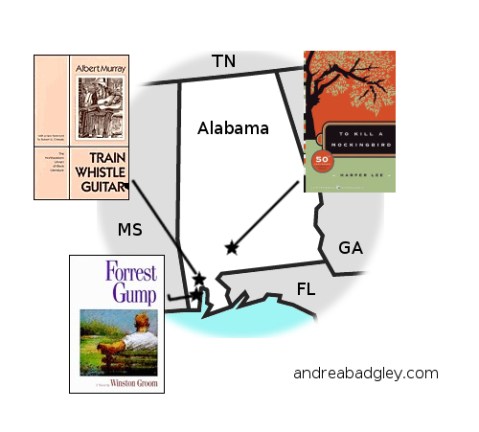
I didn’t look at an Alabama map when I selected books set there for my Andrea Reads America project, so I didn’t realize until I started reading that two of my three picks took place on the coast. Boy did they make me miss home. All that talk about herons, and shrimp, and the salt marshes took me right back to the coast of Georgia. Only, and I never knew this until I read these books, in Alabama they don’t call it the marsh, they call it the bayou. Even though Georgia and Alabama share a border, even though geographically they are neighbors, I never once heard anyone call our marsh the bayou growing up in Georgia. I guess it’s because we were on the Atlantic, colonized by the English. We don’t have the French history of those Gulf coast states. I always associated bayou strictly with Louisiana, but the Cajun and Creole sensibilities must stretch along the marshy shoreline of the Gulf of Mexico.
I was pleased that all three picks for the inaugural state of this tour – To Kill a Mockingbird by Harper Lee, Forrest Gump by Winston Groom, and Train Whistle Guitar by Albert Murray – evoked Alabama landscapes, mannerisms, dialects, and the racial frictions inherent in all Southern states. Now, as I move forward into the unknown, the exotic, the slightly terrifying state of Alaska in winter, I’m glad I started someplace familiar.
Novel: To Kill a Mockingbird
Author: Harper (Nelle) Lee, born 1926 in Monroeville, AL
Setting: 1930s Maycomb, Alabama, northeast of Mobile
Categories: Literary fiction, Pulitzer Prize winner, Southern Gothic
Harper Lee’s To Kill A Mockingbird takes place in 1930s Alabama, in the small town of Maycomb (based on Lee’s home town of Monroeville). In addition to being a wise work of fiction in its own right, with iconic characters, racial struggles, and a funny, refreshing childlike point of view to gently show us, as adults, to be alert to our hypocricies, To Kill a Mockingbird does a fine job of setting us smack in the middle of the small town South. Lee accomplishes this not just through a story of racial tension and prejudice, but through dialogue, scene descriptions, and my favorite device of all, which she writes masterfully, dialect. Since I’ve written about To Kill a Mockingbird several times on my blog, I’ll change it up this time and leave you with some my favorite quotes for making you feel like you’re in Alabama:
“North Alabama was full of Liquor Interests, Big Mules, steel companies, Republicans, professors, and other persons of no background.”
“The class was wriggling like a bucketful of catawba worms.”
“That boy’s yo’ comp’ny and if he wants to eat up the table cloth you let him you hear?”
“The usual crew had flunked the first grade again, and were helpful in keeping order.”
“If I had my ‘druthers I’d take a shotgun.”
“In Maycomb, grown men stood outside in the front yard for only two reasons: death and politics. I wondered who had died.”
Novel: Forrest Gump
Author: Winston Groom, born 1943 in Washington, DC, and raised in Mobile, AL
Setting: 1960s-1980s Mobile, AL, the world, and outer space
Categories: Humor, Southern fiction
Before I say anything else, I have to say this: Forrest Gump made me laugh so hard I cried. Written by Winston Groom, Forrest Gump paints a portrait of contemporary Alabama from the point of view of an idiot savant. I grappled with whether to include this as part of my project because technically, Forrest Gump does not take place wholly in Alabama. In fact, most of the time Forrest isn’t in Alabama at all. He fights in Vietnam, where as he tells us, “Somewhere in all this, I got myself shot, an, as luck would have it, I was hit in the ass.” He travels to Washington, DC, an island in the South Pacific, Indiana, China, Hollywood. But even though he travels the world (and outer space) in the novel, I’m keeping Forrest Gump as an Alabama read because Forrest, through his dialect, his harmonica, and his Southern manners, carries Alabama everywhere he goes.
Whether he’s rasslin’ in Indiana or playing ping pong in China, Forrest is a walking representation of his Alabama roots. In every country, and even in space, Forrest recollects his aim to get a “srimp boat,” and every time he does, we’re back on the bayou. When his spaceship crash lands on an island of cannibals, and savages are banging on their hatch but Major Fitch wants to pretend nobody is home, Forrest displays classic Southern hospitality by saying, “It ain’t polite not to answer the door.”
But more than anything, in addition to the fact that it contains genius commentary on the way we view “idiots” and how stupid the rest of us really are, I wanted to keep Forrest Gump in my version of the Alabama canon because of some of the final passages. A lot of non-Southerners might not get the South, might find it charming but backwards, like Forrest appears to be when really he’s quite deep. But Winston Groom gets it. In our rare glimpses of life on the marsh, he captures the lowland perfectly:
“They was a nice breeze blowin off the bayou an you coud hear frawgs an crickets an even the soun of a fish jumpin ever once in a wile.”
In that sentence, and in the final pages, Groom captures what it’s all about, what Alabama, and the whole of the Southeast coast, are all about. Why those who visit are enchanted by it, and why we who know it crave it, and are ever questing to get home to it.
Novel: Train Whistle Guitar
Author: Albert Murray, born 1916 in Nokomis, Alabama
Setting: 1920s Gasoline Point, Alabama, just north of Mobile
Categories: African American fiction, Southern fiction
Set in 1920s Gasoline Point, Alabama, a fictitious town based on author Albert Murray’s hometown of Magazine Point, Train Whistle Guitar is a coming of age story of Scooter, a young black boy who with his friend Little Buddy, learns about life by hopping a train, wandering the woods, listening to grownups at garden fences and fireside circles, hiding underfoot at the barbershop, or perching in trees at night to watch dancing in the jook joint. In each of these settings, Murray not only captures the feel of African American kinship within a small town in the South, but what to this white woman is the foreign experience of children who are raised not just by their parents, but by an entire community. Regardless of blood relationships, all of Scooter’s elders in Gasoline Point play the role of Auntee or Uncle, as when their train-hopping guitar idol, Luzana Cholly, sat Scooter and Little Buddy down for a talk when he found them trying to jump a train:
“That was when we found out what we found out directly from Luzana Cholly himself about hitting the road, which he (like every fireside knee-pony uncle and shade tree uncle and toolshed uncle and barbershop uncle since Uncle Remus himself) said was was a whole lot more than just a notion.”
This was perhaps my favorite element of Train Whistle Guitar, this entrée into a childhood unlike my own, where a people shared a common history, a common struggle, that brought them together into a community that was so tight-knit the barbershop men made decisions about when young boys were old enough to hear man talk. This sense of community-as-family made me think of one of the most memorable pieces of parenting advice I’ve heard: it’s important that children have adults in their lives they can turn to and trust for perspectives beyond Mom’s and Dad’s.
While Train Whistle Guitar certainly has moments and undercurrents of racial tension, the book was gentle and showed love instead of hate, eagerness instead of anger. And while Murray is skillful in evoking the Alabama bayou and the thickets that skirt it, my favorite passages are from the jook joints, places I’ve only come across in African American fiction:
“Stagolee moved over to where the piano was and put his fruit jar [of whiskey] on top of it and stood clapping his hands and snapping his fingers with the women around him doing the shimmieshewooble and the messaround.”
Murray’s language is alive with rhythm and swing, and he was able to show me an Alabama I would never have access to without him.
Books I’ve read and recommend: Fried Green Tomatoes at the Whistle Stop Cafe by Fannie Flagg Salvation on Sand Mountain: Snake-Handling and Redemption in Southern Appalachia by Dennis Covington (nonfiction)
Books that have been recommended to me but I have not yet read: Boy’s Life by Robert R. McCammon Crazy in Alabama by Mark Childress All Over But the Shoutin’ by Rick Bragg (nonfiction)
I am reading America: 3 books from each state in the US with the following authorships represented – women, men, and non-Caucasian writers. To follow along, please visit me at andreareadsamerica.com.
“I reckon there’s nothing awkwarder in the world than the sight of two women in long dresses at either end of a crosscut saw.” – Robert Morgan
When I move to a new area, or get a hankering to immerse myself in a culture, or to smell the air of a region, I turn to literature. Fiction, through characters and a well-woven story, can drop you in the middle of a place and allow you to witness, without recourse or requirement of participation, its particular brand of drama, to feel its weather, to listen to its dialect. Likewise, a well-written nonfiction piece can confirm fiction’s characterizations and give you a glimpse into the real life struggles of a place and its people.
When we moved to Maine, and to Minnesota, I devoured fiction about those areas to help acquaint me with their history and flavor, and now that we live in Virginia, I’ve been reading literature set in these hills to dig deeper into the culture of our new home. Here are some of the titles I’ve read, and some I haven’t, if you’re ever feeling the need to walk the green forests or hear the mountain twang of Appalachia.
Wish You Well by David Baldacci – Set in the Appalachian mountains of southwest Virginia, Wish You Well is fiction that pulls from Baldacci’s childhood experiences in that region. It is an account of a 1940s family whose lives are isolated from any world off the mountain, who do not earn money to provide for themselves, but who work the land to survive. Baldacci nailed the dialect – he wrote it masterfully, so that you can hear the characters’ speech, without the dialect being distracting or tiring. And he captured a way of life on the mountain that most of us will never know. Somehow, though, there wasn’t enough depth for me. Or maybe complexity. I can’t pinpoint what it was that had my mind wandering at times, or that kept me from getting truly engaged, but Wish You Well is worth a shot if you want to disappear into the mountains for a while, and particularly if you are interested in the coal mining issues currently going on in the Appalachians (blowing up the mountains to empty them of their coal and then abandon them, piles of rubble, barren and stripped of life).
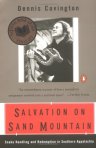
Salvation on Sand Mountain: Snake-Handling and Redemption in Southern Appalachia by Dennis Covington – This was a fascinating nonfiction read about the culture of snake handling Pentacostalists in Southern Appalachia. The author, a reporter for the New York Times, originally approached the story as a journalist covering an attempted murder trial. A snake handling preacher was convicted of putting a gun to his wife’s head and forcing her to reach her hand into a rattlesnake cage, where she was then bitten. The author covered the story, but was captivated by the snake handlers’ culture, and as he got deeper into their stories while simultaneously tracing his own family’s roots, he became part of the story himself. He writes their faith beautifully and convincingly, but as time progressed, he also began to see the handlers’ too human faults and hypocrisies. I enjoyed the book immensely – I think I read it in two days – but I am not sure if the author had put enough space between himself and his experience with the handlers before he finished the book. He still seemed lost at the end, which left me somewhat unsatisfied.
Prodigal Summer by Barbara Kingsolver – It has been a while since I’ve read this one, but I have read it multiple times because Kingsolver captures the depth and richness of Appalachian wilderness in a sensuous, deeply respectful way that resonates with me. It doesn’t hurt that Luna moths, a favorite creature of mine, play a role in Prodigal Summer as well. But since I have not read the book recently enough to summarize it here, I will give you an abbreviated synopsis from Publishers Weekly: A beguiling departure for Kingsolver, who generally tackles social themes with trenchantly serious messages, this sentimental but honest novel exhibits a talent for fiction lighter in mood and tone than The Poisonwood Bible and her previous works. There is also a new emphasis on the natural world, described in sensuous language and precise detail… A corner of southern Appalachia serves as the setting for the stories of three intertwined lives… Deanna Wolfe is a 40-plus wildlife biologist and staunch defender of coyotes, which have recently extended their range into Appalachia. Wyoming rancher Eddie Bondo also invades her territory, on a bounty hunt to kill the same nest of coyotes that Deanna is protecting. Their passionate but seemingly ill-fated affair takes place in summertime and mirrors “the eroticism of fecund woods” and “the season of extravagant procreation.” Meanwhile, in the chapters called “Moth Love,” newly married entomologist Lusa Maluf Landowski is left a widow on her husband’s farm with five envious sisters-in-law, crushing debts, and a desperate and brilliant idea. Crusty old farmer Garnett Walker (“Old Chestnuts”) learns to respect his archenemy, who crusades for organic farming and opposes Garnett’s use of pesticides… Readers will be seduced by her effortless prose, her subtle use of Appalachian patois. They’ll also respond to the sympathy with which she reflects the difficult lives of people struggling on the hard edge of poverty while tied intimately to the natural world and engaged an elemental search for dignity and human connection.
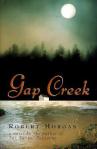
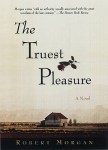
Gap Creek and The Truest Pleasure, by Robert Morgan – I finished my second reading of Gap Creek this summer, and now I want to read The Truest Pleasure again as well. Like Baldacci’s Wish You Well, Gap Creek explores the rawness of life in the Appalachians. In Gap Creek, the novel from which the introductory quote to this blog post was taken, protagonist Julie Harmon moves down the mountain from her family’s home, where she did the hard labor after her father’s death, to a home in the valley with her new husband. There, she works harder than ever, navigating a new marriage, butchering hogs, collecting chestnuts from up the mountain when they had no other food to eat, and birthing her baby alone on the kitchen floor. The first time I read Gap Creek was before we had children, and the childbirth scene was one I carried with me through labor, delivery, and to this day. Morgan’s is the truest account of childbirth, from the laboring mother’s perspective, that I have ever read. Likewise, his prose took me into the grease fire, the flooding creek, and the way of life of a hard-working, no-money, living off the land existence that I have not seen since Little House on the Prairie. Only Morgan’s story is a grittier one, told from the perspective of an adult instead of a child.
Like Gap Creek, The Truest Pleasure also takes place in the western mountains of North Carolina. It has been a few years since I’ve read it, and honestly, given the stoic nature of the husband in it, I remember it feeling more Midwestern than Appalachian. But what sticks with me about The Truest Pleasure is that the protagonist, Ginny, is a Pentacostalist who speaks in tongues, to the shame of her husband. I remember that Morgan did a brilliant job of putting the reader inside Ginny’s head, and like Covington with Salvation on Sand Mountain, Morgan writes the Pentacostalist’s faith beautifully and convincingly, allowing an outsider like myself to understand the power of Ginny’s convictions and the bliss of her salvation.
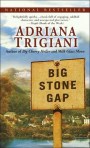
Big Stone Gap series by Adriana Trigiani – Unlike every other book on this list, the Big Stone Gap series is a fun, beach or poolside, race through the story and the characters type of read. In other words, chick lit. While there are certainly tensions and conflict, the overall memory I have of these books is that they were lighthearted and I loved the characters. I’m pretty sure I read the entire series like a chain smoker smokes cigarettes, lighting the beginning of one off the end of another, in the space of a couple of weeks. But since it has been a while, I will again give the Publishers Weekly synopsis: Trigiani’s story of a middle-aged spinster finding love and a sense of self in a small Virginia coal town is a lot like a cold soda on a hot summer day: light and refreshing, if just a little too sweet. Trigiani, a playwright, filmmaker and former writer for The Cosby Show, has a Southern voice that perfectly embodies her main character, the embattled Ave Maria Mulligan. Ave Maria, who’s satisfied if not exactly happy in her role as the town pharmacist, begins questioning her quiet, country life after a posthumous letter from her mother reveals a jarring secret. Ave Maria soon faces a crisis of identity, the advances of a surprising suitor and the threat of her acerbic, money-grubbing Aunt Alice. From the suitor, who points out his brand-new pickup truck during a marriage proposal, to the town temptress, who dispenses romantic advice from her bookmobile, Trigiani brings the story alive with her flexible vocal inventions. Fans of true love stories and happy endings certainly won’t be disappointed.
The Glass Castle: A Memoir by Jeannette Walls – Another excellent nonfiction read, The Glass Castle begins:
“I was sitting in a taxi, wondering if I had overdressed for the evening, when I looked out the window and saw Mom rooting through a Dumpster.”
Who can resist a first line like that? The Glass Castle was so captivating, so well written, and so true,it turned me into a life-long fan of memoir. It has been several years since I read The Glass Castle, but I recommend it to anyone who is reluctant to try nonfiction. Here is an abbreviated Amazon.com synopsis: Jeannette Walls grew up with parents whose ideals and stubborn nonconformity were both their curse and their salvation… When the money ran out, or the romance of the wandering life faded, the Walls retreated to the dismal West Virginia mining town—and the family—Rex Walls had done everything he could to escape. He drank. He stole the grocery money and disappeared for days. As the dysfunction of the family escalated, Jeannette and her brother and sisters had to fend for themselves, supporting one another as they weathered their parents’ betrayals and, finally, found the resources and will to leave home… What is so astonishing about Jeannette Walls is not just that she had the guts and tenacity and intelligence to get out, but that she describes her parents with such deep affection and generosity. Hers is a story of triumph against all odds, but also a tender, moving tale of unconditional love in a family that despite its profound flaws gave her the fiery determination to carve out a successful life on her own terms… For two decades, Jeannette Walls hid her roots. Now she tells her own story. A regular contributor to MSNBC.com, she lives in New York and Long Island and is married to the writer John Taylor.
I’m Appalachianed out for now, but I’ve got a list for when I’m ready for more mountain fiction. Bucknell University in Pennsylvania once offered an Appalachian Literature course, for which the professor posted a book (and movie) list online. Here are some of the titles for further reading:







 Butterfly Mind