Usually, swallowtail caterpillars spend all summer munching the rue in the garden, along with any dill or parsley I’ve planted. This year, I’ve checked the rue nearly every day since May. Until yesterday, I didn’t find a single one of these fat little stripey guys.
This has been a strange insect year for us. No swallowtail caterpillars. Tons of wasps. A yellow jacket nest under the stairs. Mosquitos in the house. At least we had the monarch caterpillars and chrysalises, and the butterflies and bumblebees have been a constant.
I’ve got the garden in a better place than it was a couple of weeks ago. I just remembered I need to water all the plants I planted last weekend. I hope I haven’t already failed them, less than a week in. Cool weather makes me forget the watering step.
And thank god it’s finally cool. The weather has been spectacular the past few days. With the garden in a tamer state, but still filled with plenty of seeds and shelter for the critters, I can enjoy the cool air, changing colors, and dying back, and know that our one little swallowtail caterpillar will have a safe place to overwinter in its chrysalis.
The messier the garden gets with dried out perennials long past the point of being attractive, the more likely I am to find monarch chrysalises in the debris. I mowed earlier this week in the shadows of the late day, and when I pushed the mower past the compost pile, I saw a chrysalis hanging off a desiccated, composting stem. I saw one hanging from the underside of the birdbath bowl. There’s one hanging off an upright post on the stair railing. There were three hanging from tomato cages stored on their sides under the porch stairs.
This time of year, I become desperate to tidy the garden. The beds that were so lush and green in the spring and summer now look ramshackle and abandoned. The once vibrant rudbeckia, with its emerald foliage and sunshine yellow flowers, looks like someone took a blowtorch to its blossoms; black stems stand in a sea of brown-spotted, crispy leaves. The goldenrod is no longer grassy-green and gold, tall, and swaying in the breeze, and the shasta daisies no longer bursts of dazzling white on proud stems. Instead, the two have fallen over, exhausted from reaching for the sun, and are now tangled up together in a thicket of brown brush. The underleaves of the yarrow and lavender are musty silver-black instead of the fresh silver-green of spring, and the Joe Pye weed, which now reaches my shoulders, looks like the remanants of flower stems that have been left in a vase too long: the bottom leaves are rotting, and the stalks a dusty brown.
Once the flowers are done, and their petals curl to crispies, the plants transition to making seeds. It’s not a pretty process. I know this, and yet I struggle every year. I want to cut things back because I can’t stand the mess, but I also want to leave it because the joy of my garden is not just the greenery and pretty flowers, it’s that it surrounds our house with a little wildlife preserve. I garden because I like the birds and the insects, the chipmunks and bunnies and squirrels. I love watching them all, and I am delighted that they come hang out in our yard. The garden is intentionally full of botanicals for butterflies and birds because they’re what’s interesting about plants to me: I don’t want a sterile garden that just has pretty flowers, I want a garden that invites all the creatures.
This time of year, when the garden is its messiest, and every instinct in me screams to clean it up, is harvest time for the birds, and shelter time for the work caterpillars need to do. As soon as I think I can’t take it anymore, and I’m ready to cut it all down, a goldfinch will land on a crunchy echinacea cone and start eating the seeds. It’ll bob there, a burst of happy yellow brightness atop the black stem, and I decide, okay, I can leave the echinacea a little longer. But just the echinacea. Everything else must go.
Then I mow the lawn and see a chrysalis on the compost pile. I remember the chrysalises under the stairs, under the birdbath, in the nepeta and pineapple sage, the rue and the Russian sage last year. I look across the swaths of spent stems and brown withered leaves in the garden, and I know there are likely a dozen chrysalises tucked away in that mess. And I know I won’t cut it back. I can’t bear to. What if I kill a poor caterpillar on its way to becoming a butterfly?
I set today aside to garden and to tidy at least some stuff so I don’t have as much work to do in spring. I can cut some stuff back and still leave plenty for the animals. But wouldn’t you know it, it’s raining. Maybe it’ll ease up and I can take advantage of the hydration to put some stuff in the ground instead of cutting stuff back. I’ve been wanting mums and a couple of shrubs…
My mind can finally rest about the garden. Friday was warm, and Saturday was above freezing. Both days I dug holes and moved plants. Then Sunday, as it snowed, I finally found a way to plot out my ideas for how to change everything.
The thing I love about gardening, aside from the fact that I get to be outside, and it connects me to the earth and all the little creatures — worms, birds, bees, bunnies — is that I can change it every year, like moving all the furniture around in a room to create a space that feels new and different.
At the end of every summer, I think, “Everything in the garden is good, I don’t need to change anything next year.” And then February comes, and I’ve been inside too long, and I decide everything, in fact, could be better. If I just transplant these daisies which are blocking the sun for half the bed, and pull out these Russian sages that are hidden by the Black Eyed Susans, and put some perennials in the new bed because really, that one was fine for its first year, but the annuals-from-seed took too long to come in, and then they were messy and too tall and reality didn’t match the tidy vision I’d laid out on graph paper.
My main objective this year was to break up a huge clump of Shasta daisies that look gorgeous during the 2 week period they’re in bloom, but the rest of the season are poorly placed — they get too tall and block a large swath of prime bed space. Their placement bothers me every year until they bloom, and then I can overlook it while they make me happy with their bright cheery blossoms, and then after the blooms fade, they irritate me again.
So Friday, when it was warm, I started breaking up the Shasta daisies, all 40 square feet of them. I completely rearranged the new bed I created last February on my latest grass-killing spree, and anchored the bed with a clump of transplanted daisies. I filled in the rest of the bed with flowers that will complement them in bloom time and in color, so that I don’t have to wait until July for something to happen like I did last year.
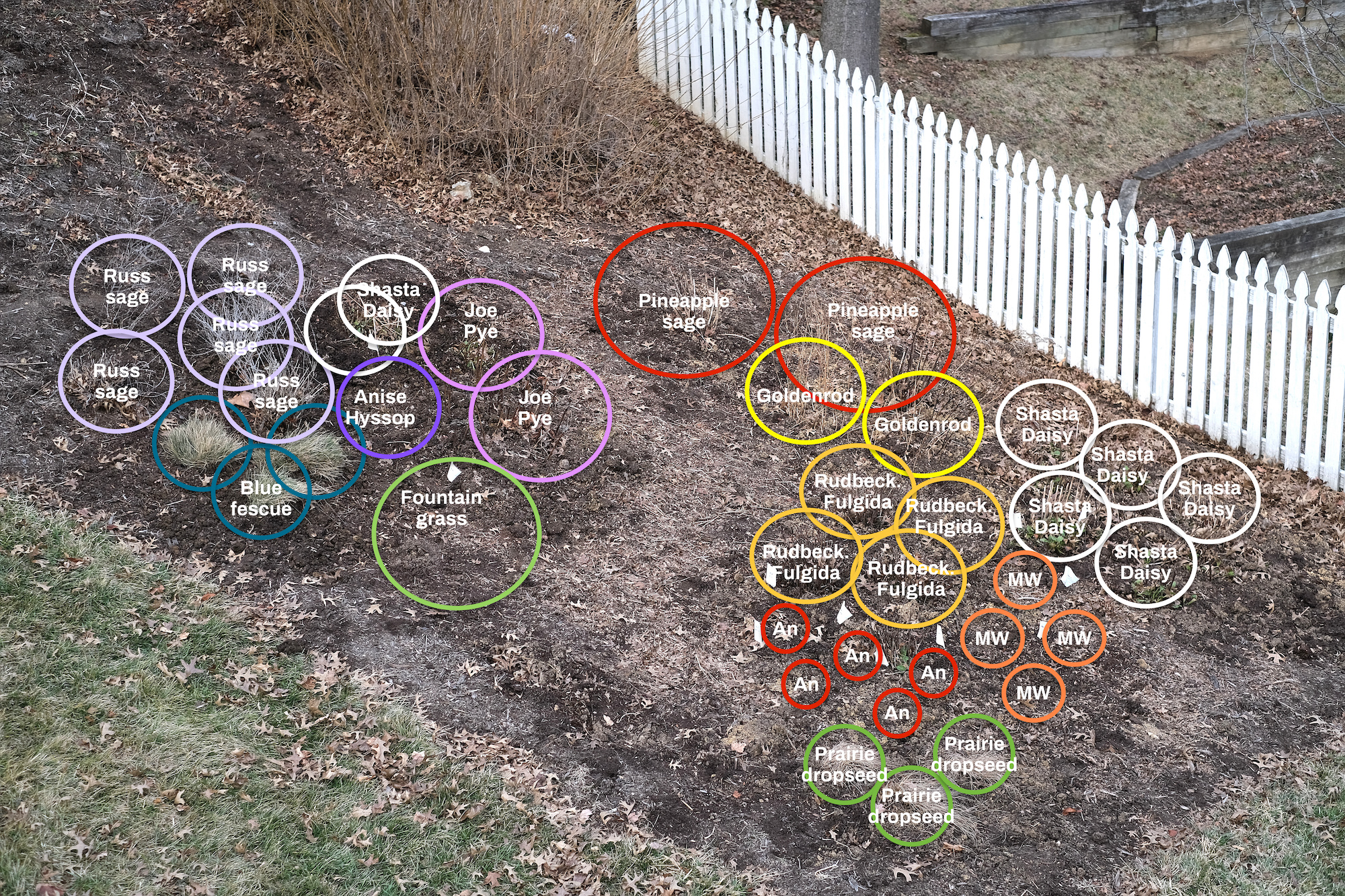
And, on Sunday, I finally figured out a way to plot out plants in a way that I can visualize how they’ll look in the space. I photographed the back beds, then annotated the photos using Preview on my mac. I had to combine two pictures to get a full panorama of the back hill, but I think I’ve finally (mostly) gotten to a point where next time it’s warm enough to work in the garden, I know which plants to move and where. The images aren’t perfect — the perspective is weird because of the hill and the angle, so the spacing isn’t super accurate — but they’re good enough for me to finally be able to rest my mind, now that the ideas are documented instead of me having to hold the vision in my brain.
Now I just need good weather and time. I’m dying to get everything moved and for stuff to start growing again.
Done! These are the plants I’ve already moved (except for a few I still need to buy)To do: move every single one of the plants represented as a circle on this photo 😬
It’s that time of winter where I walk from window to window, observe the garden, and mentally rearrange everything.
Last year, I thought for sure that I wouldn’t need to do that this winter. I thought everything was pretty well settled in, I’d let the stuff in the new bed go to seed so it could reseed itself, and this year, I’d just let the garden do its thing.
In June and July, it bothered me a teensy bit that the new bed, all annuals started from seed, had nothing to show for itself but bare dirt and tiny sprouts. It didn’t fill in until August and September, and then it was so full it didn’t blend with anything else. And the plants got too heavy and dense for themselves and were mildewing. And the Shasta daisies are too tall for where they are; they’ve bothered me for years, but they look so pretty for those two weeks when they’re all in bloom that I haven’t touched them even though their placement is all wrong. And the Russian sage bushes didn’t really work out the way I thought they would where I put them. And the blue catmint is crowding out the white coneflowers, which are some of my favorite flowers in the garden and I don’t want to choke them out.
So now, of course, I want to redo everything. I blame the Prairie Moon catalog that came in the mail a couple of weeks ago. I’ve bought all these books about butterfly gardening, about host plants and nectar plants and gardening with natives, and here comes this free catalog in the mail that has all that same information, plus sells the plants, plus sells kits, complete with layout suggestions, to plant an entire bed for birds or butterflies. I’ve got my eye on the Colossal Pollinator Garden kit, except that several of the plants included in the kit are not deer resistant, which means I’d spend $200 just to get everything either eaten or trampled by the gang of deer that roam our neighborhood.
Regardless of whether I purchase a colossal pollinator garden kit, the catalog solidified for me that the garden was not, in fact, settled last year, and I will not, in fact, just let the garden do its thing this year.
I started drawing new plans in my graph paper notebook, and I wish for better tools. It’s too hard to draw stuff over and over again, and get the scale right, and figure out how to show “this needs to move here,” and I don’t like how messy my plans become with erasures, and imperfect circles, and the realization that I’ve forgotten plants along the way. And I forget to plan for blooming throughout the seasons, so that there’s always something interesting going on in each bed, and the beds all harmonize together. A degree in design would probably be helpful here. But I don’t have a degree in design, so I’ll just use the tools I have and I’ll do it my own messy way, and I’ll try stuff and maybe it will work and maybe it won’t. The stakes are pretty low, and in all cases I have a garden that grows.
I love this about gardening: that I can continually play. I like change too much to just leave it the same every year.
The butterflies haven’t arrived in droves yet, but I’m hopeful that by the end of July they’ll be here. I walk the garden every day to turn leaves over and look for caterpillars. So far I’ve found none. I may have spotted a couple of swallowtail eggs on the rue; I’ll keep a close eye on that.
Meanwhile, the garden is in full bloom. Most of the flowers I planted serve as nectar sources for butterflies and bees; hummingbirds drink from them, too. The caterpillar host plants aren’t as pretty, so I haven’t photographed them, but I have five different kinds of milkweed for the monarchs, lots of dill, rue, and parsley for the eastern swallowtails, and a spicebush for the spicebush swallowtail. I hope they’ll all visit this summer.
Echinacea foreground, lollipop vervain background. Butterflies love the nectar of both; goldfinches sway on the echinacea.
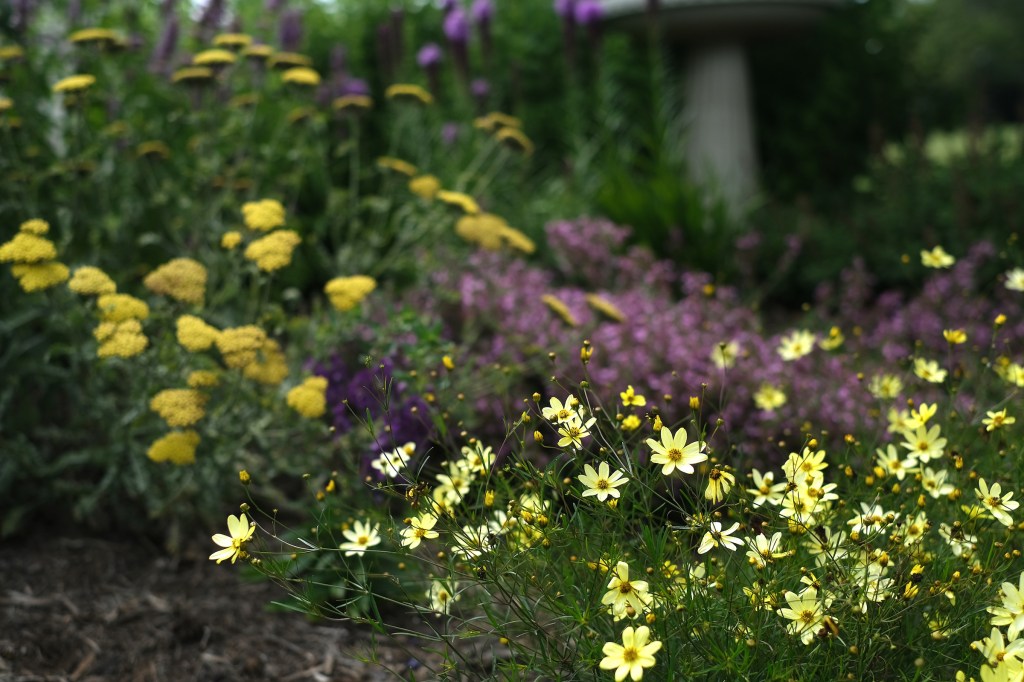
Coreopsis foreground, yarrow and germander background
Rudbeckia (brown-eyed Susan)
Echinacea, liatris (blazing star;gayfeather), and passionflower in the background
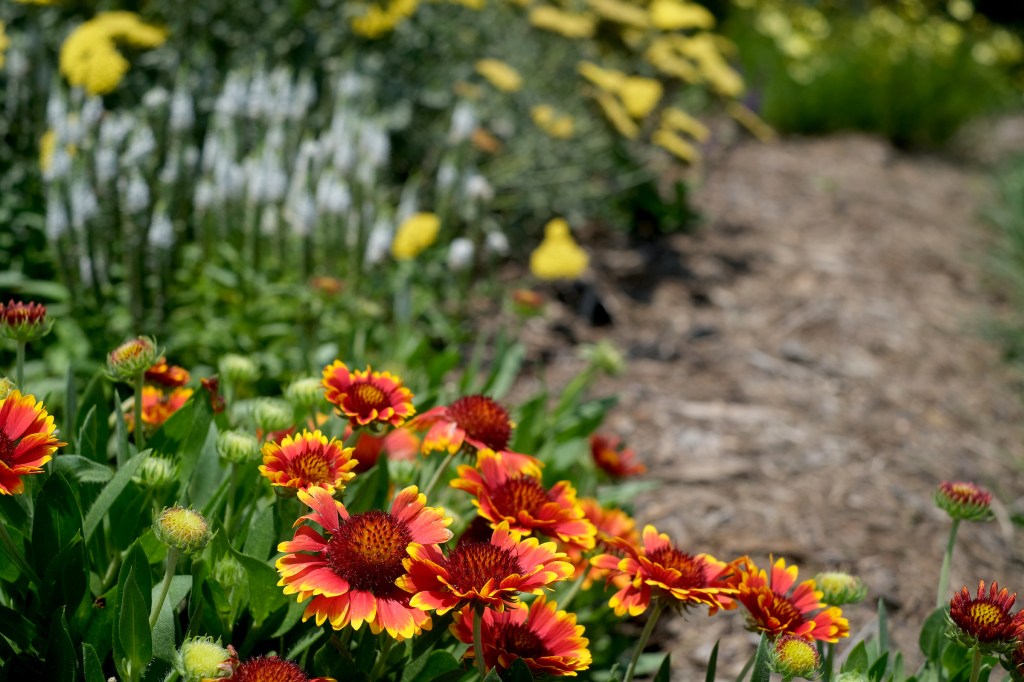
Gaillardia (blanket flower) foreground, white veronica and yellow yarrow background
New Sombrero Adobe cone flower. These are intensely orange. I love them.
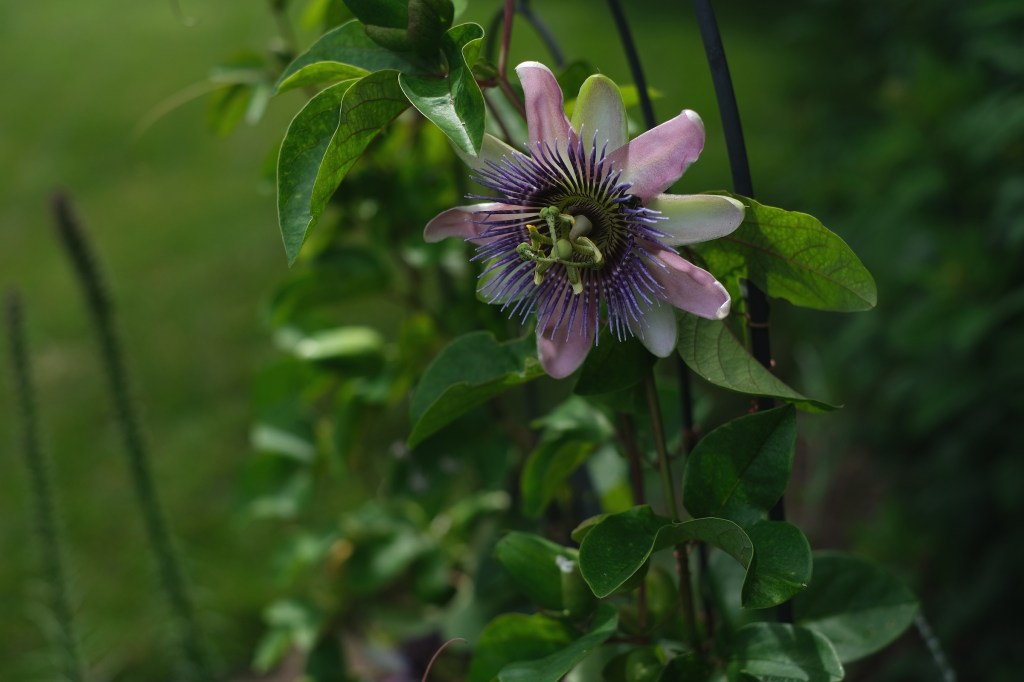
Passionflower
Shasta daisies
Common milkweed. The flowers smell like almond, and this is a host plant for the monarch caterpillar.
When the garden first begins to return in March, I might find something new to get excited about once per week: a snowdrop, a sprout emerging from the cold earth. Now, dozens of new things happen every day. I can sit outside and admire the garden for hours.
Today I wandered around with my camera, then looked back at photos from when I mulched on my gardening vacation in March. It’s so different now, and it’s only May!
Dwarf lilac
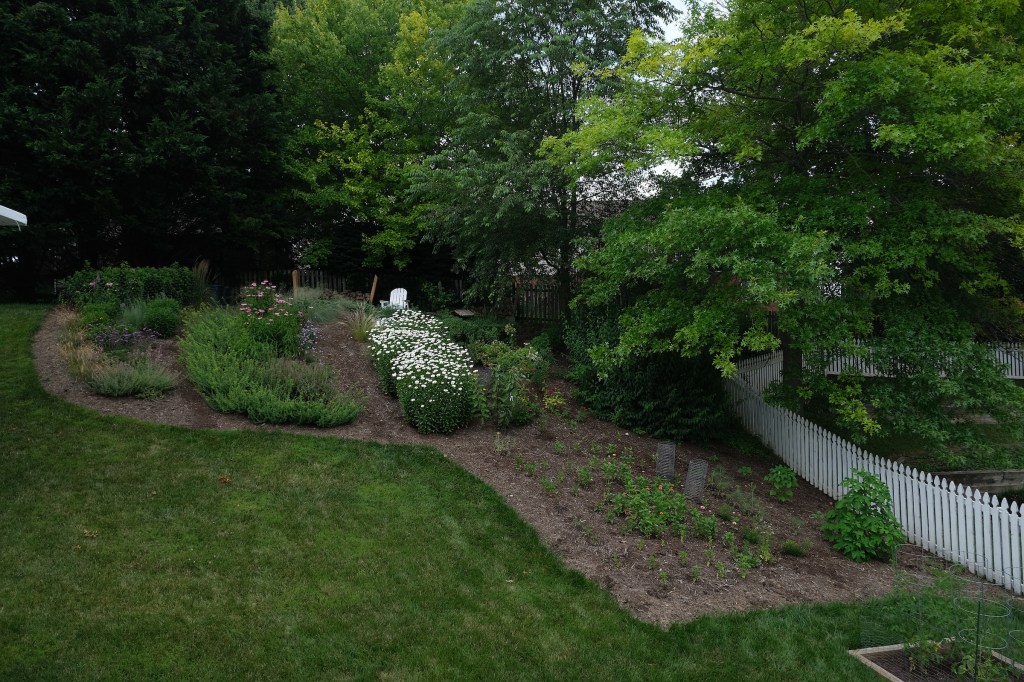
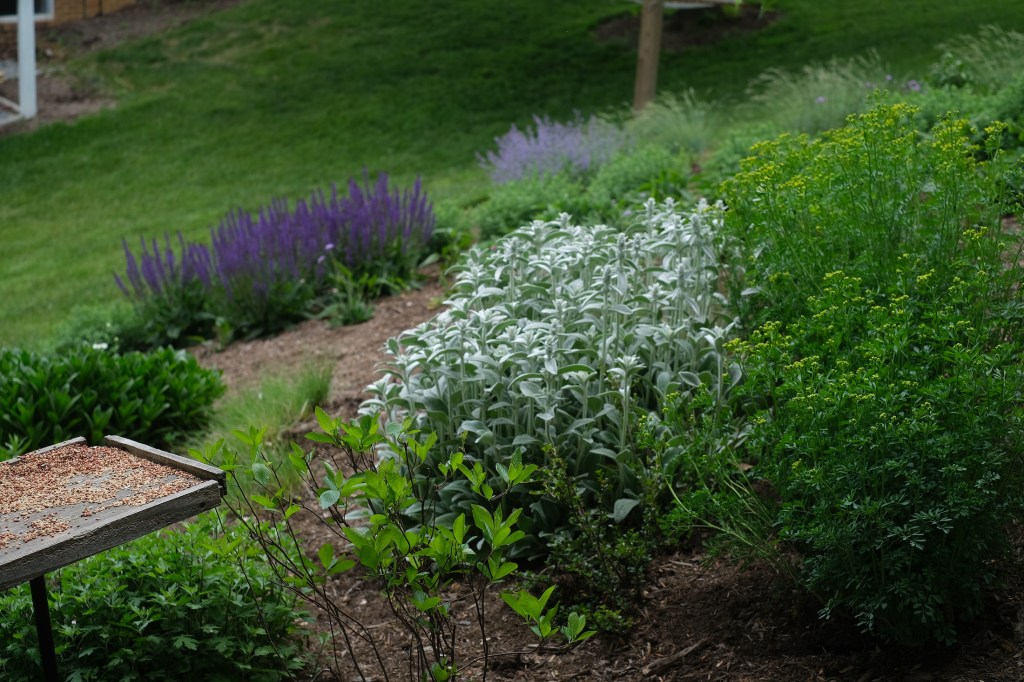
Back bed from the foot of the hill: marjoram and purple salvia in foreground, lambs ears and rue in front of the chair, shasta daisies to the right
The sugar snap peas are flowering
View from the top of the hill
My new passionflower ♥️
Lambs ears, penstemon, Walker’s Low nepeta
Yarrow
Penstemon
I planted the new bed (background) last weekend. The zinnia seeds have started to emerge, and the milkweed seedlings have survived so far. I put in some red salvia annuals so there’d be at least something there while everything fills in.
The Mexican feather grass isn’t coming in very thick this year 😦













 Butterfly Mind