It crackles: sweet, ruby red, and shellac smooth. When I was a little girl I wanted a candy apple red Corvette. One of the old models, with the sweeping lines and the chrome bumpers — not the modern ones so covered in plastic they look like sedans. I have no idea why I wanted a candy apple Corvette. I have a feeling I was influenced by Prince.
Candy apple red is a gorgeous color because it is transparent, like a gem. There is something of substance inside its candy coating: something to bite into, something sweet, but that grew from the earth; something wholesome that in the act of chewing it, will scrub your teeth clean of the sticky candy you crunched through to get to the red apple inside.
I don’t really care about candy apples to eat, but I sure do love to look at them. Maybe that’s what I liked about a candy red Corvette, too — it would be beautiful to look at. At the time I wasn’t old enough to drive; I wouldn’t have appreciated how much fun it would be to shift gears, push the pedal to the floor, and vroom.
I don’t have a candy apple red Corvette, and I don’t care about having one anymore. I do still love the color, though. And lucky for me, we now have a candy apple red canoe. It won’t be fast and loud, like a Corvette.
It will be and smooth and silent, and built with my husband and children’s hands.
Deep, magical, dusted with stars: midnight blue. It was my favorite Crayola color. It was rich, mystical, a dark night blue with the tiniest hint of green. I looked for excuses to color night scenes, to color oceans.
The Crayola boxes don’t contain midnight blue anymore. I’ve not found its equal. Anything similar is too light, too dark, too grey, too green, not green enough. The midnight blue I remember was the dark blue of deep water at dusk, when there’s enough light to give it color, but not so dark it would be black.
I always wondered why “midnight blue.” Every sky I’ve seen at midnight is black. But the Crayola color was reminiscent of the beautiful blue of dusk, when the sun has set and there may be a hint of pink at the horizon, but it’s quickly being consumed by a blue green that darkens with every second as night takes over day.
The color — that dark dusk blue — is possibly my favorite color in nature, as it deepens into night into the midnight blue Crayola color. It awes me. It feels almost sacred.
Thinking of it like that reminds me of that novel, Sacré Bleu by Christopher Moore, about Van Gogh and the lengths he went to to get the blue pigments for his paintings. What a book. I think Moore (or more accurately, Van Gogh) felt the same way about midnight blue — and all the blues — that I do. It’s magical. It draws you in. You can disappear into it’s depths: the depth of the sky. The depth of the ocean.
There’s maybe a bit of madness in it.
This is a ten-minute free write prompted by the words “Midnight blue.” I pulled the prompt from my prompt box, set the timer for 10 minutes, and wrote until the timer stopped.
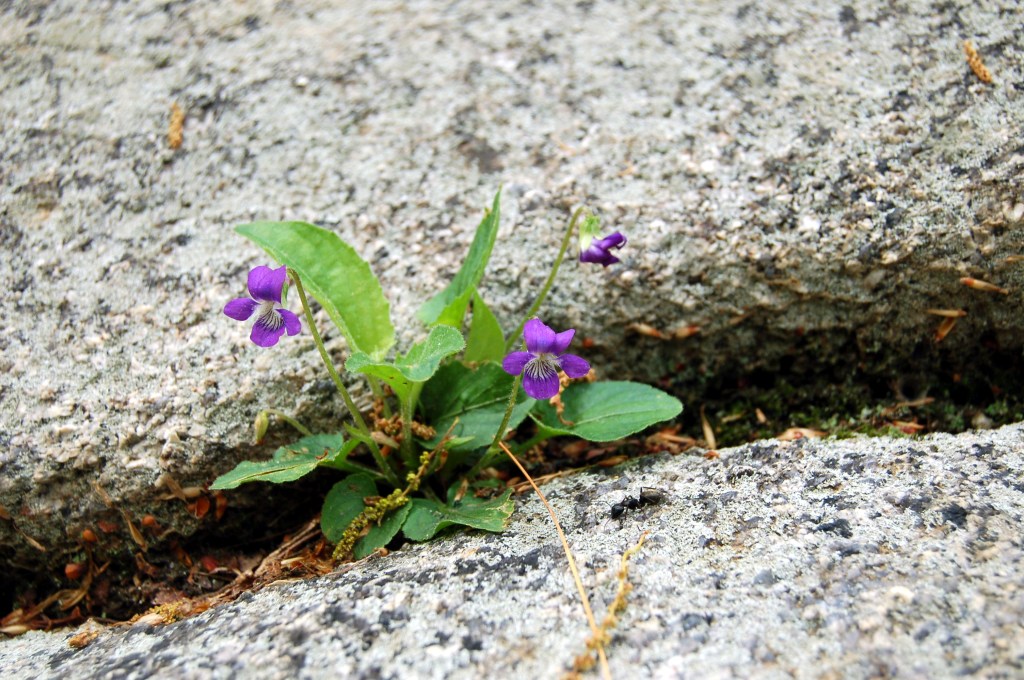
I can’t resist greenery growing from the fissures of stones. Rocks seem an unlikely place for plants to take root. Granite is unyielding. It says: keep out, you cannot penetrate me.
And yet. There are little flowers that do. Every time I see green growing from stone, I am reminded of the persistence of life. And I am glad.
I’m feeling festive among the jeweled reds of the season. I don’t want to take too much time away from family to write on Christmas (though they are all occupied with other things – new Wii games, a new Samsung tablet, a pre-feast workout), but the colors of the day are inspiring me. Since I gathered greens in the garden this summer, I’ll complete the holiday palette with a collection of crimsons on Christmas:
ruby
garnet
maraschino
cranberry
pomegranate
framboise
raspberry
roseate
dark cherry
candy apple
holly berry
On a highway called A1A, the one you’ve heard about in Jimmy Buffet songs, that ribbon of road that hugs the Atlantic Ocean on Florida’s east coast, somewhere between Little Torch Key and Key West, in that 24 mile stretch of road, there is a stairway that climbs into sky.
I remember that stairway, emerging into open air, from open wooden walls, sand brown, by the water’s blue-green edge. As you came over a bridge headed west, there it was on the left bank – a stairway to heaven. I don’t know if there were other houses around, or if it was really alone there. It stands alone in my memory. A house with a stairway through its middle, but without a roof or second story walls to cage it. Had the house been destroyed by a hurricane, or had the construction crew from Key West gotten drunk and stopped working on it ten years ago? There was no soot, it did not burn, I remember that.
We drove over the bridge, my parents and I, on our way to brunch, and the morning sun behind us shone peach on the house walls. The stairwell, with its two by four banisters, glowed apricot with turquoise Gulf of Mexico water in front of it, a wisp of white clouds behind it, and the sky a deep blue in the pre-noon slant of light.
I wanted to climb that stair, to start at the bottom, enclosed by walls where no one could see, then wind my way up, where the walls dropped away, and I emerged into sunlight. I’d look out over the moppy heads of palm trees, listen to coconuts drop, lean against the banister and look for shadows in the water – a sea turtle, or a manta ray, or a manatee beneath the surface. The sun would warm my crown, and my arm hairs would glisten gold, and I would smell salt and sea.
At night, the air would be different. Cooler. The glare, the heat, the intensity of sun and sizzle would soften, and there would be a scent of sweet floral beneath warmth rising from sand. Music would drift from a nearby rooftop. Wavelets would lap gently at the shore.
At night, I would turn my eyes upward into the sky instead of down into the sea, and I’d climb the stairs into the stars.
When I sit at my tan desk, in our beige room, with dull buff carpet beneath my chair, I often have a hard time coming up with color words. I google “synonyms for green,” rifle through crayon boxes, and scroll through images of paint chips and artists’ color names, but I am not usually inspired by what I find.
Then today, in an effort to wring the last few drops of fun out of summer before the kids go back to school, we rode our bikes over to the Virginia Tech horticulture garden, where they love to play in the sprinklers and find flowers in the colors of the rainbow (“Here’s a red one!”, “I found orange berries!”). I had folded up a blog post draft and stuck it, along with a pen, in my back pocket so that I could work on it in the quiet of the gardens while the kids played, and as I scribbled and edited, walking the mulched paths, filling the page with ink, I saw a pale green hydrangea.
“Hey guys, here’s green,” I said.
“Oh, flowers!” our daughter said when she saw them. “We don’t usually find green flowers, we just use leaves for green.”
I studied the hydrangea petals, trying to determine their color, and thought, celadon. Is that what color celadon is?
Yes.
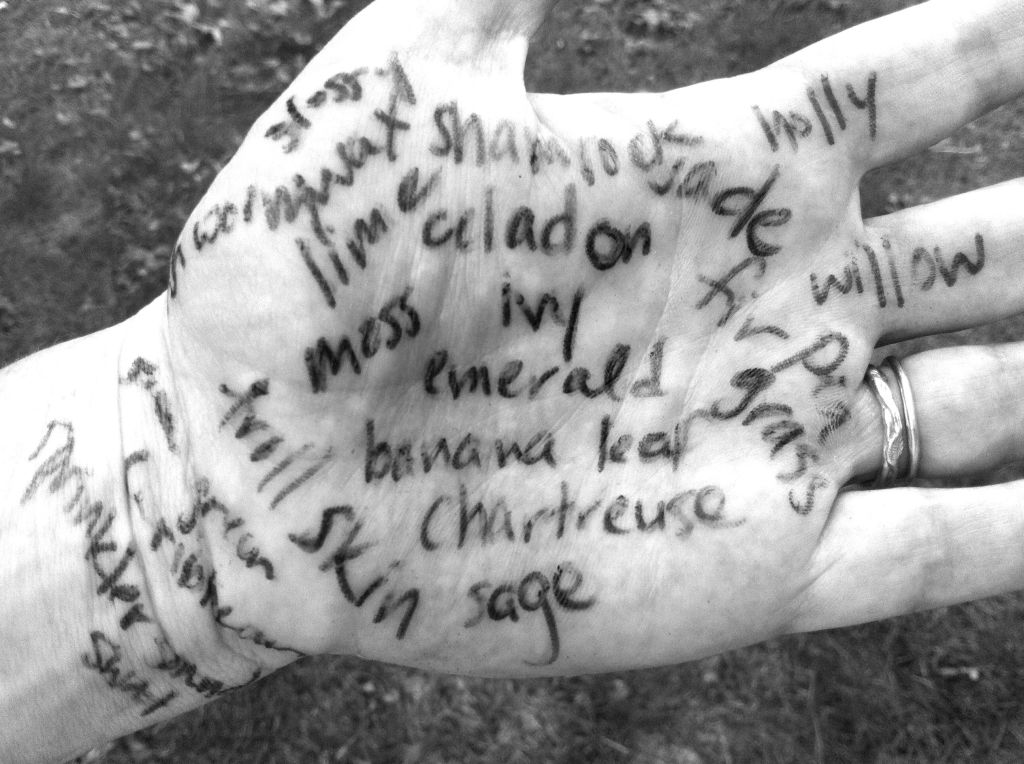
I looked around and saw banana leaves, fir trees, weeping willows, and thought, these are each a different green – dark and glossy for banana leaves, shadowy blue-green for firs, a soft yellow-green for willow. Each plant species is its own hue. And so I started writing. I’m not usually a write-on-my-hand type of person, but my paper was full, and I needed these words.
“Mom, what are you doing?”
“I’m writing down all the greens I see,” and wrote sage. “What greens do y’all see?”
They shrugged, as if that were a dumb question, and then our daughter said, “Shamrock.” Yeah, she’s good.
“Inch worm,” said our son.
They ran off to play in the sprinkler, and I sat and filled my hand. A few minutes later they came back dripping, and our daughter said, “We saw some algae in the pond that looked like troll skin.”
“Troll skin! That’s perfect,” I said, and wrote it down.
“Troll skin isn’t a color,” said our son.
“Sure it is – it’s silvery blue-green and warty.”
“Yeah,” said our daughter, “that’s what color the algae was – it was even bubbly like warts.”
On the bike ride home, the kids shouted out more words – “pea,” “yellow-green,” and “olive” – and when I saw my friend Dee, she asked, “Did you get peridot?” Now, thanks to their assistance, and to inspiration from the gardens, when I am sitting in our neutral living room, trying to conjure color words, I have an entire page in my lexicon dedicated to the color green:



 Butterfly Mind