I am 23, newly married, and my husband is on a research trip in Bermuda for the next six months. I am a young woman alone in our new home in Takoma Park, Maryland, but I feel safe up here in the upstairs apartment of a cute cottage house with a steep, angled roof. The landlady, a hip, smiling woman with centimeter-long bleached curly hair and velvety chocolate skin, painted our walls a gleaming white – not an ecru or an eggshell, but a white white that shines clean and bright when the sun pours in all of our windows. She lives downstairs with her two handsome sons, and she welcomed us by tossing pennies under the throw rugs when we moved in. To bring us prosperity, she said. She’s studying feng shui.
Maria is over today. She works with me in the lab and her Os are round when she speaks them. She’s from Minnesohta. She keeps me company while my husband is away, and we carpool together to work. The first time we parked in the UMD garage she got out and walked to the front of the car, put her hands on her knees and crouched down to inspect the cement wall in front of us. “Where do you plug your car in in winter?” she asked. Being from Georgia I had no idea what she was talking about. Now, she fans her armpits a lot and says, “My Gahd it’s hot.” Being from Georgia, I am tickled by how much the heat of a Maryland summer distresses her. Maryland summer is nothing compared to the oppressive, heavy heat of coastal Georgia.
Being from Minnesota, she was probably tickled in winter when I white-knuckled the steering wheel when it snowed, or in spring when the trees were in bloom and I couldn’t stop gasping. On the coast of Georgia spring is subtle. Most of the trees have leaves year-round, and they do not burst forth into flower before leafing into green. When we drove to work, I’d exclaim over every cherry blossom, every Bradford pear, every redbud. “Look at that one, Maria! Those pinks!” I’d turn my head and see another, “And that one is just covered, I mean COVERED with white flowers!” She’d smile quietly and think of her Minnesota home.
Now, we are in the spare room with newspapers spread on the round wooden table. Maria is teaching me how to make patterns for sewing. Calico cloth that reminds me of Ma Ingalls is draped over the back of a wooden chair. My bike leans against one white wall, and Maria and I bump against the others. It being an upstairs apartment with slanted ceilings, the room is small and cramped, but it is happy with bright light pouring in the windows and reflecting off those crisp white walls. Maria tells me about paddling the boundary waters while she positions spaghetti straps on newspaper, straps that remind me of summer and freckles and Georgia beaches. I tell her about jellyfish and seashells and palm trees while I finger the Little House calico.
The sun glints off of scissors as Maria cuts through print along the pencil mark she traced from the tank top she brought. We are copying the pattern, two women alone, crafting summer garments from what we have, from what we know, cutting cloth and making something new.
The submissions for my Andrea Reads America American Vignette series are rolling in, and they are a pleasure to read. This is my entry for the second prompt, American Vignette: Summer Garments. If you have a story to tell about summer clothes in your state , I hope you will submit!
Ramon reminded me instantly of Ernest Hemingway. He wore a white beard and loose linen pants. His voice was low and smooth. He spoke simple Spanish with us, and he smiled and made political jokes, gently testing the mettle of his son’s American friends.
His apartment was much smaller than Quim and Cristina’s, and when we collapsed into it after our journey from France it smelled of pipe smoke and sizzling fish. Books filled dark grained shelves from floor to ceiling, and we shed our shoes to step onto the honey gold wood parquet. Ramon has been a professor of Mediterranean history and culture at the University of Barcelona for 40 years, and his apartment was tasteful – original paintings and nude sketches hung on every unshelved wall, sometimes as many as five or six on a single surface if it was large – and very masculine.
—-
Credit: blog.maptia.com 11 untranslatable words from other cultures
“Don’t eat too much,” Quim told me when we stopped at a rest stop in the Pyrenees around 6:30 pm. “My dad will have a feast prepared when we arrive.” We snacked on baguettes with cheese and jamon (salted ham) at a picnic table while Quim and Cristina’s daughter played on the playground. I thought he was kidding – we wouldn’t get to Barcelona til well after 9 pm, much too late for a dinner feast. Besides, I was pregnant, and I had a baguette. I did not heed his warning.
We met Quim in Maryland when my husband was working on his masters degree. Quim had been a visiting scientist, and he made a mean paella. His skin and hair were dark, as you might expect from a Spaniard, and his thinning hair stood up on top, as if it were always affected by static. He had the happiest smile and the llightest heart of anyone I’ve met, and when he laughed, I laughed. When he returned to Maryland on a subsequent trip, we invited him to stay with us for the few weeks he was in the States.
Now, he and his family hosted us on our first trip to Europe. When we told him we were thinking about visiting France and Spain, his face broke into his full toothed Joaquim grin. He insisted that we stay with him in Marseille. He and his girlfriend and daughter were our guides during our ten day trip, and that Friday, the Friday we ate cheese and ham at a rest stop in the Pyrenes, they cut their workday short to take us to the city of their hearts, Barcelona. They jittered with excitement to go back home, where they would take their daughter to visit her grandparents, and where Quim’s father had graciously invited us all to stay in his apartment while we visited his city.
After our rest stop snack, we climbed back into tiny cars, and we followed our friends onto the highway. When we crossed the border into Spain, Quim grinned and waved from the passenger seat in front of us. We were in the mountains, and the land was green – a green unbroken by buildings, power lines, or human evidence of any kind. Not Ireland green, but green with the stumpy trees of the Mediterranean, and green with the cleanliness of a recent summer rain. My husband and I thrilled to see road signs we could decipher after the foreignness of France. Even though the signs were in Catalan instead of Spanish, we could at least puzzle them out after four years of high school Spanish.
We arrived in Barcelona at dusk. The July sun set late, and after the leisure of driving on a deserted highway, following our friends on the hectic streets of a foreign city in the low light between mountains was harrying. The highway spit us onto a roundabout, and we cut across multiple lanes of traffic to make quick turns, hugging Cristina’s bumper so that nobody would elbow between us. Cris had driven slow on the highway, but now we whipped through town, zipped between cars, darted here and there with no idea where we were going or how we’d get out. My husband sweated and we hoped we didn’t lose them.
—-
As Quim promised, Ramon had a feast prepared for us when we arrived near 10 o’clock at night.
We ate on his terrace on the top floor of his apartment building – the atico. Basil and sage plants, jasmine and lantana, and hibiscus lined Ramon’s balcony. Piano music drifted up from below. “She is a concert pianist,” Ramon told us of his downstairs neighbor. We relaxed into our seats and soaked it all in.
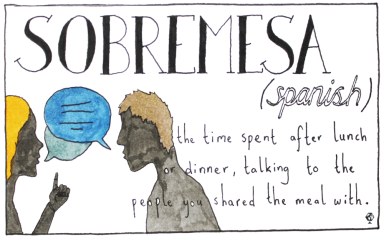
For the first course, Ramon served a zucchini casserole. When my husband and I recognized the zucchini and called it by that name, Ramon turned to his son, bewildered. In Spanish he said, “Zucchini?! That’s Italian. They must have a different word for it!” I love this culture, who when they value a thing, they give it a name. Who call zucchini calabacín, and who have a word for the time spent in conversation after sharing a meal: sobremesa. Over table.
The next course Ramon served us was a cold tomato soup-type dish from the south of Spain. The dish was cool and refreshing on a hot summer night. It was thick and almost creamy, though I don’t think it had any cream in it, and sprinkled on top were hard boiled eggs and jamón serrano, a dry-cured ham that is everywhere in Spain. Then came sardines. Not finger-long sardines in a can, but ear-of-corn sized sardines that Ramon had bought fresh at the fish market on La Rambla and cooked whole, heads and all, in his apartment in a huge paella pan.
I studied how Cristina dissected one for her daughter so I could follow her lead, but I missed what she did with the head. Mine shuddered each time I tried to scrape meat off the tiny bones of the body, and Ramon guided me in chopping the head off. I struggled with picking the small fish clean with my fork, and Quim told me “Just eat it with your hands. It’s a lot easier that way.” He grinned and wiggled his olive oil fingers, then used his thumb and pointer to slide meat off the tiny skeleton.
As everyone else ate sardine after sardine (I had to quit after one because I ate too much ham in the Pyrenees), I melted into my patio chair and listened to voices on the street below, forks and wine glasses clinking on terraces, and concert piano music floating up from an open window. I smelled fresh herbs, and the warm night air of Spain, and I was lulled by the deep man voices at our table. It was midnight by now, and I was pregnant, tired, and absolutely contented.
We slept that night with the terrace doors open, trying to stay cool on top of the sheets of the pull-out sofa bed, listening to summer sounds of Barcelona under the stars – laughter on the way to tapas bars at 1 am, glassware clinking on balconies.
Quim had a big day of sightseeing planned for the next day. “But we have to be back by 2 o’clock. My dad will prepare a big meal,” he told us. Despite Spain moving toward the half hour lunch, Ramon refused to adopt such a rush rush life. Even on weekdays he took a 3 hour break to prepare a large midday meal and nap afterwards.
I flopped my big belly over as Quim told us good night and flipped off the light. “Okay Quim,” I smiled into my pillow. “We can do that.”
I drifted on the murmur of Spaniards in the street below, and the front door clicked quietly shut as Ramon slipped away to his girlfriend’s.
“We Americans,” he said, “like change. It is at once our weakness and our strength.” – W. Somerset Maugham
I am reading too many books right now. I generally only read one book at a time. Well, amend that. I am more comfortable only reading one book at a time.
When I was younger and had leisure time and my only responsibilities were to study and go to school, I was book monogamous. Once my schoolwork was done, I’d tear into fiction, the sole book I was committed to at the time, and I’d read for hours on end. I did not start a new book until I finished the first one.
In my 20s I discovered creative nonfiction (though I didn’t know it was called that at the time). I think the game-changer for me was The Soul of a Chef by Michael Ruhlman, and so I added nonfiction to my reading repertoire. By then I had a job and could not read during the day, so any nonfiction I picked up had to be reading-in-bed worthy. It had to read like fiction. And still, I read one book at a time.
Then somewhere in my 30s I started exploring other nonfiction. I picked up works that were still interesting, but maybe not as page-turning as a well-written biography or Ruhlman’s The Soul of a Chef. I started reading writing books, and nonfiction about introverts, and I Thought My Father Was God, a book of essays from NPR’s National Story Project. As an at-home mom, nonfiction lent itself well to my new role. Because I’m not going to sit down and read a writing book or a compilation of essays cover-to-cover, I’d read my nonfiction in small pieces, during the day. During work hours. I craved injections of knowledge in my cloistered at-home life, and as an at-home mother I had small pockets of time during the day to read, while I nursed a baby in the early days, or at lunch now. Reading fiction at home while everyone else was at work seemed decadent, like eating bonbons, and nonfiction allowed me to read during the day without feeling guilty. iction remained my special treat, not to be consumed til after 5 o’clock, like a well poured cocktail. It was my prize at the end of the day.
Consequently, over time, I found myself not reading one, but two books at a time. This was fine, kind of. It made me a little uncomfortable, dividing my attention like that. But, since I separated the types, and kept it to one book of each – a nonfiction title for daytime and a fiction title for night – the dual reading became manageable. I began to be able to handle it. I thought of the nonfiction as being educational, as if I were at work, and the fiction as it always has been, as my pleasure.
But I have found that this reading two books at a time is a slippery slope. A gateway to rampant reading polygamy. Before I knew it, in addition to a daytime nonfiction title and a nighttime fiction title, I also had a book of short stories going. And in addition to my writing book, maybe I picked up a memoir as well. Next thing you know, I’m reading short stories during the day (I know! I may as well paint my nails while I watch soaps!), and I’ve even got an audiobook as backup for those occasions when I’ve listened to all my favorite podcasts.
Now? There are 8 books on my currently-reading list. As a result, I feel scattered, like I can’t commit. It’s hard for me to get into any one story when I’ve got so many going at once. I get distracted by my options, all these starts that need to be finished, and rather than being eager to dive into a single work for the simple pleasure of consuming its words, these books have been reduced to loose ends I must scramble to tie before my reading life unravels.
I don’t want my reading life to unravel.
I’ve got a plan. Book club is next week, and so our group pick, W. Somerset Maugham’s The Razor’s Edge, has become my number one priority, even though I was really, REALLY enjoying reading Little Miss Strange (a coming of age novel set in 1970s hippie love culture – for night reading) in tandem with Joan Didion’s Slouching Towards Bethlehem, (poignant essays of the same era – for day reading), when The Razor’s Edge finally became available at the library. Once I finish Maugham, which I’m pretty sure I’m going to need to read during every available reading minute (including daylight hours) in order to finish in time for book club, I’ll return to Didion and Little Miss Strange. After that, I’ll finish the very excellent Rose Metal Press Field Guide to Writing Flash Nonfiction, the first writing book since Anne Lamott’s Bird by Bird that I could conceivably read cover to cover. It may even be reading-in-bed worthy.
And then? Then I will become a monogamist again. I can’t handle the stress of all this juggling. All this infidelity.
Except, what will I read during the day? Maybe I can read two works at a time. I’ll separate the types, and keep it to one book of each – a nonfiction title for daytime and a fiction title for night. That will be manageable. I think I can handle that.
Four books I’m currently reading:
The Razor’s Edge by W. Somerset Maugham: This is our book club pick for October, and now that I’ve put all other books aside to concentrate on it, I’m turning pages like nobody’s business. Americans in postwar Paris, a society snob, a war vet trying to find God? Yes please.
.
Little Miss Strange by Joanna Rose: Set in 1970s Denver, this coming-of-age novel about Sarajean, a child of love children, throws you into the center of the free-love hippie culture. Pre-adolescent children wander the streets while their parents are thrown in jail for drugs, or are shooting heroin, or are taking lovers. It’s an intimate immersion in that world, and I am fascinated by it.
Slouching Towards Bethlehem: Essays by Joan Didion: In my studies of creative nonfiction, Joan Didion’s is a name I come across over and over again as a pioneer of the New Journalism, of weaving literary techniques into news reporting, of writing prose that makes fact read like fiction. Slouching Towards Bethlehem, her essays of the same era as Little Miss Strange, is mesmerizing on its own, but is also a fascinating companion piece, daytime nonfiction to pair with Rose’s nighttime fiction.
The Rose Metal Press Field Guide to Writing Flash Nonfiction: Advice and Essential Exercises from Respected Writers, Editors, and Teachers edited by Dinty W. Moore: This is one of the most readable writing books I’ve come across. Divided into a series of issues relevant to writing flash nonfiction, or any kind of writing, really, this field guide provides micro-essays on various topics (voice, place, objects, memory), a writing prompt for each topic (prompts I actually use rather than just looking at and saying, that’s a good idea), and then an example essay. When I’m stuck in my practice, I open this book and get started.
What about you? Are you a one-at-a-time reader, or do you read several books at once?
Tenth Anniversary Rolling Stone, issue 254, December 17, 1977
Inside cover: reprint of the editor’s letter from the 1967 debut issue of Rolling Stone magazine
Amongst our Southern literature, children’s books, fantasy and sci fi, essays on world religions, and art books, we have a single magazine on our shelves: the Tenth Anniversary issue of Rolling Stone magazine from December 15, 1977. My parents saved it for me through the years because they know I love Annie Leibovitz, and the issue features a fifty page spread of photographs from her first ten years shooting for Rolling Stone. My husband and I have moved the large format issue from Florida to Minnesota to Virginia – for more than seven years, it sat on our shelf – and the time never felt right to open it.
And then came Mad Men. My husband and I are binging on the show right now. (warning: spoilers below!)
Mad Men anyone? Volkswagen ad from 1977 Rolling Stone, issue 254. I’m a Volkswagen fan (my first car was a VW beetle, and my husband and I both drive VWs) so I get tickled every time they show a VW ad on Mad Men.
We’re in season five, when Roger Sterling eats acid with Timothy Leary,
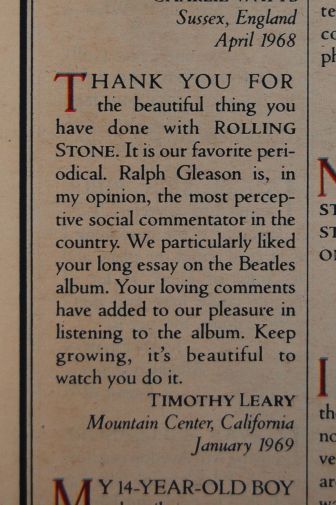
Letter from Timothy Leary to Rolling Stone magazine
the firm tries (unsuccessfully) to sign the Rolling Stones for a campaign,
Keith Richards passed out, photo by Annie Leibovitz in Rolling Stone magazine issue 254, 1977
and the gap between Don Draper and the emerging generation widens as the Beatles grow in popularity, and the youth of the 1960s follow dreams of purpose and fulfillment rather than dreams of indoor plumbing. Last week, we watched an episode that had one of the most powerful uses of music I have ever experienced in a television show (besides the “final five” sequence of Battlestar Gallactica when they played “All Along the Watchtower.” Awesome.). It was a pivotal episode, in which Don was portrayed as no longer a young, hot-shot creative ad exec, but a middle aged man who was losing touch with what is going on with his wife and staff’s generation. His young wife perceived this disconnect, and so on her way to acting lessons, to fulfill her dreams of becoming an actress, she left him with the Beatles Revolver album to help bring him up to speed. He placed it on the turntable, put needle to vinyl, and our living room filled with the entrancing final song of Revolver, “Tomorrow Never Knows.”
The montage was potent as it proceeded through a series of scenes of the younger generation in Don’s life as they followed their bliss – Peggy and Stan smoked weed while they worked, Pete watched a lover slip away, and Megan meditated in her acting class – until Don, disinterested, scratched the needle off the record, our den went silent, and Don walked out of the room to go to bed. To me, It was one of the most brilliant sequences of the show to date, and as listening to (good) music from that era often does, it made me ache with nostalgia for a time I never knew.
The following morning, after I dug through our CDs to find the Revolver album, I saw the Rolling Stone issue on our shelf, and the time finally felt right to look at it. Before I even got to the Annie Leibovitz spread, I was struck by the letters to the editor. Especially the one from angry parents who wrote, “My 14 year old boy subscribes to your magazine, Rolling Stone. On the front cover and inside the magazine were nude pictures of that Lennon man (?) and his ugly girlfriend.”
Reader letters from Joan Didion, George Bush, Joseph Heller
Letter from reader, and response from John and Yoko
Reader letter from angry parents to Rolling Stone magazine
Letters to Rolling Stone from Dan Rather and Woody Allen
I got a chuckle out of that one, but there were also letters from John and Yoko, Timothy Leary, George Bush, Joseph Heller (author of Catch-22), Dan Rather, Woody Allen, and Joan Didion. What blew my mind was not just that they had written letters to a magazine (does that still happen – celebrities writing letters to the editors of rock and roll magazines?), but that they were current at the time the magazine I held in my hand was printed. They were current when “that Lennon man” was alive, and George Bush was director of the CIA, and Joan Didion was pioneering New Journalism, or what we now call creative nonfiction. This physical magazine I pulled off our shelf after watching Mad Men, this printed material, the yellowed pages of which I turned as I sat on the carpet of our finished basement in 2013, it was there in 1977. It was exposed to 1977 air, printed with 1977 ink on 1977 paper, when Jimmy Carter was president, and I was three years old.
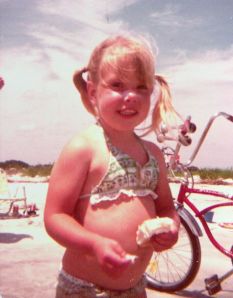
The author, Andrea Badgley, 1977ish, on St. Simons Island, GA
What struck me most about the issue, aside from the fact that I was holding a piece of history, was that Rolling Stone was once young. Timothy Leary wrote to the nascent magazine in 1969, “Thank you for the beautiful thing you have done with Rolling Stone… Keep growing, it’s beautiful to watch you do it.” I’ve never known a time when Rolling Stone didn’t exist, and here, this issue of RS on its tenth birthday, was proof that it was once a child. That it was just a baby during the period portrayed by Mad Men. When I read Timothy Leary’s words of encouragement to the young magazine, it hit me that Rolling Stone, at one time, was an emerging journal, like the ones I might submit my writing to today.
I leafed through the Leibovitz spread, with shots we’ve seen a million times of Jerry Garcia lying on his back on a beach; Keith Richards passed out; OJ Simpson in his Buffalo Bills uniform; Salvador Dali ear to ear with Alice Cooper; Mick Jagger and Keith Richards, shirtless and stoned; Brian Wilson in a blue bathrobe, his surfboard under his arm. I thought, this all really happened, and these photos were fresh when this magazine came out.
Jerry Garcia, 1972, “Finally there was marijuana!” photo by Annie Leibovitz
OJ Simpson, 1977, Buffalo Bills uniform, photo by Annie Leibovitz
Linda Ronstadt in red underwear, 1976, photo by Annie Leibovitz
Annie Leibovitz commentary on Linda Ronstadt’s sixty-dollar underwear, 1977 Tenth Anniversary issue (#254) Rolling Stone magazine
Dolly Parton and Arnold Schwarzenegger, 1977?, photo by Annie Leibovitz
Brian Wilson in blue bath robe with surfboard. “Brian seems to be on acid all the time…” photo by Annie Leibovitz
Mick Jagger and Keith Richards, Alice Cooper and Salvador Dali, Rod Stewart and Britt Ekland, Ron Wood with Rod Stewart; 1977 Rolling Stone; photos by Annie Leibovitz
I loved reading commentary from Annie herself about “playing” with her subjects in order to get shots, like when she bought Linda Ronstadt $60 red underwear for a shoot and was scared about how Ronstadt might react, or when she shared her experiences of a subject, like that “Brian [Wilson] seems to be on acid all the time.” You don’t see those notes when one of her iconic photos is used in a nostalgia piece on Jerry Garcia, or you find her portrait of Dali and Alice Cooper on a poster in a head shop.
But my favorite part of the magazine, and not just because we’re watching Mad Men, was the advertising.
Sharp Eye tape player ad, Rolling Stone magazine, 1977
When radio played vinyl – Technics turntable ad, Rolling Stone magazine, 1977
Ad in Rolling Stone for Queen’s “News of the World” album, released October 1977
ad in 1977 Rolling Stone for David Bowie’s “Heroes” album, released 1977
Hobbit and Middle Earth ads in the back of 1977 Rolling Stone magazine
Ad for Discwasher, the “Superior” vinyl record cleaner, 1977 Rolling Stone magazine
There are a couple of cigarette ads (including Vantage and the Marlboro man), a few car ads (Volkswagen rabbit, Toyota Celica, Le Car from Renault), liquor ads (Seagrams 7, Two Finger Tequila, Southern Comfort, and Gordons Gin, complete with 51 gin cocktail recipes), and my favorites, full page pieces for albums that were new at the time, like “‘Boston 2.’ On Epic Records and Tapes,” David Bowie’s “Heroes,” and Queen’s “News of the World,” all new releases in 1977, when this copy of Rolling Stone went to press. The remainder of the issue is full of ads for turntables, cassette players, speakers, headphones, and reel to reel recorders. Even better than the merchandise, though, are the sales pitches, like this one: “Now you can have something in common with FM stations. This Technics turntable.” Because radio stations once played vinyl records. !. I also loved Sharp Eye’s line, “It ends the hit and miss method of finding songs on tape.” Remember those days? When we listened to cassettes and there was no easy way to advance to the next song?
And that final ad, the yellow page with the checklist? We had that record cleaner. I remember when I was young, a 1980s adolescent exploring the music of the 60s and 70s, I’d squirt a drop from that tiny red bottle onto my parents’ vinyl records (Mom had every Beatles album, Dad had all the Rolling Stones) and using the discwasher with the velvety pad and the wooden grip, I’d run with the grain of the records’ grooves, wiping “microdust” with each swipe. The vinyl would shine black when I was done. I’d pluck a dust ball off the turntable’s needle, place the record on the spindle, turn it up loud with the big silver knob, and lie back with my eyes closed, my hands behind my head, to listen to Pink Floyd, or Queen, or any one of the surprises contained inside those mysterious album covers.
On Mad Men, there’s scorn towards the advertising world from the counterculture who consider themselves enlightened, and superior, and anti-establishment. They look down their noses on consumerism and the shallow jingles that ad agencies churn out, favoring the high culture of theater or beat poetry. But I have to say, as I leafed through this Rolling Stone, the ads are what gave me a real glimpse into 1977. Unlike iconic photographs by Annie Leibovitz, or fiction by Hunter S. Thompson, advertising is fleeting. The ads were the details that showed what daily life was like for regular people – what they wore, how they combed their hair, what they were buying that year (discwashers!). Because they are ephemeral (and, we like to think, culturally unimportant), we forget about advertisements as they update to the newest product, the latest campaign. But more than anything else about the issue, when I saw those reel to reel recorders, and all those record players, it was the ads – those snapshots in time – that brought back memories. They are what dated the magazine. It was not only the letters from John and Yoko, or the timeless photographs of ’60s and ’70s rock and roll icons, but also the ads, penned by Mad Men era creative teams, with shallow one-liners and feathered hair, that revealed the culture of 1977.
I have officially run out of story ideas. A friend of mine has encouraged me to submit work to the Southern Women‘s Review, and as the deadline approaches, I find myself creatively crippled.
I am a Southern woman, born in the South, raised in the South, and after a few years in the not-South, we have settled down in my motherland and will raise our children in the South. Anything I write, then, is fair game for this journal: “Submissions should be from women who were born in or grew up in the U.S. South; currently live in the U.S. South; or write about the U.S. South.”
But that’s not enough for me, to be a born and bred Southerner and to currently live in the U.S. South. I feel like I should write about the South, about how I never felt like I fit in as a Southerner growing up (I didn’t like sweet tea, for one), but when I moved away and folks sincerely thought the South was like Deliverance, that if they stopped their cars in the southeast they’d risk violent rape by toothless bumpkins, I defended my home against their ignorance and developed a fierce pride for my region. Or I could write about how I didn’t understand the South for so many years of my young life – Southern pride, the clinging to Dixie flags, the continued obsession with the “War between the states” – and how Gone with the Wind (the book, not the movie) explained my heritage and helped me understand Southern culture better than any history class ever could. Or maybe I should write about my experiences as a Southern woman who explored other regions, who has lived in other parts of the country and loved them, but how it still feels like a homecoming to move back to Virginia, even though I’ve never lived here.
Or maybe, I could write about my childhood in the South. About my Grandaddy and Nannie’s farm in Eatonton, Georgia. Where we dug worms from the wet soil of the creek bank, in the shade, by the old mill on their farm, then threaded them, still squirming, on our hooks to catch yellow-bellies in Crooked Creek. Where a trip to the hardware store with Grandaddy, in his old silver Ford pick-up truck with a shiny black steering wheel knob and the shifter on the steering column, was the highlight of our visit when we’d stay a whole week. Where we dug potatoes, and planted carrots in neat rows, and shucked corn and snapped peas under the walnut tree by the tractor shed. Where in the morning I’d say, “Wait Grandaddy! I’m coming with you,” while I hurried to put on my Nannie’s boots to walk through the dewy grass, past the scuppernong vine, and the gourd birdhouses, and the peach orchard, to the compost pile behind the barn. Where Nannie had a plaque on the wall that said “The only way to kill time is to get busy and work it to death.” Nannie, who’d grin and say “Scat!” when we’d sneeze, or “Skin the cat,” when my brother would peel off his sweaty shirt from working in the stagnant middle-Georgia heat. Nannie who worked crossword puzzles, and made cornbread stuffing, and raised three kids while Grandaddy flew bombers in the wars.
Or my mind goes back to Grandma and Grandpa’s house on 6th Street, East Beach, St. Simons Island, Georgia. Grandma with her pretty pastel pillow mints in a crystal dish on the sideboard, with the $2 she left under our pillows when we’d visit, with bottles of Rolaids on every end table, between all the couch cushions, tucked in the cushions of each chartreuse chair, where nowadays someone’s cell phone would fall, and get lost, and be found when the chair suddenly vibrates under someone’s bottom, surprising them so that their eyebrows shoot up and their mouth forms an “O.” Grandma, who introduced me to A Clockwork Orange, her favorite vinyl record, with that strange and wonderful white cover, with a man in a bowler hat and one set of false eyelashes who smiled an enigmatic smile as he emerged, dagger in hand, from a black triangle. Grandma who taught me how to brush my teeth with my finger when I forgot my toothbrush, who had a rosebush by her front door, and who’d give me scissors and a vase when I asked if I could cut pink roses for her. Grandma, who said “You all” instead of “y’all” in her sophisticated, old money, soft Southern drawl.
And Grandpa in his seersucker suit, quiet, always smiling, who’d disappear to his room upstairs, full of light and warm salty air, with a clear view of the dunes, and the wide tan beach, and the distant sound of waves swishing over sand. Grandpa who had a podium up there, with the biggest dictionary you ever saw, and an old black and white TV with a rabbit ear antenna and a knob that you turned with a satisfying click to change the channel. And Grandpa’d come back down with a handheld wooden maze where you’d have to deliver the tiny silver bead from one end to a hole in the other. Or with a wooden puzzle cube that we’d pull apart and spend hours trying to put back together. Grandpa, a career diplomat, who earned his law degree after his three sons had grown up and moved away, who was scorned as a young man by Grandma’s parents (for being poor) until he started working for the State Department, when his now proud mother-in-law began submitting his and Grandma’s travels to the Atlanta Journal’s Society pages. Grandpa, who loved Heavenly Hash ice cream, who smiled and waved at us, the grandkids coloring quietly on the green shag carpet, during the evening hours when Grandma would settle in with her gin and milk to talk politics with her sons and their wives.
But those are just descriptors, right? Childhood memories of an aging Southern woman who has returned to the South. There’s no plot. There’s no story there. So here I sit, wondering what I will write.
I try to make sure [my students] understand that writing, and even getting good at it, and having books and stories and articles published, will not open the doors that most of them hope for. It will not make them well. It will not give them the feeling that the world has finally validated their parking tickets, that they have in fact finally arrived.
-Anne Lamott
My enthusiasm is about to reveal to you how green I am as a writer, and I’ll probably look back on this in a few months or years and groan in embarrassment. But for today – Holy Crap, y’all, I am now published! And the funny thing? I feel exactly like the world has validated my parking tickets. That I have in fact finally arrived.
Arrived at what, I’m not sure, but I am there, baby.
I’ve never submitted anything for publication before. I hear that if you want to write for real, you need to go ahead and grow a thick skin. Prepare to wallpaper your walls with rejection letters. Prepare to be told over and over again that you suck. Personally, I’m not really into that. I like gold stars and A pluses and for people to tell me how awesome I am, so I’ll just avoid the rejections and the character assassination and I will self-publish here on my blog, thank you.
But my friend, the one who rescued my About page, wouldn’t give it up. “Andrea, I really think you should submit something to this journal.” Six months later, “Andrea, have you submitted anything yet? Andrea, really. Just write something and send it in.”
So I did. My “Writer’s Block” essay, a piece about my Southern childhood, a piece born of deadline paralysis, was accepted and is on page 20 of the current issue of Southern Women’s Review (Volume 6). You can read it for both the paralyzing process and the product that emerged from it if you’re interested.
P.S. I really do know where I have arrived. I have arrived at myself as a writer. Working on this piece and submitting it has helped me recognize my love for writing, for both the process and the product. With its success, and my love for the craft, I think I finally know what this butterfly mind is made for.
P.P.S. I realize that I just ended a sentence with a preposition, and the irony of that error when writing about being a writer. I’m okay with that, but my friend probably isn’t.








 Butterfly Mind