I, of course, immediately took a field trip to Blacksburg Books and ordered Attenberg’s book. And subscribed to her Craft Talk newsletter.
After hearing the episode last month, I toyed with the idea of joining the community to write 1000 words a day for two weeks on something besides my rambly what’s-in-my-head journaling. In morning writes, I’ve listed topics to explore. While I wondered when this year’s #1000wordsofsummer event might start, I considered what project I might work on for a two week, 14,000 word commitment.
I learned a lot about my writing self in the process, namely that I recoil from planned writing work. That’s what it feels like when it’s planned: work. Right now, what attracts me to writing is spontaneity, and being in the moment. As soon as a topic becomes planned, I lose interest. Right now, I want to play. I don’t want to work.
One of my favorite writing prompts is the Here and Now* exercise. I frequently do this exercise when I want to write but don’t have anything in mind to write about. I love it because it makes me pay attention, right here, right now. It engages my senses and makes me realize how much I don’t know, like what kind of trees those are across the street, the ones I see every dang day of my life, or the name of the little hat a pendulum (pendant) light wears (it’s a shade, just like a lamp), or whether those metal ceilings with stamped patterns in them have a name (pressed tin ceiling).
I’d considered focusing on a particular topic for 1000wordsofsummer — I found one I thought I was excited about — but as it became more clear that it would feel like work instead of fun, Jami announced the dates of this year’s event: May 31 – June 13. The entire time I’ll be on vacation in Europe.
There’s no way I’m doing a project that feels like work while I’m there. But can I sit in a café, on a train, in a garden, on a museum bench, and write 1000 words on the here and now? Hell yeah I can. And I can’t wait to do it.
*There are many variations on this prompt. Here and Now is what Priscilla Long calls it in The Writer’s Portable Mentor. In Old Friend from Far Away, Natalie Goldberg uses “I’m looking at,” which can be expanded to “I’m listening to, I feel, I smell…”
It’s a good thing I’m rejecting perfectionism in this 10-minutes-per-day drawing habit thing I’m doing, because the quality of my drawings took a pretty deep plunge in the third week. Enough so that I’m embarrassed to even share them here. But the theme of the week was to be silly and have fun, and to definitely not take myself too seriously or feel like the drawings had to actually be good.
The challenges included drawing with your eyes closed, with your non-dominant hand, and upside down. They also included only drawing negative space, exploring shading by drawing an alien in sunlight, and drawing a subject three ways with your body: once using just your fingers (no wrist or elbow motion allowed), once with just your wrist, and once with just your shoulder, holding your arm out straight and moving only at the shoulder joint. I drew a blood orange.
And it was fun, and silly, and I didn’t take it seriously. In fact, it loosened me up enough to try using a paintbrush with my inks to add a little color. I hadn’t been brave enough to do that before. In the spirit of bravery and posting embarrassing stuff on the internet, here are my silly drawings from the third week of my 30 days of 10 minutes a day.
eyes closed and left-handeddrawing upside downthe space around my ivyfinger, wrist, and shoulder blood orangealien in the sun
One of the exercises in the first week of The Artist’s Way is to consider other life paths. If you could, just for fun, imagine five other lives you’d like to lead, what would they be?
Since I’m doing this with a group of friends, I wanted to know what everyone else would pick. I learned about them through their answers. These imaginary lives say a lot about our inner worlds, our joys, our hopes and dreams. I liked the exercise so much, and what I learned about each person, I asked another group of friends the question as well. One joked, “Is this the new Myers Briggs?”
The lives I initially blurted onto the page were novelist, photographer, philosopher, psychology researcher, and literature professor.
After I saw others’ lists, which included lives like seamstress, horse trainer, mechanic, campground owner, and musician, I realized how mind-based my list is – other than photography, there’s nothing material or interactive with the outside world. I stared into space as I considered this, my eyes resting on my garden. When I realized what I was looking at, I thought, duh. Horticulturist. I scratched out philosopher and replaced it. Then I thought of several Instagram accounts I delight in that involve arranging flowers in various ways (art, color, fashion, photography). One of my favorite books is The Language of Flowers. I scratched out psychology researcher and replaced it with flower arranger.
My revised list became novelist, photographer, horticulturist, flower arranger, and literature professor. That feels better.
As Julia Cameron reminds us in The Artist’s Way, the point of these lives is to have fun — potentially more fun than you’re having in the life you’re living now. Then came a part I wasn’t expecting: to pick one and do it for a week. This doesn’t mean change careers. It means that if I think being a photographer would be fun, then go take some photos. If I think being a novelist would be fun, then play with fiction. If I think flower arranging would be fun, then go to a florist, pick out some flowers, and arrange them. The point is to do the thing you think would be fun about that life. Do it now, from wherever you are, with whatever expertise you do or do not have.
One of the podcasts I listened to on my recent drive to Georgia was the TED Radio Hour episode called The Source of Creativity. In it, host Guy Raz shares excerpts and interviews from four different TED talks about creativity: one from Sting about overcoming writer’s block, one about what happens inside the brain during creative output, one about creativity in schools, and one from Elizabeth Gilbert about tapping into creativity.
What struck me about all four talks was the common element: we get in our own way when it comes to creativity. Ego, fear, and self-sabotage are the greatest obstacles for many creatives. Every speaker talked about having to shut down the critic or ignore it (and likewise the fear) in order to release creativity. The segment about the brain on creativity backed this up: during times of high creative output, the part of the brain associated with conscious self-monitoring shuts down.
In other words, when an artist is in the zone, successfully creating, the brain has zipped the inner critic’s lips.
What the episode didn’t offer was a sure-fire way to make the brain silence the inner critic, to put the ego in the corner, to banish the fear. For Sting the answer was going back to the childhood town he had so desperately wanted to escape. For the segment about creativity in schools, the answer is encouraging creativity instead of suppressing it. For Elizabeth Gilbert, the answer is diligence in practice, sitting down with your creative work even if you’re not feeling it, so that you’re ready when inspiration strikes.
I’m not sure what the answer for me will be. It’s not easy to suppress the inner critic, especially if you’re polite and allow it to talk to you. I have found, though, that committing to blog every day has given me less time to listen to it. I’m on a deadline every day to write, and that puts me in a different mindset. Pressing Publish has become more important to me than wringing my hands about the doubts my inner critic whispers in my ear.
Everything that gave her pleasure was small and depressed him.
– “Everything That Rises Must Converge,” Flannery O’Connor
When I first read that quote, it made me laugh. Then, it puzzled me. It made me question myself*, because most things that give me pleasure are small: a flaky pastry, a smooth cup of coffee, the smell of dew on a cool summer morning.
And these:
On the rare occasion that I’ve played an online game that awards badges, I didn’t care a whit about the little digital trophies. But on my blog? I get a jolt of glee every time one pops up on my phone. They totally motivate me.
I’ve been thinking a lot about drive lately, and in fact am reading the bookDrive: The Surprising Truth About What Motivates Uson the recommendation of a friend and colleague. I would classify myself as an intrinsically driven person. I often get so wrapped up in creating, whether writing, blogging, photographing, or working on my reading project, that I have to actively pull myself out of my own head and pay attention to my family and life.
Nobody is giving me anything for my writing, blogging, or photographs. I do them because I can’t not do them. I identified immediately with this statement the author makes in the early pages of Drive:
Enjoyment-based intrinsic motivation, namely how creative a person feels when working on [a] project, is the strongest and most pervasive driver.
At the same time, at work we’ve been discussing intrinsic vs. external motivation, and what it means to want external validation for a job well done. I find this discussion fascinating because of this key question: does a desire for external recognition indicate that a person is not sufficiently driven internally?
It seems paradoxical that someone who is driven from the inside would need recognition from the outside, but I am a walking example that it’s possible to enjoy both. My husband teases me about my love of praise. What can I say? I respond to positive re-enforcement.
Like “You’re on a streak!” trophies.
Internal drive and external appreciation do not have to be either/or, and they are not at odds with each other. Instead they work together to create a positive feedback loop. Even if it’s a simple digital badge. When I see that streak badge, I’m like, “Hell yeah! I’m kicking ass!” and I am inspired to keep posting.
*And that man in the Flannery O’Connor quote who was depressed by his mother’s small pleasures? I realized after finishing the story that he was the questionable one.
Note: on publication of this I will be on a 14 day streak. YEAHHH!
There’s a Dar Williams song, “Mark Rothko Song,” that affects me. I have listened to it over and over again over the past ten years, and though I never knew who or what it was about there is something about this song that makes my heart shift every time I hear it, that makes me feel something: something warm and also like deep blue currents, something both smiling and melancholy, something incandescent like flashes of sunlight on the surface of dark fathomless water. Something I can’t contain with words.
Despite my love for the song, I only cared about how the song made me feel, and I never bothered to research Mark Rothko. Then, last year, quite by accident, I came face to face with his work. In season two of Mad Men, on the wall of Bert Cooper’s office, was a Rothko. I saw his work for the first time, and my heart shifted. When I saw the painting I felt the same feelings I feel when I listen to “Mark Rothko Song” and I thought, “Ahhh, now I see,” and I understood, for the first time in my life, abstract art.
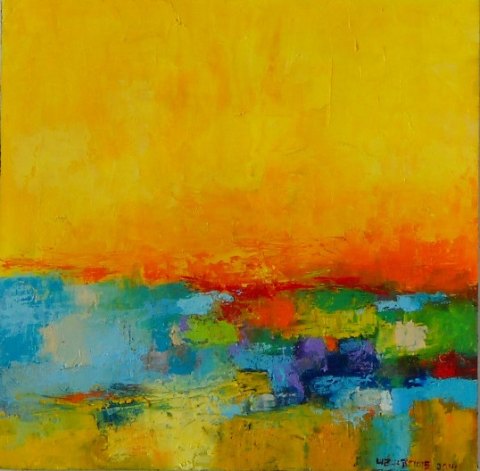
Many people make the same claim when they see a Rothko or a Jackson Pollack: they snort and say, “I could have done that!” But the thing is, they didn’t. And I would argue that they couldn’t. Sure we can all draw rectangles, maybe even color them in, but I know I can’t mix those paints: that saturated sunshine yellow, the white like shimmering silk, that vermillion red as rich as blood. I can’t scrape a pallet knife to create dimension, I can’t achieve proportions and balance, I can’t intuit where to place the white blocks, the orange blocks, the turquoise blocks, evoke tension with shape, movement with spatters or brush strokes or angles; I would not be able to stop when it was time to stop, to restrain myself from muddying the colors.
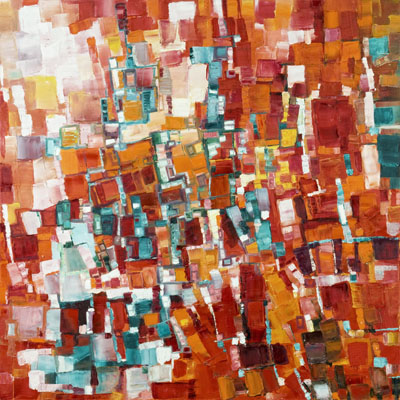
Art Credit: Kymm Swank, Structure 2 (Swank’s work appears in the Draper apartment, season 5 of Mad Men)
I was walking with my friend last week and I told her, “We finally got curtain rods and throw pillows for our living room.” We panted and pumped our arms. “All we need now is art,” I said.
The new spring heat was getting to us, and she perked up. She’s a photographer and likes talking art. “Oooh, what kind of art are you looking for?” she asked.
Art Credit: Mark Rothko No.5/No.22
My heart thumped as I thought about the Rothkos I binged on, the Rothkos I browse on a weekly basis since seeing his painting on Mad Men. His yellows like sunlight blazing on the wall, the electric reds, the horizontal blocks that make me feel stable, that make me feel like the ground is solid beneath me, unlike vertical compositions I’ve seen that make me feel like I’m sliding off the edge of the world.
“Well,” I said, “I really want something abstract.”
She cocked her head at me. “Go on,” she said.
“We get bored with things,” I told her. “We’ll buy a print we like and a year later we’re over it.” I thought of the wooden boats from Maine, the fat fruit from Naples. “A picture of an object will always be that object, you know?”
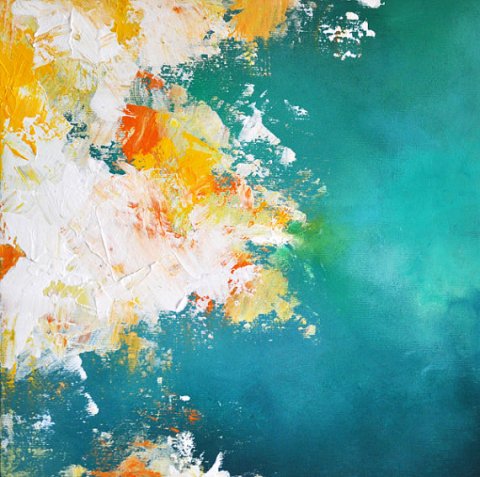
Art Credit: Autumn textures by AbstractArtM on Etsy
In a writing craft piece for The Daily Post, Let the Reader’s Imagination Do the Heavy Lifting, Krista Stevens advises the writer to hold back, to leave things open to the reader for interpretation. To let the reader create his or her own experience. The evening I read her piece, we watched an episode of Mad Men and I started noticing the art on the walls in Don’s office, in Peggy’s office, in the meeting room at Sterling, Cooper, Draper, Pryce. I thought about art in the terms Krista had written about, and how abstract art leaves interpretation to the viewer. Whereas a painting of an object puts you in a box — a boat is always a boat, a tree is always a tree — with abstract art there is no box. Concrete art is relatively closed, it is mostly interpreted for you by showing you exactly what it is (a pear, a flower), while abstract art refrains from explaining itself to you or telling you what to think. Abstract art encourages you to create your own experience.
Art credit: Butternut by Michal Shapiro (appears in first three seasons of Mad Men)
The creators of Mad Men are smart. Don Draper and the creatives display all the behaviors of successful creative types: they free associate, they alter their consciousness, they think, they stare into space, out the window, at a real life dramatic scene. They nap. A lot. And they hang abstract art on their walls.
Peggy in Don’s office with Butternut by Michal Shapiro
Throughout the offices of Sterling, Cooper, Draper, and Pryce are pieces of art that box nobody in – pieces of art that, in Krista Stevens’s words, allow the viewer’s imagination to do the heavy lifting. On the walls of every creative is art that suggests, evokes, moves, art that nails nothing and nobody down, art that can be anything to anyone. Art I want to look at more because it makes me feel something, because it affects me, because my mind opens both into it and outside of it.
This has been revelatory to me. A creation — whether a successful ad, a piece of writing, or a piece of art — does not have to be an end point, someone else’s rendering of a thing that already is. A rendering that says “This is a boat. It was a boat yesterday, and it is a boat today, and it will be a boat tomorrow and for all of eternity.” An artist’s creation can instead be a jumping off point, a piece of work that walks the viewer into his or her own story.
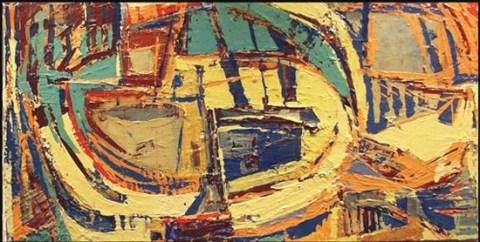
Art Credit: Abstract Painting by ARSartshop on Etsy
I want this type of art for our home. I want a piece of art that doesn’t box us in, that doesn’t tell us what it is, that we can interpret however we like. I want art that makes me feel something; I want art that affects me. I want a painting that can be a city scape today, a forest tomorrow, contemplation yesterday, passion next week. That right now is warmth, just a second ago was chaos, and in five minutes is a tunnel into the best idea my creative self ever had.






 Butterfly Mind