My husband and I decided to pare back in 2026. Belongings can begin to feel burdensome after a while. They need to be maintained. They need to be dusted. They need to be moved out of the way when so many have accumulated that they pile up. The more you have, the more space you need to store them all in.
Last weekend, after both kids drove away to go back to college, we systematically went through the house to decide: pitch, keep, or store for a later decision? We started with our clothes. I made hard decisions to throw out clothes that were worn so hard they were threadbare. I made easy decisions to throw out clothes I’ve worn once or twice in the past year. We filled two or three garbage bags, some for donation, some for the dump.
Then we moved to linens. We had blankets and sheets, pillows and towels stored in multiple closets around the house. We dumped them all on the bedroom floor and sorted. We filled half a dozen more garbage bags.
We pulled all of our kitchen stuff out, which was also scattered around the house because our kitchen is small and we store infrequently used equipment downstairs. We went through the junk drawers and our hobby supplies. We filled bins for donation.
I wondered, on many occasions, why do we have this set up this way? The stick blender’s motor housing was in a drawer, while the cup and the blender arm were in a cupboard. The firewood is across the room from the fireplace instead of next to it.
We’ve cleared space, and our house feels like it’s breathing clean air. Like the corners have been scrubbed and sparkle. When I reach in the cupboard for a coffee cup, I can pull one out without without worrying about toppling a stack.
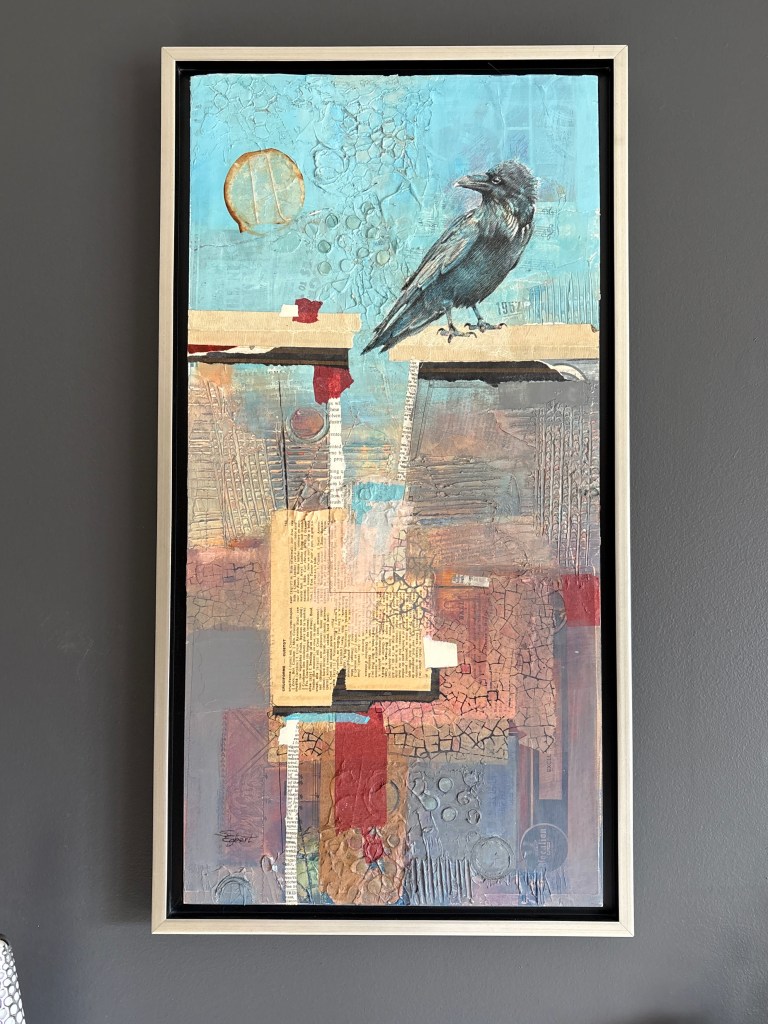
We moved art around, including a painting Santa brought me this year that Brian and the kids consulted him on. We moved a painting into the living room that had looked flat on its previous wall but has come to life in the changing light of its new place. We moved furniture around so that the dining room no longer encroaches on the living room.
I thought this paring back would take months, and I was not looking forward to it. But last weekend, we agreed that if we could get through the decluttering, then this weekend we could go shopping to refresh our living spaces. I am eager to replace the raggedy old towels we threw out. I have been dreaming of new furniture for our living room for a long time, of comfy places for more than one person to be able to lie down and read at the same time. When we agreed we could shop this weekend if we got through the decluttering last weekend, I was very motivated.
Now the work week is almost done. We’re going to a cello recital tonight, and then tomorrow, we shop! I cannot wait to put a love seat by the fireplace, move the bookshelves to open up the corners, and bring the firewood to its rightful place by the hearth.
One of my favorite things about winter, besides fires in the fireplace, is going into the sauna to dry off after my morning swim. Sometimes, that’s the reward that gets me out of bed at 5am, when it’s frigid out, to put on a swimsuit and go jump in a cold pool.
This morning, after my swim, I pulled the smooth wooden handle of the sauna door and, as it always does, warm air billowed out as I stepped in. The scent of the wood gets me every time. Every time. It’s warm and spicy as if it’s been baking in the sun. When I step in, everything falls away, and I just stand there and inhale, deeply, smelling the wood that grew in the earth and sun and rain, that scrubbed the air, that made its own food, that stood tall and reached for the sky while making shade and shelter for forest creatures, before I start moving again to towel off. The sauna is cozy, planked entirely with cedar boards — under my feet, above my head, walls, benches — like I’m in a toasty cabin while winter rages outside.
As I breathed the spiced air, as I felt the warmth seep into my skin, as I steeped in the visual pleasure of the wood boards and the cozy warm light, I remembered that wanted to set an intention this year to pay attention to my senses. I want to deepen my experience of being alive.
I promise I’ll stop writing about Zadie Smith soon. It’s just that I’m making my way through her book of essays right now, Dead and Alive, and with nearly every one I read, I fall more in love with her. Whenever I see prompts or ice-breakers like, “If you could hang out with any one famous person, dead or alive, who would it be?”, every person I think of I’m like, but do I really feel connected to that person? What would spending time with them actually be like? Would we have anything to say to each other?
After reading this book, I think it’d be Zadie Smith, even though I’d be super intimidated and fangirly and wouldn’t know what to talk about, and I’d make it all weird and awkward because I’m not her equal. But if I could manage to be cool — maybe we could listen to hip-hop or go dancing to break the ice and then talk — I think she would be super fun to hang out with.
She adores fiction. She adores reading it. She adores writing it. She adores “the way it lies to tell the truth.” And she believes in its ability to truly immerse us in different points of view in a way that social media and the absolute glut of online news sources do not:
[The internet] seems to be a place of diverse views but the deeper truth is it’s all taking place on the identical platforms with identical aesthetics and in the end an identical motive: profit. It’s such a narrow version of ’the real’. I just have to open Mieko Kawakami or Thackeray or Dostoevsky or Bambara and I’m in a completely alternative perspective, unsponsored, uncontrolled, unmediated by anything apart from language. It’s not an important vision of reality because two million people upvoted it. It’s important because I am communing with it and being transformed by it.
I want to read all of these people! Previous to this paragraph, she had referenced several other writers and philosophers I’ve never read in response to a question about her sharp, fresh, and natural style. All I could think was, “Where does she find the time?!”
When I got older and read philosphers like Wittgenstein and Russell and Fanon — or the essays of Virginia Woolf — it occurred to me that there are few thoughts so complex that they can’t be expressed in clear, accessible prose. It’s a discipline.
She makes me want to quit my job and spend all my time reading. I know this is not possible. So the alternative is to keep myself healthy and live a very long life, if for no other reason than to be able to read as much as possible before I die.
What an incredible year for books. Time is my biggest challenge to getting to everything I want to read. A three month sabbatical in 2025 made this glaringly obvious. Not only did I read more books in 2025 than I’ve ever read in a year (73), but I also read great books. And I mean great in multiple senses: with a capital G as in Greats of literature, great in that I loved them, and great in that my reading life was much richer for reading them.
I read a lot of beautiful writing in 2025, along with classics that are referenced so much they are part of our cultural DNA. I got hooked on the Zero to Well Read podcast, which has also enriched my reading life, and I revisited some old favorites, like A Prayer for Owen Meany and The Shipping News, which I wonder if I will ever tire of.
Our son is an English major, and I love to see his excitement when he gets deep into a work and really thinks about it. I often speed through a book and then move onto the next one without any reflection. In 2026, I’m interested in thinking more about what I read. I’m not sure what that looks like yet. Maybe writing notes after I finish. Maybe getting physical copies to mark up. I’m excited to join a local book club starting in January, so that’ll be a great way to engage more with what I read.
Some of the greatest influences in my life come from the pages of books. Settings send me on real life travels. Characters inspire or give me permission or make me laugh. Writers motivate me and send me back to my notebook.
I finished Annie Proulx’s The Shipping News again this week. I don’t know how many times I’ve read this. I’ve blogged about it multiple times. This time was just as good as all the others. Like any good book, I got something different out of it than in other readings. My first read, I was probably struck by the setting. I’d never read anything set in Newfoundland. I loved how immersive it was, both the landscape and the descriptions of the characters.
On the horizon icebergs like white prisons. The immense blue fabric of the sea, rumpled and creased.
Weather coming on. I see the spiders is lively all day and my knees is full of crackles.
Other readings, I’m sure the sense of place brought me back to the book — it’s a great winter read — but once I was in it, I appreciated the evocative language in one read.
Jack had things on his mind and talked like a rivet gun.
The humor in another.
“You’re a rotten, bitey shit!” bawled Sunshine.
The wisdom in another.
Of course you can do the job. We face up to awful things because we can’t go around them, or forget them.
In this read, what struck me was the main character, Quoyle’s, transformation. His whole life, he was unloved and outcast, a hulking freak. But didn’t want to be.
For Quoyle was a failure at loneliness, yearned to be gregarious, to know his company was a pleasure to others.
When he went north after his demon lover’s death, north to Newfoundland where his terrible ancestors were from, he found his talents. He found community who did not judge him. He found felt a sense of rightness. He found his place in the world.
Thirty-six years old and this was the first time anybody had ever said he’d done it right.
My husband and I are entering a new stage of our lives as both kids move through college. They will start their own adult lives soon, and Brian and I are thinking where we might want to end up one day. Blacksburg was an amazing place to raise our family, but neither of us feel that sense of rightness here.
On a team call once, the icebreaker was “If you could live anywhere in the world, where would you live?” One person looked confused and said, “Uh, where I live now. I can live anywhere in the world, so I moved to where I want to live.”
This was revelatory to me. Lately I’ve hung out with several people who feel this way about their home region. They’re proud of where they live. They have roots and community and that sense of rightness. And for the first time in however many readings of The Shipping News, I see this for Quoyle, too, and I love it for him.
Quoyle experienced moments in all colors, uttered brilliancies, paid attention to the rich sound of waves counting stones, he laughed and wept, noticed sunsets, heard music in rain…
I’m thinking differently now about where I might want to go next. I want it to feel like home.
The first time I went to Spain was 22 years ago. It was July and sweltering, and I was pregnant with our son. We went to Barcelona with a friend who grew up there. We stayed with his Dad. We ate late-night gazpacho and fresh sardines from La Rambla on his terrace. Visiting a friend who was from Barcelona, who shared with us his favorite childhood pastries and his everyday meals and who welcomed us into his home, was one of the most magical travel experiences we’ve had.
Last week, I got to experience something similar, this time in cities I never knew I wanted to visit. My team at work traveled to Spain to meet up with a colleague who lives north of Madrid, and who couldn’t get away to travel. We had originally planned to meet up in Madrid, and he said, You should go to Segovia instead. It’s smaller and cheaper but has everything you want. Plus there’s an aqueduct! I can take you to good restaurants there. And you can come visit my city on your activity day and I’ll show you around!
So we went to Segovia. And his home town of Aranda de Duero. This time we were bundled up, and there were Christmas lights, and I drank all the Spanish wine my heart desired.
Segovia Aqueduct
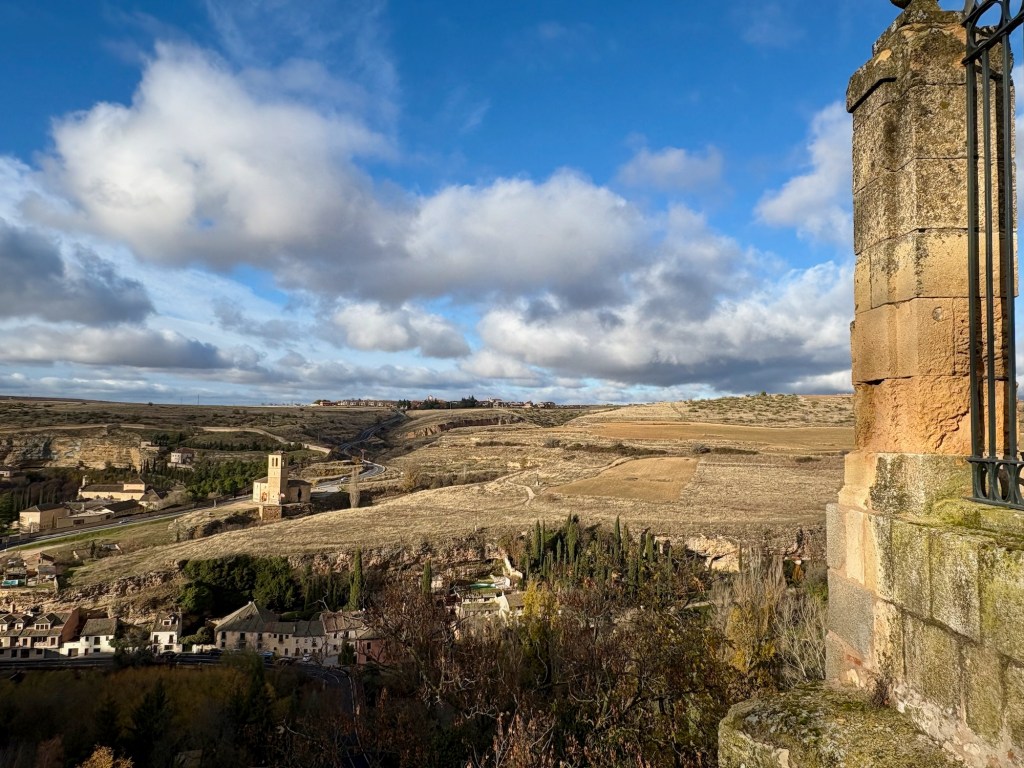
From the airbnb where we worked, we walked a block to get to the aqueduct, then we followed the aqueduct for 5 minutes or so to the heart of the city. On our first day, after working for a few hours, we took a stroll around Segovia under a crisp November sky. The ochre colors and earthy textures of the buildings and the landscape soothed my soul. I really loved it there.
Architectural textures in SegoviaI can’t get enough of the patterns and the earthy colorsLook at that light!Patterned exteriors of buildings. So many cool patterns.
As promised, Raúl took us to his home city of Aranda de Duero, the capital of the Ribera del Duero wine region, on our activity day. Raúl drove us from Segovia in his minivan, and as we approached the city, we saw miles and miles of browned grape vines propped in neat rows above the rocky soil.
Beneath the city of Aranda de Duero is a vast network of wine cellars, or bodegas, 10-13 meters under the ground. They are everywhere. Associations called peñas, which seemed similar to Elks lodges in the US, have their own bodegas where they meet, hang out, celebrate. We visited three. The first was an underground escape room, Ribiértete, which we managed to escape after copious wine. I won’t tell you any more in case you ever decide to go.
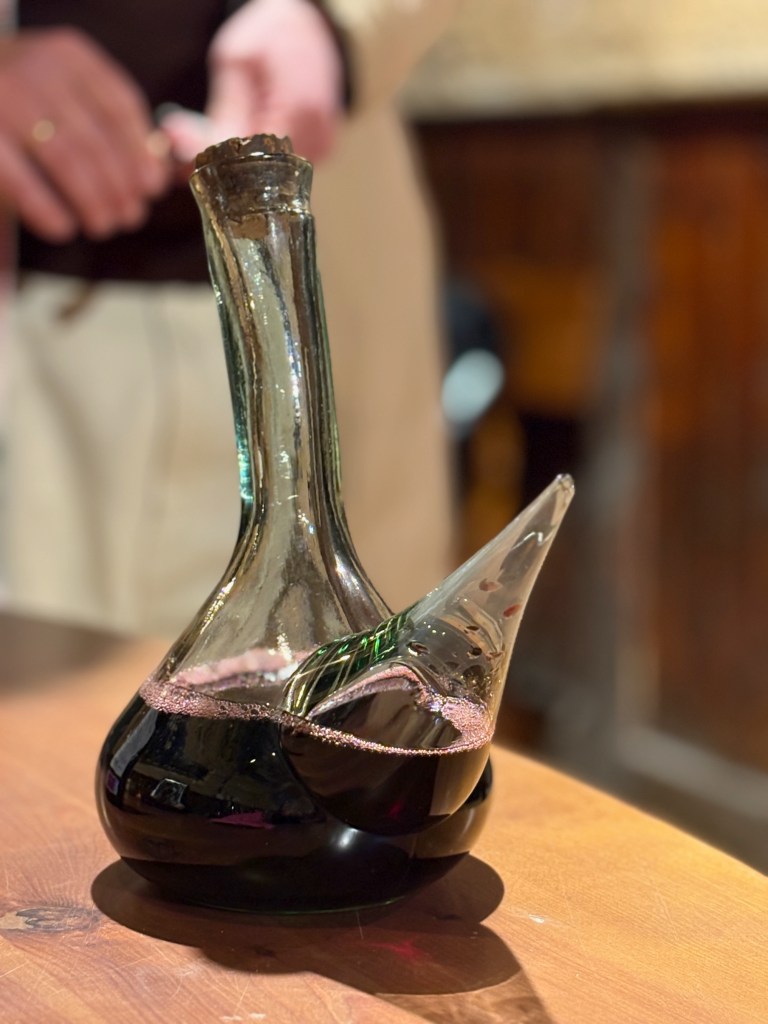
Our escape room host, Sonia, and a porron, which folks drink from in bodegas.
The second belonged to a friend of Raúl’s who was kind enough to show us around his bodega. He swiped a key card across the panel of a large wooden door, and it opened into a stone staircase underground.
Raúl had stuffed our pockets with bottles of wine from his own house, and I carried his porron in my backpack. Once we were underground and his friend had shown us around his bodega, Raúl pulled out a bottle, filled a porron, and he and his friend demonstrated how to drink out of it. You pour the wine in an arc into your mouth without touching the spout. It is not as easy as it would seem to do this without pouring wine in your nose or dribbling it all over your clothes. Luckily I wore black. I asked why this way? As soon as I said it, I realized, ahh! When done correctly, nobody’s mouth touches the porron. This makes for easy cleanup: no wine glasses to wash.
It took a lot of practice to get the technique right, but after 3 or 4 bottles throughout the day, we all mostly got there in the end.
After the escape room and the Bodega la Navarra, we went in search of tapas. Raúl’s favorite place was packed, so we walked around the block to another, where we got tortilla de patatas, the Spanish omelette with potatoes that I can’t get enough of, and some sort of small salty fish. I don’t know what it was but it was delicious. Probably anchovies. We were six people, and there was enough for each of us to have one or two bites of each, and then we headed back to the first tapas place to see if any people had cleared out.
We managed to find a standing table and ordered a larger assortment of tapas. The one I still dream about was a toast with warm goat cheese and caramelized onions. Oh my god. It was one of the best things I’ve ever eaten. There was something else with small pickles sandwiching anchovies and an olive on a toothpick. Google tells me that tapas that are skewered like this are called pintxos, and this particular one was possibly a Gilda. They are described online as “piquant”. I agree. It was briny and vinegary and crunchy and delicious. And everywhere had olives de anchoa (anchovies). I couldn’t get enough of these either. Raúl took us to his favorite olive shop at the end of our day and I bought a giant can to bring home.
After tapas, as we walked along the streets of the town’s center, Raúl pointed out doors everywhere — “That goes to a bodega. And that one. That one, too, and that one.” As he neared his peña’s bodega, he pointed across the square, “That’s my wife’s association.” He waved his card over the door, and we descended another set of stone stairs.
Raúl’s porron
We filled the porron and carried it with us as Raúl took us on a tour of his association’s bodega. One room was full of pictures of the members of the peña, lined up like in class photos at school, different events they’d hosted, and big life events, like new babies. I kept saying, “I can’t believe this is your life Raúl.” It was one of the neatest things I’ve ever experienced.
1503 map of Aranda de Duero, which is Spain’s oldest city plan and map in perspective. It is everywhere around the city, including on the label of the first bottle of wine we drank while there, the Tierra Aranda Tempranillo
I never knew I wanted to go to Segovia or Aranda de Duero, and now that I’ve been, I’m so grateful I got the chance. It would not have been the same without our friend and coworker as a guide. It was magical. Thank you, Raúl!