I have beaten eggs to stiff peaks two days in a row now. I feel like a pro.
I made ladyfingers yesterday, which require beating egg whites to stiff peaks. I did this at 7am. I needed to leave them out in the air to get stale, and I spent most of the day hoping the cats weren’t batting the cookies I labored over off the kitchen counter. At some point I realized I could put the completed ladyfingers in the oven to protect them from the cats, and I thought I was so clever. Then I realized someone might decide to bake something without knowing there were cookies in there getting stale, so I put signs up all over the range “Do Not Turn The Oven On.” I really didn’t want my cookies to burn up in there by accident.
Don’t worry, me mentioning the oven isn’t like Checkov’s gun. Nobody turned the oven on, and my cookies didn’t burn up in there by accident. They made it through the day and night safely.
Today – our daughter’s 17th birthday and therefore tiramisù day — I made my normal Saturday morning trip to the grocery store. I got through my list within 20 minutes or so, then spent at least another 25 minutes pushing my cart through every section of the store that might have mascarpone. That’s the ingredient of the tiramisù filling, and without it, there would be no tiramisù. About 20 minutes into my search, and my fourth round through the deli/bakery section where the mascarpone should have been, I finally found its empty slot in a case: BelGioioso Mascarpone. I had sad visions of spending my Saturday desperately driving to every grocery store in a 20 mile radius trying to find this ingredient. This search would mess up all my plans for the day: watch the Morocco v Portugal World Cup match at 10am, eat lunch and make tiramisù at noon, and watch the France v England match at 2pm.
In a last ditch effort, I pushed my cart over to the deli counter and asked in my very nicest voice, “Is there any chance you might have any more mascarpone that hasn’t been put out in the case yet?”
“Oh yes, we do. I’ll go get it. Mascarpone is really popular this time of year.”
And they came out with a whole case of it! I can’t tell you how relieved I was. I bought the four tubs (four!) I needed for the recipe I was making and raced back home to put all the groceries away.
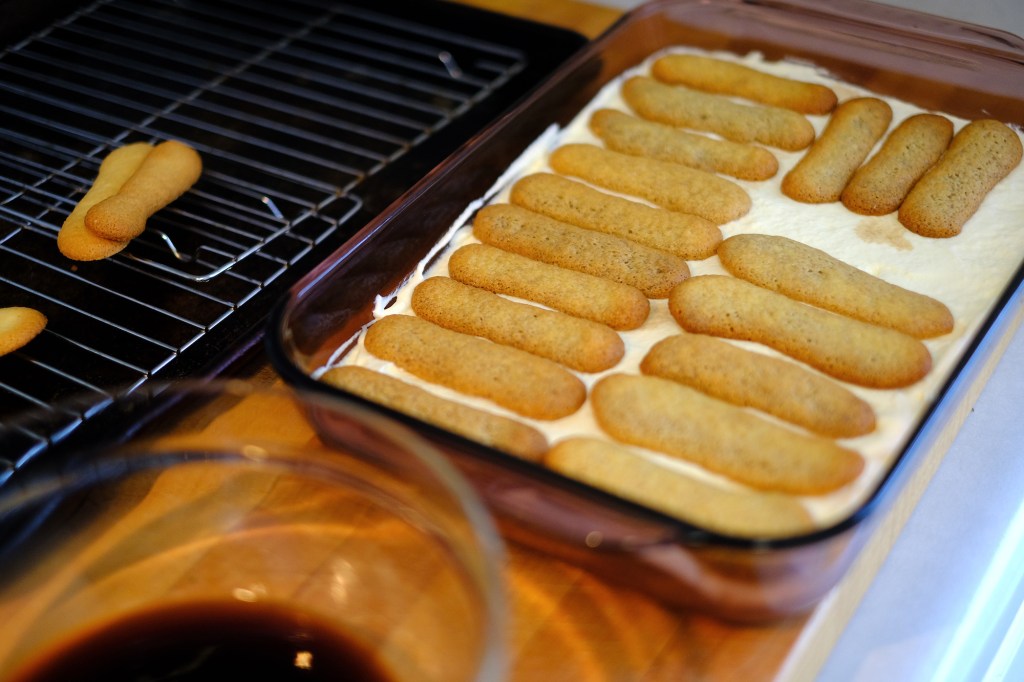
As planned, I made the tiramisù between World Cup matches. I’m pretty sure it’s going to be amazing. The mascarpone cream is the exact tiramisù flavor I was hoping for, and when I submerged the stale ladyfingers in the double strength coffee I’d made earlier in the morning, they released bubbles as they soaked the dark liquid into their airy pockets. They’re going to be such a beautiful dark-coffee contrast to the sweet cream filling. After I assembled the tiramisù, I dipped an extra ladyfinger in the coffee and then into some of the leftover mascarpone cream, and it was divine.
Now the whole thing is waiting in the fridge for after dinner, melding all of its delicious flavors. I can’t wait to eat it.
Unlike the praline catastrophe, where I was able to save the candy, my attempt at a campfire blueberry crisp was a spectacular failure from which there was no recovery. Two weeks and a dozen rounds of soaking, scraping, and scrubbing later, there is still blackened blueberry cemented to the bottom of our cast iron Dutch oven.
After years of camping together, my husband and I are sick of the same old outdoor meals we always make – mac n cheese, chili, hot dogs, s’mores – so on our most recent trip, we thought we’d branch out and try to cook a new dessert, not on a stick, over the campfire. Most of our cookware at home is cast iron, which is ideal for campfire cooking, so I went crazy online researching Dutch oven recipes, looking at pictures of coals piled on cast iron lids, and generally feeling excited and adventuresome. In my zeal, I neglected to dig deep and learn, step by step, how to cook over an open fire with a Dutch oven. It wasn’t until we started our campfire that I began to realize all of the things I didn’t know.
Mistake #1: Underprepare for firebuilding
Our trouble began at the beginning, with the campfire itself. Dutch oven cooking assumes you can build a decent campfire. We don’t generally build campfires that need time to mature, as we usually just need enough heat to toast a marshmallow or brown a hot dog on a stick, so we didn’t take the fire seriously. In other words, I forgot to pack any fat lighter. My husband spent at least an hour with his face in smoke, blowing on tiny twigs, dried leaves, and other campsite kindling trying to build a fire up.
Mistake #2: Use expensive ingredients on your first attempt
Since it was going to be our first time cooking with coals, I thought I’d be smart and minimize our variables. Rather than trying a new recipe and a new method of cooking, I went with at least one known quantity – our son’s favorite blueberry crisp. We picked fresh blueberries the week before our trip, so as soon as we got them home, I measured out five cups of fresh blueberries (5 cups!) for the crisp and poured them into a gallon freezer bag with sugar and flour so that all I’d have to do was pour them into the Dutch oven at the campsite. Our daughter and I prepared the crumble topping ahead of time as well, and at camp, I sprinkled the brown sugar and oat mixture over the blueberries.
Pre-prepped ingredients for campfire blueberry crisp
Assembled blueberry crisp in cast iron Dutch oven for campfire dessert
Mistake #3: Neglect to research how to work with coals
As my husband worked with getting the fire to catch, I fretted over the gaps in my knowledge. I had never worked with charcoal briquettes on a campfire, and my husband is the one who works the charcoal grill at home. I wondered, assuming we ever get the fire going, how long do we need to let it burn before we put briquettes on? Where in the fire do I put them to heat them? If they actually catch and burn, where do we then put the oven – in the fire, next to the fire, on the grill grate? Do we set it directly on hot coals, or prop it on rocks since it doesn’t have feet? I had no answers to these questions, and no cell service to look them up.
Mistake #4: Underestimate the strength of your fire
By the time we finally got the fire going, it was late, and we didn’t feel like waiting for it to burn forever to build embers. When we decided to start coals for the crisp, we had little faith in our fire’s heat or its staying power. We reluctantly separated the wood pieces, assumed we were killing our hard-earned heat, and threw a bunch of charcoal briquettes on the small pile of embers.
Pile of charcoal briquettes on campfire
Mistake #5: Neglect to measure your Dutch oven
Before our trip, I emailed my uncle Joe, who has been cooking over a campfire with a Dutch oven for a long time now. I asked for general advice and any recipe recommendations, and his take-to-camp advice was this:
The most important thing is to put coals on top & bottom while cooking. Not knowing the size of your oven, here’s a guide from the World Championship book:
Dutch Oven size # Coals on top # Coals on bottom
8″ 6-8 4-6
10″ 8-10 6-8
12″ 10-12 8-10
14″ 12-16 10-12
16″ 16-18 12-16
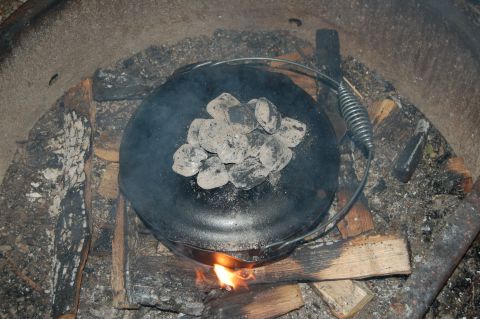
I assumed our oven was a 12″ and went with those numbers, for a total of 22 coals, plus a couple extras, just in case.
Dutch oven with campfire coals
(A week later, as I researched this post, I still am not sure what size our oven is – the base is 8″ in diameter, the top is 12″, and the lid has “10” stamped in it, which indicates a 10″ diameter. I’m thinking its a 10″ which means we used more than 5 extra briquettes. At 25 degrees per briquette, an interesting factoid which I also learned after burning the crisp, that means we added more than 125 degrees. Oops.)
Mistake #6: Disregard advice on number of coals to use
I followed Uncle Joe’s advice on placing the correct number of coals on top of the Dutch oven (for a 12″oven, which ours may or may not be), but since we did not have faith in our fire’s power, and I was not sure where exactly to put the oven, we blew off the 8-10 coals on bottom rule and just set the oven directly on the remains of the fire – charcoal briquettes (plus the extras), campfire embers, and all.
Mistake #7: Do not check progress
I am told that if you know your oven’s size and are using the correct number of coals, you can effectively create a 350 degree oven using your Dutch oven and charcoal briquettes. If you are doing it correctly, your recipe should cook for the same amount of time it would at 350 degrees at home. I know our crisp usually takes 30 – 35 minutes, so once we situated the oven and coals, I checked the time on the car clock, sat down at the picnic table, and waited. Since our fire seemed young and wimpy (see mistake #4), we feared lifting the lid and letting all the heat escape. Plus it seemed like such a pain to remove all those coals on top, especially since I had also forgotten tongs and we were using two wooden spoons to move hot coals around.
We really should have taken our chances and checked the crisp’s progress.
Because we underestimated our fire’s heat, overestimated our oven’s size (resulting in too many briquettes), and disregarded the instructions to place a certain number of coals under the oven, when we finally pulled the oven off the coals after 35 minutes and opened the lid, it looked like this:
Burned campfire blueberry crisp (note the ash on left)
I admit, I cried. Especially when I realized I hadn’t brushed off all the ash from the lid coals and I dumped a huge pile onto the crisp. Not that the crisp was edible, even before the ash, though believe me, I ate some. I downed a big smoky bowlful, even after everyone else took one bite and then asked for S’mores.
Which, thank God, I had the makings for.
Up next: Campfire pizza! Stay tuned for awesomeness…



 Butterfly Mind