The first step to getting things fixed is to know they are broken. This is true whether you work for a software company, are coaching a little league team, or write a blog. None of us is all-knowing, and we all make mistakes. I would venture to guess that most of us, if we have made a mistake, especially on a project that we care very much about, would like to fix it.
So thank you, thank you, thank you to those of you who have pointed out errors on my site. I can’t tell you how much I appreciate that my mistakes are not hanging out for all the world to see anymore. That would be embarrassing! What kind of mistakes do I mean? Here are a few of the more recent ones:
The Mesh gallery on my recent Making apple pie: a photo essay was broken. My dad reported it to me, as did several readers in the comments. As a result I was able to report feedback to the Mesh team, and they got it fixed up.
I misspelled “lobotomy” in every instance in my Half-full post. Thank you to my friend Dee, of birchnature.com, who texted me and said “Hi hon – love the new post! Heads up, though, it’s lobotomy, not labotomy.” Thank you, Dee ❤️
I entered some HTML into the visual editor instead of my text editor on a recent post, and the code appeared on the front end of my site. My coworker Kelly pinged me to let me know it was showing, and also make sure it wasn’t an error with the editor. No, I assured her, it was not the editor. It was a case of PEBCAK.
I know it can be hard to tell someone, hey, you’ve got a big chunk of black bean on your front tooth. But that’s the kind thing to do, right? Better to tell them and be embarrassed for five seconds than to let them walk around ALL DAY with gunk in their smile.
Posting a photograph last Friday of where I walk when I listen to my podcasts reminded me of a piece I wrote soon after our family moved to Blacksburg, Virginia. Nearly two years later, we still love it here; I think that means we have a chance at durable happiness. Please enjoy this post from the very early days of Butterfly Mind (October 18, 2012).
“RESEARCH OFFERS HOPE FOR THOSE SEEKING DURABLE BOOST IN HAPPINESS.” That’s the title of an article I clipped from the paper this summer. I don’t think I’ve ever clipped a newspaper article, but I saved this one. Because in this piece, I learned the secret of people who are able to sustain happiness after an exciting life change (being newly married, or, say, taking the perfect job): that, even beyond the initial excitement of their good news, rather than letting the novelty wear off and searching for something newer and better, these happy folks continue, on a daily basis, to appreciate the positive differences the change has made in their lives.
Kind of like how every time I drive out of our neighborhood and see Appalachians in front of me, I think, “Wow! I can’t believe we live here!”
I’ve been thinking a lot about this article since we made our move to Blacksburg because it tells our story – “When Jim Gubbins finally got the job he’d been working toward for 12 years, he was a very happy man.” Every day, my husband and I marvel at our good fortune, that all of our work actually paid off in they way we were hoping it would, and in a place so spectacular. But what really caught my attention, especially since, like my husband, this Gubbins character is a professor, is that after three years in his tenure-track position, Gubbins is even happier than when he first landed his dream job. All because he is satisfied with what he has, because he is not looking for something better. Because he marvels at his good fortune. After three years, he still savors the changes his job has offered him in all aspects of his life – the friendships he’s cultivated in his workplace, the perks of being at a smaller university, the opportunity to share knowledge. The amazing place he lives.
That last part – the amazing place he lives – resonates deeply with me, and makes me think we might have a shot at this durable happiness thing. My husband and I moved around a lot before settling in Blacksburg, no place ever feeling like quite the right fit, no place feeling like home. A friend likened us to Goldilocks, as we started in Florida (too hot), then moved to Minnesota (too cold), and are finally settling down in Virginia (just right). But it’s not just the climate that fits. Every time I see hemlocks and white pines, or we hike with our kids on the Appalachian Trail, or I smell the scent of mountains – a crisp mix of dry leaves, warm granite, damp earth, and high, clean air – every time I hear a Southern drawl, or my manager at work says “cotton-pickin’,” I delight in our good luck. I can’t believe we live here.
Sometimes I hesitate to get too attached, or I try to rein in my happiness, because I’m so used to having to uproot, to not get too close. Or I think the novelty will wear off at some point. The mountains will surely become so everyday, such a normal part of the landscape, that I won’t even notice them anymore.
This article, though, it’s urging me to risk it – to get attached, to get real close, to notice the mountains (like broccolli forests in summer, glittering gemstones in fall), to breathe the Appalachian air. It reminds me to savor these gifts. Having already hiked six different trails in six weeks – with waterfalls and babbling brooks, views of Allegheny ridges and the New River Valley, with boulders, hemlocks and white pines, deciduous trees ablaze in citrine, garnet, and yellow sapphire – and countless choices for new hikes, all within 30 minutes of home, the outlook is good that even in a few years we will still be in awe that we get to live here. Because we haven’t even unpacked our camping gear yet.
But the most exciting bit of encouragement that our happiness will endure comes from folks who have lived here a while. On a late-summer day in the courtyard at our kids’ school, when the sky was a crystalline blue, and the sun was warm, but not too warm, on my face, and another time, on a damp autumn morning, when fog rolled over the gentle green domes of the Appalachian mountains, I said to my companion of the day, “Every day, I look around me, or I smell the air, and I think, I can’t believe we live here.”
And my friends – two separate women, unknown to each other and on separate occasions – said quietly to me, both smiling in the same conspiratorial way, “You know, I’ve lived here for 14 years, and I still feel that same way.”
I stood behind my husband in Minnesota, rubbing his shoulders while he sat at our desk, focused on the screen in front of him. He was transferring all my files from our desktop to the laptop I was to take with me to Virginia.
I watched branches sway in the breeze, laden with the heavy weight of broad sumac lives, fingers of blue spruce needles, or delicate walnut leaflets. Our kids and their neighbor friends, the ones they spent eight hours a day with outside, popping in for a popsicle or an apple snack before dashing out again, tromped through the yards, all in a line, singing and pumping their arms like they were in a parade. They reminded me of the lost boys in Peter Pan.
I rubbed my husband’s neck and began, quietly, to cry.
The keyboard clickety-clacked while he loaded programs onto the dinosaur laptop, then stopped when he heard me sniff.
“Are you crying?” he asked.
“Yes.”
He reached up behind him and held my hands on his shoulders. “Because of the kids?” He watched them laugh and parade with the friends they would soon leave.
“Yes,” I said. “And because of the trees.” And the move. And the unknown.
“Why the trees?”
I pointed to the tallest tree on our lot – the one all the neighbors hated because it was tall and gangly and had been carved out in the middle of its crown to accommodate power lines.
“That’s a black walnut,” I said. “It is a host plant for the luna moth.” I wiped my eyes, thinking about yet another move. “I always wanted to have a walnut tree.”
The first time I saw a luna moth was nearly 20 years ago, before I married, before I had kids, when I was an ecology student in Athens, Georgia. It was night, and I had pulled into an empty bank parking lot to hit the ATM before going out for beers. I stepped out of my car, and as I slammed the door, something in the parking space next to me caught my eye. I looked down and there on the ground, two feet from my front driver’s side wheel, motionless with its wings spread flat, was a the largest moth I had ever seen. Luminescent green, it was more beautiful than butterflies. Had it crawled on my palm, its wings would have eclipsed my hand.
I forgot about the bank, forgot about the bar. I cared for nothing but this otherworldly creature on the pebbly black asphalt. The saucer-sized moth was the color of absinthe, and even with me standing over it, even after my feet crunched, and my ton of rubber and steel gravelled over pavement just inches from its body, it did not move. It lay there, basking in the light of a street lamp, as if in a trance. I had never seen anything like it. I stood there in that dingy parking lot, under the street light, in front of a brick bank, the most ordinary, paved over, non-natural setting, and experienced a sacred moment as I witnessed this gorgeous creature who had stopped time and space for me with its luminous glow.
Since that night, almost 20 years ago, I have hoped for the gift to see another. The only time I’ve seen one, besides in photographs on the internet or pinned in glass cases at a science museum, has been in a commercial for a sleep aid. Lunesta. I remember the first time I saw that ad, how offended I was that it had exploited such a special creature for the pedestrian purpose of peddling pills. It was like using God to sell toothpaste.
Ten years after that moth, when we bought a home in Florida, I wanted to cultivate a butterfly garden. I learned that you could attract local species by planting host plants for caterpillars (milkweed for monarchs, parsley for swallowtails, passionflower for frittilaries) and nectar flowers for butterflies (lantana, echinacea, goldenrod, plumbago). After successfully inviting multiple generations of monarchs and swallowtails, Gulf Frittilaries and zebra longwings, after watching the adults drink nectar, and their caterpillars munch leaves, and their chrysalises transform squishy larvae into winged butterflies between the slats of our wooden fence, I one day saw a tremendous, absinthe green caterpillar crawl across the our garden path. Its colossal size (larger than the largest swallowtail caterpillar I’d seen) and its luminous color (it seemed to glow even in daylight) immediately put me in mind of my magical moth, and I thrilled that it could possibly be a luna larva. I rushed in to fetch my camera and field guide, but when I reemerged and got down on my hands and knees in the mulch, trying to follow its trail, I could not find the caterpillar again.
Luna moth caterpillar: photo credit Dave Wagner, 2002
Having seen my only luna moth in the foothills of the Appalachians, it never occurred to me that I might find one in Florida. I researched Actias luna to find the luna’s host plants: persimmon, sweetgum, hickory, walnut. All large specimens. None in our postage stamp yard in Tampa. I searched the neighborhood for these trees but never found them, nor did I find another luna larva.
When my husband accepted a three year postdoctoral position in Minnesota, and it was time to move away from Florida, I made a wish board of what I wanted in our new northern home: 3 bedrooms, a big kitchen, good schools, a yard for the kids, and a host plant for the luna moth. I forgot the board during our rushed two-day house-hunting trip. All we were looking for was a place we could afford in the school district that offered half-day kindergarten. A place we could spend three years and be comfortable. We moved in November, and one month later had our first snow. We didn’t see leaves or earth until the following May.
In September, after ten months in Minnesota, our kids clomped through the mud room one Saturday with their fingers stained black. “What on earth?” I asked.
“There are these things all over the yard – I think they’re coconuts!” our son said.
I walked outside with our daughter and him to find a pile of lime-sized green globes they had collected. Some had tiny fingernail gouges in them, some were chewed by squirrel teeth until a black pulp showed, some were inexpertly shredded by child fingers, and some were broken open like to show fibrous husks like… coconuts.
“Huh,” I said. “I don’t know what those are.”
A few days later I was kneading dough in the kitchen and I heard a THUNK. I looked up at the ceiling where it sounded like something had landed on the roof. I kneaded the bread some more. THUNK. I wiped my hands, THUNK, and walked to the big plate glass window that looked out on the yard. I saw one of the heavy green globes plummet to the ground, THUD, and my eyes traced its path up to a branch in a tree. There, a squirrel nibbled the thick husk of another one and sprayed flakes of the olive green skin from its mouth as it chewed.
I walked over to a neighbor’s house and asked, “What are these things?” I showed her an intact nut. It was heavy in my hand, like a stone.
“That’s a black walnut,” she said. “The kids love to try to tear them open. Be careful, though – the black stain is really hard to get out.”
I remembered the wish board I had forgotten and thought, holy shit, my magical thinking worked: we have a walnut tree.
After I realized we had a host plant on our property, after I realized my wishful intent had come to pass, I thought, “It’s meant to be! I will find another luna moth!” In spring and summer, I searched for luna caterpillars, but the crown of the tree was too high, and there were no climbing branches. I couldn’t see the leaves way up there in the sky. I could not see if luminous larvae ate them. I checked by the porch light at night for adults and walked outside in moonlight through the neighborhood.
Season after season went by, and in the three years that we lived in that house, I never saw a luna moth.
When we left Minnesota and I stood by the window with my husband, I was sad to leave the tree so soon. Sad that I never got a chance to see my moth. Sad to leave what was known. Again.
We moved into our Virginia townhouse in December. The trees were bare when we dragged furniture up stairs and decided which cupboard would hold the plates, which drawer would hold the silverware. After settling in, we sledded in the neighborhood in January, bicycled past pastures in July, gathered words in the horticulture gardens in August. I forgot about the luna moth. Had given up on it. Did not wish for a host plant when we relocated, not (consciously) out of disappointment, but because I had moved on. Because my mind was on practical things: transitioning our children, affordable housing, school districts. Soccer. Swim team. The daily grind.
Summer turned to fall in our new home, and with September came the first day of school. As we did last winter and last spring, the kids and I walked through the park in our neighborhood to wait at the bus stop. We shuffled our feet in the few golden oak crisps that had already fallen, and when the bus arrived, our children looked to the windows and saw friends they hadn’t seen in three months. Little hands stuck through open rectangles, waving. A face popped up with bright eyes and a mouthful of teeth and beckoned them onto the bus. Our kids grinned and said hi to their driver and climbed on the bus with more excitement than they were willing to admit on the first day of school.
I was relieved to see them happy, thrilled to know they had already made fast friends, proud that they had not only survived the transition, but were now thriving in their new, not-Florida, not-Minnesota home. I walked through the park that morning with my hands in my pockets, kicking crunchy leaves, at peace. I was grateful for where we landed. Thankful that our family could finally settle down in a town we loved, in a town we wouldn’t have to leave.
I watched leaves fly fluttering from the toe of my shoe, and then I stopped. There on the ground, next to the curving brick path, among the brown leaves, was a husk. A husk like the ones the squirrels threw from tree tops in Minnesota. The ones that thunked on our roof and littered our yard in September. A husk the size of a lime, but woody like a coconut. I scanned a wider area and spread among the crisp oak leaves, like peanut shells at a picnic, were hundreds of these husks. The earth was littered with black walnut hulls. The park was full of walnut trees. I walked deeper into the neighborhood and saw hickories and sweetgum. Looked out over the Appalachians and realized in our forever home, in the town we wouldn’t have to leave, we didn’t just have one tree, we had a whole forest. Ridges and valleys lush with host plants. An entire mountain range of habitat.
My heart jumped, and I smiled at the trees, and I thought, “It is meant to be.”
I grew up in my Southern home on pound cake, cheesecake, layer cakes with frosting, chocolate chip cookies and two kinds of pie: pecan and key lime. We didn’t do fruit pie in our house.*
But when I met my husband, and more specifically, ate my first holiday meal with his mom, dad, sister, and two pies for the five of us, I discovered the gift of cherry pie.
Until his mom’s cherry pie, I had only eaten frozen or pre-made fruit pie, or pie made with filling from a can, where the fruit was mush or mealy, and the only flavor was sugar. From those experiences – at diners? on all-you-can-eat buffets? as a guest in someone’s home? they weren’t my mom’s, so I’m not sure where I tasted them – I assumed I did not like fruit pie, and I turned my nose up at it. But at this meal with my then-boyfriend’s family, the only dessert option was pie, and the pies were beautiful, and I didn’t want to offend his family, and so I ate pie.
I remember the crust, homemade and flaking, and the fruity burst of tart and sweet when the cherries touched my tongue. My limited experience with fruit pies in the past had not prepared me for this. I was transformed. Into a pie-lover. I ate the whole piece, then served myself another. Ate pie for breakfast the next day, because they do that in my husband’s family.
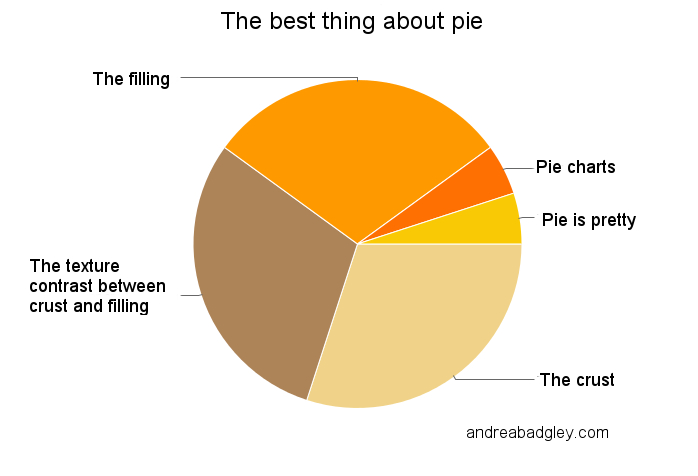
My husband is a Midwestern man, and in his family, pie is as vital to life as laughing. Over the years I’ve eaten every kind of pie they served up (except mincemeat): apple with a double crust, apple with a crumble top, apple with lattice work, pumpkin, sour cherry with a double crust, sour cherry with a crumble top, peach, strawberry rhubarb, loquat, pecan, chocolate pecan, and the most legendary of all, Aunt Sue’s grape pie. At nearly every holiday – Easter, Thanksgiving, Christmas – during the pie eating portion of the meal, when everyone is sinking forks into golden crust and warm fruit, three pieces of pie on their plates (a slice of each – my kind of people), someone will inevitably say, “But have you tried Sue’s grape pie?” Eyes will roll in pleasure. “She always tries crazy stuff, and boy, that one is the best.”
Over the years, I have watched how they do things, building my pastry repertoire. Grandma Janet, the matriarch, advises not to cut the shortening all the way down to pea size when you’re making your crust. She says the secret is to leave some bigger chunks. Sally, my mother-in-law, uses a waxy rolling pad, with guiding circles printed on it to show how big to roll your dough, depending on whether you’re making a 9”, 10”, or deep dish crust. Aunt Sue (yes, I have had her grape pie, made from grapes she grows on her vine out back in Chicago, and yes, it is as good as they all say) uses a tea infuser – the $1.99 stainless steel kind with a handle that you squeeze to open the ball – to sprinkle flour on her board to roll out the dough.
But the best part of all is that there is never, ever shame associated with eating pie. At that first meal with my husband’s family, the meal with the life-altering cherry pie, there were actually two pies to choose from: cherry, and chocolate pecan. I stressed, plate in hand, about which one to try. The pecan was a sure bet, but the cherry was golden and red and glistening and beautiful. I wanted both. Then, talking and cutting, like nothing strange was going down, nothing greedy or gluttonous or shameful, my husband put one of each kind on his plate. So did my sister-in-law. And my mother-in-law.
I looked up at them, “So I can have them both?”
And they looked at me like, “Who is this woman Brian has brought home with him? Doesn’t she know how to eat pie?”
And I knew I wanted to marry this man. And his family.
Last year, we went to Aunt Connie’s for Thanksgiving, where the second incarnation of the family cherry tree still produces. It, or its predecessor, has stood in the same spot in the Columbus, Ohio yard since my mother-in-law and her six siblings were children. When they were growing up, Grandma Janet would harvest the sour cherries and make pies and cherry jam, just as Aunt Connie continues to do now.
When we arrived for Thanksgiving, Connie had two cherry pies on the counter (one with a crumble crust and one with a pastry crust), along with an apple and a pumpkin. I added my pecan pie to the spread. Our children, then 6 and 8, stood at eye level with those pies, and they drooled. Cousin Joe, in his mid-40s, immediately recognized them as competition.
On Thanksgiving day, after we feasted on the savory portion of the meal, we got to the part everyone was waiting for. The pie. Our son wanted apple. Our daughter wanted pumpkin. Cousin Mikie, in her early 40s, watched as our daughter squirted whipped cream on her piece. “That’s not enough, girl!” she said. Our daughter looked at me for permission, and I tipped my head. She grinned, flipped the can back over, and kept squirting.
I served myself a piece of cherry, a piece of apple, and a piece of pecan. I don’t know what everyone else ate, except that our son went back for a second piece of apple with Aunt Connie’s blessing.
Afterward, as we slouched in the dining room with our heads lolling on the chairbacks and our tongues hanging out of the sides of our mouths, totally spent from our day of gorging, Cousin Joey wandered through the kitchen. He didn’t know I was watching him, but I was. He surveyed the mostly empty pie plates, calculating how much was left, how much we would eat in a couple of hours, and how much might remain after that. He planned to go home for the evening and come back tomorrow. He looked up and I was looking right at him. “There were five pies,” he said. “Five.” His shoulders slumped. “I hope there’s some left tomorrow,” he said as he picked up his keys to leave. It didn’t look promising.
Sure enough, a few hours later, when we could move again, we hit the pies for a second round. Our son sliced yet another piece of the apple and I chided him. “Dude, leave some for everyone else.”
Aunt Connie swatted her hand at me and crouched down to our son’s level. “You eat as much as you want. I’ve got an extra one in the freezer.” Our son’s eyes widened, and he showed a bunch of teeth.
“You have another one in the freezer?” I asked. I didn’t know you could freeze pies.
Aunt Connie shrugged. “Yeah, you know, for emergencies.”
Emergency Pie.
I heard the squssssshhhhh of the whipped cream can, then Mikie and our daughter giggling. Our son looked at Aunt Connie and gave her one of his sweet, soul-felt smiles, where his eyes crinkle and his irises clear, and you can see down into his deepest, gratitude-filled, awe-inspiring depths and you wonder, how many lives has this little boy lived? How ancient is this happy, Buddha soul? Then he turned his smile to me, holding his pie-filled plate in both hands, and he said, across the golden brown crust and with his silly open mouthed grin, “I love my family.”
* Apparently my dad loves apple pie, but for some reason I don’t remember apple pie from my childhood. Maybe my brother and I complained so much my mom threw her hands up in frustration and quit making them. If so, I’m sorry Mom and Dad. I didn’t like tomatoes either, but now give me a tomato and a salt shaker and I can make a meal. Likewise, I certainly appreciate apple pie now.
“RESEARCH OFFERS HOPE FOR THOSE SEEKING DURABLE BOOST IN HAPPINESS.” That’s the title of an article I clipped from the paper this summer. I don’t think I’ve ever clipped a newspaper article, but I saved this one. Because in this piece, I learned the secret of people who are able to sustain happiness after an exciting life change (being newly married, or, say, taking the perfect job): that, even beyond the initial excitement of their good news, rather than letting the novelty wear off and searching for something newer and better, these happy folks continue, on a daily basis, to appreciate the positive differences the change has made in their lives.
Kind of like how every time I drive out of our neighborhood and see Appalachians in front of me, I think, “Wow! I can’t believe we live here!”
I’ve been thinking a lot about this article since we made our move to Blacksburg because it tells our story – “When Jim Gubbins finally got the job he’d been working toward for 12 years, he was a very happy man.” Every day, my husband and I marvel at our good fortune, that all of our work actually paid off in they way we were hoping it would, and in a place so spectacular. But what really caught my attention, especially since, like my husband, this Gubbins character is a professor, is that after three years in his tenure-track position, Gubbins is even happier than when he first landed his dream job. All because he is satisfied with what he has, because he is not looking for something better. Because he marvels at his good fortune. After three years, he still savors the changes his job has offered him in all aspects of his life – the friendships he’s cultivated in his workplace, the perks of being at a smaller university, the opportunity to share knowledge. The amazing place he lives.
That last part – the amazing place he lives – resonates deeply with me, and makes me think we might have a shot at this durable happiness thing. My husband and I moved around a lot before settling in Blacksburg, no place ever feeling like quite the right fit, no place feeling like home. A friend likened us to Goldilocks, as we started in Florida (too hot), then moved to Minnesota (too cold), and are finally settling down in Virginia (just right). But it’s not just the climate that fits. Every time I see hemlocks and white pines, or we hike with our kids on the Appalachian Trail, or I smell the scent of mountains – a crisp mix of dry leaves, warm granite, damp earth, and high, clean air – every time I hear a Southern drawl, or my manager at work says “cotton-pickin’,” I delight in our good luck. I can’t believe we live here.
Sometimes I hesitate to get too attached, or I try to rein in my happiness, because I’m so used to having to uproot, to not get too close. Or I think the novelty will wear off at some point. The mountains will surely become so everyday, such a normal part of the landscape, that I won’t even notice them anymore.
This article, though, it’s urging me to risk it – to get attached, to get real close, to notice the mountains (like broccolli forests in summer, glittering gemstones in fall), to breathe the Appalachian air. It reminds me to savor these gifts. Having already hiked six different trails in six weeks* – with waterfalls and babbling brooks, views of Allegheny ridges and the New River Valley, with boulders, hemlocks and white pines, deciduous trees ablaze in citrine, garnet, and yellow sapphire – and countless choices for new hikes, all within 30 minutes of home, the outlook is good that even in a few years we will still be in awe that we get to live here. Because we haven’t even unpacked our camping gear yet.
But the most exciting bit of encouragement that our happiness will endure comes from folks who have lived here a while. On a late-summer day in the courtyard at our kids’ school, when the sky was a crystalline blue, and the sun was warm, but not too warm, on my face, and another time, on a damp autumn morning, when fog rolled over the gentle green domes of the Appalachian mountains, I said to my companion of the day, “Every day, I look around me, or I smell the air, and I think, I can’t believe we live here.”
And my friends – two separate women, unknown to each other and on separate occasions – said quietly to me, both smiling in the same conspiratorial way, “You know, I’ve lived here for 14 years, and I still feel that same way.”
*Six trails so far: Cascades (waterfall, babbling brook), the War Spur Loop (view, dozens of varieties of mushrooms the day we went), various trails at Pandapas Pond (easy trails for kids, 5 minutes from Blacksburg), Sinking Creek (views), Angel’s Rest (gorgeous trail, boulders, mountain views, New River view), and Dragon’s Tooth (bouldering/scrabbling over rocks, views).




 Butterfly Mind