What makes me laugh? Everything! Wit. Irreverence. Puns. Footballs in the crotch. The best humor is smart and surprising, and my favorite kinds of humor are probably the extremes: the low and base, filled with profanity and to be shared only with the most intimate of friends, in a safe space, which is probably why I love it so much, and high humor, which is sharp and intelligent, like Hannah Gadsby, and which studies the human condition and finds the secrets we all share, then surprises us by bringing them out in the open with such perfect awareness, you’d swear the comic had gone inside the darkest corners of your mind and said, “I see you!” And their comedy shows you’re not alone, and look, everyone is laughing because they too can relate, and hey, this thing you thought was a you thing is actually a human thing.
I especially laugh when high humor is also base. Because it often is.
I laugh at puns, at wordplay, at memes, gifs, emoji reactions, cat videos. Cats are very funny. David Sedaris makes me laugh, especially Me Talk Pretty One Day. All of my favorite people make me laugh. Often when our kids tell me about a new person in their lives, I ask, “Are they funny?”
I guess it’s not true that I laugh at everything, though. Meanness isn’t funny to me. And sitcoms and comedy movies often aren’t that funny to me either. I don’t know why. Perhaps they’re obvious, or basic, or predictable. Or maybe they try too hard. Or maybe it’s just because they’re trying to set the expectation from the beginning that they are going to be funny — “I am a comedy!” — so they lose the element of surprise.
I’m lucky, though, that I laugh easily. My husband says he married me because I’m an easy laugh. But truly, he’s very funny. And our kids have picked up his wit. Dinner time is often a testing ground for landing jokes, and perhaps my favorite part of that is that they all keep trying even when something doesn’t work. They’re not afraid of failure: if a line doesn’t land, they’ll analyze it to see what didn’t work, then try a different approach. I make them all feel good by laughing at everything, but the true test is if you can get a laugh out of a more discerning member of our family. Then you can feel proud of your work.
Today marks the 20th day the four of us have been in isolation at home. It feels like an eternity.
One way I’ve watched the progression of how seriously people are taking the coronavirus is through the lens of what is happening at my local grocery store. Because, you know, that’s the excitement these days, going to the grocery store.
On February 29, I first bought a few extra supplies — an extra bag of rice, a few boxes of mac and cheese, a small package of toilet paper. Nothing was amiss at the store. The coronavirus was in the news but Americans in general weren’t looking at it as a serious threat — not enough to make a run on groceries. The next week, March 7, was the same story. I bought a bigger bag of rice, a bigger package of toilet paper, a box of kitty litter, a carton of shelf-stable milk. The shelves were fully stocked; nobody seemed concerned.
When I shopped on March 13, after the NBA canceled the rest of the season, March Madness was called off, Disney was talking about closing, and we began self-isolation because someone we had contact with was awaiting a COVID-19 test result, I had a feeling I’d see a difference at Kroger. The paper products aisle was completely empty. The beans and rice were cleaned out. There was no rubbing alcohol, no shelf-stable milk.
But it was this last trip, on March 28, where I saw the starkest difference. When I entered the store, an employee wearing gloves and a mask stood ready with a fleet of shopping carts. “Large or small cart?” he asked, then disinfected the handle of my large cart. Throughout the store, customers and staff wore masks and gloves. Many more shelves were empty (good thing I got peanut butter the previous week!). It was eerily quiet.
Now, we are in full-on lockdown. Until Monday, my husband and I ran limited errands: Kroger for groceries, the local co-op for bulk foods, the hardware store, the local nursery, curbside takeout once a week.On Monday March 30, Day 18 of our family isolation, our governor issued a state-wide Stay At Home Order effective until June 10.
JUNE 10!
My first thought was oh my god, that’s more than 8 weeks away, how will we survive, these past 3 weeks have already been eternal. Then I looked back through my journal to find the dates for those grocery trips and realized IT HASN’T EVEN BEEN 3 WEEKS. 😭. June 10 is 70 days away. We’ve now been at home 20.
The good news is that tension is low at our house. I bought ice cream and peanuts and chocolate syrup and melting chocolate and toaster strudels. Our daughter made caramel sauce. I made Ostara seed bread. We all have doors, and we use them. Miraculously, we’re all getting along, making jokes at one another’s expense, as we do. Dinner time is my favorite time of day, when we all open our doors and come out to see each other.
The kids aren’t stressed, even though they are aware of what’s going on. My husband and I are though. Our stress relief is fits of giggles at the dinner table. Dinner time is when the four of us argue amicably about really dumb stuff, like whether the tail of a cursive o comes off the top of the bottom (the top, duh) and make alliances based on who gets each others’ jokes. The other night my husband said something that sent me into tears of laughter. I recovered myself, wiped my tears, then remembered what he said and started laughing again. Then he started laughing and snorted the sip of bubbly water he had just taken. I have never seen him laugh so hard he nearly lost his beverage through his nose.
I suspect we’re a little delirious. But laughter is how we will survive.
One thing I’m enjoying with the pandemic is the creativity and dark humor that are coming out of it. Here are a few of my favorites:
Last holiday season, when I worked at the Barnes & Noble in Minnesota, a clean-cut 30-something man, about my age, approached me at the information desk. His short, sandy hair was neatly trimmed, his face freshly shaved, and he wore a grass-green long-sleeved polo, tucked into khaki chinos. He stepped up to the counter where I stood waiting to help him and said, straight faced, “Yes, I’m looking for a book called ‘Lost Balls.’ “
It had been nine years since I’d worked in the world, having stayed home with our kids until I started this job at the book store. Though I dressed the part in a pale pink button-down shirt and tailored black slacks, light makeup and petite pearl earrings, I wasn’t accustomed to maintaining professionalism. I smiled involuntarily, tucked in a giggle, and said, “I’m sorry, did you say ‘Lost Balls?’ “
“Yes,” he said, squinching his eyebrows and looking somewhat perplexed.
I typed it into BookMaster and tried to school my face, the hilarity growing inside of me as I watched the letters, one by one, fill in the search box. L-O-S-T- -B-A-L-L-S. The corners of my mouth twitched, and my eyes watered, and the more I tried to remain stoic, the harder it became to contain my Beavis and Butthead reaction. Huh huh. He said balls. I stifled a laugh, but my lips cracked into a smile despite myself.
He tilted his head a little, still serious, still knitting his eyebrows. “It’s about golf balls,” he said.
I looked up from the computer screen, straight into his searching eyes, stretched my mouth into a full grin, and said, “It’s still funny.”
P.S. I am in our kids’ elementary school cafeteria, seated in the half moon arrangement of folding chairs as I wait for our son’s 3rd grade concert to begin. Sitting next to me is a small child – maybe three? – farting up a storm. He squirms around in his chair, his butt aimed mostly at me, and I suffocate in a noxious cloud of toddler toots while he jabbers on, oblivious to his killing cloud. It is all I can do not to burst into laughter as I smell this kid’s farts and write about lost balls. (Okay, I did burst into laughter. The kind that you try to keep in, but still it escapes, through snorts and squeaky giggles. Our daughter is looking at me weird, head tilted, eyebrows squinched. Not unlike the man at the book store.)
P.P.S. I added the graphs last minute in response to the WordPress Image vs. Text challenge. That last one really has me thinking. Who is a subset of whom?
“So, have you noticed that irony is super trendy now?” I dealt Phase 10 cards to Amy and my two kids. “‘The Ironic Generation.’ I keep hearing that. What does that even mean? That people want to live off the grid, yet they can’t survive without Facebook and Twitter?”
Amy fanned and arranged the cards in her hand. “It’s a hipster thing.”
“What’s a hipster?” Our son’s big eyes looked up at me.
“Well,” I said, “Every generation – do you know what a generation is?”
“Yeah, it’s like a thousand years or something.”
“Not quite,” Amy and I laughed. “It’s a group of people of a certain age,” I told him. “Like, you and all your friends are your generation. Daddy and me and Amy and all of our friends are our generation.”
He discarded. “Okaaay.”
“Each generation has a group of, I don’t know,” Rebels? Outsiders? “A subculture that kind of defines the generation. In the 20s it was flappers.” I played a card and looked across the table at Amy. “When were beatniks?”
“Beatniks were in the 60s,” she said. “And hippies were the 60s and 70s.”
“Punk was the 80s. And now,” I said, “it’s hipsters.” I peered over my cards at our son to see if he understood. He did not.
“There were tons of hipsters in the Twin Cities,” I told him. “They think they’re really cool. Like, they were cool before cool was cool.” He had no idea what I was talking about. He’s nine.
I played a card and asked my friend, “Do you know how the hipster burned his tongue?”
She raised an eyebrow, waiting for my answer.
“He ate pizza before it was cool.” I giggled hysterically. Our son rolled his eyes.
Amy was more useful to him, describing the hipster look – the skinny jeans, the PBR tee shirts. “And then there are the older hipsters, like Ira Glass and my husband, with the glasses, and the beard, like my husband has,” she said. She moved some cards around in her hand. “Although he had the glasses and the beard before they were a thing.”*
I giggled again, thinking she was making fun of herself, saying that her husband had adopted the hipster look before it was cool. I looked up from my cards to acknowledge her cleverness, but she wasn’t smiling about it. She was laying down her sets, getting ready to go out.
“So, back to irony,” I said. “I’ve always loved irony, but I never know how to explain it. If somebody asked me to define irony, I could give an example, but I couldn’t define it.” I laid down my sets of four and discarded. Amy looked thoughtful, turning her eyes up as if she could look into her brain, rifle through files, and find a definition for ironic.
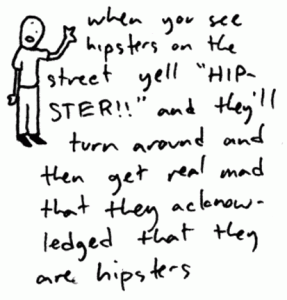
“Only Hipsters Know Irony,” writing and “art” by J. David Ramsey
“But the irony I know is not anything like that Alanis Morissette song,” I said. “‘It’s like 10,000 spoons when all you need is a knife.’ What the hell is that? That’s not ironic. That’s just annoying. Ironic has some sort of, I don’t know,” I gestured toward my heart. “Mystical quality.”
Amy’s eyebrows shot up and she grinned. “Let’s look it up!”
I gave her the dictionary, and she riffled pages while I shuffled cards. Her face turned scowly.
“What the hell?” She said. “Listen to this:
Ironic. 1. Characterized by or constituting irony. 2. Given to the use of irony.
“That doesn’t tell you anything,” she said. “It uses irony in the definition!”
My son arranged his new cards. “It’s your turn Amy.”
“Oh, sorry,” she said, then smiled and stroked the book. “I have this dictionary now, you see,” and she played a card.
“Well, look up irony then,” I said.
She followed the words with her long finger.
Irony. 1.a. The use of words to express something different from and often opposite to their literal meaning.
I had had a couple of whiskey sours at this point. “What? That confuses me,” I said, and took another sip. “This is an example of irony to me. I have this friend whose mom was a super fructavore – she loved fruits and veggies and ate them all the time. They were her snacks, her desserts, always a component in her meals. Tons of fiber, you know? Well, she died from colon cancer.” I laid down a card. “That’s ironic.”
“Okay, listen, though. Here’s the third definition of ironic”:
3. Poignantly contrary to what was expected or intended.
“Poignant! That’s going in my Lexicon.” I jumped up to get my Moleskine. “Poignant is one of my favorite words. It’s like irony – it has this mystical quality,” and I gestured toward my innards again. “It makes me feel.”
“Mom! It’s your turn!”
“Sorry babe.” I played a card and thought of the example of irony I had just told. “My friend’s mom contracting colon cancer after a lifetime of fruit eating is, well, poignantly contrary to what was expected. That’s a perfect definition! That’s the irony I’m talking about. It’s all about the poignancy.”
“You really need to read the usage examples here,” Amy said, pointing at the entry in the dictionary.
I thought about all the young hipsters in the Twin Cities as play went round the the table. I thought about the sad irony that they try desperately to avoid anything mainstream, yet they have become so mainstream they even have a look. Glasses, skinny jeans, fixed gear bicycles. iProducts.
When it was my turn again, I fingered my cards, then hitched up my skinny jeans so I could start the music back up on my iMac. I smirked, “Well, I’ve loved irony for, like, 20 years. Irony spoke to me before it became a ‘thing’.”
And then I laid down my cards and laughed.
Usage Note: The words ironic, irony, and ironically are sometimes used of events and circumstances that might better be described as simply “coincidental” or “improbable,” in that they suggest no particular lessons about human vanity or folly. Thus 78 percent of the Usage Panel rejects the use of ironically in the sentence In 1969 Susie moved from Ithaca to California where she met her husband-to-be, who, ironically, also came from upstate New York. By contrast, 73 percent accepted the sentence Ironically, even as the government was fulminating against American policy, American jeans and videocassettes were the hottest items in the stalls of the market, where the incongruity can be seen as an example of human inconsistency. (The American Heritage College Dictionary)
When I was researching this post, I came across some pretty hilarious stuff. Like the wikiHow article 9 Ways to Be a Hipster. I also found a fascinating opinion piece in the NY Times: How to Live Without Irony by Christy Wampole. Both great reads if you are curious about hipster subculture.
——-
I originally published this post Februrary 26, 2013. When I saw this week’s writing challenge, Oh, The Irony, I couldn’t resist reposting. I don’t know if hipsters are still a thing, so hopefully this isn’t woefully outdated.
Today is the anniversary of my first post, One Last Move, on June 7, 2012 on Butterfly Mind. In that first post, and in many subsequent ones, I wrote about trying to find my way as an at-home mom when our children both went off to elementary school, leaving me alone in quiet, not for minutes but for hours, for the first time in 9 years. I didn’t know if I should pursue a new career, and if so, what would I do? Who would I be? A young friend in Blacksburg commented on one such searching post:
“For your main line of work, I would follow whatever you naturally gravitate toward when you feel the need to be productive.”
How very wise he was. Thank you Phil. You were right. I gravitate towards words when I want to be productive, and I did not see that at the time. When I thumb through old diaries, I realize I’ve gravitated towards writing all along. Every couple of years I express in those private pages my desire to be a writer. A desire that seemed so impractical and unattainable, I never gave it credence. Until this blog. Now, I’m building a writing practice, laying a foundation so that when the kids grow up and move away, I can move forward into a writing career. If that’s still what I want to do ten years from now.
To celebrate my first anniversary, I thought I’d serve up the year’s most popular posts. For those of you who have been around since the beginning, thank you. I am grateful for your support. For those of you who are new here, welcome. Perhaps this run-down will give you an idea of where to start and what to expect on Butterfly Mind. Thanks to all of you for your readership, and enjoy.
One morning, when the kids were 5 and 7, and I was standing at the chopping block cutting crusts off sandwiches, I heard our son say to his little sister, “Do you know the ‘D’ word?”
He and our daughter slurped cereal at the kitchen table a few feet behind me. I paused imperceptibly, remained facing forward, and wrestled gently with a plastic sandwich bag, taming it into quiet, unrustling submission. Where was he going with this? I tried to remain silent so I could hear our daughter’s response.
“D-U-M?” She said.
I relaxed, smiled to myself, and stuffed the bagged sandwiches into lunch boxes. I pulled the rinsed strawberries towards me from the far corner of the board and patted them dry.
“What about the ’S’ word?” he asked. I stiffened.
“Umm. S-T-U-P-I-D.”
My shoulders softened. How precious that she was spelling the “bad words” out instead of saying them. I sliced berries and pretended I wasn’t listening.
Our son was quiet a moment, probably chewing his mini-wheats. I dared not look lest I give myself away. “What about the ‘H’ word?” he asked.
“H-A-T-E.”
Oh my goodness, be still my heart. Did I teach them this, that “hate” is a bad word? If so, major mom kudos to me. I tucked the strawberries next to the sandwiches and smiled smugly to myself about my parenting skills. Our son asked, just as I was about to zip up a lunch box, “Do you know the ‘F’ word?” I busied myself with wiping the board instead of securing the noisy zipper.
“F-A-T?” our daughter asked.
“Nooooo…”
“F-A-R-T?”
I could feel our son smiling. I chuckled, too. “Nooooo…”
Wait. What could it be if not “fat” or “fart?” Well, obviously you and I know what it could be, but if the kids didn’t know the “D,” “S,” or “H” words, how on earth would they know the “F” word?
“I don’t know,” our daughter said. “What is it?”
“F-U-K,” our 7 year old son said.
Oh my God. He knows. He knows! How does he know this?!
Okay, act casual. I folded my cloth, picked up a lunch box, and took a deep breath.
“Hey baby,” I said, turning my body toward them at last, nonchalantly sealing the lunch box, not freaking out. Not correcting his spelling. “Where did you hear that word?” We don’t say that word around the kids. Maybe he heard it on the bus. There were fifth graders on the bus, and he was only in second grade. The big kids must have talked about it. That’s how he knew it was a bad word. Surely second graders weren’t talking about it. Surely.
His sister lost interest and cleaned up her bowl. He shrugged and said, “I dunno.”
This conversation could go anywhere. Why it’s a bad word, why kids shouldn’t say it, who is offended by it, why some people use it, whether their dad and I ever use it. How much do I say? I decided: as little as possible. “You know not to use that word, right?”
“I know,” he said, and slurped the last spoonful of cereal milk. “I don’t even know what it means.”
Well, that’s good. “Okay, if you have any questions, you can ask me. For now I’ll just tell you it’s a word that is very offensive to a lot of people, and children should not use it, especially since you don’t know what it means.”
“Okay Mom.” He got up and brought his bowl to the sink.
“Here’s your lunch box, buddy.” I kissed him on the top of his head, patted his back, and sent him off to brush his teeth. I collapsed in a kitchen chair and realized the baby years, which I’d thought were awfully trying, were hard in a physically demanding, bone exhausting, I’m-responsible-for-this-baby’s-every-need kind of way. But the elementary school years? Those are hard in a completely different way. They are demanding in an intellectual, emotional, I’m-responsible-for-helping-this-child-navigate-the-weirdness-of-life-and-become-a-decent-human-being kind of way.
With the kids’ births I thought, Now it begins. We navigated sleep deprivation and the endless repetition of diapering, feeding, clothing, cleaning. But after that morning’s dialogue – “Do you know the ‘F’ word?” – and facing the strain of trying to know the right thing to do, to react swiftly and intelligently, to be a responsible adult even when I thought the whole exchange was funny, I knew this stage of parenting was different than simply keeping our kids alive. As I’ve thought with countless turning points that came before (walking, talking) and will come after (puberty, rebelling), that morning after our “F-U-K” conversation, when I realized our kids would one day lose their innocence, I thought, Now this wild ride really begins.




 Butterfly Mind