In my 9th of 10 years of being a stay-at-home-mom, I was antsy to add meaning to my life beyond the role of Mom. I had recently begun blogging, and I was in constant search of my identity.
We often identify ourselves by what we do: scientist, lawyer, Mom. I am a mother, but that is not everything I am. I struggled with this idea of defining our identity by what we do — our hobbies, our jobs, our roles in our relationships — rather than some essence of ourselves. At the same time, our actions do define us; thoughts and ideas and words evaporate when they are not made real through action.
After 9 years out of the workforce and in the home, it was hard to overcome Mom as my sole identifier. I felt cut off from the world, invisible, and my identity was dependent on others: mother to our children, wife to my husband. I felt disconnected from myself. Who would I be without my husband and our kids, without an identity relative to them?
During that summer of 2012, I soul searched. I thought deeply about who I was, what I wanted, where I wanted to go. I tried to look beyond what I do as being who I am. I read StrengthsFinder 2.0 to find my natural strengths; I figured out my Myers-Brigg personality type; I wrote haiku; I filled notebooks and published blog posts.
I can’t remember what inspired me to do so, but ultimately I wrote a personal mission statement in a 5 x 8 inch Moleskine.
I worked hard to develop my mission statement, and then I forgot about it. Two years later, I found myself employed by Automattic, the company that makes WordPress.com. When I was hired full time, I was paired with what we call a D’OH (Developing Our Happiness) buddy: a mentor who helps a new Happiness Engineer transition into the chaos and culture of working for a fully distributed company that doesn’t have managers, doesn’t have offices, and that trusts its employees to be self-driven.
In our early chats, my D’OH buddy, Simon Ouderkirk, asked me about my career dreams and how I would know if I was succeeding in vague goals like “I want to be better at this, I want to learn more about that.”
At one point he encouraged me to think about writing a personal mission statement.
“Oh! I did that a couple of years ago,” I told him. “I’ll see if I can find it.”
I dug out my old Moleskine and found this:
Inspire and facilitate movement towards our best selves through kindness, compassion, fun, personal stories, and writing.
When I looked at this mission statement after forgetting it, I stared at it in amazement. I had not only found a job doing the thing that was my personal mission — I support bloggers who are telling their stories, our company mission is to democratize publishing, and my title is Happiness Engineer, for Pete’s sake — but when I looked at my mission statement, I realized this is my identity.
An identity is both a mission and the action we take to fulfill it. An identiy is who we are in our hearts and minds, and it is also what we do in the world, whether that doing is a paid occupation or not.
My personal mission statement encapsulates what I do and who I am, and it tells me the path I need to stay on to fulfill my deepest needs and be my best self. It feels true and right.
This moment of self-discovery, of finding my identity, was pivotal. I rarely struggle now with defining who I am. And now that I know my mission, I can use it to guide my action not only in my personal life, but also as I navigate my career. I refer to it when I feel lost, when I need to make decisions, when I wonder if I’m on the right path. And so far, it has not steered me wrong.
This was inspired by the Daily Post Discover challenge: Identity.
I have a close friend, J, who has never met a mirror she didn’t like. When we were teens, and later in college, and her eye caught a reflective surface – a shop window, a car window, a mirror in a mall bathroom – she turned her head this way and that as she looked into it, smoothed an eyebrow, tucked a curl, and watched herself as she continued to talk, completely unselfconscious about her mirror-gazing as she carried on the conversation. We teased her about it then, and we tease her about it now, 25 years later. She laughs at herself when we tease her, then flits her eyes to a mirror and winks at the best friend she sees there.
This past March, at our annual Girls’ Weekend, we talked about mirrors and who among us looks into them. The conversation was spawned in part by J’s mirror-love, but also, at least for me, by a deeper wondering about our comfort with ourselves. J is one of the funniest people I know, and also one of the happiest. At several points in her life, whether on a precipice with a boyfriend or on the verge of a life-changing move, she has shrugged her shoulders and said, “I dunno. I think I could be happy with anyone” in the case of the boyfriend, or “anywhere” in the case of a move. And it’s true. She could.
As we went around the table at Girls’ Weekend, we found that we all have very different relationships with the mirror. J is friendly with them – she sees her favorite person when she looks into one. Others of us use them strictly for pragmatic reasons: check the teeth, blow dry the hair. One of us doesn’t use them at all – says she can’t remember the last time she looked into one. “Not even to brush your teeth?” I asked. “I brush my teeth in the shower,” she said.
And me? It used to be that when I looked in the mirror, the person who looked back at me was a mystery. The image I saw in that silver surface did not match up with the person I knew from the inside. All my life my reflection has caught me off guard. Recently I brushed our daughter’s hair and when my reflection moved in the mirror I did a double-take – Who’s that? Oh. That’s me. The same face that’s been looking back at me for 40 years. Why does she still surprise me? Why do I not connect with her?
I told my girlfriends about this weirdness, about the disconnect between me and my reflection, and after our mirror conversation, inspired by J, I said, “I’m going to start doing mirror work. I’m going to figure this out! I want to be best friends with my reflection too.”
I tried, but still, we were off, my reflection and me. And then, something changed. I got glasses.
Now, I look in the mirror and say Oh! There you are! And I smile. The Andrea that looks back at me – the bookworm, the word nerd – is the Andrea I know from the inside. I just never knew she had glasses.
I see this revelation frequently in fashion, especially on the the TLC makeover show What Not to Wear. Contributors to the show are brought to New York, instructed to dispose of their entire wardrobe, and then taught how to shop for new clothes that fit their personalities and figures. It is always difficult for the women to let go of their former clothing – even if the clothes did not serve them and did not even fit them, those clothes were familiar – but once they let go and start finding clothes that do serve them, that do fit them, the women are transformed. There are often tears when they see themselves in clothes that match their personalities. The women look in the mirror at their new hair, the skirt that flatters their hips, the fun shoes in their favorite color, and they point and they say, “That’s what I always felt like on the inside – now I look like that on the outside.”
That’s how I feel with my new glasses. Now, when my reflection catches me unaware, when I’m vacuuming and I see myself pushing the upright in the wall mirror, I wave or I wink. She and I, we’re on our way to becoming fast friends.
This is my interpretation of finding something, the day 13 assignment for Writing 101. *Edit: added next to last paragraph after initial publication.
I stood in sunshine on the sidelines of our son’s soccer field – the first game of the season – and a mom I had not met yet smiled and thrust her hand toward me. “Hi, I’m M___,” she said. “Thanks for all the email organizing you did for the team last week.” Her glasses glinted in the sun and her eyes were bright and friendly. We stood together with our arms crossed against a chilly March breeze and watched our ten-year-old boys warm up. The sunshine and our boys’ laughter made me feel melty.
“So you’re an author?” she said. My melty body seized. I am? I looked around. Who told her that?
“Uhhhhhh.” I said. And then I remembered my email signature: Andrea Badgley, Author at Butterfly Mind and Andrea Reads America. “Well, author might be too strong a word,” I said. I squirmed. “I write a blog. Well, two blogs.”
I smiled weakly. I don’t usually talk about my blogs except with my writing group and a couple of close friends, and I felt too center-of-attention talking about them on the soccer field sidelines. I shoved my hands in my pockets, then crossed them across my chest again.
“So what do you write about?” M___ asked. Her body faced me and she still smiled. She was truly interested.
“Uhhhhhh.” I said. My mind raced. What do I write about? What do I write about? I could not think of a single thing I write about. A tiny Buddha! I wrote about a tiny Buddha. But what relevance does that have for M___? Writing. I write about writing. My God, how lame! Who cares about writing except writers?
“Uhhhhhh,” I said again. “Well today I wrote about the lunacy of the writing life.” I grimaced. I probably looked like I had gas. None of the parents would want to be my friend after reading that. “And, uh, I wrote about a little Buddha figurine last week.” I saw bewilderment in her eyes. Totally bombing here. “I write about whatever is on my mind, I guess.”
She tilted her head and furrowed her eyebrows. “And do people care about those things?” she asked. “Do people read your blog?” She seemed doubtful. I didn’t blame her after the pitch I gave her.
“Well, yeah,” I said, practically apologizing for what I put readers through. “My blog’s name is Butterfly Mind because I’m kind of all over the place.” I smiled weakly again.
“Oh, I like that,” she said. “Have you seen The Butterfly Effect?”
And then, to my great relief, we were off on another subject.
All week I’ve thought about our encounter, and how that’s not the first time I’ve been caught unprepared when someone asks me in real life what my blog is about. In real life and real-time, I have to answer on the spot instead of being able to chew the tip of my pen and stare off into space while I craft a succinct response. In real life, someone is looking in my eyes, is smiling at me, is genuinely interested in what I’m going to say, and I feel like I always let them down. I decided, No More. I’m going to craft a response now, while I have the leisure to answer in the way that is most comfortable to me: on paper.
I’m going to repeat this aloud while I clean, while I shower; I’m going to practice this until I can rattle it off without thinking. Next time I’m at the soccer field, in the dentist’s chair, at the hair salon, or on the highly unlikely occasion when I’d be in an elevator with an interested stranger, I will have an answer when, in real life, someone asks, “What do you write about?” Next time, I’ll pitch it right.
As a stay-at-home-mom whose life consists of my husband, my children, these walls, washing dishes… most of my stimulus, my interaction, my life experience that would be of any interest to the outside world are the funny things my kids say, the conversations we have about sex and bad words and God. My material comes from my husband and my children, because really, who wants to read about dusting picture frames and planning grocery trips? What do I write about as a stay-at-home-mom who won’t write about her husband and kids?
When I read this back to the workshop, the instructor’s mouth dropped open. She shook her head and I think she may have wagged a finger at me. “Oh no no no. Change of plans. We’re not doing the next exercise until we get something out of the way first. Andrea, you do a 10-minute free write about yourself without husband or children. Your prompt: ‘I’m not married and I don’t have kids.’”
I glared at her. “I don’t like this plan, Lesley.”
She smiled sweetly. “Good.”
I’m traveling. I’m in Ireland, in the green hills and pubs and stone walls. I’m at Stonehenge. Then I’m in Italy, eating pizza, sitting in the sun, riding on a bus.
But I’d be lonely. As I sat on a green hill on campus today, on my belly in the grass, with no husband, no children, just the sun and the blue sky and the buzz of insects and my miniature prompt book, I saw a little girl ride by on her purple sparkled bicycle. Her helmet was white and pink, and she looked to be maybe 7, and the sight of her made my heart ache for my daughter. It had only been four hours, and I missed her.
But I’m to write about what it would mean to me to be a woman not defined by my husband or my kids, as that is how I defined myself in the previous piece. “What can I write about if not my husband and kids?” My God, I’m going to have another identity crisis.
Needless to say, Lesley’s plan unmoored me. When I moved from the workplace into the home to raise our kids it was critical to me to maintain my identity, to not be defined solely by my roles as wife and mother, to not be lost, wandering in circles and wondering “Who am I?” when our children move away. I wasn’t one of these women I read about in Judith Warner’s piece, The Opt-Out Generation Wants Back In, powerful executives who gave up success and high pay and a bright future to raise families, but that doesn’t make my identity any less important. My husband and I both wanted our children to see that I am not just Mom, a one-dimensional woman whose sole purpose is to serve them, and their school, and our family. I am Andrea, too.
So why, then, all the belittling self-talk? Why, when faced with the prohibition on writing about my family, did I feel so less than – less than the high-powered execs, less than my husband, less than my kids, as if their life experiences are so much more valuable than mine, their stories more worthy of telling? Why did I feel I have no stories to offer if I can’t offer theirs? Perhaps it is the memory of the neighbor who said, “Is that all you do?” when I told her I was a stay-at-home-mom. Or the glazed eyes of a grad student at a party after she asked, “What do you do?” (those dreaded four words) and I said, “I stay home with our kids,” and she sipped her drink through her straw and scanned the room for someone more interesting to talk to.
Or maybe it was analogous to when someone says, “Don’t think of black,” and of course all you can think of is black. When I thought “don’t write about husband or kids,” I zeroed in on their significance in my life. I don’t know who I would be if not for them now, I wrote.
But as Lesley instructed at the beginning of the exercise, I kept the pen moving. “Don’t lift your pen from the paper. Do not pause. Do not think. Just write.”
But if I am to follow my son’s advice, if I am to write what I like, I am a book lover. I love words. I love the way words can capture life, can articulate feeling, can bring us together and show us – yes! There is someone else like me! I get you, you get me, I am not alone.
I continued, I like place. I like the feel of fresh air on my skin, the smell that distinguishes a person’s home, the scent of a cliff over the Atlantic in Maine, the silk of my daughter’s hair spread over her pink pillow. I began to feel grounded. Less floaty. I like people. I like the refined drawl of my aristocratic Southern Grandma. I like boatsmen who wave. I like bakers who see their craft as a means to share celebrations. Felt my Andrea-self flowing down my arm and through the ink. When I am alone, and not doing chores, I choose to read, or I choose to write. Or I walk in nature. I watch a butter-white butterfly soar up and down over violet blooms, flapping its wings excitedly in sunlight, “ohmigod ohymigod, I found it guys! I found the purple flowers!”
When the timer dinged, I wasn’t satisfied that I’d gotten anywhere. That I’d have anything to write about, or any stories to tell. Lesley instructed us to read through our piece, pick three words or phrases, and for each of those we would do a three-minute word association exercise. Okay. Easy enough. I picked “what I like,” “life experience,” and “stay-at-home-mom.” She started the timer.
I wrote, What I like: thunderstorms, islands, sand, sea, salt, sky, white puffy clouds. As I wrote, I thought, huh. I’ve written pieces about all of these things. Baking bread, color, literature, trees, rocks, thinking, smells, coffee, a good pen. Good pieces, I thought. I wrote good pieces about some of these, and I could write better pieces about more. God, the universe, pastries.
We moved to our second phrase. Life experiences: Riding a bicycle from North Carolina to Washington, DC, SCUBA diving, toting carboys of water through the woods, happy hour in Annapolis. Those were good times. Riding in boats, making marsh shoes, fiddler crabs. I’ve written about those too. Maybe I don’t depend on the kids for material as much as I thought.Attending Quaker meeting, natural childbirth, living on an island. Damn, there’s a lot here.
I started feeling good, started thinking about whether my best pieces really are about the kids and realized, nope. They are not. My best pieces have been about my own experiences, sometimes from the perspective of mother, which is a large part (but not all) of who I am, and sometimes not. And so I came to my final phrase. I swallowed and began.
Stay-at-home-mom: Mother, nurturer, loving, kind, compassionate, baker, home maker, peace maker, yeller, boring, bland, creator of life. Supportive, alone, lucky, temporary, mother, mother, love, love, tender, caring, family, trying really hard to do the best thing for our kids, opportunity to write, good at my job, funny, different from what folks expect, full of ideas, educated, intelligent, warm, big-hearted. Not boring. Interesting.
The timer dinged and I stared at my list. My identity there on the page. Not boring. Interesting. Human. A woman who who has plenty of her own stories to tell.
This is part 2 of a two-part series. For the first installment, please see The right to be forgotten.
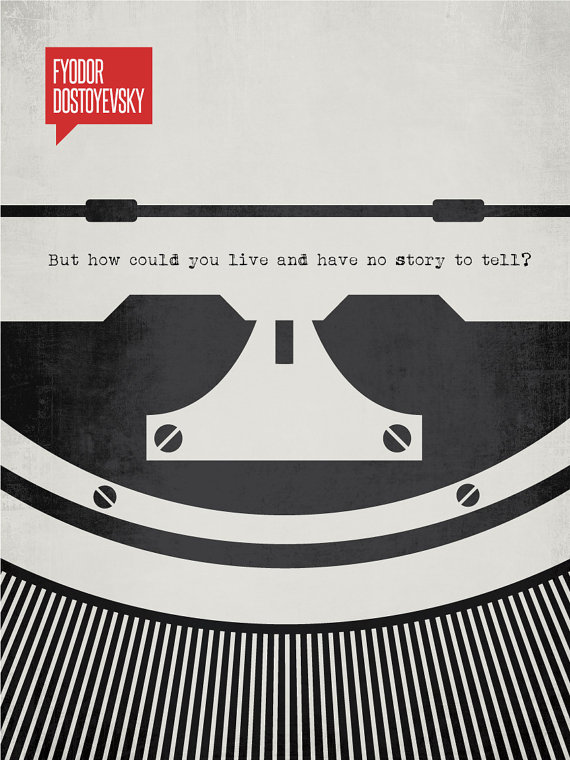
This post was inspired by Simone Gorrindo’s A Hidden Writing Life on Vela magazine’s blog and by the Dostoyevsky artwork at the top by Ryan at Design Different.

 Butterfly Mind