When my team went to New Orleans for a meetup in November, I had a chance to see my friend Pam, who trained me when I joined Automattic a little over ten years ago. She is one of the most creative people I know. She’s a natural writer with a clear voice — I feel like I’m in a room with her when I read her blog — and she sews beautiful clothes.
She also binds books (check out this cool time lapse of her process). When I saw her in New Orleans, she had a gift for me: a journal. That she made! With her own hands! She bound it with paper that has line drawings of flowers every few pages, pasted colorful floral endpapers inside, covered the book in green cloth, and attached a ribbon bookmark with a leaf and a flower charm on it. So much gardening love 😍. As soon as I saw it, I knew exactly what I would do with it. It would be my sabbatical journal.
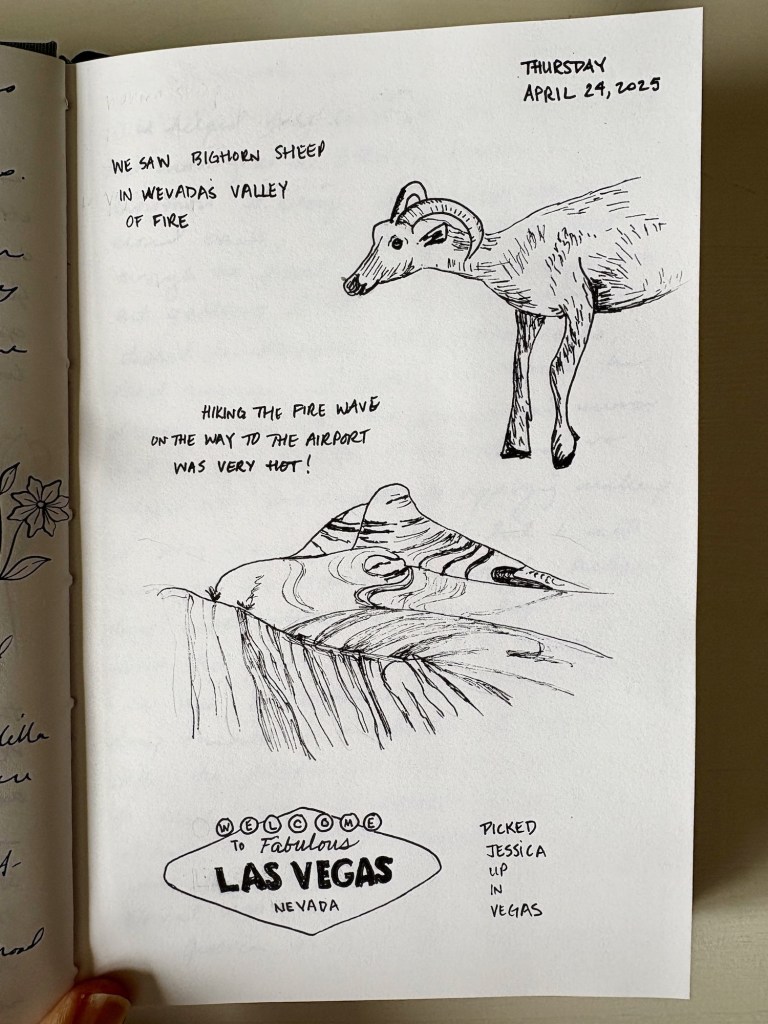
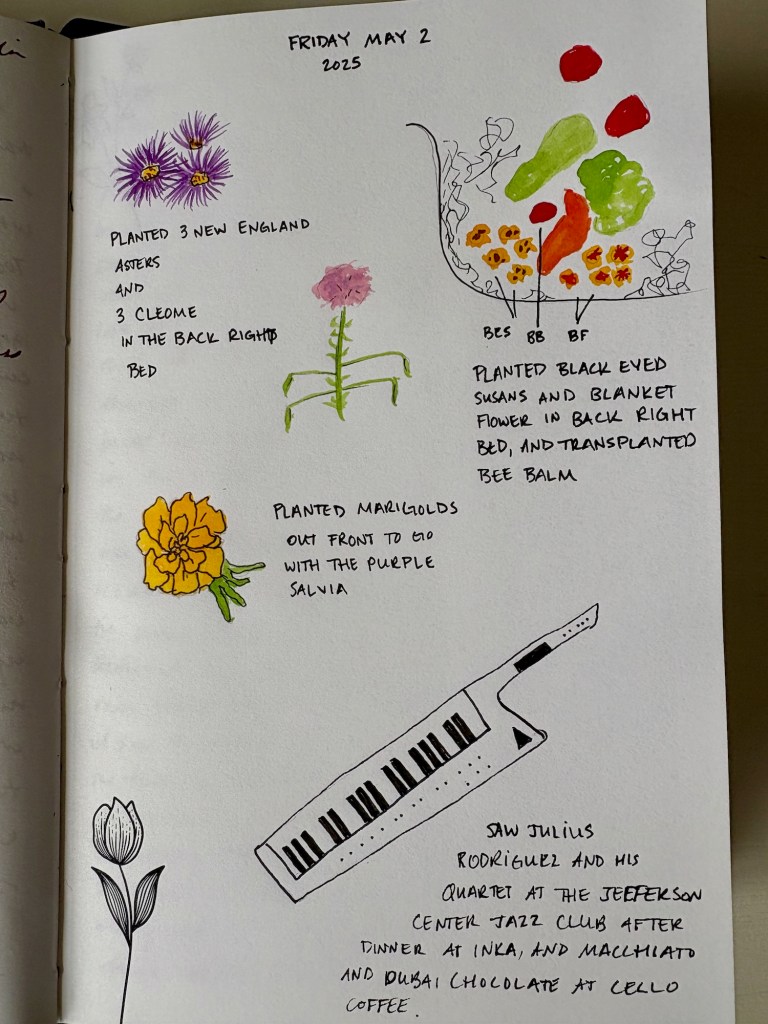
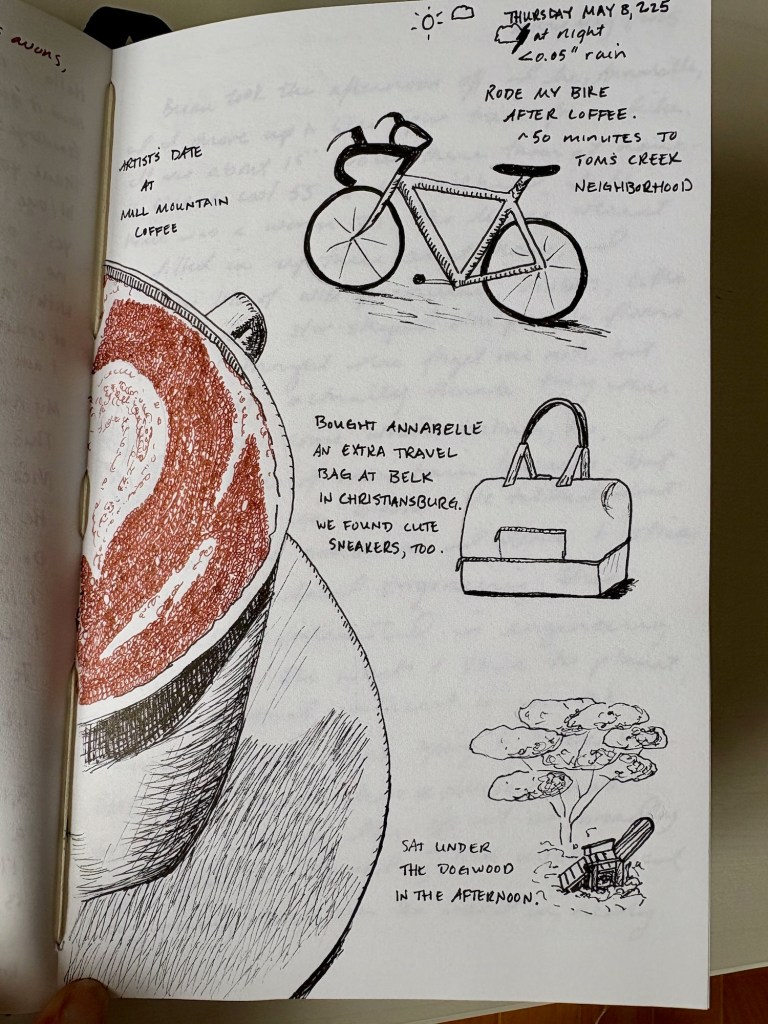
I saved it for five months, and on my first official day of sabbatical, I created my first entry. I’ve written in it every day of this first four weeks of my sabbatical. I’ve also drawn a little something to illustrate every day.
It’s funny, I like the process of writing, but I rarely go back and read what I’ve written. I do like to go back and look at the drawings, though, even though they’re so amateur. Drawings take a lot less effort to consume. I love flipping through pages and getting little visual reminders of my sabbatical so far.
A great joy for me right now is that I can swim at 8am instead of 5:30am since I don’t have to squeeze my laps in before work. I reserve my lane for a whole hour instead of 30 minutes, too, which means that I can mix things up, add more exercises, and take my time with my workouts. I can do kick sets, which are slow, so I never use the kick board in my 30 minute swims. I can also add longer rests after sprints. This felt like a luxury yesterday — to rest 30 seconds instead of 10 — and I was shocked by the results. By adding rest between sprints, I dropped 6 seconds on each all-out effort. After a longer rest, I swam stronger and faster. There is likely a lesson in this, if one wants to swim stronger and faster.
Similarly, with the time affluence I find myself with, I feel very little compulsion to run for exercise. I’d rather go for a long walk and listen to birds, or listen to short stories. When I have a job to go to every day, time is my scarcest resource. It has now occurred to me that I run because running is a fast, efficient workout, not because I actually like it. I do, however, actually like walking. When I’m walking, I feel present. I notice things. I check on the progress of the peonies in the neighborhood, I smell roses, I pay attention to the scent of sunlight on pine needles. Tomorrow I can hike in the the woods with our daughter.
When I’m working, I squeeze in one journal page per day if I’m lucky. I may blog once every two weeks. On sabbatical I get to write as much as I want, and that ends up being a lot. I blog multiple times a week. I keep a daily sabbatical journal handmade by my friend Pam that includes 2 pages per day and some sketches. I do morning pages — 3 pages of non-stop brain dump. On some days I do an additional 3 pages of exploratory writing.
This morning when I looked out the window at my poppies, whose buds look like they are going to burst open into flame red flowers any day now, I thought, “Oh, I want to journal about those!” What will I write about them? Who knows! But I had a moment of lucidity about why I love writing and journaling. It’s not just a way to discover what I think, or to clarify my thinking. It’s not just a way to be present in the moment by paying close attention to sensory details. It is both of those things, yes, and much more. But what struck me as I thought about my poppies is that writing is a way of being friends with myself. When I write, I can say whatever I want without worrying about whether it’s interesting or how someone else might respond. Maybe all I’ll journal about the poppies is that I love them, their weird hairy plump buds, their ridiculously bright petals, the thrilling anticipation of waiting for them to open. It doesn’t matter what I write: I can put my thoughts on a page without worry about being boring or having any purpose in what I’m saying.
Maybe later in my sabbatical I’ll care about improving my writing, but maybe I won’t! I was interested that my swim sprint got faster, but that was a just a side effect of the thing that I was actually excited about: I liked the luxury of the longer rest. I thought I’d want to spend time on sabbatical improving my craft(s), but pushing to always be faster, better, stronger is exhausting. I like this life of leisure. I’m leaning more now towards just writing (and swimming, and walking) for the joy of it, as a way of being friends with myself.
Today is Saturday, and my husband is home. As I write, I smell the warm scent of bread he’s baking. I recently heard an idea to switch the end-of-day question from “How was your day?” to “What was your happiest moment from today?”, and as of right now, at 3:08pm, my happiest moment is smelling this bread. I don’t know if there’s a cozier, more comforting smell in the world. Maybe cookies baking.
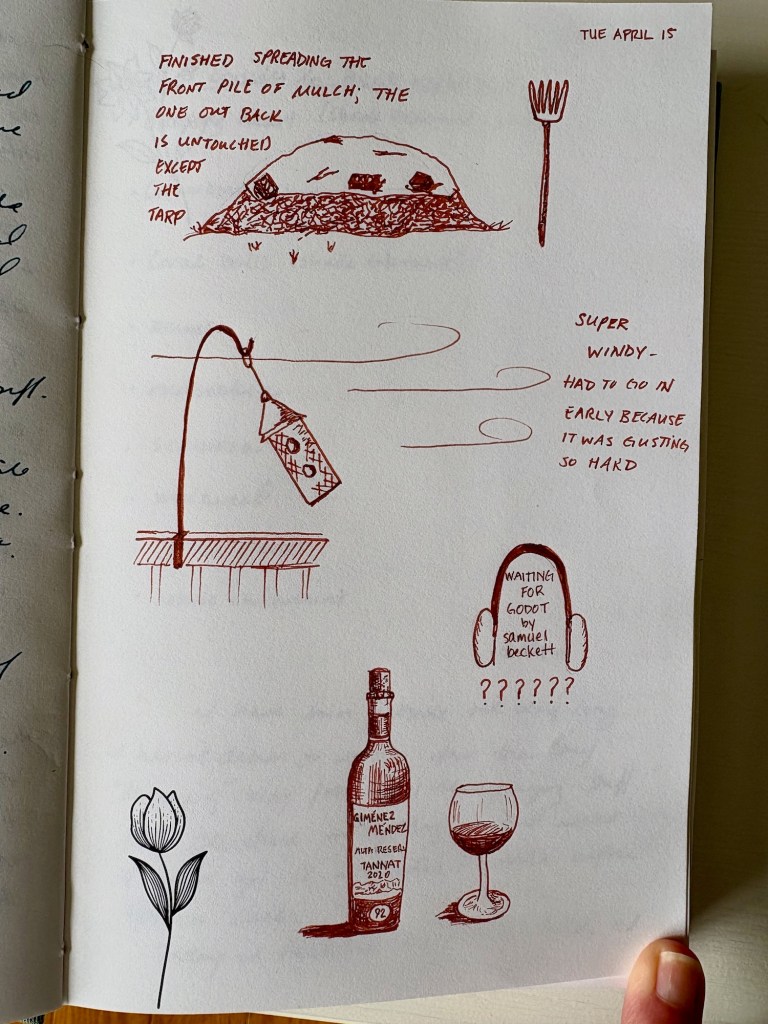
I’ve completed my gardening vacation. I spread all the mulch. I counted the number of times I filled the wheelbarrow, and it more than doubled my estimate of 50 barrows per pile: I moved 107 wheelbarrows for the pile out back, which I assume means I spread 100+ wheelbarrows from the pile out front as well.
Once I finished the mulch, I filled the bird feeders with seed, and I washed the bird bath basins, set them back on their pedestals after winter, and filled them with fresh water from the hose. I saw a little pink finch splashing in the one by our bedroom window this morning.
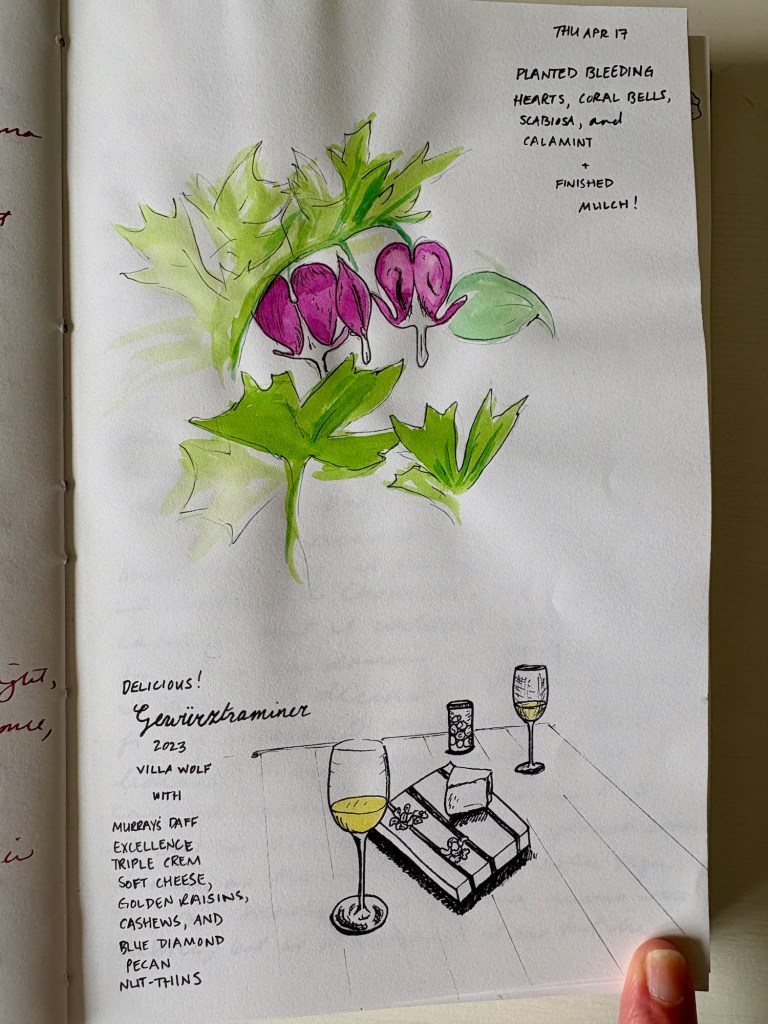
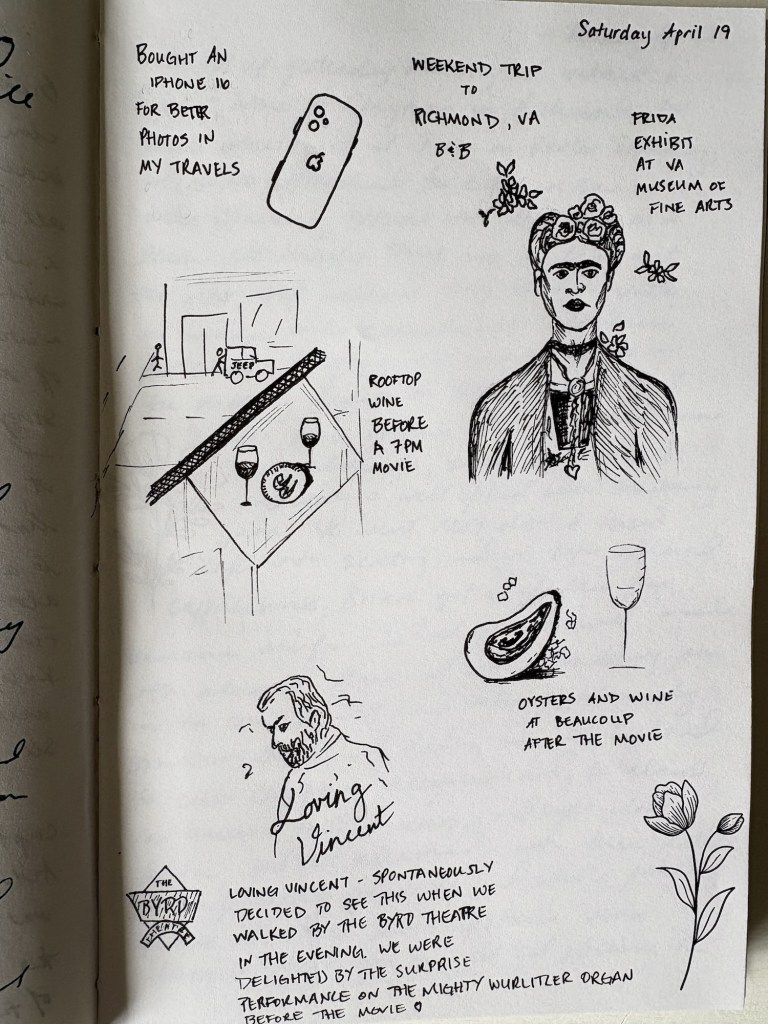
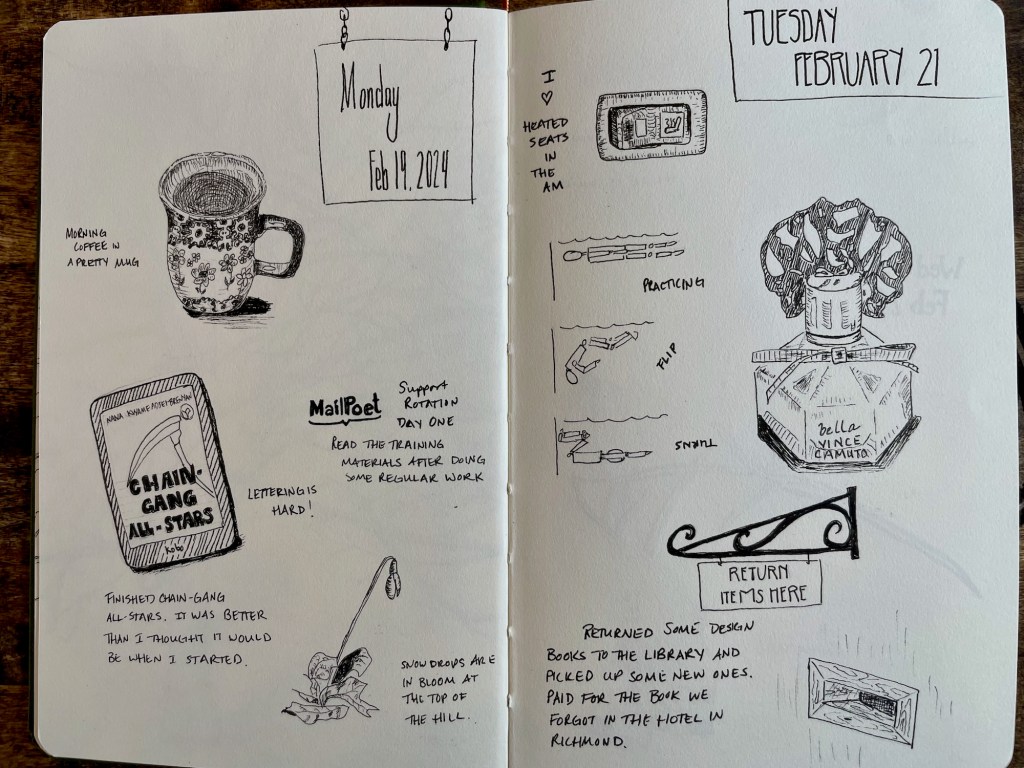
I still have garden stuff to do, but I’m gardened out for now. The fertilizer and new plants will have to wait for another weekend. With my two remaining days before going back to work, I want to return to my sketch journals. After completing my four week 10-minutes-per-day drawing challenge, I discovered that, surprise! I enjoy drawing as a method of journaling. I don’t complete an entry every day, but I do manage 2-3 journal pages per week. I enjoy the process of drawing little doo-dads from my days, and unlike my written journals, I actually go back and look at my drawn journal pages. I enjoy the little delights I’d forgotten about.
To help keep me going, I signed up for a 12-week creators club at work where we each committed to making something to exhibit at the end of the 12 weeks. I didn’t know what I would make; I only knew that I wanted to keep drawing, and I’d probably use pen and ink. We’re now 4 or 5 weeks from the exhibit, and I still don’t know what I’m going to make. I seem to like the mundane — I gravitate towards it in both my writing and my drawing. I enjoy daily nothings, just little delights. I also like lists. The list assignment in week four was one of my favorites from my January drawing challenge: I drew my ink bottles. I’m considering a list drawing for the creators club. Maybe a sketch list of 10 boring things about me, or of my favorite drinks.
I know what my motivations are not. In all my years of journaling I’ve rarely reread a journal entry. Journals from the past 20 years line my shelf. I can’t bear to get rid of them, but I also know I will never read them. I’m not interested in looking backward. Keeping records does not motivate me to journal.
I frequently think I’ll want to journal to warm me up so that I can write something real. But that rarely happens. I’ll journal for 10 or 30 minutes, and then my writing itch is satisfied and I don’t move on to something that’s not riddled with “I”s. So “writing warmup” is not a motivator either.
Journaling has always pulled me toward it. I have garden journals, gratitude journals, tarot journals. I have hand-written journals, digital journals, drawn journals. I have journals of pen inks, book journals, nutrition journals, cycling journals, running journals, work journals. But why?
Sometimes, I think I want to journal so that I can observe my progress in an area. That’s where the cycling and running journals would come in, or the journals I start when I want to pick up a new habit. I do reference some of the more specific journals, like my gardening and tarot journals, so I can see what was happening at this time last year in the garden, or learn from other times I’ve pulled a certain tarot card. But I don’t end up using journals to track progress over time (see “I’m not interested in looking backwards” above). It might be good for me to reflect and all that, but ugh, I don’t want to.
I do know one of my motivations for journaling is that I like to write. Plain and simple. Take words out of my brain and put them in order on a page? Yes please. Journaling is the most frictionless path to do that. I love using my fountain pens, but I’m fine tapping words out on a keyboard as well. Journaling helps me clear my head. It gets messy in there if I don’t let some of the words out. Similarly, but a little different, I journal to clarify my thinking. I frequently turn to pen and paper when I’m trying to work through a problem, and I need to get all the pieces out on paper (it does have to be paper when I need to work through a problem). This helps me understand what I think, whereas when it’s all swirling around in my head, I can’t put all the pieces together in a way that makes sense.
But even those motivators don’t explain the fact that I tend to start journals for everything I’m interested in. Several of my journals don’t involve stringing words together. My nutrition journal is primarily checkboxes and colors. My drawn journal is sketches, often without words. So what is it that drives me to say, “I’m going to start a journal for that”?
I think my motivation for journaling is that it helps me focus on the things I want to bring into my life. To capture something on paper or screen, I have to give that thing my attention. I have to say, “What did I eat today? Did I eat anything green?” Or “What’s beautiful in the garden today?” Or “What’s going on in my head? What do I think?” Or “What am I thankful for today?”
It is work to do this! And strangely, I think that’s a motivator as well. When I sat at the breakfast table this morning and read the prompt*, “What are my motivations for journaling?”, I had a bunch of thoughts. The presence of a lot of thoughts could make it seem like it’d be easy to answer such a prompt. But thinking without writing is very different from actually writing. It took effort for me to pull out my laptop and start writing. A lot more effort than what I had previously planned to do, which is lay on the couch and read.
But the effort of journaling results in creation rather than consumption. It feels good to create. You put in the effort, you make something, and it’s concrete. It’s not ephemeral. The act of creation feels very grounding. And the work of creating makes me feel satisfied. I like to lay on the couch and read, and that is what I’ll do next, but reading doesn’t make me feel satisfied. Not like writing does. And especially not like writing towards something I want bring into my life.
*I’m doing a journaling challenge through the Day One journaling app, and today’s prompt was “What are my motivations for journaling?“
When I was pregnant with our son, in the summer of 2003, my husband and I traveled to Europe for the first time. We stayed with a friend in Marseille, and then traveled with him to his home city of Barcelona. I kept a dedicated journal on the trip, a paper journal with the Eiffel tower on its cover. I wrote nearly every day. I wrote about the croissants and baguettes our friend fetched from the bakeries each day in Marseille. I wrote about trying to buy train tickets to Aix en Provence without knowing any French, and trying to figure out how to use a payphone to call our friend to tell him we’d be late for dinner, and about trying to order food in a restaurant where we couldn’t read the menu and didn’t speak any French. I wrote about how nervous we we were about all of that, and how much energy it takes to move around in a place where you don’t know the language.
I wrote about the anticipation of waiting on the roadside for the Tour de France to race by, and the helicopters and caravan that preceded the cyclists, and the clicking and whirring and whoosh when the peloton finally sped by. I wrote about following our friend in the car from Marseille into the streets of Barcelona, and how we glued ourselves to his bumper because we had no idea where we were going and no way of contacting him if we got separated. I wrote about our friend’s father, and his apartment and terrace and the meals he made for us in Barcelona. I wrote about the busker painted as a devil who gave me a devilish kiss when I tossed a coin into his cup, and how exciting it was to go to Spain where we could understand the language and speak it a little bit after being in France where we could not. I wrote about photographs I overexposed and missed forever because I didn’t set my camera correctly or didn’t capture at all because I didn’t have a wide angle lens. I wrote about the siestas and the heat and the walking and the pastries, and how my feet ached and swelled because I was pregnant, and it was July, and it was very hot.
As I convert this journal from paper to digital and read all the entries in the process, I am grateful to my past self that I wrote so much down. These entries took a lot of time for me to write — I frequently stop an entry to say my hand hurts, or I had to break for a meal, or now I’m on the plane after the trip and am trying to capture it all in the air before I forget, but it’s taking hours to capture every day — and I’m glad I took the time to write them. They pull out details and impressions, fears and excitement, sounds, smells, and sensations that snaps on a cell phone, or even nice photos with my real camera, which is how I now document my travels, just don’t capture.
My husband and I have traveled a lot more since that first trip, and I am — I don’t know the word for what I’m feeling, maybe surprised? wistful? — reminded of what it was like to know so little, to have so little experience with travel, and to not have cell phones to communicate when we were going to be late or if we got separated from our friend, to not have a digital camera for quick photos, and to not have a translation tool for signs and menus, or digital maps for navigation. I don’t want to go back to those pre-tool times, but this journal makes me wish I kept better written diaries of my travels since that trip.
This year, the magnetism of the tarot tugged at me more than usual. I’ve played with self-reading for a few years, but I struggled to make meaning of what I was doing.
This year, I wanted to really learn the tarot. I’d never owned or really even looked at the traditional Rider-Waite-Smith cards, which are the most well-known and referenced tarot images, so I bought myself the Radiant version of the deck. The deck came with a proper guide book I could learn from rather than the tiny paper insert that often comes with a small box of tarot cards. I also bought the book Tarot for One by Courtney Weber, and I started listening to the Tarot Heroes podcast. Those resources, along with the guidebooks from my existing decks, help me understand traditional interpretations of individual cards, deck-specific interpretations, and how to think of the tarot in general.
But what brought it all together, what helped me start to internalize the cards and really make meaning of them in a fun way that adds zest to my life, was to not just pull cards every day, but to journal about them. Pulling tarot cards helps me set an intention each day and focus my attention towards that intention. For example, as I shuffle I might ask, “What should I pay attention to today to have a fulfilling day at work?” Journaling about the cards helps me learn them: I pull cards, look them up, consider what I see and what guidebooks say, and write my thoughts and interpretations. At the end of the day, I look at my journal entry from the morning and reflect on the day as it relates to the cards. This last step helps me understand cards that might not have made sense at the beginning of the day (and maybe they still don’t at the end of the day! And that’s okay! This is a hobby, it’s all for fun, this is not life or death.)
I love two things about the journaling process. First, journaling reinforces the message of the cards so that throughout the day, I pay attention to events or my mindset in relation to my intention. Writing about the cards helps me remember them. For example, when I pull cards I might ask, “How can I approach today so that I have a happy day?” If one of the cards indicates “Be open to saying yes,” writing that out will help me remember that message during the day. If something comes my way that my knee-jerk reaction is to say No to, maybe I’ll pause and consider whether Yes is actually a better answer. Second, by keeping a journal, I can reference previous entries to see what happened when I pulled a certain card last time, or I can identify patterns. This helps me learn the how the cards show up in my life, what they mean for me, and what lessons keep showing up that I might need to learn.
A coworker asked for any tips on how to get started with tarot journaling, so here are some of the ways I journal.
How I journal
I started by journaling on paper, but this method missed a really important part of the tarot, which is the visual element of the cards. Tarot cards are tiny pieces of art in which every component has meaning: suit, numbers, colors, posture, sight-line, atmosphere, clothing, plants, animals, tools. In a paper journal where I just wrote words, my journal entries lacked that visual representation. So I switched to a digital journal using the Day One journaling app*. I pull cards first thing in the morning, take a photo of them, then drop the photo into a new entry in my Tarot journal on the app. I title the post with whatever intention I focused on when I pulled the card, then I write my thoughts about what the cards mean. At the end of the day, I check back in and write a summary of the day and how the cards seemed to relate.
*An added benefit of keeping a digital tarot journal is that it makes it much easier to search for specific cards from past readings.
Different kinds of entries
Daily encounter This is a three card pull: the first card represents me and how I’m showing up, the second card represents an encounter that day, and the third card represents the outcome. When I first started my tarot journey this year, I’d pull these three cards, read about them in the guide book, and write out those meanings in my journal. I pretty much copied the books verbatum, and then at the end of the day, tried to correlate the card meanings with what my experience was like that day. After a while, I realized this copy paste style was akin to memorization rather than understanding, so I switched to pulling single cards and studying the art on them to find my own meaning. Now, when I pull my daily encounter spreads, I jot down what the cards mean to me and then revisit at the end of the day.
Single card Sometimes three cards are too much to digest, or I find myself not really paying attention to what I think about them and instead just regurgitate what the guidebooks say. In those periods, I’ll pull one card for the day with the sole intent of learning that one card — I’m not even necessarily asking a question about the day. I’ll put the card next to my laptop and look at it closely while I describe it in my journal. I’ll describe the colors, the facial expressions and body language, and the overall feeling it gives me. Then I’ll write what I think it is saying as a piece of art. Throughout the day or at the end, I’ll jot down moments that felt like the energy of the card.
Bigger spreads It’s rare that I do spreads any more complex than three cards except on my birthday. On my birthday, I’ll usually do a solar year spread where I pull one card to represent the whole year, and then 12 cards: one for each month. I photograph the spread and tag it in my journal so that when the month changes over, I can easily find the spread and see what to look forward to that month.
Reference Sometimes I want to take notes that are general to the tarot, and that I use as reference entries to help in my own interpretation of cards. For example, I have an entry that describes the suits (swords, cups, pentacles, wands) and an entry for numerology. I imagine one day I might have one for colors, and I have a couple of reference entries from exercises in Tarot for One. I tag these with a Reference tag in my journal app, which makes it easy to find them when I want to jog my memory.
Have fun!
My favorite thing I learned this year about the tarot is that it originated as a card game: they were playing cards. When asked for advice he’d give beginners, Jeff Petriello, co-creator of the Pasta Tarot deck said on the Tarot Heroes podcast, “Oh my god, have fun! That is absolutely the biggest thing to remember…These cards were used as playing cards for centuries… so it’s really important to remember to play with them. They have a whole history in play so I really try to encourage beginners to have that spirit.” His advice helped me not take anything seriously, and to just play around with my cards and in my journal.