My recent read of Alone in the Classroom got me all excited about words again. Since I can’t seem to stop with the blogs, I created a new one: Andrea’s Lexicon. Each entry is short. A word and its meaning. Enjoy :-).
Tag: lexicon
-
Dear lotion pump manufacturer,
This may seem a strange request, but I am a writer who loves words, and I wondering if there is an industry term for the crusty glob of lotion that clogs the tip of a dispenser. Because you attempt to design products to prevent these clumps, I thought you might have a name for them. If so, would you mind sharing the term with me?
Thank you,
Andrea Badgley~
Sometimes I feel like a lunatic, like when, on the day I wrote a collage on Lunacy, I sent the above email out to several soap and lotion dispenser manufacturers. I have no need for the term. I’m not working on a piece about lotion or its dispensers; I have no place for the name once I have it. I just want to know: what is the word for that crusty bit?
When I sent out that email, I was researching lunar words for my Wednesday word work – moon, lunacy – when I came across this entry in the dictionary:
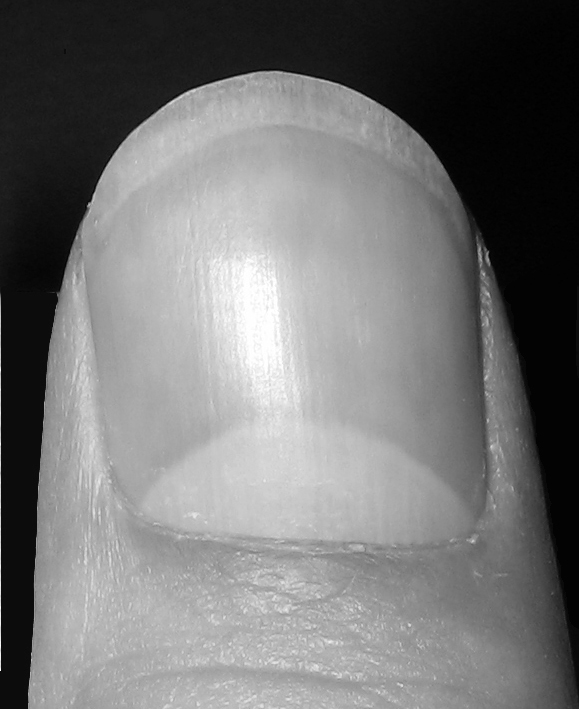
lu·nu·la n. A small crescent-shaped structure or marking, esp. the white area at the base of a fingernail that resembles a half-moon.¹

lunula Who would have thought there was a word for that half-moon at the base of our fingernails? I was awed by this for some reason, that this seemingly useless body part (is it even a part?) would have a name. In a quest for a decent photograph of a lunula, I followed the word down the internet rabbit hole and, as I gagged over photos of thick, yellowed, and sometimes even green finger and toenails, I discovered that our nails are evaluative tools for doctors: the health of a patient’s fingernails can be indicative of nutrient deficiencies, diabetes, anemia. And it occurred to me, when a doctor evaluates, she needs a name for each body part; she can’t be writing a report and say “that little white thing at the base of the fingernail, the half-moon shaped bit, is not the right shape.” She’s a busy woman. She needs to have language to say “Lunula is malformed.”
This precision of language is my favorite takeaway from Strunk and White’s gem, The Elements of Style:
Omit needless words. Vigorous writing is concise.²
In order to be concise, writers, like doctors, need to have language that allows for this precision. We need to have words. We need to have names.
Everything has a name. Even the snipped tips of green beans. On a recent radio quiz show episode, a guest player canned green beans for a living. The host asked, What are the tips of green beans called, the end things that we cut off? I hate those things – surely you guys have a name for them. Snips. They are called snips once they’re snipped off (EVM when they are still on: extra vegetative matter).
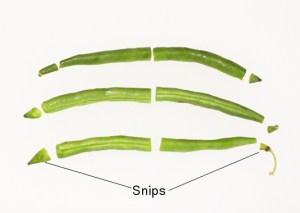
Green bean snips (original photo credit: http://yireservation.com/recipes/dry-fried-string-beans/) When you need a name for a thing, you go to the people who work closely with that thing, like doctors for human anatomy, or green bean canners for green bean anatomy. And for lotion dispenser diagnositcs? You go to lotion dispenser manufacturers. In writing group, we talked about words, and precision of language, and how everything has a name. Like the globby chunk of dried lotion that clogs the dispenser. My friend Lesley said, There must be a name for that. I’ll bet people in the lotion industry have a name for it.
I have not yet received a reply to my emails, but that day, when I was under the lunar influence, I thought a good name would be operculum, like the door attached to a moon snail’s foot, the door that seals off the entrance to its shell. If I do not hear back from the lotion pump people, and if I ever have occasion to write about the crusty bit that clogs a pump’s tip, that is what I’ll call it. An operculum.
*log·o·phile n. a lover of words.³
¹ “lunula.” The American Heritage College Dictionary. Third Ed. 1993. Print.
² Strunk, William, Jr.; White, E.B. (2000). The Elements of Style (Fourth Edition). Boston: Pearson. p. 23.
³ “logophile.” Dictionary.com Unabridged. Random House, Inc. 26 Mar. 2014.<Dictionary.com http://dictionary.reference.com/browse/logophile>. -
I’m feeling festive among the jeweled reds of the season. I don’t want to take too much time away from family to write on Christmas (though they are all occupied with other things – new Wii games, a new Samsung tablet, a pre-feast workout), but the colors of the day are inspiring me. Since I gathered greens in the garden this summer, I’ll complete the holiday palette with a collection of crimsons on Christmas:
ruby
garnet
maraschino
cranberry
pomegranate
framboise
raspberry
roseate
dark cherry
candy apple
holly berryclaret
merlot
cabernet
bordeaux
burgundy
sugared berry
poinsettia
cardinal
scarlet
crimson
dried cranberrysanta suit
peppermint swirl
fire engine
vermillion
grenadine
Bing cherry
red tartan
strawberry
rhubarb
carmine
candied cherryMerry Christmas everyone!
Did I miss any holiday reds? Please share your favorites in the comments.
-
I’m all fired up after declaring I will dedicate next year to craft work within my writing practice: technique, structure, word choice, revision (gulp). The moment I pressed publish on my previous entry, 2014: The year of the craft, the moment I made the decision to postpone submitting until I have a firm grasp on writing, I felt giddy about focusing on what I love (writing) instead of what writing might get me (publication).
So giddy, in fact, that I read The Elements of Style, the first of my craft work resolutions, before the new year even began. I read the tiny guide-book in two sittings, chuckling and highlighting “Aha!” passages throughout (see review on Goodreads). Strunk and White invigorated me, and I went directly from the final page of their delightful little book to the first page of the latest issue of Creative Nonfiction. The special double issue, which celebrates the magazine’s 50th volume and 20 years of publication, chronicles the history of creative nonfiction, the genre, and Creative Nonfiction, the journal. The essays on its pages – sharp, poignant, beautifully written, and on a level I have not yet reached – convinced me of the rightness of my resolution, and I realized I’d better come up with a plan of action while my resolve is still strong.
I debated whether to share my steps here because, well, the titles are kind of embarrassing. “Mentor Monday.” “Talking Tuesday.” But the thing is, I’m not a young thing anymore; I need memory aids. If I want to hit several elements of craft work, and if I want to practice them regularly, I need to make time for each one in my week. And I’m pretty sure the only way I’m going to remember what I want to do each day is via a mnemonic device that works for me: alliteration. Here’s my plan, in all its cutesy glory:
Mentor Monday
I dedicate Mondays to craft exercises prescribed by writing mentors (i.e., the books I resolve to read this year). Specifically, I plan to work through Priscilla Long’s The Writer’s Portable Mentor. I plan to work through Long’s exercises with my writing group, but if you want to adopt this schedule, any mentor will do. Most writing books include writing prompts or exercises, and Monday is the day I plan to focus on that aspect of craft.
Talking Tuesday
Revision advice that crops up again and again, across writing books, across writers, across writing blogs and websites and comment sections, is to read your work out loud to listen for mistakes. I, too, have written about reading out loud, and how effective it is for finding holes or unnecessary repetition or phrasing that just doesn’t sound right. But despite learning the lesson first hand, I rarely remember to read my work out loud. Tuesdays will now be dedicated to the auditory element of revision.
Word Work Wednesday
This may be the day I’m most excited about in the week. I LOVE word work: exploring dictionaries, cataloging color names, mining for verbs, making mind maps. In February of 2013 I started a lexicon. At first I registered a favorite word every couple of days. Now it sits dusty on my writing shelf, along with all those writing books I started and abandoned because I was burning with submission fever. No more. My lexicon will get a work out every Wednesday in 2014. This Wednesday, Christmas day, I plan to collect words for the color red: holly berry, cherry pie, peppermint swirl.
Workshop Thursday
I didn’t really need an alliterative title for this one because I meet up with my writing group on Thursdays; it is unlikely I will forget what Thursdays are for. In weeks we don’t meet, however, I will spend Thursdays doing what we normally do in writing group: 10 minute prompted writes, exercises from writing books, and planning for the next week’s work.
Free Friday
Do I need to explain this one? Friday is for whatever the heck I want it to be for.
Wisdom Weekends
That sounds awfully stuffy doesn’t it? If you can come up with a W word for reading, please let me know. I plan to dedicate weekends, if I have leisure time, to catching up on reading: magazines (Poets & Writers, Creative Nonfiction); literary journals (The Sun when I finally save enough money for a subscription), online journals (Vela magazine, Brevity), and of course, all the writing books I aim to finish throughout the year.
That’s the plan for 2014. I’ll let y’all know mid year how it’s going. Until then, Merry Christmas, Happy New Year, and may your resolve hold for all your 2014 resolutions!
P.S. If you have any favorite festive yuletide words, please share them here. I’d love to gather them in my lexicon for this week’s Word Work Wednesday. Thanks!
-
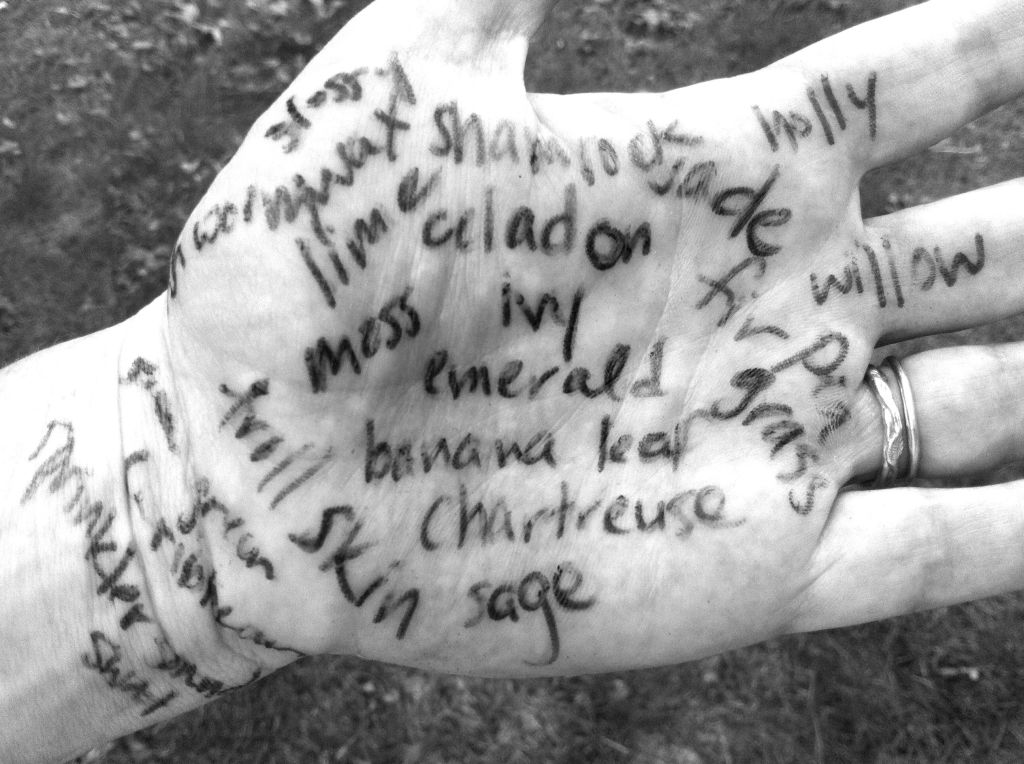
Fistful of words (for green) When I sit at my tan desk, in our beige room, with dull buff carpet beneath my chair, I often have a hard time coming up with color words. I google “synonyms for green,” rifle through crayon boxes, and scroll through images of paint chips and artists’ color names, but I am not usually inspired by what I find.
Then today, in an effort to wring the last few drops of fun out of summer before the kids go back to school, we rode our bikes over to the Virginia Tech horticulture garden, where they love to play in the sprinklers and find flowers in the colors of the rainbow (“Here’s a red one!”, “I found orange berries!”). I had folded up a blog post draft and stuck it, along with a pen, in my back pocket so that I could work on it in the quiet of the gardens while the kids played, and as I scribbled and edited, walking the mulched paths, filling the page with ink, I saw a pale green hydrangea.
“Hey guys, here’s green,” I said.
“Oh, flowers!” our daughter said when she saw them. “We don’t usually find green flowers, we just use leaves for green.”
I studied the hydrangea petals, trying to determine their color, and thought, celadon. Is that what color celadon is?
 Yes.
Yes.I looked around and saw banana leaves, fir trees, weeping willows, and thought, these are each a different green – dark and glossy for banana leaves, shadowy blue-green for firs, a soft yellow-green for willow. Each plant species is its own hue. And so I started writing. I’m not usually a write-on-my-hand type of person, but my paper was full, and I needed these words.
“Mom, what are you doing?”
“I’m writing down all the greens I see,” and wrote sage. “What greens do y’all see?”
They shrugged, as if that were a dumb question, and then our daughter said, “Shamrock.” Yeah, she’s good.
“Inch worm,” said our son.
They ran off to play in the sprinkler, and I sat and filled my hand. A few minutes later they came back dripping, and our daughter said, “We saw some algae in the pond that looked like troll skin.”
“Troll skin! That’s perfect,” I said, and wrote it down.
“Troll skin isn’t a color,” said our son.
“Sure it is – it’s silvery blue-green and warty.”
“Yeah,” said our daughter, “that’s what color the algae was – it was even bubbly like warts.”
On the bike ride home, the kids shouted out more words – “pea,” “yellow-green,” and “olive” – and when I saw my friend Dee, she asked, “Did you get peridot?” Now, thanks to their assistance, and to inspiration from the gardens, when I am sitting in our neutral living room, trying to conjure color words, I have an entire page in my lexicon dedicated to the color green:
celadon
banana leaf
jade
grass
lime
troll skin
olive
beryl
malachite
viridian
fernivy
chartreuse
fir
holly
moss
sea
peridot
forest
pine
kale
kiwiemerald
sage
pea
willow
inch worm
meadow
apple
shamrock
spinach
mint
boogerSpecial thanks to my friend Dee for peridot, and to our children for shamrock, pea, inch worm, sea, olive, troll skin, and booger.
-
It is summer, and that means it’s time for sipping iced drinks out on the porch while… wait, is it a porch? Maybe it’s a deck. A lanai? Maybe a veranda.
When I wrote my second vignette from a white sand beach, the one about the woman sweeping her walk, I originally wrote, “I sip coffee on the porch while my family sleeps in.” After a few reads, I realized that wasn’t quite accurate. I witnessed the scene from above, from the second floor, but the word “porch” suggested that I was on ground level. After a few rounds of adding descriptive sentences to give the reader the impression of height, to indicate a bird’s eye view, I sighed in frustration that I was gunking up the piece with too many extra words. Then I looked at “porch” and realized I only needed to make one change. I swapped “porch” with “balcony” and was finally able to move on.
That small change reminded me that though I grew up in a world in which outdoor seating areas are as important as living rooms, I never know the right word to use for each one. Did we rock on Grandaddy and Nannie’s front porch, or was that a veranda? When we sat in cushioned wicker furniture and ate peanuts from a crystal bowl on a glass-topped coffee table at Grandma and Grandpa’s, was that a screened porch or something else? Why was my parents’ screened area in Georgia called a screened-in porch, but when we moved to Florida everyone’s screened porch was called a lanai? Is a deck the same as a patio? Is “porch” an umbrella word that covers veranda, lanai, patio, and deck? Or does a porch have certain specifications – a railing, perhaps, or a cover?
Well, folks, I decided to find out. Here’s a primer* on balconies, porches, and patios.
balcony – 1. A platform that projects from the wall of a building and is surrounded by a railing, balustrade, or parapet. [from Old Italian balcone meaning scaffold]
courtyard – An open space surrounded by walls or buildings and adjoining or within a building.
deck – 2. a. A platform or surface likened to a ship’s deck. 2. b. A roofless floored area that adjoins a house.
lanai – 1. A Hawaiian word for veranda. 2. A veranda or roofed patio, especially a fully furnished one used as a living room. (so it doesn’t have to have a screen!)
patio – 1. An outdoor space for dining or recreation that adjoins a residence and is often paved. 2. A roofless inner courtyard, typically found in Spanish and Spanish-style dwellings. [from Old Provençal patu, pati meaning pasture or Latin patere, to lie open]
porch – 1. A covered platform, usu. having a separate roof, at an entrance to a building. (a porch does have a cover!) 2. An open or enclosed gallery or room attached to the outside of a building; a veranda. [from Latin porticus ‘entrance hall,’ and before that porta meaning ‘gate’]
portico – A porch or walkway with a roof supported by columns, often leading to the entrance of a building [from Latin porta meaning ‘gate’]
veranda – A porch or balcony, usu. roofed and often partly enclosed, extending along the outside of a building. Also called regionally gallery. [Hindi varanda, and before that Persian bar amadah, meaning coming out]
So it turns out that “porch” is not an umbrella word that covers all of these. Based on the etymology of the word, a porch is necessarily attached to an entrance, and its origins lie in the fact that a porch provides shelter at a doorway. Similarly, the etymology of veranda suggests that a veranda is also attached to an entrance. It seems that veranda and porch can be used interchangeably, though veranda seems to suggest extension along the side of a building while a porch can either extend or occur solely at the doorway. Verandas and porches do not require railings, but balconies do.
As for where we rocked at Nannie and Grandaddy’s and watched fireflies, the red planked area was roofed, attached to an entrance, had a railing, wrapped around the house, and was raised off the ground, so it would be accurate to call it a porch, a veranda, or a balcony. At Grandma and Grandpa’s, where we admired coastal Georgia sand dunes from the comfort of a fully furnished screened porch, if we wanted to get exotic (they did live on an island, after all), we could say we sat and ate peanuts on their lanai. Although, in my research, I found that lanais are generally floored like a patio, in the sense that they are tiled or paved, and Grandma and Grandpa’s porch floor was planked. Also, lanai tends to be used in more tropical climates, which explains its popularity in Florida, so maybe Grandma and Grandpa’s was more accurately a screened-in porch or veranda.
And finally, patios. Though patios are related to courtyards, the difference is that a patio does not have to be surrounded by walls or buildings, whereas a courtyard does. The difference between a deck and a patio is that a deck is floored, usually with wooden planks, like a ship’s deck, while a patio is paved with cement, brick, or stone pavers, like a courtyard. Additionally, a patio will be laid directly on the ground, while a deck will be slightly raised as it requires some sort of support. Neither is covered, which differentiates them from porches and verandas, and a patio can be either connected to the house or separate from it while a deck is generally attached.
So there you go. Now I’m going to go out back to sweep our brick patio and dream about the adirondack chairs my husband is going to build for our wooden deck.
*Definitions from 1993 The American Heritage College Dictionary, Third Edition


 Butterfly Mind