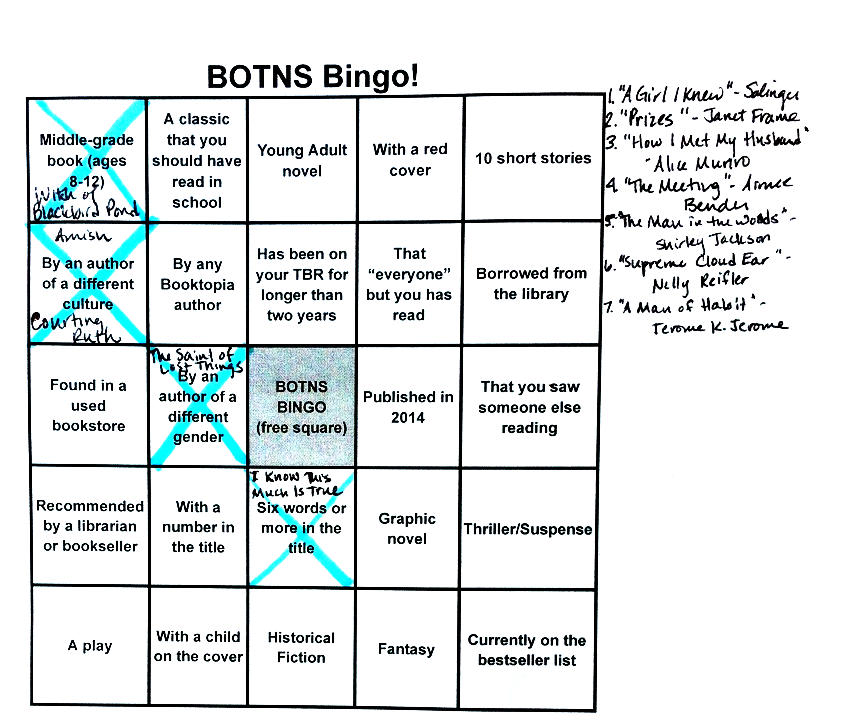
In case there was any question of my coolness, let’s just put that notion to rest: I am currently playing summer book bingo.
But look how awesome that card is!!
As you may or may not know, I am in the midst of an epic reading project. I am reading three books set in each of the 50 US states, plus the District of Columbia, and because diversity of authors and characters is central to the project, my reading this year has expanded into subjects and genres and neighborhoods that I might have otherwise overlooked.
So when I heard Ann Kingman and Michael Kindness talk on their Books On the Nightstand (BOTNS) podcast about how they want to make summer reading fun this year – by designing Beach Blanket Book Bingo card and aiming for a Bingo by Labor Day – I was ALL. OVER. IT. I mean, look at those options! “Currently on the bestseller list,” “that ‘everyone’ but you has read,” “published in 2014.” That last is one I’m particularly excited about. I almost never read brand new books. The wait list at the library is always too long. But the next book I plan to read for Delaware, The Book of Unknown Americans by Cristina Henríquez, was published in 2014 and, get this, I am first on the wait list! It’s killing me to abstain from marking that box with a big blue X. I want to mark it SO BAD. I know I have to wait till I’ve finished the book, though, and I’m just thinking about how good it’s going to feel to squeak my highlighter across that square.
Some folks are attacking their Bingo card with a strategy: they plan to read titles tailored to a specific row on the Bingo card. In the spirit of Bingo as it is played in Bingo halls around the nation, I’m taking a more randomized approach. I’m going to carry on with my reading as I had planned, state by state, Connecticut to Delaware to the District of Columbia, each book a ping pong ball with a BOTNS category stamped on it, and see if I can manage a Bingo before Labor Day. Maybe I can even score a Blackout Bingo – maybe I can fill the whole card.
Do you want to play? Go to BOTNS Bingo! to print out your card; be sure to hit your refresh button to get a fresh card. Then read your books, start marking your boxes, and if you want to follow along with other Book Bingo players, check out the BOTNS Bingo thread on Goodreads.
Henry Dumas: Arkansas-born poet and short story author
Arkansas was kicking my butt, y’all. It began well, with me devouring Charles Portis’s True Grit in two days, but when I finished the book, I realized a good half of it took place in the Oklahoma territory. Should I count it for Arkansas on my Andrea Reads America tour? (Andrea Reads America = three books set in each state, with works by men, women, and authors of color)
On top of the True Grit dilemma, Arkansas was the state that spawned my Where are the ethnic authors? post. After reaching out to faculty in the University of Arkansas English department, I still didn’t have any works of fiction set in the state of Arkansas and written by Arkansas authors of color. I considered relaxing my fiction rule to read the professor-recommended nonfiction titles; I considered reading an Arkansas-set novel written by a novelist who has lived her whole life in New York.
I took a break from Andrea Reads America to read The Goldfinch while I ruminated on what to do about the Arkansas dilemma(s).
When I finished The Goldfinch, I was doped on excellence. I drifted through life in that post-amazing-novel daze where you haven’t yet blinked back into reality; I knew whatever followed was going to suffer, like those poor ice skaters who crash when they follow a gold-medal performance.
And what followed was Maya Angelou’s I Know Why the Caged Bird Sings. I’ve read the book before, and I know it is good, but it did not satisfy me this time. I wanted fiction. I wanted landscape. Caged Bird is nonfiction; it is soulscape. I thought, well, maybe I need something funny, something totally different from the literariness of The Goldfinch; maybe I need something light, something totally different from the seriousness of I Know Why the Caged Bird Sings.
I found a murder mystery series set in Arkansas and written by Arkansas author Joan Hess (she satisfies my woman author criterion!), and I drove to our library to pick up one of the titles in the series, Misery Loves Maggody. I tried to like it, I really did. But the characters were caricatures – exaggerated and expected – and the settings, dialogue, and scenes were cliché after cliché after cliché. The murder didn’t even happen until more than 100 pages in. But more disappointing than any of that was that since I did not detect authenticity in the characters, I did not trust the setting either; the setting could have been a silly spoof of any Southern town – I didn’t get a feel for Arkansas from it.
In other words, Misery Loves Maggody didn’t work for me either.
I was a teensy bit frustrated at this point. Just a tinch. I still needed a non-Caucasian author, and I still needed a woman. One of the Arkansas professors suggested Janis Kearney, the Presidential Diarist for Bill Clinton. She is an African-American writer from Arkansas who wrote a biography of Daisy Bates, an Arkansas civil rights activist. She also wrote a memoir, Cotton Field of Dreams. Awesome, right? Woman and not white. Works set in Arkansas. Problems solved, right?
Neither were available at our county or University libraries. And as I’ve mentioned before, despite being an avid reader, I rarely buy books.
On the drive home after yet another trip to our county library, where I discussed the option of an interlibrary loan of Cotton Field of Dreams with the librarian ($3 fee, could be a few weeks before it shows up, maybe I should just order it), it occurred to me: why don’t I run a search for short stories? Surely there’s at least ONE short story out there by an ethnic author. That’s all I need. Just one.
So I searched.
I searched, and I found.
Henry Dumas. Born 1934 in Sweet Home, Arkansas. Called “an absolute genius” by Toni Morrison. Wrote poetry and – get this – short stories. Fiction! And? And! When I searched the University catalogue, his short story collection, Ark of Bones, with – praise the Lord – stories set in Arkansas, pinged “Available, 3rd Floor, Newman Library.”
The next day, after a trip to the 3rd Floor, Newman Library, I plopped down on our couch with Ark of Bones, and I nearly cried for joy. The stories are alive, and they are different from anything I’ve read in a very, very long time. If ever. They are dark and smoky, masculine and earthy, filled with mojo and magic; they read as if they come from a long line of souls buried deep in the earth. I imagine Henry Dumas was an intense man; he certainly had a reverence for the dignity of his race.
Most importantly, in what is surely the crowning accomplishment in his writing career, he rescued me from a post-Goldfinch spiral and an anti-Arkansas frustration. I am grateful to him for that. And I am grateful to the works that didn’t work: I would not have found Henry Dumas without them.
I decided to keep True Grit for Arkansas. It’s too great a book to leave out.
I am reading America: 3 books from each state in the US with the following authorships represented – women, men, and non-Caucasian writers. To follow along, please visit me at andreareadsamerica.com.
Holy cow, y’all. I’ve made it to California (in my reading project). After STRUGGLING to find suitable Arkansas-set novels written by Arkansas authors (it was a STRUGGLE. more on that in a future post.), I finally found three titles, and I finished reading my third last night. I woke this morning, ready to move on, ready to start my search for California-set novels written by California-based authors, and I am overwhelmed by the possibilities. Hollywood. San Francisco. California desert. Redwood forest.
Actually that last one, the redwood forest, is a setting I’d love to read, but I haven’t come across a title set there. Any ideas?
Anyway, I’ve got so many options I’m not sure what to do with myself. For the Asian-immigration experience alone I’m seeing four titles that all sound exciting (The Gangster We Are All Looking For, The Buddha in the Attic, Shanghai Girls, and of course, The Joy Luck Club). There’s an Indian-American title I want to read because I loved the movie (The Mistress of Spices). There’s a coming-of-age novel that I’ve already read and I’ve been looking for an excuse to reread (The Language of Flowers). There are recommendations from you (Ramona, Parable of the Talents), and recommendations from The Readers podcast (Tales of the City; A Way of Life, Like Any Other). There are a million light and fun and kitchy California-set titles, Hollywood and Malibu spoofs.
And then, of course, there is Steinbeck. I’m not sure I can read California without reading Steinbeck. I loved East of Eden and Grapes of Wrath, and maybe this is my chance to read Cannery Row, you know?
Sigh. I guess this is a good dilemma to have – to be presented with so many options I can choose whatever I want. If within 10 pages I don’t like a book, I’ve got a long list of backup titles and I can feel free to DNF. But where to begin?! Maybe I’ll start with whatever the library has in the format I want, right here, right now. It will be like closing my eyes and pointing, which from where I sit right now, is as good a way as any to pick my first book.
*A fat wave, according to Rippin H2O’s surf lingo, is “An enormous and sweet ride that comes along maybe once a day.” Reading that lingo list, with words like ducknweave (“on the bourbons”), grundle (“A totally ugly dude that thinks he’s really hot”), and party wave (“When more than one person takes a wave”) made me also want to read a California surfing book.
I am reading America: 3 books from each state in the US with the following authorships represented – women, men, and non-Caucasian writers. To follow along, please visit me at andreareadsamerica.com.
Sometimes we want what we want even if we know it’s going to kill us. We can’t escape who we are. – Donna Tartt
I took a break from Andrea Reads America to read The Goldfinch, the 756 page tome that was all the rage in 2013, for book club. Holy shizzle. By the final 200 pages you could barely pry the book from my hands.
Set in modern day New York City, in an abandoned neighborhood development outside Vegas, and a little bit in Amsterdam, The Goldfinch is the story of Theo Dekker, son of an absent alcoholic dad and a stable, art-loving mom. At age 13, Theo is suspended from school, and as he and his mom kill time at an exhibit before meeting the principal, the museum is bombed in a terrorist attack. Theo survives, but his mother does not. In the rubble among the dead, there is one man who is still alive, though dying, whom Theo bonds with in the still settling dust of the aftermath. The man, an antique and art dealer, gives Theo a ring and tells him where to take it when he escapes the museum, and he insists that Theo take The Goldfinch, the masterpiece Theo’s mom had been admiring, off the wall – to save it from destruction, yes, but also because the painting pairs with Theo’s soul.
The saga that follows is impossible to resist – PTSD, a 13 year old orphan living with a friend on Park Avenue, an alcoholic dad who whisks Theo off to Vegas, a friendship with a Russian boy named Boris, drugs and drugs and drugs, and always the painting, tugging, gripping Theo in its clutches as surely as alcoholism grips his father, as opiate pills grip Theo, as the chain grips the little yellow goldfinch to the wall.
The Goldfinch is dark alleys and golden sunlight, it is the constant grapple with who is good and who is bad, who is the right one to love, who is the wrong one; it is about how can I be any other than who I am. The Goldfinchmade me want to be reckless. It made me grateful that I’m not. It gave me a new favorite character – Boris – though in real life I would never feel safe with him. The Goldfinch is art and sublimity. It is about being shackled to things against our will – objects, memories, addictions, genetics – and finding beauty in the darkness.
In it, Tartt captures the addict perfectly – the distortion between the addict’s internal world and his external actions, his justifications, his own belief that he is good even while he is behaving badly, the lying, the covering up, the brilliant high, the tar black low, the emotional depths, the passion for who and what he loves, the aspiring to great ends via shady, ugly means.
The Goldfinch, as any great art will do, showed me a life I’ll never know while making me see my life differently. The thing about this book, aside from Tartt nailing the the struggle of the addict, the wrestling with trying to be good while knowing you are acting badly, is that Tartt shows us we can never escape who we truly are, and what can we do about that?
The Goldfinch: A Novel by Donna Tartt. “A young boy in New York City, Theo Decker, miraculously survives an accident that takes the life of his mother. Alone and determined to avoid being taken in by the city as an orphan, Theo scrambles between nights in friends’ apartments and on the city streets. He becomes entranced by the one thing that reminds him of his mother, a small, mysteriously captivating painting that soon draws Theo into the art underworld.” (Goodreads blurb)
I have a confession to make. A major motivator in my Andrea Reads America project is my ambition to read more Great American Literature. I’ve read Faulkner and Ellison and Steinbeck; I’ve read Cather and Walker and Lee; but Philip Roth – who’s he? John Updike? Never tried him. Toni Morrison? I want to read more of her work. As I work my way across the USA, reading three books set in each state, I aim to finally get to some of the big names that I might otherwise never read.¹
Pulitzer Prize fiction winners and finalists set in specific US statesNational Book Award fiction winners set in specific US states
Following the lead of researchers Kidd and Costano, who published a recent paper in Science suggesting that reading literary fiction improves empathy, I turned to the Pulitzer and National Book Award lists to find examples of Great Literature. I compiled lists of winners and finalists, and based on blurbs, reviews, and Goodreads tags, I noted the setting of each book in my spreadsheet.² If the narrative was set primarily in a specific state within the United States of America – not in generic-town-USA, not overseas, but in a specific location within the US – I plotted it on the maps above.³ Books that are based mainly on a journey across states are, for the most part, not included.⁴ Full list of titles follows.⁵ ⁶
I am reading America: 3 books from each state in the US with the following authorships represented – women, men, and non-Caucasian writers. To follow along, click on the Andrea Reads America tab on the left. For more resources on reading geographically, please see Resources for taking a literary tour of the US.
————————————————————————————————————————–
¹ No, I do not plan to read every book listed here. Are you crazy?
² If I am wrong on any of these, please correct me. In cases where I haven’t read the book (i.e. most of them. 88% in fact.), I cannot be sure how much of the narrative takes place in a particular setting. Also, the stars on the maps do not indicate specific cities or setting within a state, only that the book is set in the state. I’d be here forever if I scaled down to city level, and I’ve got reading to do.
³ The spread is fascinating, isn’t it? What’s up, Western States? Also, look how many Pulitzer winners are set in New York: NINE if you include finalists. The committee was hooked on Maine for a while there, too. And the state with the most National Book Awards? Illinois. What does it all mean, people?!
⁴ My personal familiarity with the books came into play here. Though the story travels from Texas to Montana, I included Larry McMurtry’s Lonesome Dove for Texas, mainly because the point of view is clearly Texan, and because McMurtry evokes Texas so beautifully that the state becomes a character in the story. I wonder if John Steinbeck’s The Grapes of Wrath works similarly for Oklahoma, as it is told from the Okie perspective as Oklahomans journey west to California. I do not remember the book well enough to feel comfortable plotting it in either Oklahoma or California. If you have strong feelings on this, please let me know in the comments.
⁵ Pulitzer Fiction Winners and Finalists by state setting
AL – To Kill a Mockingbird by Harper Lee (1961)
AL – The Keepers of the House by Shirley Ann Grau (1965)
AK – The Snow Child by Eowyn Ivey (2013 finalist)
DC – Advise and Consent by Allen Drury (1960)
FL – Guard of Honor by James Gould Cozzens (1949)
FL – Swamplandia! by Karen Russell (2012 finalist)
GA – Andersonville by MacKinlay Kantor (1956)
GA – The Color Purple by Alice Walker (1983)
IL – An Unfinished Season by Ward Just (2005 finalist)
IN – The Bright Forever by Lee Martin (2006 finalist)
IA – A Thousand Acres by Jane Smiley (1992)
LA – A Confederacy of Dunces by John Kennedy Toole (1981)
ME – Tinkers by Paul Harding (2010)
ME – Olive Kitteridge by Elizabeth Strout (2009)
ME – Empire Falls by Richard Russo (2002)
MA – The Edge of Sadness by Edwin O’Connor (1962)
MI – Middlesex by Jeffrey Eugenides (2003)
MS – The Optimist’s Daughter by Eudora Welty (1973)
MS – The Reivers by William Faulkner (1963)
MO – The Way West by A. B. Guthrie (1950)
NE – The Echo Maker by Richard Powers (2007 finalist)
NJ – The Brief Wondrous Life of Oscar Wao by Junot Diaz (2008)
NJ – American Pastoral by Philip Roth (1998)
NM – House Made of Dawn by N. Scott Momaday (1969)
NY – The Mambo Kings Play Songs of Love by Oscar Hijuelos (1990)
NY – Ironweed by William Kennedy (1984)
NY – The Stories of John Cheever by John Cheever (1979)
NY – The Amazing Adventures of Kavalier & Clay by Michael Chabon (2001)
NY – Martin Dressler: The Tale of an American Dreamer by Steven Millhauser (1997)
NY – All Souls by Christine Schutt (2009 finalist)
NY – The Privileges by Jonathan Dee (2011 finalist)
NY – Mr. Ives’ Christmas by Oscar Hijuelos (1996 finalist)
NY – At Weddings and Wakes by Alice McDermott (1993 finalist)
ND – The Plague of Doves by Louise Erdrich (2009 finalist)
OH – The Town by Conrad Richter (1951)
OH – Beloved by Toni Morrison (1988)
OK – Mean Spirit by Linda Hogan (1991 finalist)
PA – The Killer Angels by Michael Shaara (1975)
TN – A Summons to Memphis by Peter Taylor (1987)
TN – A Death in the Family by James Agee (1958)
TX – Lonesome Dove by Larry McMurtry (1986)
TX – Collected Stories by Katherine Anne Porter (1966)
UT – The Executioner’s Song by Norman Mailer (1980)
VA – The Known World by Edward P. Jones (2004)
VA – The Confessions of Nat Turner by William Styron (1968)
WY – Close Range: Wyoming Stories by Annie Proulx (2000 finalist)
⁶ National Book Award Winners by state setting
CA – In America by Susan Sontag (2000)
FL – Shadow Country by Peter Matthiessen (2008)
GA – Paris Trout by Pete Dexter (1988)
GA – The Color Purple by Alice Walker (1983)
HI – From Here to Eternity by James Jones (1952)
IL – The Man With the Golden Arm by Nelson Algren (1950)
IL – Herzog by Saul Bellow (1965)
IL – The Eighth Day by Thornton Wilder (1968)
IL – So Long, See You Tomorrow by William Maxwell (1982)
LA – The Moviegoer by Walker Percy (1962)
LA – Victory Over Japan: A Book of Stories by Ellen Gilchrist (1984)
MA – The Wapshot Chronicle by John Cheever (1958)
MI – Them by Joyce Carol Oates (1970)
MN – Morte D’Urban by J. F. Powers (1963)
MS – Salvage the Bones by Jesmyn Ward (2011)
NE – Plains Song by Wright Morris (1981)
NE – The Echo Maker by Richard Powers (2006)
NJ – Goodbye Columbus by Philip Roth (1960)
NY – The Magic Barrel by Bernard Malamud (1959)
NY – World’s Fair by E. L. Doctorow (1986)
NY – Let the Great World Spin by Colum McCann (2009)
NC – Paco’s Story by Larry Heinemann (1987)
NC – Cold Mountain by Charles Frazier (1997)
ND – The Round House by Louise Erdrich (2012)
PA – Ten North Frederick by John O’Hara (1956)
PA – The Centaur by John Updike (1964)
PA – Rabbit is Rich by John Updike (1982)
RI – Spartina by John Casey (1989)
WV – Lord of Misrule by Jaimy Gordon (2010)
If you’ve read any of these and have opinions on them, please let me know. I’ve read a few and thought Bah, what’s the big deal? while others have blown me away. I’m curious what your thoughts are. Thanks!
I am reading America: 3 books from each state in the US with the following authorships represented – women, men, and non-Caucasian writers. To follow along, please visit me at andreareadsamerica.com.
I am looking for titles set in each US state by authors from that state. Can you help? Scroll down for details on the project. Thank you!
Alabama: Alberty Murray
Alaska: Velma Wallis
Arizona: Alfredo Vea, Jr
Arizona: Leslie Marmon Silko
Arkansas: Henry Dumas
Arkansas: Maya Angelou
Arkansas: Janis F. Kearney
California: Chitra Banerjee Divakaruni
California: Octavia Butler
California: Amy Tan
Colorado: ?
Connecticut: Ann Petry
Delaware: Bertice Berry
D.C.: Edward P. jones
Florida: Zora Neale Hurston
Georgia: Alice Walker
Hawaii: Kiana Davenport
Hawaii: Kaui Hart Hemmings
Hawaii: Lois-Ann Yamanaka
Idaho: Janet Campbell Hale
Illinois: Richard Wright
Illinois: Gwendolyn Brooks
Indiana: ?
Iowa: Bharati Mukherjee
Kansas: Langston Hughes
Kentucky: William H. Turner
Louisiana: Lalita Tademy
Maine: ?
Maryland: Frederick Douglass
Massachusetts: Dorothy West
Michigan: Ben Carson
Minnesota: Louise Erdrich
Mississippi: Jesmyn Ward
Mississippi: Richard Wright
Missouri: ?
Montana: James Welch
Nebraska: ?
Nevada: ?
New Hampshire: ?
New Jersey: Junot Diaz
New Mexico: Rudolfo Anaya
New Mexico: M. Scott Momaday
New York: Oscar Hijuelos
New York: Nella Larsen
New York: James Baldwin
New York: Toni Morrison
New York: Colson Whitehead
North Carolina: Harriet Jacobs
North Dakota: Louise Erdrich
Ohio: Toni Morrison
Oklahoma: Linda Hogan
Oregon: Heidi Durrow
Oregon: Mitchell S. Jackson
Pennsylvania: M.K. Asante
Rhode Island: Jhumpa Lahiri
South Carolina: ?
South Dakota: Charles Eastman
Tennessee: Alex Haley
Texas: Ito Romo
Texas: Jovita Gonzalez
Utah: ?
Vermont: Jamaica Kincaid
Virginia: Edward P. Jones
Washington: Sherman Alexie
Washington: Jamie Ford
West Virginia: ?
Wisconsin: Nina Revoyr
Wyoming: ?
One of the most challenging aspects of my Andrea Reads America project* has been finding works of fiction set in each state written by non-Caucasian authors who are either from the state or have lived there as a resident (*my project is to read each state via male, female, and non-Caucasian authors). When I wrote about this difficulty in a previous post, Where are the ethnic authors?, several readers asked that I compile a list of the titles I have so far so that they could help fill in the gaps. (Thank you @LissGrunert and The Afro-Librarians for the suggestion. I’m holding you to your offer now.)
I have not been looking super far ahead, so as of the original posting date of this entry (January 13, 2014) there are a ton of gaps beyond Arkansas, which is as far as I’ve gotten in my research. I have found non-Caucasian authors from 22 states (and the District of Columbia) and am lacking titles for the remaining from 28. If you have favorite titles that meet the following criteria, please leave me a note in the comments below (or via Twitter at @andreabadgley) and I will add them to the list. If you know a title set in a specific state but do not know where the writer is from, don’t worry: please give me your titles anyway and I’ll research the author’s background. All genres are welcome:
Non-Caucasian author (African-American, Asian American, Latino, Native American, Indian American, etc.)
Narrative set in a specific US state
Author born in or has lived in the state in which the title is set OR author writes about personal ancestors in the state
For a minute I considered waiving the residency requirement in favor of only reading fiction, but after my husband said, Whoa, hold on a minute there Tiger, I changed my mind. He reminded me of the original spirit of my quest, which is to experience the United States through the voices of its people. I think the fairest way to maintain consistency and the authentic experience of each state is to read work written by authors who were born or raised, or who lived or died in that state. So whether you’ve got nonfiction or fiction titles (including short story collections), please feed them to me here, as long as they meet the criteria above. Thank you so much for your help, and here we go!
Please pass this list around to any readers you know so we can fill it in and provide a resource for folks who’d like to diversify their reading. Thank you!
*I am reading America: 3 books from each state in the US with the following authorships represented – women, men, and non-Caucasian writers. To follow along, please visit me at andreareadsamerica.com.