There’s a certain thrill in recognition. When I read Moby Dick and encountered famous passages, especially later in the book after I’d really put in the work, I thought, “I know that line! And here I am! Reading the book!” After my mom and I went to New York and had tea at The Plaza, and unrelatedly, I re-read The Great Gatsby, and realized Daisy, Tom, Nick, and Gatsby drank their drinks during the boiling hot New York City day at the Plaza, I thought, “I was there! At the Plaza! I know that place!”
I don’t know what makes recognition exciting. Maybe it’s the connection to humanity. Lines from literature become famous because they resonate with so many people. This hotel is so decadent and desirable, artists create stories within it. Maybe the recognition reinforces connection among us all and creates a sense of belonging. “Ah yes, me too! I see now.”
I don’t have regrets. Every choice I’ve made has led me to where I am, which is a place of deep love and satisfaction. I sometimes daydream, though. If I could maintain the most important pieces of my life — my husband, kids, and friends — boy it would have been fun to have studied literature. There are so many great works I haven’t read. And so many I struggle to understand on my own. Our son went to college to study Computer Science. He took English classes for fun, and he fell in love with them, and now he is double-majoring in CS and English. He tells me about his lit classes, and what he’s reading, and makes recommendations to me, and loves being in classes where someone else knows what they’re talking about and can help the students understand the genius that lies in a piece of writing.
It’s not the same as having an instructor and a classroom full of people to discuss something with, but I am making an effort to read classics I probably otherwise wouldn’t pick up on my own. The book podcast I listen to (Book Riot) recently put out an episode on which classics to read to be well-read. I paid for a Patreon membership just to get access to this episode.
I read The Odyssey, which was first on their chronological list. I’d read it in college, but my only memory of it was that it bored me to distraction. I struggle when the language is stodgy or impenetrable and doesn’t flow naturally to my sensibility. I can’t get past the stilted wording to get to the underlying story, and I therefore find the whole thing dull. I almost ran into the same problem this time, when I downloaded the free version from Project Gutenberg. My eyes glazed over and I knew I wasn’t going to get anything out of this exercise. I asked my friend Gracie, who loves The Iliad and fulfilled her life purpose by visiting the Trojan ruins on our team meetup to Istanbul, if she had a favorite of The Odyssey. She shared the translation by Emily Wilson. I checked it out from the library, and I was completely absorbed. Translation makes huge difference!
That said, I didn’t have any moments of deep recognition with The Odyssey, other than when Odysseus is tied to the mast to listen to the siren song without dashing his ship to pieces on the rocks. My main thought about the scene was, “That was so short!” It was only a couple of lines. Maybe the recognition will come later when something references The Odyssey and I will get it.
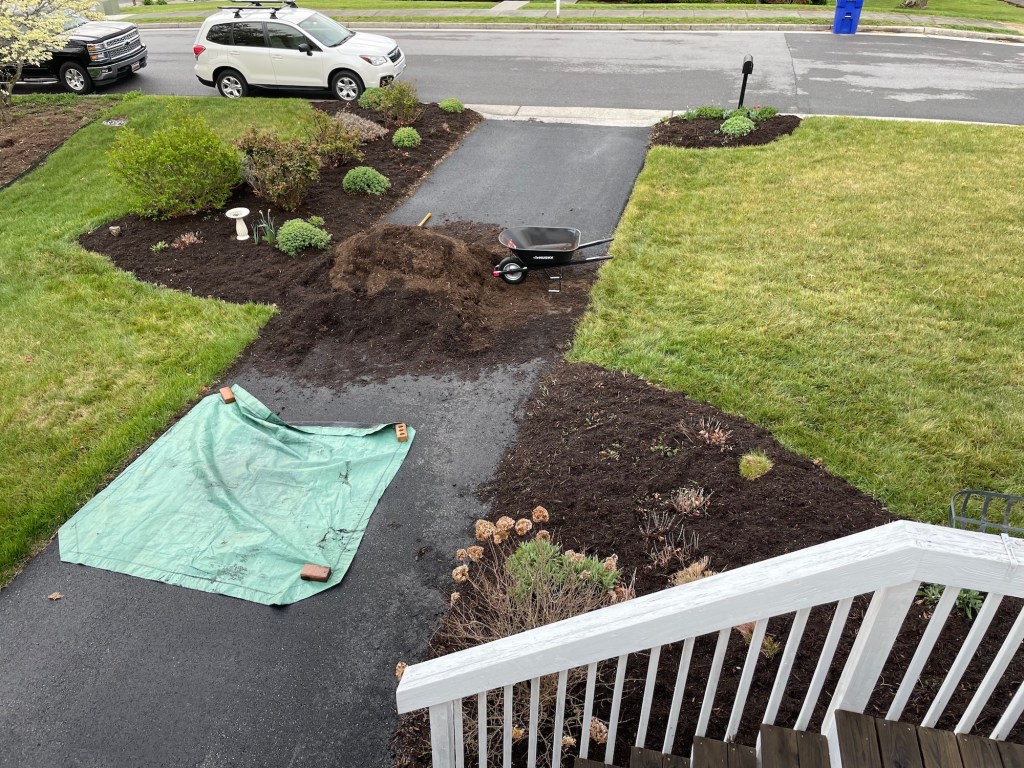
Yesterday, after titling a blog post “Waiting for mulch,” it occurred to me that I’ve seen Waiting for Godot referenced maybe a million times throughout my life. I’d never read it or watched it and had no idea what it was about, so I loaded an audio version on my phone and listened while I shoveled mulch. I tell you what, nothing clicked for me on that one either. I had to research it after I listened to understand why it’s a big deal and why it’s so important.
It would seem that this ambition to read classics is not really working out for me. I am not dissuaded. I want to read Emily Wilson’s translation of The Iliad to decide for myself which is better — The Iliad or The Odyssey — since there is not agreement among my friends and family. I’ll keep trying with other classics as well. One that gets referenced almost as much as Moby Dick is Don Quixote. Don Quixote is so influential, it spawned a new word in the English language: quixotic. Someone used that word at work the other day, and though I had to look up its meaning, I knew its origins were Don Quixote, which made me want to read this absolute doorstop of a book, just because a word was created from it, and someone used that word in every day conversation. I just don’t know if I can do Don Quixote. I’ve tried once before and kept putting it down to do literally anything else. I guess it took two tries and 10 years for me to read Moby Dick, so there may yet be hope for Don Quixote. I’m also considering Dante’s Inferno. I read that one in high school but don’t remember it.
I don’t know why I want to read this stuff. It’s not guaranteed that I’ll have exciting moments of recognition when I read them. I guess I just want to be a part of the connective tissue that literature creates.









 Butterfly Mind