I have a confession to make. A major motivator in my Andrea Reads America project is my ambition to read more Great American Literature. I’ve read Faulkner and Ellison and Steinbeck; I’ve read Cather and Walker and Lee; but Philip Roth – who’s he? John Updike? Never tried him. Toni Morrison? I want to read more of her work. As I work my way across the USA, reading three books set in each state, I aim to finally get to some of the big names that I might otherwise never read.¹


Following the lead of researchers Kidd and Costano, who published a recent paper in Science suggesting that reading literary fiction improves empathy, I turned to the Pulitzer and National Book Award lists to find examples of Great Literature. I compiled lists of winners and finalists, and based on blurbs, reviews, and Goodreads tags, I noted the setting of each book in my spreadsheet.² If the narrative was set primarily in a specific state within the United States of America – not in generic-town-USA, not overseas, but in a specific location within the US – I plotted it on the maps above.³ Books that are based mainly on a journey across states are, for the most part, not included.⁴ Full list of titles follows.⁵ ⁶
I am reading America: 3 books from each state in the US with the following authorships represented – women, men, and non-Caucasian writers. To follow along, click on the Andrea Reads America tab on the left. For more resources on reading geographically, please see Resources for taking a literary tour of the US.
————————————————————————————————————————–
¹ No, I do not plan to read every book listed here. Are you crazy?
² If I am wrong on any of these, please correct me. In cases where I haven’t read the book (i.e. most of them. 88% in fact.), I cannot be sure how much of the narrative takes place in a particular setting. Also, the stars on the maps do not indicate specific cities or setting within a state, only that the book is set in the state. I’d be here forever if I scaled down to city level, and I’ve got reading to do.
³ The spread is fascinating, isn’t it? What’s up, Western States? Also, look how many Pulitzer winners are set in New York: NINE if you include finalists. The committee was hooked on Maine for a while there, too. And the state with the most National Book Awards? Illinois. What does it all mean, people?!
⁴ My personal familiarity with the books came into play here. Though the story travels from Texas to Montana, I included Larry McMurtry’s Lonesome Dove for Texas, mainly because the point of view is clearly Texan, and because McMurtry evokes Texas so beautifully that the state becomes a character in the story. I wonder if John Steinbeck’s The Grapes of Wrath works similarly for Oklahoma, as it is told from the Okie perspective as Oklahomans journey west to California. I do not remember the book well enough to feel comfortable plotting it in either Oklahoma or California. If you have strong feelings on this, please let me know in the comments.
⁵ Pulitzer Fiction Winners and Finalists by state setting
AL – To Kill a Mockingbird by Harper Lee (1961)
AL – The Keepers of the House by Shirley Ann Grau (1965)
AK – The Snow Child by Eowyn Ivey (2013 finalist)
DC – Advise and Consent by Allen Drury (1960)
FL – Guard of Honor by James Gould Cozzens (1949)
FL – Swamplandia! by Karen Russell (2012 finalist)
GA – Andersonville by MacKinlay Kantor (1956)
GA – The Color Purple by Alice Walker (1983)
IL – An Unfinished Season by Ward Just (2005 finalist)
IN – The Bright Forever by Lee Martin (2006 finalist)
IA – A Thousand Acres by Jane Smiley (1992)
LA – A Confederacy of Dunces by John Kennedy Toole (1981)
ME – Tinkers by Paul Harding (2010)
ME – Olive Kitteridge by Elizabeth Strout (2009)
ME – Empire Falls by Richard Russo (2002)
MA – The Edge of Sadness by Edwin O’Connor (1962)
MI – Middlesex by Jeffrey Eugenides (2003)
MS – The Optimist’s Daughter by Eudora Welty (1973)
MS – The Reivers by William Faulkner (1963)
MO – The Way West by A. B. Guthrie (1950)
NE – The Echo Maker by Richard Powers (2007 finalist)
NJ – The Brief Wondrous Life of Oscar Wao by Junot Diaz (2008)
NJ – American Pastoral by Philip Roth (1998)
NM – House Made of Dawn by N. Scott Momaday (1969)
NY – The Mambo Kings Play Songs of Love by Oscar Hijuelos (1990)
NY – Ironweed by William Kennedy (1984)
NY – The Stories of John Cheever by John Cheever (1979)
NY – The Amazing Adventures of Kavalier & Clay by Michael Chabon (2001)
NY – Martin Dressler: The Tale of an American Dreamer by Steven Millhauser (1997)
NY – All Souls by Christine Schutt (2009 finalist)
NY – The Privileges by Jonathan Dee (2011 finalist)
NY – Mr. Ives’ Christmas by Oscar Hijuelos (1996 finalist)
NY – At Weddings and Wakes by Alice McDermott (1993 finalist)
ND – The Plague of Doves by Louise Erdrich (2009 finalist)
OH – The Town by Conrad Richter (1951)
OH – Beloved by Toni Morrison (1988)
OK – Mean Spirit by Linda Hogan (1991 finalist)
PA – The Killer Angels by Michael Shaara (1975)
TN – A Summons to Memphis by Peter Taylor (1987)
TN – A Death in the Family by James Agee (1958)
TX – Lonesome Dove by Larry McMurtry (1986)
TX – Collected Stories by Katherine Anne Porter (1966)
UT – The Executioner’s Song by Norman Mailer (1980)
VA – The Known World by Edward P. Jones (2004)
VA – The Confessions of Nat Turner by William Styron (1968)
WY – Close Range: Wyoming Stories by Annie Proulx (2000 finalist)
⁶ National Book Award Winners by state setting
CA – In America by Susan Sontag (2000)
FL – Shadow Country by Peter Matthiessen (2008)
GA – Paris Trout by Pete Dexter (1988)
GA – The Color Purple by Alice Walker (1983)
HI – From Here to Eternity by James Jones (1952)
IL – The Man With the Golden Arm by Nelson Algren (1950)
IL – Herzog by Saul Bellow (1965)
IL – The Eighth Day by Thornton Wilder (1968)
IL – So Long, See You Tomorrow by William Maxwell (1982)
LA – The Moviegoer by Walker Percy (1962)
LA – Victory Over Japan: A Book of Stories by Ellen Gilchrist (1984)
MA – The Wapshot Chronicle by John Cheever (1958)
MI – Them by Joyce Carol Oates (1970)
MN – Morte D’Urban by J. F. Powers (1963)
MS – Salvage the Bones by Jesmyn Ward (2011)
NE – Plains Song by Wright Morris (1981)
NE – The Echo Maker by Richard Powers (2006)
NJ – Goodbye Columbus by Philip Roth (1960)
NY – The Magic Barrel by Bernard Malamud (1959)
NY – World’s Fair by E. L. Doctorow (1986)
NY – Let the Great World Spin by Colum McCann (2009)
NC – Paco’s Story by Larry Heinemann (1987)
NC – Cold Mountain by Charles Frazier (1997)
ND – The Round House by Louise Erdrich (2012)
PA – Ten North Frederick by John O’Hara (1956)
PA – The Centaur by John Updike (1964)
PA – Rabbit is Rich by John Updike (1982)
RI – Spartina by John Casey (1989)
WV – Lord of Misrule by Jaimy Gordon (2010)
If you’ve read any of these and have opinions on them, please let me know. I’ve read a few and thought Bah, what’s the big deal? while others have blown me away. I’m curious what your thoughts are. Thanks!
I am reading America: 3 books from each state in the US with the following authorships represented – women, men, and non-Caucasian writers. To follow along, please visit me at andreareadsamerica.com.
 ‘Salem’s Lot, by Stephen King: I was a young teenager when I went through my Stephen King phase. My family lived in a large house on a small island off the coast of Georgia. At the time there were only a few houses on the island, and our road was dirt, not asphalt. We were a twenty minute drive from the mainland (ie a hospital), if there was an emergency. We were isolated. My room was on the second floor, and I had a white day bed with brass knobs on the corner posts. My bed was pushed up against the window, so that when I propped my head against the pillows to read, my body lay inches from the glass, my face in the center of the single four-foot pane. On the other side of the glass, a few feet from the house, swayed a cabbage palm, its moppy head at eye level with my bed.
 Gone With the Wind, by Margaret Mitchell: I was once traveling and got delayed in Atlanta for several hours – maybe six or eight? I had brought with me the 32-pound hardcover of Gone With the Wind, and with so much time on my hands, rather than sit in the loud and bustling Atlanta airport, I decided to take the Marta train downtown to Centennial Olympic park. I lugged Mitchell’s tome with me and found an outdoor table at a café where I could watch kids chase bursts of water shooting up from the ground in the Centennial park fountain. As I read with my huge book splayed flat on a black iron café table, the moist Georgia heat pressed down on me. Condensation from my icy Coke trickled down the cup and pooled, then dripped onto the sidewalk below. I didn’t understand Atlanta, this city that seemed to be both South and not-South, with its messy tangle of inelegant roads and its fast pace and its strange mixture of old and new that I rarely experienced in coastal or rural Georgia. For four hours I sat with my dripping cup and I turned pages. I read the city – it’s pre-Sherman heyday, its burning, its invasion by outsiders, the fierce pride and dignity of its natives, reconstruction’s disregard of the South’s ways, of gentility, and Atlanta’s in-your-face rise from the ashes – on the pages of Mitchell’s book as in real life I breathed its air, drank its Coke, and listened to the laughter of its children, finally, through a work of fiction, understanding the history of this proud city that rose and fell, and then rose to what it is today.
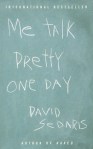 Me Talk Pretty One Day, by David Sedaris: (There are, um, a few F-bombs in this piece. Consider yourself warned.) Though it wasn’t the first time I read Me Talk Pretty One Day, my most memorable reading took place in Minnesota where, in the Mom circles I ran in, I never heard a single swear word (much to my dismay). I sat in the bleachers at the ice skating rink where my daughter wobbled back and forth in her lessons, the paperback in my lap, and I read “The Rooster,” a story about David’s brother, Paul, who “politely ma’ams and sirs all strangers but refers to friends and family, his father included, as either ‘bitch’ or ‘motherfucker.” Paul’s response to his father’s various lectures was, “‘Fuck it,’ or on one of his more articulate days, ‘Fuck it, motherfucker. That shit don’t mean fuck to me.”
 Butterfly Mind