The evening light has changed. After work, it shines an amber glow across spindly seedheads. Shadows stretch. Coppery leaves fall slowly to the ground.
At the beginning of October, our son announced he planned to watch a horror movie every day of the month. I don’t think he’s accomplished that, but his idea inspired me to read spooky classics.
I started with Frankenstein, which I hadn’t read since high school. At a friend’s 50th birthday in September, I got to talking to her her sister, a former high school English teacher. I asked what book she most liked to teach, and she said Frankenstein. She said she thinks it should be required reading for everyone. It tells of what happens when we go too far, when we create beyond ourselves without thought of consequence, when we play god, when our creations become more powerful than we are. The next weekend, when we visited The Lynx bookstore in Gainesville, I saw this shelf-talker from the same staff member whose writeup inspired my husband to read Virginia Woolf’s To The Lighthouse:
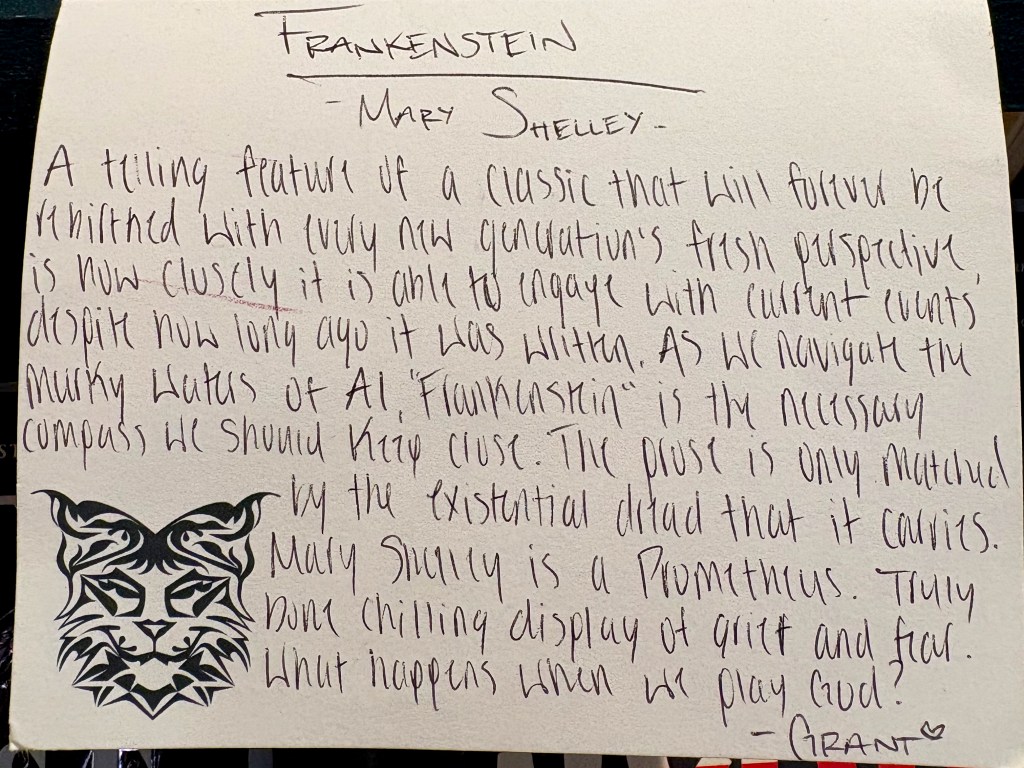
The two convinced me. I read it. It broke my heart.
Next I read The Shining. Stanley Kubrick’s masterpiece came to our local movie theater early in the month. We went to see it on the big screen with our son, and I wasn’t sure if I’d still want to read it after seeing it, but seeing it only made me want to read it more. Stephen King is such a delight! Like Frankenstein, I hadn’t read this in probably 35 years. It took me back to all the Stephen King I read as a teenager: Carrie, Pet Semetary, Misery. Cujo, Christine, Firestarter. The Tommyknockers. It. Salem’s Lot. It! Salem’s Lot! My favorite thing about Stephen King is that it’s so clear, so obvious, that this is a man who loves his job. He’s having a whale of a time writing these books. They’re imaginative and free and fun, and I can just see him laughing to himself as he rolls along with the stories that come out of him.
And also disturbing himself. The Shining goes deep inside the psyche, to those dark places that are part of us even as we try to be good. The main character, Jack, is a recovering alcoholic, 18 months sober when he and his family arrive at the Overlook hotel as caretakers for the winter. Anyone who’s interacted with a mean drunk, whether in real life or in fiction, has probably wondered, “Is that meanness who they really are, and the alcohol just lowers the barrier to let it out? Or is it the alcohol that makes them mean. Would they be kind if they never drank again?” I found myself asking similar questions with The Shining. What comes out when we’re under the influence, whether of drugs or alcohol or the Overlook hotel? Is that who we really are, or is it the substance we’re on?
Now I’m on Dracula. My husband and I are going to see an adaptation of it this weekend in a nearby theater, and I wanted to read it again before we go. I’d forgotten what a page-turner it is. And I do need to keep turning the pages — I only have three more days to finish it, and I’m about halfway through. But also, I came across a passage this morning that surprised me. When I think about faith, I typically think about faith in a higher power, in God, in a benevolent force outside ourselves. Bram Stoker flips that on its head in Dracula. In a clever argument for faith, instead of asking a man of reason to believe in God, he asks a man of reason to believe in the monster of Count Dracula:
I heard once of an American who so defined faith: ‘that faculty which enables us to believe things which we know to be untrue.’
This reminded me of Life of Pi, which was a transformative book for me when it comes to faith. It freed me to believe what I want to believe, even things which I suspect to be untrue.
I didn’t expect to take anything profound from reading horror novels, but here we are! What a pleasant surprise.
 ‘Salem’s Lot, by Stephen King: I was a young teenager when I went through my Stephen King phase. My family lived in a large house on a small island off the coast of Georgia. At the time there were only a few houses on the island, and our road was dirt, not asphalt. We were a twenty minute drive from the mainland (ie a hospital), if there was an emergency. We were isolated. My room was on the second floor, and I had a white day bed with brass knobs on the corner posts. My bed was pushed up against the window, so that when I propped my head against the pillows to read, my body lay inches from the glass, my face in the center of the single four-foot pane. On the other side of the glass, a few feet from the house, swayed a cabbage palm, its moppy head at eye level with my bed.
 Gone With the Wind, by Margaret Mitchell: I was once traveling and got delayed in Atlanta for several hours – maybe six or eight? I had brought with me the 32-pound hardcover of Gone With the Wind, and with so much time on my hands, rather than sit in the loud and bustling Atlanta airport, I decided to take the Marta train downtown to Centennial Olympic park. I lugged Mitchell’s tome with me and found an outdoor table at a café where I could watch kids chase bursts of water shooting up from the ground in the Centennial park fountain. As I read with my huge book splayed flat on a black iron café table, the moist Georgia heat pressed down on me. Condensation from my icy Coke trickled down the cup and pooled, then dripped onto the sidewalk below. I didn’t understand Atlanta, this city that seemed to be both South and not-South, with its messy tangle of inelegant roads and its fast pace and its strange mixture of old and new that I rarely experienced in coastal or rural Georgia. For four hours I sat with my dripping cup and I turned pages. I read the city – it’s pre-Sherman heyday, its burning, its invasion by outsiders, the fierce pride and dignity of its natives, reconstruction’s disregard of the South’s ways, of gentility, and Atlanta’s in-your-face rise from the ashes – on the pages of Mitchell’s book as in real life I breathed its air, drank its Coke, and listened to the laughter of its children, finally, through a work of fiction, understanding the history of this proud city that rose and fell, and then rose to what it is today.
 Me Talk Pretty One Day, by David Sedaris: (There are, um, a few F-bombs in this piece. Consider yourself warned.) Though it wasn’t the first time I read Me Talk Pretty One Day, my most memorable reading took place in Minnesota where, in the Mom circles I ran in, I never heard a single swear word (much to my dismay). I sat in the bleachers at the ice skating rink where my daughter wobbled back and forth in her lessons, the paperback in my lap, and I read “The Rooster,” a story about David’s brother, Paul, who “politely ma’ams and sirs all strangers but refers to friends and family, his father included, as either ‘bitch’ or ‘motherfucker.” Paul’s response to his father’s various lectures was, “‘Fuck it,’ or on one of his more articulate days, ‘Fuck it, motherfucker. That shit don’t mean fuck to me.”

