My recent read of Alone in the Classroom got me all excited about words again. Since I can’t seem to stop with the blogs, I created a new one: Andrea’s Lexicon. Each entry is short. A word and its meaning. Enjoy :-).
Tag: words
-
After arriving in Las Vegas last week for a work trip, I opened up my hotel room to my co-workers. I stayed in one of three social suites where we hung out at night to talk, snack, drink, and play Boggle. After I settled in, a couple other early arrivals stopped by to say hi and do some support tickets before the real work of the meetup was to begin. My friend and co-worker, Sandy McFadden, dropped a book on the round end table for me.
“I think you’ll like that,” he said. He pointed to the testimonials on the back of the book, one of which reads, “[She has an] evocative grace that brings to mind Annie Proulx.”
I smiled and stroked the book cover. Sandy, who lives in Nova Scotia, knows and shares my love for Proulx’s The Shipping News (he has also committed to letting us come visit him and his family some time in the coming years to see the Bay of Fundy. If you’re reading this, Sandy, I’m holding you to that promise!).
I was in the middle of a Jane Austen binge on the Vegas trip. I had read Persuasion a couple of weeks earlier, then Pride and Prejudice (SO GOOD), and I was in the middle of Sense and Sensibility when Sandy gave me the Saskatchewan and Ottawa Valley-set Alone in the Classroom by Elizabeth Hay. It sat, waiting, on my table in the hotel, for a whole week before getting packed in my suitcase to take home with me. I finished Austen on the flight home, and started Hay’s novel the first day I was back.
Within two pages I knew it would be my kind of book, with vivid descriptions of berries, of kettles to hold them, of hot kitchens to can them, of their sensuous ripening, and of their role in the story to come.
In a dress you were one flitting colour among many in a landscape that mobilized its colours into a procession of ripening — from wild strawberries in June… to raspberries in July that raked your hands and arms as you grabbed a thorny cane and swung it back like a throat about to be slit, the soft red fruit like gobbets of blood.
Hay’s writing makes me fall in love with language in a way I haven’t felt in quite a while. With sentences that unfold into unanticipated endings, with unusual phrases, she manages to capture secreted-away emotions I’d never be able to capture in words.
They heard a bird deep in the woods, a blue jay’s stabbing cry, and he startled her by saying that almost every day he heard or saw something so beautiful it was like tapping into all the sorrows of the world.
Why sorrow? Sorrow was not what I expected. But I felt the truth of it. It is more true than almost any other ending to that sentence. I don’t know why. Perhaps because beauty is ephemeral. Perhaps because the beauty of the earth, the beauty that is here without us needing to do anything, goes unappreciated, even destroyed. Perhaps because beauty makes us feel. Perhaps because there must always be balance, and beauty can’t only bring joy.
But it was this passage that really struck me, and secured my loyalty to Elizabeth Hay:
That week there were the kind of dark, intense, festering skies that reminded her of a full range of blues in a child’s box of colours. She felt a great urge to see the water.
After recently writing about the midnight blue crayon in my childhood Crayola boxes, I was both jealous of and grateful for her command of language. These aren’t complicated words. But the leap from the description of the sky to the craving it creates is graceful, and impressive. I know exactly the feeling Hay describes, the appetite the blues awake. She felt a great urge to see the water. I love everything about those two sentences, and the feeling they evoke, and the truth they capture.
Thank you Elizabeth Hay, and thank you Sandy.
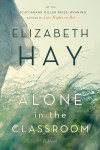 In a small prairie school in 1929, Connie Flood helps a backward student, Michael Graves, learn how to read. Observing them and darkening their lives is the principal, Parley Burns, whose strange behaviour culminates in an attack so disturbing its repercussions continue to the present day…
 -
Image courtesy of HomeSpot HQ.
I lay in bed this morning looking at our bedroom’s freshly painted walls. I studied the color, trying to find accurate words to describe it in my mind.
Cream.
That’s not accurate. Cream — dairy cream in real life — is more white. This is closer to vanilla ice cream, but still darker. Richer. It’s the color of French vanilla ice cream. It’s a rich cream.
And then I realized that’s the name on the paint chip: Rich Cream.
I have great admiration for the vocabulary of whoever names paint colors. Think of the scope of words you’d need to know. Most colors are named for something concrete: an object, a noun. For example, my office color is Lime Mousse. Our son’s room, a terra cotta color, is Oxide. Like rust.
I often want to paint a room a certain color simply because I like the feeling the name evokes. Our original pick for our room was Kansas Grain, which I loved the thought of sleeping in. Warm, light, golden. But the color wasn’t right for the space. It was too peachy. Now we sleep in Rich Cream, a bowl of silky vanilla ice cream, which isn’t a bad evocation either.
I suppose that’s another element of naming colors, which makes me appreciate the skill even more: the names evoke pleasant feelings. Our daughter’s room is Jamaica Aqua; our front door is Florida Aqua. Two colors, two names, that take me to warm, islandy, happy places.
I’m not the best at home improvement projects. I scowl and snap when I paint or try to execute upgrades at home. But I do love browsing paint chips. Frosted Emerald; Waterfall; Roman column; Wood Violet.
I love the sensory experience of seeing all those colors and exploring temperatures, tastes, textures, and smells the names evoke. I’d be terrible at naming — too many options! so much specificity! — but I delight in the work that paint-namers do.
For the month of April, I will publish a 10-minute free write each day, initiated by a prompt from my prompt box. Minimal editing. No story. Just thoughts spilling onto the page. Trying to get back into the writing habit.
-
Oh boy. This must be a prompt a reader left for me. I don’t know the meaning of the word “derelict.” It sounds like it should mean shabby or abandoned, like a crumbling house with broken windows, a porch that’s caved in, boards falling off the exterior. A derelict house would have once been smooth and honey brown with the color of fresh wood, but in it’s abandoned state would be grey and splintered.
Like a haunted house. The thing with haunted houses though, is that they are not truly derelict, if derelict means what I think it means. A haunted house is abandoned by the living, but not by the dead.
Growing up in Savannah, Georgia, I did a report for school on the haunted houses of our town. My friend and I borrowed a video camera and interviewed the owners of some of the stately old houses of Savannah — historical homes downtown on the squares, and the Victorian columned homes on Victory Drive. We interviewed the owners and asked them to tell us ghost stories.
The only one I remember is one on azalea-lined Victory Drive. A kind elderly woman walked us through the rooms of the house, telling us strange hauntings that had happened in each. The room I remember was a bedroom. The walls were plaster and were painted a soft color — a subtle mint or a pale blue — and the gentlewoman told us of footprints on the ceiling. The room was for visitors, and guests had awoken in that fluffy bed, looked up, and seen impressions of shoes indenting the solid white ceiling. The footprints moved as if two people were dancing.
I loved that story. It didn’t seem scary at the time, but it was daylight and there was no dancing on the ceiling.
So is a haunted house derelict? I don’t know. I don’t know if even an abandoned house is derelict. I think I need to look it up.
*Derelict does mean abandoned. Score! Thank you to LRose for the prompt.
For the month of November, I will be participating in NaBloPoMo and plan to publish every day of the month. Usually, I will publish a 10-minute free write, initiated by a prompt from my prompt box. Minimal editing. No story. Just thoughts spilling onto the page. Follow along with the tag #NovemberDaily.
-
Hard sounds and sharp edges. Pointy personality. Angular nose. Protruding bones. Persnickety is not soft. It is astringent, acerbic, tough, sharp, angular. I’ve used those words and can’t find the word I’m looking for.
Vinegary.
Picky and particular, sarcastic but not in a funny way. Puckery, like from lemons; not like for kissing.
Persnickety is not satisfied. Persnickety is tall and lean. Persnickety is pasty, does not like light, reminds me of vampires but only in the living-in-cold-stone-walls way, away from the the sun, not in the tempting sexy way of charm and seduction.
Persnickety likes the coasters just so (for coasters are a given). Persnickety likes the tassels aligned, the crumbs removed, the curtains symmetrical, the book spines uncracked. Persnickety does not allow dog-earing pages, or marring books in any way. Persnickety requires spotless glass, tidy tables, chairs pushed in. Persnickety, if it likes anything, likes order.
By this definition, I am persnickety.
Persnickety is a funny word. Cartoonish. Though the roundness of cartoon is in direct opposition to the harsh points and clacking sounds of persnickety. Still. Persnickety is a caricature.
I’ve got another minute to write and I’m out of things to say. Toast points. Cucumbers. Cream cheese. Salmon and capers and cilantro on a toasted bagel. These are not persnickety. Just words that are popping into my head.
actual definition of persnickety:
adjective, informal. 1. overparticular; fussy. 2. snobbish or having the aloof attitude of a snob. 3. requiring painstaking care.
For the month of April, I will be publishing a 10-minute free write each day, initiated by a prompt from my prompt box. Minimal editing. No story. Just thoughts spilling onto the page. Thank you to cindyloucamp for the prompt, “persnickety.”
-
sun, sunlight, solar
skin, hide, pelt, cuticle
freckles, moles, sun spots, age spots
golden, tan, brown, tawny
epidermis
bikini, naked
sunbathe, tanning oil, Coppertone
sunbow, sunbreak, sunbright, sunburst
sunbrowned
sunburned or sunburnt: reddened, tanned, seared by the sun’s rays
sunbaked
summer, sky, warm, hot
bright, blazing, blistering, sizzling
lush
tropical
sprinkled, spotted, freckle-faced
rays, sun rays
tan: to convert (skin) to leather by impregnation with an infusion of tree bark, mineral salts, or some other form of tannin or a substitute
sand, beach, salt
mineral, crust, salty, saline, briny, brackish, brown
salt-tinged, mud-tinged
beach chair, beach towel, lounge chair
wading, body surfing
cooler, salty snacks, boiled peanuts, Coke
tan, leather, browned, exposure
yellow, orange, glaring, white, blinding
shimmering, heat waves
sand, sandbar, sandbank, sandal
beach, shore, splash zone
quartz, glass, abrasive, grainy, gritty
sand crab, ghost crab, sand dollar
star fish, moon snail, mud ball
seashore, shoreline, beach comber
seashell
beach cusp (n.): sand and gravel deposits formed by wave action into points that project seaward along a coast
beach flea, beach grass, crustaceans, sea oats
sand dunes, reeds, sand burrs, stickers
superfine, white, dry, sugar sand
beach umbrella
Sunkist, Budweiser, Blondie: “The tide is high”
lifeguard stand
brown water, surf, waves, jetty
boats, boating, outboard, hum
hull, fiberglass, bimini
wake, kneeboard, crab traps, buoys
marsh, Spartina, oyster beds, mud flats
tide, tidal, rivers, creeks
serpentine, still, buzzing
boat deck, peach, warm, vibration
guard rail, bow rail, stainless steel
helm, anchor
bumper, line, cleat, dock
planks, searing hot, blistering hot
blistered skin, pink, tender
jellyfish, jelly balls, cannonball jellies
barefoot, flip flops
sundress, straps that hurt
melanoma, cancerFor the month of April, I will be publishing a 10-minute free write each day, initiated by a prompt from my prompt box. Minimal editing. No story. This one was just a spilling of words. I was tired of prose.
 Butterfly Mind