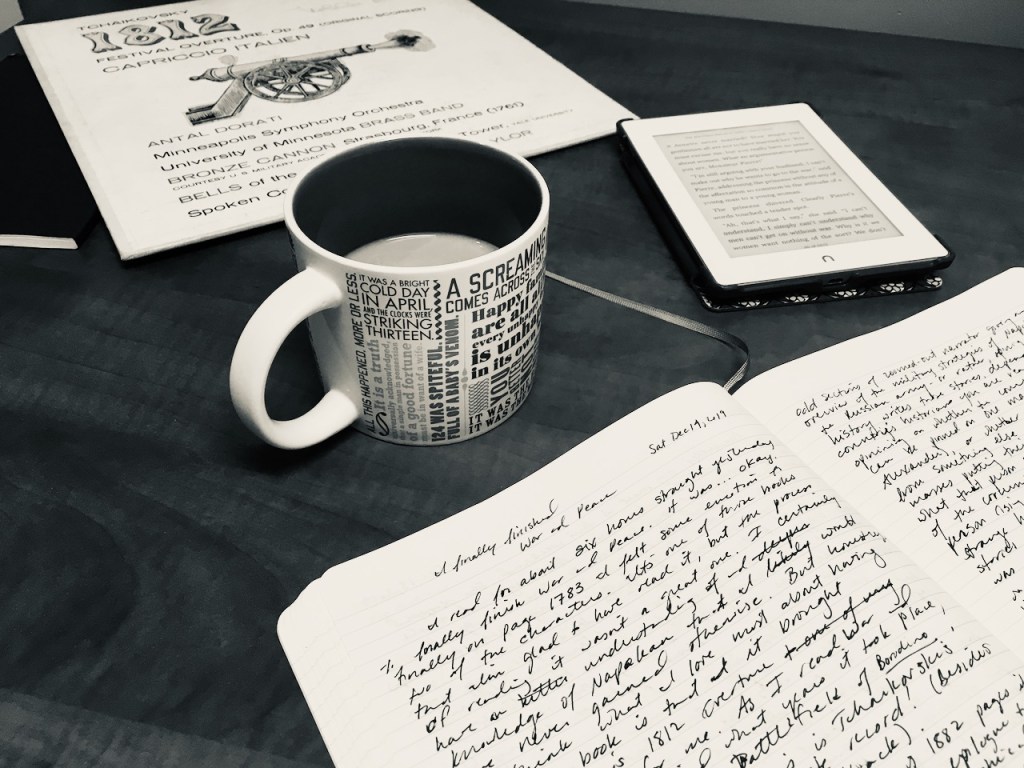
I read for about six hours straight on Friday to finish War and Peace.
It’s one of those books that I’m glad to have read it, but the process of reading wasn’t a great one. Kind of like Moby Dick. I certainly have a deeper and broader knowledge of Russia’s defense against Napoleon’s invasion that I would have never in a million years have gained otherwise. But like our kids say about history class, “When will I ever need this?”, I wonder why on earth I would ever care to know about Napoleon or his advance and retreat across Russia.
Maybe it’s because I feel gleeful when I understand abstract references in my daily life because of something I learned in a Great Novel that I read. Whenever I recognize a reference to Moby Dick or Anna Karenina, I get an unexpected trill of I read that! So now when I hear anything about Napoleon, even if it’s in something as dumb as Bill & Ted’s Excellent Adventure, I will feel a little tickle of pleasure that I now know something about him.
Honestly, though, what I love most about having read War and Peace is that it brought one of my grandmother’s favorite pieces of music to life for me. As I read the book, and realized what years it chronicles, and especially when the pages took us to the battlefield of Borodino in 1812, and I put it together that Tchaikovsky is also Russian, I realized, this is the cannons and the tolling bells of Tchaikovsky’s 1812 Overture.
Such a fearful spectacle, so great a mass of killed in so small a space, had never been seen by Napoleon nor any of his generals. The roar of the cannon that had not ceased for ten hours, exhausted the ear and gave a peculiar character to the spectacle (like music accompanying living pictures).
Leo Tolstoy, War and Peace
My copy of the novel is 1882 pages if you include the 92 page, ten-part epilogue, which I am. The epilogue, like the novel, is part story and part repetitive philosophical arguments that read like geometric proofs. Snore. I wondered several times if I was just reading a poor translation because of the redundancies. My conclusion is that the book didn’t have to be this long.
Like a runner in a marathon, I set rewards for myself along the way. “When I get to that mailbox I can walk for a minute and drink some water.” Only for me, it was “When I get to page 1382 I can drink vodka.” I bought a little bottle of Stolichnaya and made a White Russian when I was within 500 pages of the end. For my final day of reading, I changed into sweatpants and slippers, cranked up my space heater, made a cup of coffee in my new literary mug that was a gift from my friend, and I blared Tchaikovsky while I read through to the end.
I’m still sorting my understanding of the book. It’s a lot to digest. I spent so much time with it, I think it will linger a long time as I penetrate the layers. When I first finished, I wondered, But where is the peace? The action itself all takes place in war time.
As I went back through the quotes I highlighted, and as I wrote about the novel in my journal, I realized the peace is in Tolstoy. He wants desparately to show that, with rare exception, men don’t want to kill each other, and that war is a devastating waste of life.
In every face could be seen hesitation, and in every heart alike there rose the question: ‘For what, for whom am I to slay and be slain?’
Leo Tolstoy, War and Peace
War robs parents of their sons, children of their fathers, wives of their husbands, and for what?
When the frosts began, the flight of the French assumed a more tragic aspect, from the men being frozen or roasted to death by the camp-fires, while the Emperor, and kings, and dukes, still drove on with their stolen booty in fur cloaks and closed carriages.
Leo Tolstoy, War and Peace
In the characters who find do find joy and meaning, in the characters whose souls do find peace, war is not glorious. Tolstoy shows what we sacrifice when we turn on one another. In War and Peace, the peace is what could be.


3 responses to “War and Peace was Okay”
I know that I read it when I was a teenager but I don’t remember anything of it ! As a French, I suppose I would be more interested than you. But is it worth re-reading it, that’s the question !
Thank you! Based on this post, I can now happily NOT read it for myself. 😉 Happy Holidays!
Needed a review for that glad that i was able to see