This year, the magnetism of the tarot tugged at me more than usual. I’ve played with self-reading for a few years, but I struggled to make meaning of what I was doing.
This year, I wanted to really learn the tarot. I’d never owned or really even looked at the traditional Rider-Waite-Smith cards, which are the most well-known and referenced tarot images, so I bought myself the Radiant version of the deck. The deck came with a proper guide book I could learn from rather than the tiny paper insert that often comes with a small box of tarot cards. I also bought the book Tarot for One by Courtney Weber, and I started listening to the Tarot Heroes podcast. Those resources, along with the guidebooks from my existing decks, help me understand traditional interpretations of individual cards, deck-specific interpretations, and how to think of the tarot in general.
But what brought it all together, what helped me start to internalize the cards and really make meaning of them in a fun way that adds zest to my life, was to not just pull cards every day, but to journal about them. Pulling tarot cards helps me set an intention each day and focus my attention towards that intention. For example, as I shuffle I might ask, “What should I pay attention to today to have a fulfilling day at work?” Journaling about the cards helps me learn them: I pull cards, look them up, consider what I see and what guidebooks say, and write my thoughts and interpretations. At the end of the day, I look at my journal entry from the morning and reflect on the day as it relates to the cards. This last step helps me understand cards that might not have made sense at the beginning of the day (and maybe they still don’t at the end of the day! And that’s okay! This is a hobby, it’s all for fun, this is not life or death.)
I love two things about the journaling process. First, journaling reinforces the message of the cards so that throughout the day, I pay attention to events or my mindset in relation to my intention. Writing about the cards helps me remember them. For example, when I pull cards I might ask, “How can I approach today so that I have a happy day?” If one of the cards indicates “Be open to saying yes,” writing that out will help me remember that message during the day. If something comes my way that my knee-jerk reaction is to say No to, maybe I’ll pause and consider whether Yes is actually a better answer. Second, by keeping a journal, I can reference previous entries to see what happened when I pulled a certain card last time, or I can identify patterns. This helps me learn the how the cards show up in my life, what they mean for me, and what lessons keep showing up that I might need to learn.
A coworker asked for any tips on how to get started with tarot journaling, so here are some of the ways I journal.
How I journal
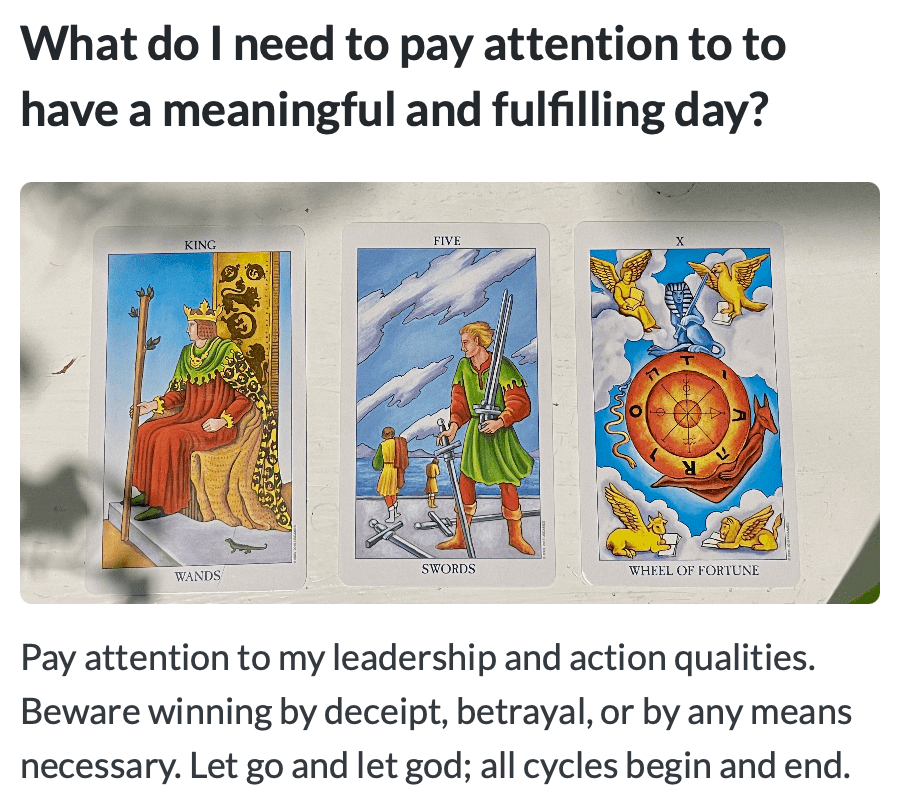
I started by journaling on paper, but this method missed a really important part of the tarot, which is the visual element of the cards. Tarot cards are tiny pieces of art in which every component has meaning: suit, numbers, colors, posture, sight-line, atmosphere, clothing, plants, animals, tools. In a paper journal where I just wrote words, my journal entries lacked that visual representation. So I switched to a digital journal using the Day One journaling app*. I pull cards first thing in the morning, take a photo of them, then drop the photo into a new entry in my Tarot journal on the app. I title the post with whatever intention I focused on when I pulled the card, then I write my thoughts about what the cards mean. At the end of the day, I check back in and write a summary of the day and how the cards seemed to relate.
*An added benefit of keeping a digital tarot journal is that it makes it much easier to search for specific cards from past readings.
Different kinds of entries
Daily encounter
This is a three card pull: the first card represents me and how I’m showing up, the second card represents an encounter that day, and the third card represents the outcome. When I first started my tarot journey this year, I’d pull these three cards, read about them in the guide book, and write out those meanings in my journal. I pretty much copied the books verbatum, and then at the end of the day, tried to correlate the card meanings with what my experience was like that day. After a while, I realized this copy paste style was akin to memorization rather than understanding, so I switched to pulling single cards and studying the art on them to find my own meaning. Now, when I pull my daily encounter spreads, I jot down what the cards mean to me and then revisit at the end of the day.

Single card
Sometimes three cards are too much to digest, or I find myself not really paying attention to what I think about them and instead just regurgitate what the guidebooks say. In those periods, I’ll pull one card for the day with the sole intent of learning that one card — I’m not even necessarily asking a question about the day. I’ll put the card next to my laptop and look at it closely while I describe it in my journal. I’ll describe the colors, the facial expressions and body language, and the overall feeling it gives me. Then I’ll write what I think it is saying as a piece of art. Throughout the day or at the end, I’ll jot down moments that felt like the energy of the card.
Bigger spreads
It’s rare that I do spreads any more complex than three cards except on my birthday. On my birthday, I’ll usually do a solar year spread where I pull one card to represent the whole year, and then 12 cards: one for each month. I photograph the spread and tag it in my journal so that when the month changes over, I can easily find the spread and see what to look forward to that month.

Reference
Sometimes I want to take notes that are general to the tarot, and that I use as reference entries to help in my own interpretation of cards. For example, I have an entry that describes the suits (swords, cups, pentacles, wands) and an entry for numerology. I imagine one day I might have one for colors, and I have a couple of reference entries from exercises in Tarot for One. I tag these with a Reference tag in my journal app, which makes it easy to find them when I want to jog my memory.
Have fun!
My favorite thing I learned this year about the tarot is that it originated as a card game: they were playing cards. When asked for advice he’d give beginners, Jeff Petriello, co-creator of the Pasta Tarot deck said on the Tarot Heroes podcast, “Oh my god, have fun! That is absolutely the biggest thing to remember…These cards were used as playing cards for centuries… so it’s really important to remember to play with them. They have a whole history in play so I really try to encourage beginners to have that spirit.” His advice helped me not take anything seriously, and to just play around with my cards and in my journal.
 Butterfly Mind