On our drive to Ohio for Thanksgiving, I thought about socks. Six hours is a long time in the car, and you know, your mind wanders.
Specifically, I was thinking about the clothes our son packed for himself, which included a mismatched pair of socks – both were white, but one had a gray bottom and one had a navy bottom. I had just done all the laundry, so he should have had plenty of socks, but mysteriously, he did not. Those were the dregs from his drawer. So I got to wondering, where could his socks be? We just bought him a new package a few weeks ago, and if I had just washed everything, he should have had at least six clean pairs of socks in his drawer. And then I recalled the balled up sock behind the bathroom door. That one was red. And the sock I found in his sheets when he got out of bed that morning. I think that one was gray.
And then I recalled the socks we’ve found on the basement floor, under the couch, between couch cushions. On the oval rug in the middle of the living room. In a LEGO bin. And it was no wonder he only had three pairs of socks (one mismatched).
Then I got to thinking about my girlfriend telling me she has the same issue with her husband. He’ll be getting ready for work in the morning and holler, “I need new socks – I don’t have any” when she knows good and well he’s got at least twelve pairs. Half a pair is on the kitchen counter. Several dusty ones are behind the couch. There’s one on the coffee table, and three or four between the couch cushions. I think she said she has even found her husband’s socks between the mattresses.
I chuckled to myself in the car, thinking of her husband plunking down on the couch after a long day at work, settling into his favorite spot, clicking over to a Braves game, maybe munching on some chips. Then, feeling the need to wiggle his toes in fresh air, to free his paws after another day of work-shoe imprisonment, I could see him peeling his socks off as the final step in his putting-his-feet-up ritual.
Once we were in Ohio, I didn’t think much about socks, except to wish I had brought one more pair of black ones to go with my black boots. And then, the day after Thanksgiving, Aunt C plucked a sock from the end table in her husband’s football den, rolled her eyes and shook her head, and delivered it to its rightful place in the hamper. I laughed and told her about my sock musings in the car, and we teased about men and their socks, me feeling self-satisfied about my socks always being where they belong – in the drawer, on my feet, or in the hamper.
I was still chuckling about the socks when I walked into the living room and noticed, scattered across our hosts’ floor, a pair of slippers, two black bootlets, and tossed about like the kids had gotten ahold of them (though they hadn’t), a pair of tall brown boots. All mine.
* Our son’s birthday is Thursday, and we’re moving this weekend, and then our daughter’s birthday and Christmas will be upon us, so this is the sort of gripping content you can expect here over the next few weeks when I get a chance to post. Enjoy!
Our Hurricane snow day was so fun I thought it deserved a second post, dedicated entirely to the food the kids and I made. First up is the homemade, from-scratch hot chocolate that apparently everyone I know, except me, knows how to make. And I can officially tell you now that hot cocoa packets are crap. This homemade stuff – so rich and creamy and warm and chocolatey and comforting- it’s everything that’s good and fine in the world. Here’s the recipe, from Hershey’s Kitchens. Follow it exactly, including the salt and vanilla, for heaven in a cup.
Homemade hot chocolate
2 tablespoons sugar
2 to 3 teaspoons HERSHEY’S Cocoa
Dash salt
1 cup milk
1/4 teaspoon vanilla extract
Pour all ingredients into a small saucepan and stir over medium heat. The cocoa and sugar will dissolve with stirring, I promise. Take care to watch the pot and keep it from boiling. You just need it warm enough to drink.
Muffins!
We also made muffins on our snow day. Since our daughter likes banana chocolate chip and our son likes blueberry, we made two separate batches. Now you see why we need Gobble Cakes nearby – our kids don’t like the same muffins, and they don’t like the same cupcakes either. Both of these muffin recipes are better with melted butter instead of oil, but I used up all my butter the night before to make Paula Deen’s cornbread.
Banana Chocolate Chip Muffins
1 3/4 cup whole wheat flour
1/4 cup packed brown sugar
2 tsp baking powder
1/4 tsp salt
1 cup bananas (or 3 bananas, or anywhere around there. Whatever you’ve got)
1/2 cup milk
1/4 cup canola oil (melted butter tastes better)
1 egg, beaten
1/2 cup chopped nuts (pecans are best, walnuts are second best, chopped almonds will do in a crunch)
2 oz chopped semisweet chocolate or 1/3 to 1/2 cup chocolate chips (who said baking has to be exact?)
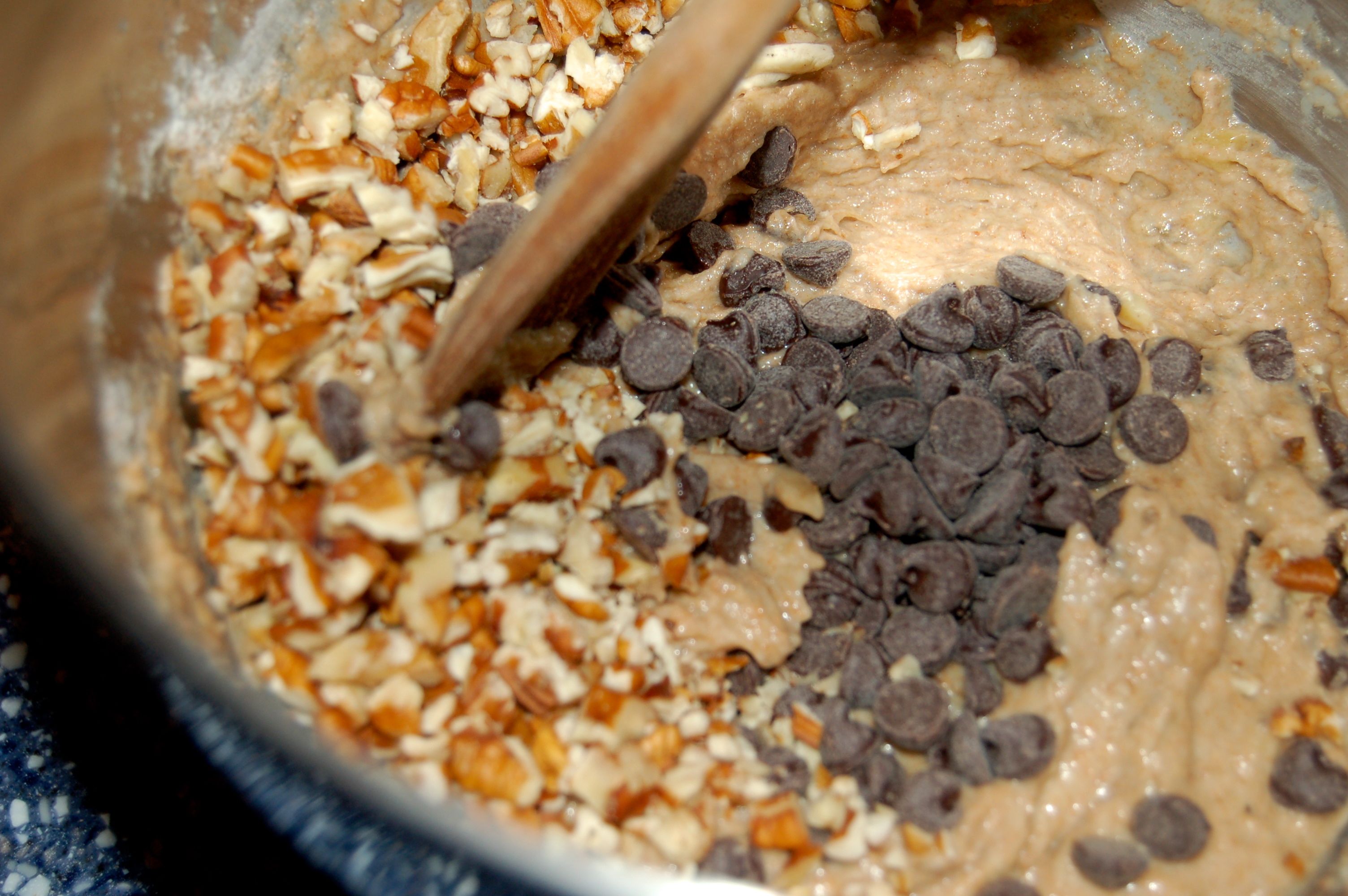
Preheat oven to 400 degrees F. Grease 12 muffin tins and set aside. In a large bowl, smash bananas and then add your wet ingredients – milk, oil, and egg – and mix them all together. In a small bowl combine flour, sugar, baking powder, and salt. Pour dry ingredients into wet ingredients (I know this is backwards, but I smash the bananas in a large bowl, so this the way we do it) and stir until the dry ingredients are moistened. Batter will be lumpy. Gently fold in chopped nuts and chocolate chips.
Spoon batter into greased muffin cups (we use an ice cream scoop for ease), filling each 1/2 to 2/3 full. Bake 18 to 22 minutes until golden brown and a toothpick inserted in the center of the center cupcake comes out clean (crumbs are okay, but not gooey batter). Cool in muffin cups for 5 minutes, then remove and serve warm.
Blueberry Muffins
1 cup whole wheat flour
3/4 cup unbleached all-purpose flour
1/3 cup sugar
2 tsp baking powder
1/4 tsp salt
3/4 cup milk
1/4 cup canola oil (melted butter tastes better)
1 egg, beaten
1 cup fresh or frozen blueberries
Preheat oven to 400 degrees F. Grease 10-12 muffin tins and set aside. In a large bowl, combine flour, sugar, baking powder, and salt. Make a well in the center and set aside. In a small bowl, combine milk, oil or butter, and egg. Pour wet ingredients into dry ingredients and stir until just moistened. Batter will be lumpy. Gently fold in blueberries
Spoon batter into greased muffin cups (we use an ice cream scoop for ease), filling each 1/2 to 2/3 full. Bake 18 to 22 minutes until golden brown and a toothpick inserted in the center of the center cupcake comes out clean (crumbs are okay, but not gooey batter). Cool in muffin cups for 5 minutes, then remove and serve warm.
Summer turned to fall here in Blacksburg last Saturday, with the temperature dropping 15 degrees in an afternoon. The air is crisp, like autumn apples, and I’ve heard that coffee sellers have put the pumpkin spice latte back on the cafe menu. Mmmm, pumpkin spice latte….
In celebration of the gorgeous autumn here in Appalachia (and because a loyal customer from my soap-making days requested it), I thought I’d post my recipe for the pumpkin spice soap I used to make for my soap business. It’s a soap celebrating the bounty of harvest time, and is named for Gaia, Greek goddess of the abundant earth. If you have a hankering to make your own soap, this one really is the bomb (and it makes a perfect gift for your Thanksgiving host.) Just please make sure you read up on how to make soap before trying it – the instructions here are not comprehensive enough for your first time, especially since there is swirling involved!*
Gaia Pumpkin Spice handmade essential oil soap
202 g sodium hydroxide/lye (NaOH)
19 oz distilled water
1 tsp sugar and 1.5 tsp salt dissolved in pre-lye dH2O
1 lb coconut oil
14 oz palm oil
12 oz olive oil
3 oz castor oil
6 oz sunflower oil additives:
2 tsp pumpkin pie spice
3 oz canned pumpkin
1.5 tsp clove essential oil (EO)
2 tsp nutmeg EO
1 tsp cinnamon leaf EO
0.5 tsp cassia bark EO
1. Prep a 2 cup vinegar bath with 1 cup water and 1 cup vinegar. This is for neutralizing lye spills, utensils, etc.
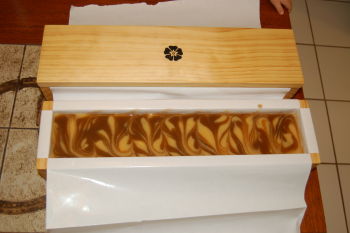
2. Line soap mold. For my recipes (~4.25 lb batches) I use a wooden loaf mold my husband made. The internal measurements are 18 inches long (the width of a roll of Reynolds Freezer Paper, which is what I use to line the molds), about 3.4 inches wide (sorry I don’t know the exact measurement – the molds are still packed), and the soap ends up being approximately 2 inches tall. I cut the loaf into 15 bars.
3. Start by measuring out your additives so that you’ll have them ready when it’s time to mix them in (if you’re a foodie, you’ll recognize this as mise en place – like cooking, things can go fast in soap making, so you have to be ready). Measure essential oils (EOs) into a non-reactive, preferably glass bowl, cover with plastic wrap, and set aside. Measure spices into a separate bowl. Measure pumpkin puree into yet another bowl.
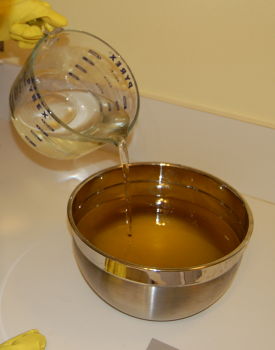
4. Measure distilled water into a large pyrex beaker. Place beaker in a well ventilated area and/or in a utility sink. Don safety goggles, apron, and gloves, then measure sodium hydroxide (NaOH) granules into a non-reactive bowl. Slowly add NaOH to the water while stirring. Stir until dissolved (I use a thick silicone spatula to stir). Do not breathe fumes (I hold my breath while I’m stirring). Rinse spatula and lye bowl in vinegar bath.
5. Melt solid fats (coconut, palm) in a stainless steel pot over medium heat.
Measuring sold fats for soap making
6. While solid fats are melting, measure liquid oils into large stainless steel bowl. Pour melted fats into liquid oils and set aside.
7. When lye solution and oils are both between 90 and 105 degrees (you should be able to hold the bottom of bowl or beaker in your hands without it feeling like it’s going to burn you), add lye to oils.
Pouring lye into oils for soap making
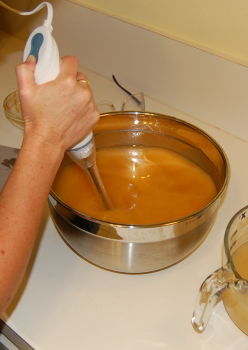
8. THE NEXT THREE STEPS GO VERY QUICKLY! BE PREPARED! For the Gaia soap, which is a swirled soap, mix briefly with a stick blender until the lye and oils are just mixed. Remove a portion of the batter back into the pyrex beaker, set it aside, and add the pumpkin and essential oils to the mother batter in your big stainless bowl. Blend the mother batter quickly with a hand held stick blender to break up the lumps of pumpkin. Within seconds, it should come to what is called “trace,” which means that when you drizzle some of the batter onto itself, it will leave a trail before sinking back in. Once it’s at trace, the saponification process is underway and you must move quickly.
Stick blending mother batter (batter with EOs and pumpkin puree)
9. Add pumpkin spice (ground cloves, allspice, cinnamon) to the separated portion of batter, which give this batter the rich, spicy brown color that will become the swirl. This swirl batter also comes to trace quite quickly (spices and “warm” essential oils like cinnamon and clove tend to accelerate saponification).
Mother batter (left) and spiced batter (right)
10. Gently pour the mother batter (the orangeish batter) into your mold. Pour the spiced batter (brown batter in the pyrex beaker) in dots into the orange batter in the mold. Once you’ve poured it all, use a knife or a chopstick to swirl the dots together, starting at one corner of the mold and moving your implement side to side until you get to the opposite corner at the other end of the mold (if you’ve ever made those marbled cheesecake brownies, that’s pretty much the method I use). Then you can do one more long swoop up the center of the mold if you’d like. There are tons of ways to swirl, and I’m not super accomplished at it, but feel free to play with it. Here’s what the raw soap looks like, freshly poured and swirled, in the mold:
Swirled raw soap in mold
11. Finally, cover your mold and let it sit for about 12 to 18 hours. The chemical reaction between the lye (base) and fats (acid) creates its own heat, so with cold process soaps, you usually insulate the molds so that the majority of saponification will take place overnight in the mold. Because of the “warm” spices in the Gaia recipe, insulation is optional – this soap gets pretty hot without you having to insulate it. However, whether you insulate or not, since you do not cook the soap to completion in the cold process method, saponification will not be complete for many days. I usually cut the soaps one or two days after unmolding the loaf, and then let the sliced soaps curefor the remaining 3 or 4 weeks. The longer your soaps cure, the harder and sudsier they will become, which is an argument for slicing them within a couple of days of unmolding so that they don’t get too hard to cut. Handmade soap has a shelf-life of about 6 months, though, so keep that in mind when you decide on your cure time. Have fun!
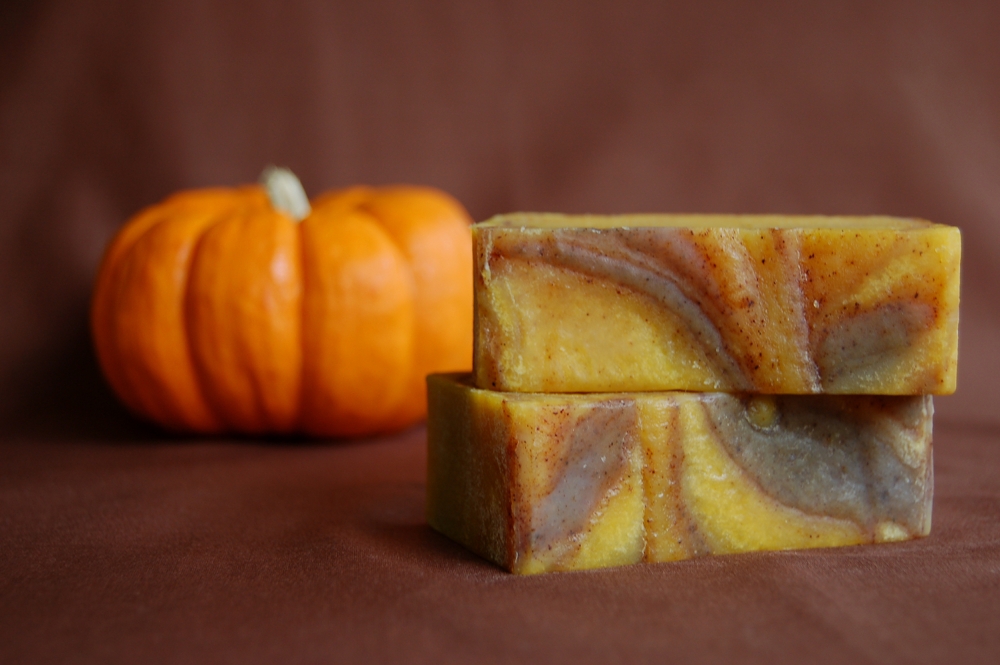
Swirled pumpkin spice soap
*If you are new to soap making, I recommend The Soapmaker’s Companion for cold process soaping or Handcrafted Soap for hot process soaping. I made the Gaia pumpkin spice soap using the cold process method, but it could certainly be adapted to hot process soaping if you know what you’re doing.





 Butterfly Mind