When we took our boat out a couple of weeks ago, I thought it would be our last sail before winter. I was wrong. Yesterday it was warm enough to layer up for a couple of hours on the lake. Even if there wasn’t going to be any wind, we wanted to be on the boat.
The peace that comes with the silence of a November sail is a rare gift. Most people have pulled their boats out of the water by November, and for those whose remain, it’s too chilly to be on the lake. What that means for us is a flat, wake-free surface and enough quiet to hear the sploosh of a fish, the gurgle of our hull moving through calm water, and the honks of Canada geese echoing off the mountainsides.
When the lake is smooth, our little sailboat can be moved by the slightest breath of wind. Without boat wakes to break our light momentum, we glide along in liquid silence. It is one of the most soul-satisfying feelings I know.
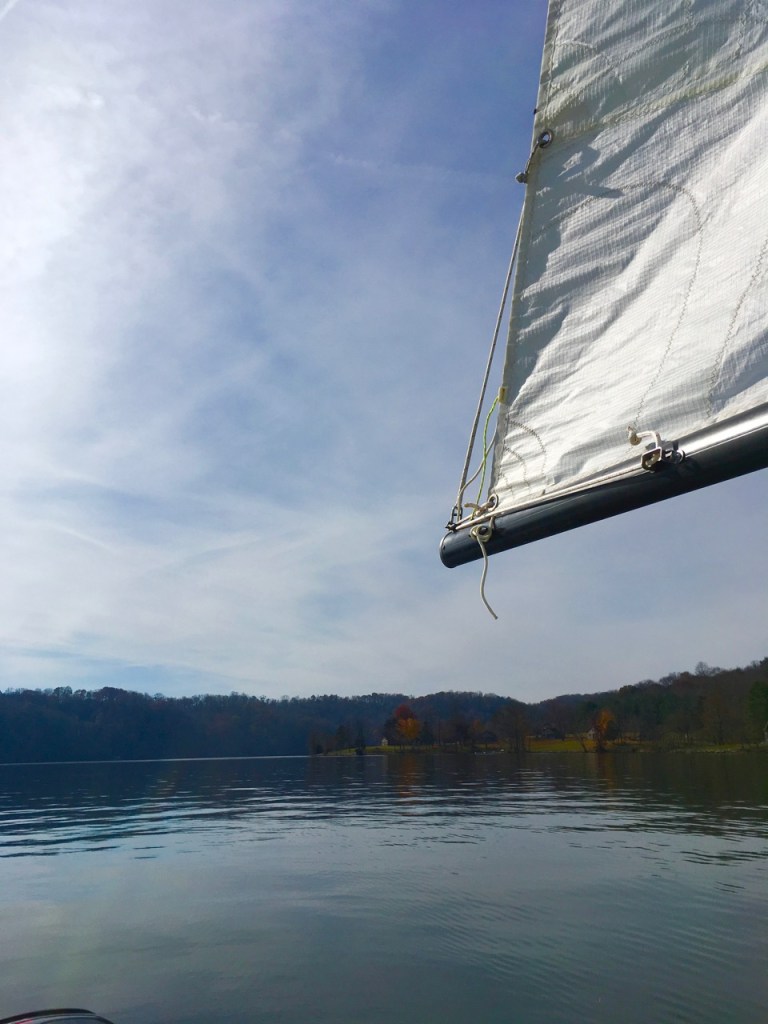
Foggy and 40℉ (4℃)Fog is burning offSailing on smooth water
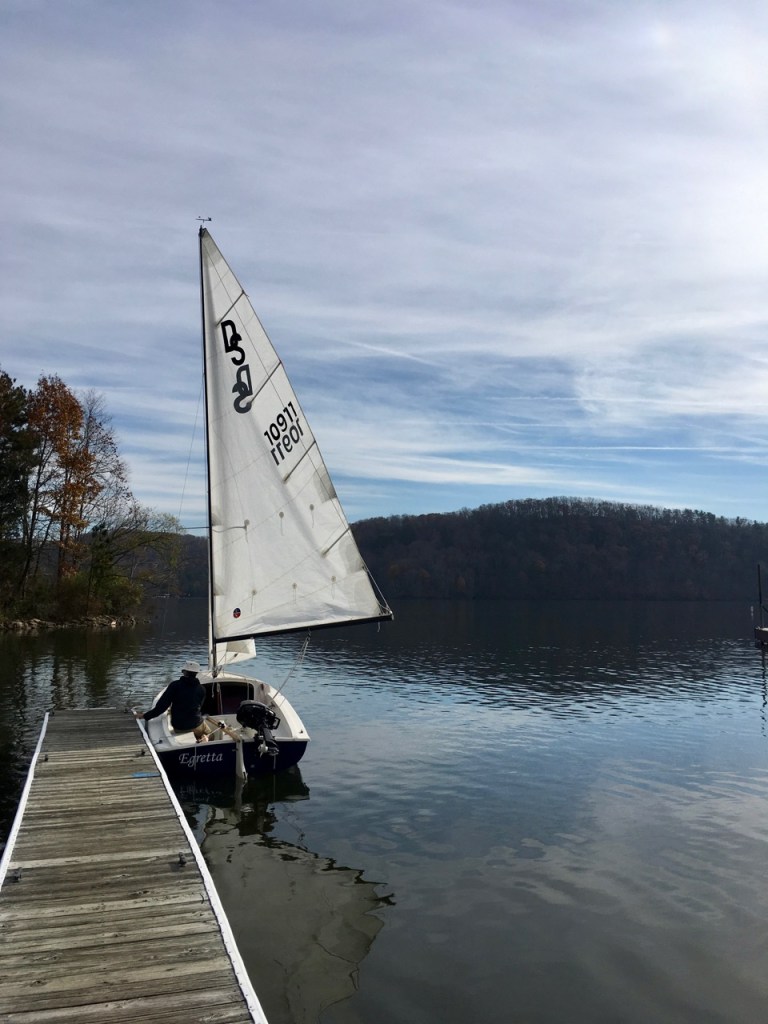
The last of the autumn leavesQuiet enough to sail to the dock (instead of motoring)Drying the sail before putting it away for the season
I was away from home last week, and my husband and I had our fingers crossed we’d be able to get one more sail in when I returned.
Winds were gusting up to 20 mph today, which would usually keep us home. But the skies were clear and blue, the leaves were bright and orange, and we couldn’t stand to potentially miss our last chance to sail.
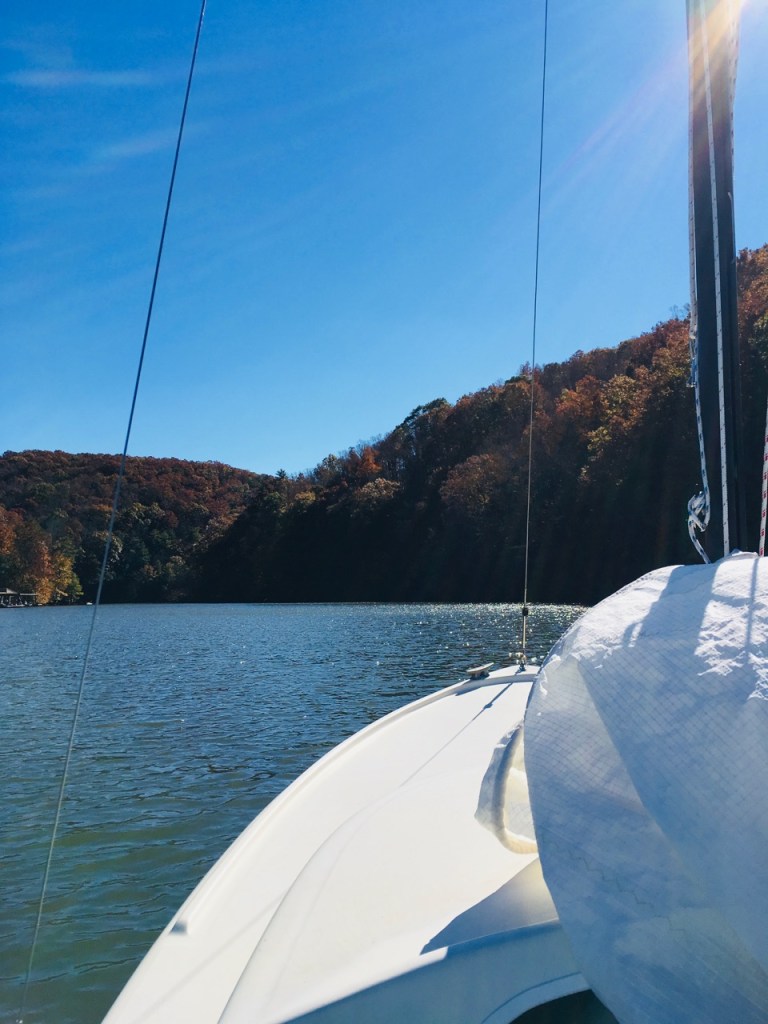
November leaves and sky at Claytor Lake, VirginiaEgretta ready to sail
We decided we’d brave the higher winds by attempting a reef in our sail for the first time. Reefing the sail means you lower it a bit, tuck the extra canvas and tie it to the boom, and ultimately reduce the amount of sail available to catch the wind. Reefing the sail makes it safer to sail in high winds and also makes the boat less tippy in gusts since the top of the sail is closer to the boat and there is less fabric to catch the air.
A spot sheltered from the wind where we could raise the mainsail
Sailing with the reef gave us confidence for sailing in higher winds. By the time we ended our trip, the gusts were scary. The boat tipped far and it was cold out. I was wearing long underwear and wool socks in addition to multiple layers on the top half of my body (tank top, long sleeved shirt, fleece, windbreaker, gloves, fleece earband, wide-brimmed hat), and I was still chilly. I did not relish the possibility of capsizing.
We had a great sail, though. I brought hot cocoa in thermoses, we did not capsize, and now we’ve sailed with a reef and know we can manage the boat in winds we used to think were too strong for us.
I put the kids on an airplane on Wednesday to fly down to Florida and visit their grandparents. Without us.
We’ve never sent them away without us before.
They’re 14 and 12 now, and they were super excited to go on an airplane alone (except for the giant badges they had to wear). As for my husband and I, we took the chance to go sailing. The Support Driven Expo I’ve been working on the past few months had just wrapped up in Portland, and the timing was perfect for us to get away for a couple of days.
Deltaville on the Bay
We found an in-law suite Airbnb — with a dock and a neighborhood boat ramp – in Deltaville, Virginia, about 5 hours away from our home in the Appalachians. On Thursday, we hitched up the boat and headed east.
There’s not a lot in Deltaville, tourism-wise, but there is tremendous access to water. There were half a dozen marinas full of sailboats in this little town where there didn’t appear to be people, and there were canvas shops and sail tailors, and even the maker of our boat’s mainsail, Ullman Sails. We stopped in to get a new length of batten, and picked up some rope too since it was on sale.
There was no wind when we arrived, so we pottered around town and got settled into our Airbnb before starting out in the late afternoon on the water.
There was still no wind. We hoisted the sails and flopped around, then motored a bit to get closer to the mouth of the river where we saw some ripples that looked like they might be wind. We caught a couple of puffs and got a little bit of sailing in before we realized, hmm, in this sleepy little town, restaurants might close at 9pm.
Sailing on the Piankatank River, VA
We were back at the dock and inside the house by 8:30, and yes, everything closed in 30 minutes and was also 15-30 minutes away. We wound up at a pizza place that at least had food that could go in our bellies. The atmosphere left a lot to be the desired, but we didn’t go hungry, so there’s that.
Our second day, though — it was glorious! We had the entire day with nowhere we had to be except on the water.
We motored out of the glassy creek at about 10 am after stocking up on lunch provisions (grapes, Babybel cheeses, corn tortillas, cherry tomatoes, hummus, and baby carrots, plus lots and lots of water). Once again we flopped around before motoring closer to the mouth of the river where we finally caught the wind.
For hours we sailed. We tacked back and forth, on long tacks in steady wind. There was chop and lumpy water and we stayed dry and Egretta handled it beautifully. It’s amazing how different it is — how wonderful it is — to sail in a steady wind that doesn’t change direction or speed and that you could just spend all day on the same tack if there weren’t land in the way.
The water slaps the hull when you’re sailing close hauled, which we were, since you’re sailing into the wind. When there’s chop, you’re cutting through it, and the sound is percussive. It smacks and claps as the boat bumps through the water. The wind is on your face, and it’s cool even when it’s 90 degrees. It feels like you’re going fast because of the wind flying by.
I wanted badly to get out into the Chesapeake. We never did on our trip last year to Wareneck, when we were on Mobjack Bay. And on this trip it was right there, we could see it. So I told Brian I wanted to get out there, like dipping our toes in the Pacific if we were on the west coast. You can’t go that far and not dip your toe in.
We couldn’t be that close to the Chesapeake and not wet the hull in it.
So we kept sailing. Out and out towards the open water. We navigated crab pots, we ate on the water, we hove to and swam, we sailed with stingrays and a sea turtle and listened to the different sounds the water makes against the hull on different tacks.
After a swim near the mouth of the river, we sailed out past both final points of land and were in the open water of the Chesapeake. There were swells and wind and the boat was beautiful and we sailed fast. It was wonderful! The swells were maybe 2-3 feet and we were totally fine in our little 17 foot day sailer.
In the open water of the ChesapeakeSailboats on the Chesapeake
We kept sailing for another 30 minutes or so so that we were good and out in the Bay, then noticed our sunburned legs and also didn’t want to run into the same problem as last night with dinner. We decided we should be home by 5 pm at the very latest, and around 2 or 2:30 we turned around to come back in.
With the wind at our backs, we flew. We surfed the swells. We ran so fast our bubbles streamed behind us. Instead of a slapping sound against the hull, the water gurgled around the rudder as we rushed through it. It swooshed and swirled, a gentle, flowing sound rather than a sharp smack. As we rode the swells, we sounded like waves on a beach, swashing as we coasted down a swell or one snuck up behind us.
We stayed completely dry in the boat, and rather than a boring run back inshore, as we expected to experience on a hot day with the wind at our back (because you usually can’t feel it like when you’re pointed into the wind), it was thrilling. We were riding the water, riding the wind. We were with it, we were part of it. When I looked over the beam, the swells, which had turned to chop, were alongside us, running with us. It was beautiful.
After washing up at home, we dressed for dinner and drove to Merroir, an outdoor oyster restaurant on the Rappahanock River. We ate ceviche and grilled oysters and drank a bottle of cold white wine that we kept in a metal bucket of ice on the table. We were back home and asleep by 8:30pm and slept all the way through until 8 the next morning.
We had one more day of sailing but this post is already long, so I’ll stop with the words and just post the pictures and the 6 second video.
Egretta from the stern
Dolphin 🙂
Dinner on our evening sail
My crew station
On the bow, under the jib
The waters treated us to a double rainbow as we closed out our last Chesapeake trip. On this one, the waters treated us to dolphins swimming alongside our boat and playing in our bow and stern wakes.
Standing barefoot on the bow Saturday, with my arm wrapped around the forestay and feeling the liquid world move under my feet, I fell in love. I fell in love with sailing, I fell in love with the Chesapeake (again), and I fell in love with our little boat, Egretta.
That morning, after being discontent with my performance hoisting and lowering the sails on the previous day’s trip, I sat on the airbnb porch with my notebook. Steam drifted from my coffee cup, and I declared to my husband that I was setting a goal: by the end of next summer, I wanted to be able to do everything on a daysail, end to end, from motoring away from the boat ramp, to skippering the journey, to docking at the end of a sail. I was tired of feeling incompetent on the boat.
As I talked it through with him, though, I began to realize that’s an ambitious goal for someone who doesn’t even know how to do their current job on the boat: crewing. Aiming for complete mastery of sailing within 12 months is like wanting to be executive chef in a year without knowing how to use a knife right now. Becoming a chef or a sailor takes years, and the paths to both begin with the basics.
For months now I’ve felt intimidated. There’s so much to learn: hauling sails, lowering sails, tying knots, skippering, trailering; how to use the forces of wind and water to move the boat forward using canvas, keel, and rudder; knowing when to do anything and knowing what needs to be done; boating rules, regulations, etiquette; outboard usage and maintenance; keeping the boat from capsizing and knowing what to do if it does roll; safety; vocabulary. His hand on the tiller, Brian will tell me something like “Don’t forget the topping lift,” and I won’t even know what he’s talking about. How can I expect to be in command and tell everyone what needs to be done when I don’t even know the parts of the boat and the language of sailing, much less why the topping lift would need to be remembered?
Egretta at sunrise
I sipped coffee on the porch, the rising sun glistening on spiderwebs as my folly dawned on me, and as the solution revealed itself. I was paralyzed by the journey of 1000 miles rather than animated by the single step in front of me. As I am prone to do, I focused so much on the end goal — knowing how to sail — that I didn’t break it down into the steps I need to take to me to get there.
That first step, I now realize, is to master my role as crew: raising and lowering the sails, helping the skipper by knowing my job when we’re underway (lookout, trimming the jib, watching for obstacles, paying attention, being aware), learning the language so we can communicate with precision, keeping lines neat and safe, keeping alert for the radio, and various other tasks I am currently mediocre at at best.
As crew, I have a specific job with components that are mine to own, that I can fiddle with until I truly understand how everything works, that I can hone the processes of until they are smooth and I can do them instinctively. This simplification, to sharpen one skillset, has given me a specific role I can master. It has given me a purpose. It has removed the fear and ineptitude I felt because of my lack of knowledge.
This has changed everything for me. Where before I had a wall up, where before I was nervous about sailing, now I can’t stop thinking about it. On our first sail after my mindset shift, I no longer felt like a bumbling idiot. Instead, I felt the eagerness of a novice apprenticing. I felt confident, a vessel for new experiences. I began to get to know our boat. I began to get attached. Standing barefoot on the bow after our sail, with my arm wrapped around the forestay and feeling the liquid world move beneath us, I fell in love.
On our drive home Sunday, I kept checking the rearview mirror to see our little boat behind the car. “I feel like we have a family of seven now,” I said. “The four of us, Tootsie and Tubbles [our cats], and Egretta.”
If you’re interested in more details about that first sail as true crew, I wrote about it in the Becoming crew post on my sailing blog.
I’m going on vacation today, and one of the things I’m most excited about is that I’ll have free time over the next few days to write, and to play with my blog(s). Before heading out of town, I opened my laptop to add my other sites to the menu here on Butterfly Mind, and as I added them, I realized I have five blogs. Five.
If you’re interested in sailing, gardening, words, or American literature, I’ve got blogs for you! While Butterfly Mind is the place where I share whatever thoughts alight on my screen or notebook pages, these other blogs chronicle journeys on the water, on the land, and in books:
Andrea Sails: these are the logs of our adventures on the water. The entries help me keep track of what I’m learning as I venture into this new-to-me world of wind- and human-powered boating.
Andrea’s Gardening Blog: this site is often the result of me blogging with dirt on my hands, from my phone, in the garden, right after I’ve put plants in the ground. I love having a searchable record as each month comes around where I can take a look to see what the garden was doing this time last year: what was blooming? How has everything grown since then? When did I sow those seeds?
Andrea’s Lexicon: these are words I collect that I think are cool. Sometimes I hear them in conversation, sometimes I find them in books. Most of them appeal to me because they’re fun to say. Haberdasher! See what I mean?
Andrea Reads America: this is the chronicle of my journey through the US in literature in three books per state. The three books must be set in the state and be written by an author who is from the state or who has lived in the state. For each state I am reading men, women, and non-Caucasian authors. I’m going in alphabetical order. I’m reading Michigan now, though I still need to write up my Massachusetts reads.
Alright, time for me to hit the road. I’m going to have a hard time deciding which one(s) of these to write for while I’m gone.
When our record club sent us the March record-of-the-month, Yours Conditionally by Tennis (duo Alaina Moore and Patrick Riley), my husband put the disc on the turntable, started it spinning, placed the needle on the pink vinyl, and sat down on the couch with a cocktail and the liner notes. Later, he told me, “You should read the booklet that came with this album. Something about the writing, and the woman who wrote it — you would really love it.”
Last night I put the disc on the turntable, started it spinning, placed the needle on the vinyl, and sat down on the couch with a cocktail and the liner notes. And my husband was right: I loved the writing, the woman, the story. I was crying by the end, after she’d told of her time at sea, living aboard a 35 foot sailboat with her husband, doing things that terrified her — like sailing away from land and watching mountains flatten on the horizon until her world was nothing but the blue of the sky and the blue of the sea — and spending their time together on the boat making the music that became this album.
My craving for the ocean has been fierce the past several months. I leave for Mexico tomorrow for a work trip, and I am thrilled to see the aqua water, to feel warm sand, to smell the salt and feel it’s thin crust on my skin after swimming in the Caribbean Sea. I want that experience with my family, too. I want to strap masks and snorkels on the kids; I want to watch sunsets with Brian. I want to do a whole lot of nothing while I listen to the sound of water lapping.
As much as sailing scares me, I can’t stop thinking about what it would be like to sleep on a boat, to anchor under the big sky. To dive off the bow, to read on the warm deck, to smell the air and feel the wind. To write under the sun. To live under the stars. To spend that time alone with my husband.
In the Tennis liner notes, Alaina Moore writes that while under sail, she and her husband live entirely in the present moment and the moment that will immediately follow. That sounds amazing.
I wonder about the rest of the time, though, for the days and weeks when not under sail, when resting, when at anchor. What would true isolation feel like? No restaurants, no towns. No wifi. No socializing, no blogging, no phone. What would it be like to be so disconnected from humans? I like being alone. I like quiet. But people are always a few keystrokes away. What would it be like to be cut off? Would I get bored?
I want to try it and see. For right now, I am equally disconnected from the natural world. I am equally cut off from the sea.
But what I really wonder about, is what would we eat, and how would we cook it? I look around our dining area at home and the cookware is abundant. I see a 1.5 qt pot, a 2qt pot, a 3 qt pot, a 4qt pot, a 10qt pot. I see a heavy cast iron Dutch oven, 3 cast iron frying pans, a 5qt enameled iron braiser; multiple colanders, box graters, baking sheets, pie plates. We have dinner plates, salad plates, cereal bowls; coffee mugs, tumblers, Collins glasses; spatulas, silverware, ladles, tongs, wooden spoons; a charcoal grill. On a small boat we might have a pot, a pan, two dishes, two cups, two forks, two knives. Maybe more, but not by much. And our pantry would be tiny compared to the storage we have in our kitchen.
Sailing in the fresh air, under the sun, would be hungry work. What do people eat when they are two on a boat? Do they catch fish, clean it, and cook it? Do they bring canned foods? Dry foods? What’s the quality of the food? Backpacking food is tolerable for a few days, but what if this were your whole life? What about fresh foods? What about snacks? I’d love to learn some simple, filling meals we could prepare on a boat at sea. Is that a thing — simple cooking? Minimalized food? It should be. I have simplified my purse, I’d like to simplify my food as well. I have some research to do. I want to bring this into our lives, whether we’re living aboard or not.






 Butterfly Mind