It crackles: sweet, ruby red, and shellac smooth. When I was a little girl I wanted a candy apple red Corvette. One of the old models, with the sweeping lines and the chrome bumpers — not the modern ones so covered in plastic they look like sedans. I have no idea why I wanted a candy apple Corvette. I have a feeling I was influenced by Prince.
Candy apple red is a gorgeous color because it is transparent, like a gem. There is something of substance inside its candy coating: something to bite into, something sweet, but that grew from the earth; something wholesome that in the act of chewing it, will scrub your teeth clean of the sticky candy you crunched through to get to the red apple inside.
I don’t really care about candy apples to eat, but I sure do love to look at them. Maybe that’s what I liked about a candy red Corvette, too — it would be beautiful to look at. At the time I wasn’t old enough to drive; I wouldn’t have appreciated how much fun it would be to shift gears, push the pedal to the floor, and vroom.
I don’t have a candy apple red Corvette, and I don’t care about having one anymore. I do still love the color, though. And lucky for me, we now have a candy apple red canoe. It won’t be fast and loud, like a Corvette.
It will be and smooth and silent, and built with my husband and children’s hands.
Sailors have a reputation for colorful language, usually in relation to swearing and storytelling. I admit, this is one of the aspects of sailing that tickles me most: the vocabulary. The terminology is filled with unfamiliar words that I’m slowly learning — words that sound old and nautical, like shroud and sheet, halyard and cleat.
In our two-day course, we learned both official language and unofficial, equally colorful, language. Like the chicken jibe.
Jibing can be dangerous. It happens when the wind is at your back, and the stern of the boat turns through the wind. If uncontrolled, jibing can bring the boom hurtling across the cockpit with great power, knocking unprepared crew in the skull and potentially breaking the boat.
If a skipper judges conditions or their skills unsafe for jibing, they can opt to chicken jibe: to chicken out of a jibe and instead take the safer route of putting the bow through the wind and tacking through 260° (rather than jibing through 90°). Our captain indicated no bravado about choosing a true jibe over a chicken jibe; the chicken jibe is totally acceptable if a skipper judges it to be necessary or smart. But it’s still called the chicken jibe.
At one point, Captain Sara went through the different cleats on the boat.
“You’ve got the jam cleat, the cam cleat, the clam cleat, and — ” she looked at the dock cleat, hoping for a rhyme. “And the dock cleat — the damn cleat — the one you’re always stubbing your toe on.”
She glanced at the bench where the crew sits with the lines that control the jib. The jib sheets end up on the seat where the crew sit when tacking, and on the floor of the cockpit.
“Then there’s the foot cleat.” She pointed at our feet. We had deployed the foot cleat on accident through at least one tack, when we tried to release the jib and one of us was stepping on the line.
She gestured at the seat itself, where a jib sheet lay. We both knew what the final cleat was going to be. We had been warned against this one several times the day before. It is easy to deploy on accident; without care and intention, the lines end up right where the sailor sits.
“And a’ course,” she said, “there’s the butt cleat.”
As I did through every tack yesterday, when Captain Bill said, “Watch for the butt cleat!”, I giggled. Butt cleat is my new favorite sailing term.
I think I may be a lost cause. My day job is with Automattic, the company behind the WordPress.com software that I and millions of others use for blogging. I am doing a great job at not working while I’m on vacation: I turned off Slack and email notifications on my phone, ensuring I don’t look at work stuff.
However, I can’t seem to keep myself from blogging.
My husband and I visited family down in Florida for Christmas, and while we are here, he and I took a two-day sailing course: ASA 101, Basic Keelboat Sailing. On day two, our instructor, Captain Sara, encouraged us to keep logs of all of our time on the water. We asked what to log, and she said “Anything! ‘Winds were calm, heard a loon, ran out of gas.’”
Being a writer, I got very excited about the prospect of a log. I even have a new navy blue WordPress Moleskine to use for it. As I wrote out my first entry in ink on a page, the blogger in me kicked in, and I thought “If I blog this, maybe it will help other new sailors.” Plus it will be searchable when I try to remember something years from now and I can’t recall which log book it’s in or what year it happened.
So I created sail.andreabadgley.blog, my online boating log. Most of the entries will likely be sailing, but my husband and kids are building a canoe, so maybe I’ll log those voyages as well. And when I go to my folks’ house in Georgia and go out in their power boat, I’ll ask my dad to teach me some things I never did myself growing up — like docking the boat — and I’ll log those as well. As it will be log entries, and since we won’t be in sailing season when we return home, it won’t be the most exciting blog, but if you’re into boating, I’d love to hang out with you there.
Also, I’m now a certified sailor! Not that that means anything to real sailors, but it’s pretty fun to have passed all the practical tests and the written one as well. The only thing I missed was the difference between a Genoa and a jib (a Genoa is a large jib used for light winds).
The week after Christmas, the four of us are traveling south to visit grandparents, aunts and uncles, and cousins down in Florida. While we are there, my husband and I are taking a two-day sailing course.
To use my favorite new word from my friend Krista Stevens, I’m terricited about the course. Our packets of books arrived yesterday, and by great good luck, I happen to be taking a flex day today. Time to dig in and nerd out, learning how to sail from books until we can get back out on the water.
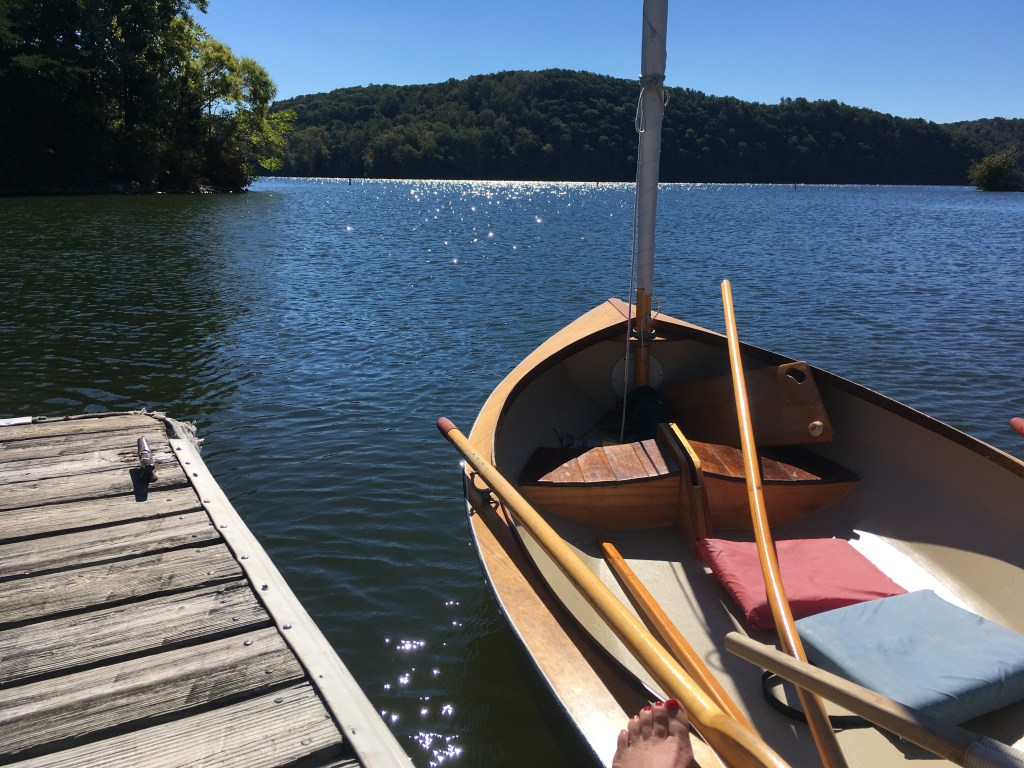
In the beginning of the summer, we bought a little wooden yawl. We knew when we bought it that it wouldn’t hold our family of four. So the most practical thing to do, since we can’t all fit in the first boat, is to build a second boat, right? So that the two people who aren’t in the sailboat have their own little boat to play in?
Yep, that’s what we thought, too. The kids love canoeing, my husband loves wooden boats, and with wooden boat kits from Chesapeake Light Craft, we thought it would be fun for the kids to help build our second boat.
They are having the time of their lives. Every weekend, our daughter asks, “Dad, are you working on the canoe?” She pouts when he works on it without her.
First step: stitching the hull
Stitching the hull
Glue in the garage
The hull
Glassing
Clamping the rail
The kids have stitched wood, glued, clamped, sanded, applied fiberglass, and epoxied. I’ve even received text messages with videos of our daughter using power tools.
I’m not sure when the boat will be ready for launch, but it’s sure going to be a pretty canoe. I can’t wait for the kids to take me out in it.
Our daughter gave up her seat in the sailboat this past weekend, and I took it. It was likely to be our last chance to sail before it gets too cold. Already it was chilly for a small, wet boat: sweatshirt and long pants weather rather than sweatshirts and swimsuits.
“I don’t know,” my husband said. “There’s a wind advisory. Gusts to 20 knots.” He looked out the window at the brilliant autumn sky. I sipped coffee and was happy for my slippers.
He looked down at his phone, at the forecast again. “It ends at 6pm though, I think we’ll be okay to go out this afternoon.”
When we arrived at the lake, the sun glittered on its surface, which was free of boats.
Beautiful day for a sail. Or so we thought.
After rowing a short distance from the dock, the wind blew us steadily into the middle of the lake while we hoisted the sails, and then zipped us fast across the dimpled surface.
“It’s not so bad!” I said.
“Yeah, I’m glad we came out,” said my husband.
“The wind is perfect, look how fast we’re going.” It blew splashes of water over the bow, into my face, and down the neck of my sweatshirt.
“The mountains are protecting us from the gusts.” The puddle from the bow splashes grew deeper.
“We’re probably going to regret saying these things.”
Then the sail whipped and snapped and we lost our momentum. We were pointed towards a bend in the lake where we don’t normally go, because there’s not usually wind enough for it. The boat tugged, tipped, took off for a second, and then stalled again.
“The wind is swirly,” said Brian as he pulled the mizzen sheet to fill the main sail to point us where he wanted to go. “Unpredictable.”
I shielded my eyes to look out over the water in the direction we were headed, toward the bend off to the right. The water was getting pretty choppy. “Wow, the wind is tunneling down that part of the lake up there, between the mountains. I see white caps.” Which we were headed towards in our tiny little boat.
My husband looked up at the mountain behind us, where tall trees not blocked by the mountain to our right were twisting and bowing in the wind.
“Coming about,” he said.
The water was not calm any more. The direction of the chop did not match the direction of the wind. My back was soaked. My bare feet were wet and numb in the puddle I sat in. And the boat continued to jerk and snap in gusty air that kept changing direction.
I’ll be honest, I was scared.
We made our way back up the lake in squirrely wind that was growing stronger and more erratic by the minute. We watched the sailing team who had come out onto the water to practice also struggle. They seemed to be having as much trouble as we were. They had jammed rudders and flapping sails, or they’d fly along with their mast at 45° and their rails almost in the water and then suddenly the mast would be straight up and down.
The further we got toward the far side of the lake, the gustier the wind — and it didn’t seem to want to let us turn back. I wanted to turn back. I thought about a crazy thunderstorm I was caught out in a boat with my dad when I was a kid, and how now that it’s over, it seems like a grand adventure.
I hoped this sail would seem like an adventure once it was over, too. At least the sky was blue and there was no risk of getting struck by lightning. Capsizing in the cold doesn’t seem quite as bad as getting struck by lightning. Maybe.
We finally cruised in close enough to roll up the sails and row to the dock.
“Well,” my husband said, “now we know. If there’s a wind advisory we should listen. That was too much for this boat.”
We’ve got soccer games and swim meets until the weather will be too cold for wet sailing, and now I’m sad we might not be able to sail our little boat until spring. Last weekend was an adventure on a glittering mountain lake under a brilliant October sky. It was gorgeous. I was glad when it was over. Now that it’s over, and we’re safe on land, I want to go out again.




 Butterfly Mind