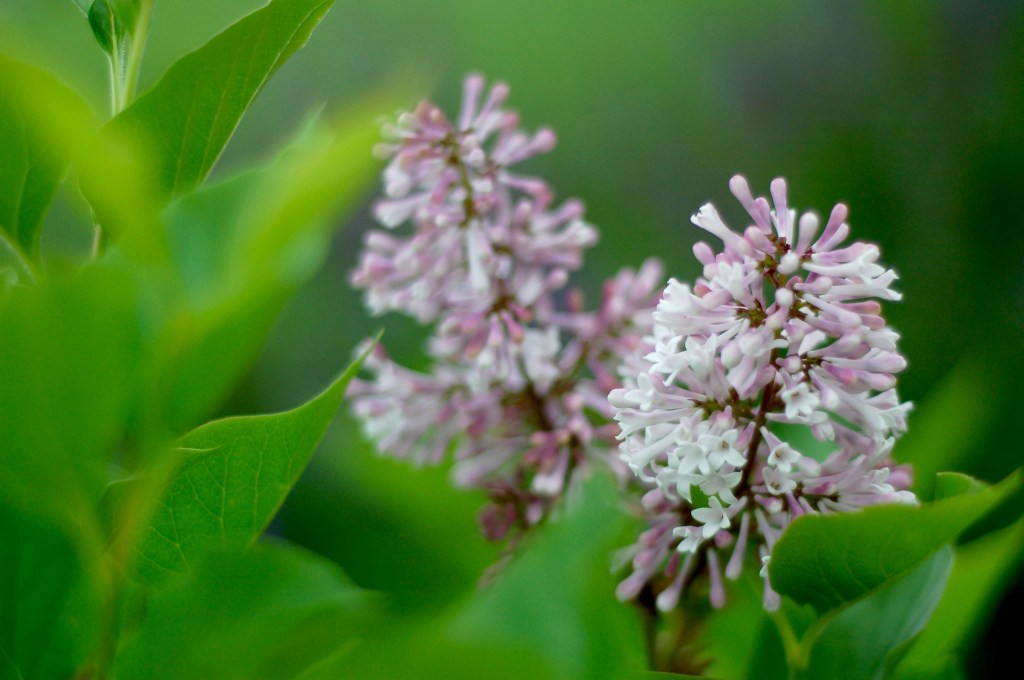
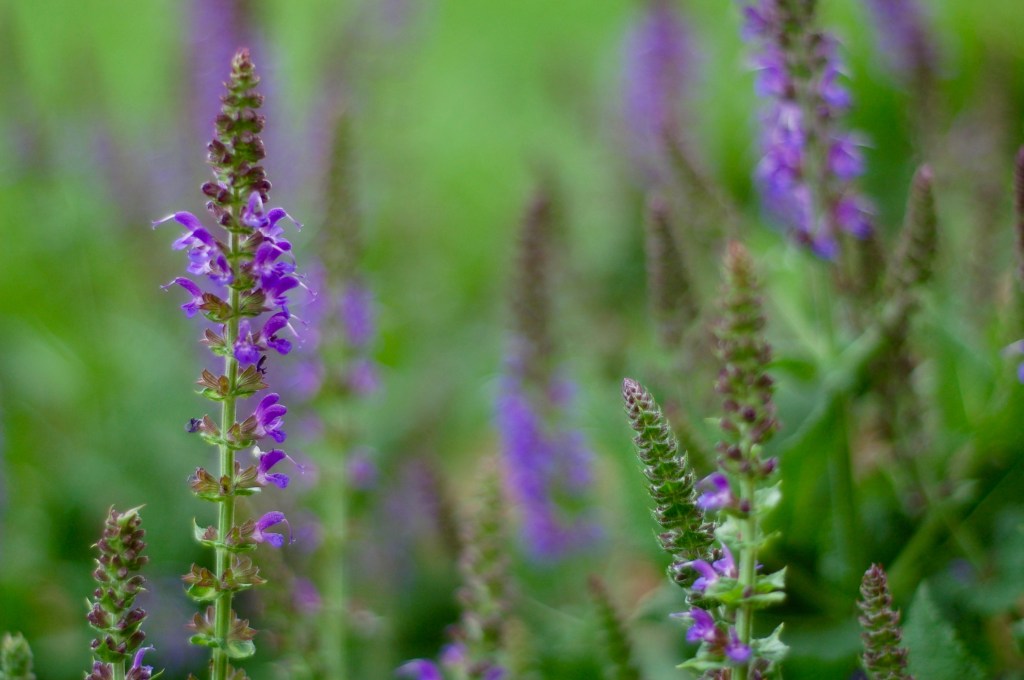
It just wouldn’t be April without a photo essay of the status of the garden. Here’s where everything stands right now, after last week’s drenching rains: herb blossoms, shrubs in bloom, and perennials building up their flowers.


It just wouldn’t be April without a photo essay of the status of the garden. Here’s where everything stands right now, after last week’s drenching rains: herb blossoms, shrubs in bloom, and perennials building up their flowers.


The drenching has finally subsided. For three days it rained. Maybe four. The kids’ school was cancelled Monday due to flooding. Yesterday our grass was shin high and thick. It looked too dense to push a mower through.
During the rains, I watched the garden from the window. So much green against the darkness! The knee-high yarrow is a silver mound that looks like it could pick up its skirt and walk away. The catnip domes to mid-thigh. The Echinacea is lush and dense with long, dark, blue-green leaves that don’t yet have age spots or brown edges from the blazing summer sun.
One evening I couldn’t stand it anymore. I yanked my raincoat off its hanger in the hall closet, pulled on my green rubber boots, opened my polka-dotted umbrella, and I walked the garden in the rain. Drops pattered on the taut nylon of my umbrella, and my boots squished in soft, wet earth.
It had been 10 days since we sowed our wildflower seeds, and I wanted to find sprouts. And boy did I ever find sprouts. In the area we scattered zinnia seeds, several pairs of cotyledons had emerged. In the wildflower bed, dozens of tiny stems pushed up through the mulch. Beneath the ground their seeds have split open, sending a shoot towards the light and roots into the earth. Germination. “The process of something coming into existence.” What a beautiful word.
The seedlings are fragile at this stage, as they anchor themselves, brand new and vulnerable in the big, new world. They will need to grow leaves to gather sunshine and make food; they will need to spread roots to gather water and make a foundation. And they will need space for both: above ground to collect light, and below ground to absorb their drink.
This means I need to weed.
I’ve not yet figured out how to do that, especially since I’m not sure which of the seedlings are the weeds and which ones are the wanted. I can dig out the established weeds, though: the grass that’s creeping into the flower beds, the dandelions and spiny thistles that will never die. Up on the hill there are other weeds I’ve not dealt with before, broad-leaved and fast-growing: wild rhubarb and others I haven’t identified. Like the dandelions, these hillside weeds will be my nemesis throughout the growing season. I will have to be relentless with the spade, digging them out at their roots, refusing to let them take hold and dominate the hill and its new inhabitants.
The fog was thick this morning, and the grass and garden shone neon green as the sun rose and finally cast light on the quenched earth. On Friday I have a flex day. It will be warm and sunny, and I can’t wait to get out there and make space for our seedlings. To give them the chance to put down some roots.
This is my response to The Daily Post’s one-word prompt, roots.
I’m in the garage, sitting in a camp chair, two wooden boats and a husband behind me, spring rain falling on the garden in front of me. I’ve worked outside for three sunny days, and now that I’m finished and the rain has come, I can’t stand to go inside.

Rain drips on the weeded mint bed under the stairs. Music plays behind me in the garage, and my husband raps his knuckle on the sailboat in time with the beat. His real work — the work that makes him rich — is with his hands, like mine is with writing and gardening. He’s tinkering with the boat trailer, sanding the sailboat, hammering into the plywood on the wall to hang another tool. I hear the hammer thunk on his wooden work bench when he lays it down; a wrench clangs on the concrete floor.
Droplets cling to the handles of the wheelbarrow, and I am enjoying my rest. I’ve spread mulch on all the beds, I’ve weeded, scattered seeds, watered, planted goldenrod and roses and columbine, transplanted bee balm and bottle brush, pruned forsythia, cleaned leaf litter out of the herbs, filled a vase with mint. My hands feel arthritic, but the garden is beautiful. The redbud blooms magenta, the rosemary has dainty lavender blossoms, our daughter’s columbine is crowned with purple and white flowers, and the roses pop a hot pink. Our neighbor’s dogwood flowers spread open in a spring green, the sky is storm grey, and thunder rumbles over the mountains.
When I was weeding, I got a good look at the ground level of the beds, and among the weeds I found an Echinacea volunteer, and I think the Joe Pye weed might be coming up as well. The wildflower seeds I planted by the mailbox ten days ago are starting to sprout as well. From this point on, I will be able to go out every morning and inspect the garden: what’s sprouting? What’s flowering? How are the seeds we planted? How are the transplants doing?
The sun is out now. It is warm on my bare toes. Rain drops glisten on the bright green grass, and the porch rail is a brilliant white against the stormy sky.
I love this time of year.
I ache in every muscle of my body. Even the joints of my fingers are sore. It’s that good kind of soreness, though, the kind that reminds me I did manual labor yesterday. I must have trudged up and down that hill sixty times between mowing, pruning, going back and forth for tools and iced water, going up and down for food and to consult my gardening books, turning the water off and on to water in seeds, and finally, wheeling barrow after barrow of mulch.
I also broke the hoe. Hoeing is hard work. Too hard for the hoe, apparently. I feel pretty good about my body outlasting a metal and wood tool, but my back feels it today.
The hill is very steep. It is too steep to push a wheelbarrow or lawnmower directly up the face. I pushed the wheelbarrow in switchbacks to get each load of mulch to the patch I was covering.
But it is done! The hardest part of my vacation gardening ambitions is now complete. As I suspected I would, I did go to the nursery.
“Just to look,” I told myself.
“We’re not going to buy anything,” I said to my daughter when I asked if she wanted to go with me.
And as I suspected I would, I bought something. A goldenrod. I’ve been wanting one for two years! How could I pass it up? We’ve never had one because we’ve never had a meadow garden, and it would look silly in the flower beds we do have. But I’ve always really really wanted one.
“We need something to anchor the hill while we wait for the seeds to sprout.” That’s how I justified it to myself.
“It’s good for butterflies and birds,” I told our daughter. That’s how I justified it to her.
So I bought a goldenrod that was bursting out of its pot. When I shook the plastic container off, there was hardly any soil: it was nothing but a tangled mass of roots. “I think I can make four plantings out of this one purchase,” I said to myself. I couldn’t pull anything apart to divide the mass, so I cut through the pot-shaped root ball instead. I hope the plants survive. I really don’t know what I’m doing in the garden. I’m shocked anything lives under my care. Goldenrod is supposed to be pretty hardy, though, so I’ve got my fingers crossed it’ll be okay.
I transplanted some bee balm from out front, and then I called our daughter up to plant the seeds. I spread cleome (spider plant) seeds next to the fence since those plants can get to be 5 feet tall. Then our daughter scattered milkweed, dill, liatris (blazing star), zinnia, and the wildflower mix. All of these should be good for butterflies and hummingbirds.
After I cursed the hill with every single wheelbarrow full of mulch, and swore under my breath every time I slipped or almost fell down the hill trying spread the mulch, I finally watered it all in at about 6:00pm. I inspected my fingernails as I watered. They were shredded and filled with dirt.
After my shower, I stood on the porch and observed my work: a big empty patch of yard that is now a different shade of brown than it was before, rough at the edges because I was too tired to cart one more load of mulch up the hill. It does look better, I suppose. I just hope those seeds sprout.
One more day until the mulch arrives and my vacation begins. I am as jittery with excitement as a child before Christmas. My to do list for the garden is growing: mow, cut back forsythia, read about when to plant the seeeds I want to plant, check on the last frost date, sow seeds, mulch, weed, transplant bee balm.
I don’t know how I’m going to make it through six days of vacation time, at home, in warm spring weather, without buying plants. We saved the rest of the garden budget for May, when it’s truly time to plant, but sowing seeds is going to make me crazy with impatience to see green stuff in our garden.
I need to take a step back and be grateful for the green that’s already emerging. The lilac is leafing out, and I see flower buds like tiny grape clusters on it. The indigo salvia is leafing as well, with flower spikes forming. The cat mint is already a fluffy knee-high mound; the lemon balm is returning. The yarrow, the bee balm, the rue: these all have new growth. And the first tulip finally opened down by the mailbox! They survived my amateur attempt at transplanting last year!
So there is some leafy life. But there’s way more bare brown earth than growing green flora. I’ll have to wait weeks for seeds to sprout, and more weeks for them to grow, and more weeks for them to flower. When it’s warm and sunny, and birds are chirping, and tulips are blooming, and I’ve got dirt under my fingernails, I’m going to want flowers. I will want to fill our flower boxes. I will want to plant roses. I will want to put annuals in the empty spaces in our flower beds. I want something alive and new, and I’ll have six days of freedom in which I’ll have to restrain myself.
I am counting down the days until the mulch truck arrives. Three days, and then I can scatter wildflower seeds on the slope out back: a moment I’ve waited for for weeks.
I can’t stop thinking about the garden. Our back yard is a steep hill that makes me pant when I mow it. When we moved in, the top corner was overgrown with forsythia, brambles, poison ivy, and I don’t know what all else. Whatever was back there, it wasn’t pretty. It was a tangled, impenetrable mess I thought we’d never be able to clean up.
Slowly, over the past two years, we dug out stumps, pulled out vines, and eventually got the patch down to bare dirt. My husband and son got it to that point a few weeks ago, on a warm day in winter.
When confronted with a bare expanse of earth on our property, I want to fill it with flowers.
Since that day several weeks ago, I have consulted garden books, garden magazines, butterfly books, seed catalogs. I’ve been to our local nursery, Home Depot, Lowe’s, Pike nursery in Charlotte, NC, while we were there for our son’s soccer tournament. I’ve started a gardening notebook, an online gardening log, and added a Garden category to my blog menu so I can easily access posts that tell me when I did what in the garden in years past (we were killing lawn this time last year).
I’m ready. And now the time is almost here. Three days until the mulch arrives. Three days until I can sow seeds.
We have a back deck I never sit on because there’s nothing to look at but grass. Instead, when I want to sit outside, I take a folding camp chair to the front garden and pop it open under the dogwood tree so I can be among hummingbirds and butterflies. Now, we have a bird feeder out back. It has lured goldfinches and woodpeckers to our back yard, so sitting out back is more appealing now. But there are still no flowers. Soon, though. Soon we will have a wildflower patch for butterflies and hummingbirds.
Starting Thursday, our kids’ spring break begins and so does mine. I’m taking several days off from work to play in the dirt. In my research I’ve found several species I must have out back for the butterflies — parsley, dill, cleome, zinnia, globe amaranth. I bought seed packets for those. I also have seeds gifted from my friend Dorothy‘s garden — milkweed, blazing star (Liatris), and blanket flower (Gaillardia). And to fill in the rest of the area, I bought a 1.5 pound bag of Pennington wildflower seeds to attract hummingbirds and butterflies. Surely from all of those sources, something will come up.
I’ve already got my first day off planned out. The day is forecast to be sunny, with a low of 41° F the night before, and a high of 71 during the day. I’ll have a lie-in, as my British friend calls it, to let the temperature come up a bit before heading outside. After my smoothie breakfast, I’ll pull a bowl from the cupboard and stir seeds from my store-bought packets and seeds from my friend into the wildflower mix from Pennington. I’ll huff up the hill with a hoe and a heavy rake to break up and smooth the soil, then I’ll sprinkle seeds over the entire area. I’ll rake again to cover them.
And when I hear the rumble of the mulch truck coming down the street, and the screech and clang of the metal dumper spilling 6 cubic yards of shredded hardwood bark onto our driveway, I’ll wheel my barrow down the hill and start shoveling.
The only thing I’m still trying to figure out is whether to distribute the seeds randomly, or to create a few patches within the plot — a milkweed clump, for example, or a dill clump. I still can’t decide.
I’ve got time. Three more days until the fun begins.