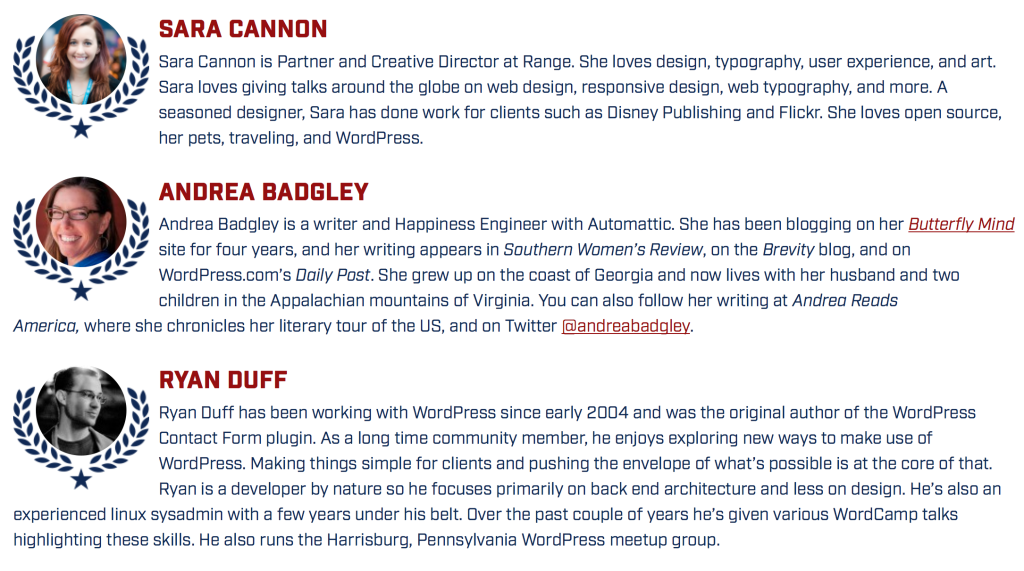
I’ve been waiting like what feels like an eternity to share this publicly, and the time has finally come. I am thrilled to announce that I will be speaking at the inaugural WordCamp US to be held in Philadelphia, Pennsylvania, December 4-6 this year. Look, my picture is even on the website:
I’m somebody now!
A WordCamp is a conference that focuses on all things WordPress: from developing and designing WordPress to using the software as a blogger. I am honored to be a part of this event, and I cannot wait to spend time with and learn from the stellar lineup of speakers. My talk is “Publish in 10 Minutes Per Day.” Look for details here on Butterfly Mind when WCUS arrives, or better yet, get yourself a ticket and join us in Philly.
When a crew member in Kauai jumped off the stern to sink an anchor, it brought back memories. I’ve been anchored on land too long. I miss being on the water, in the water, under water. I had forgotten about the ocean after been so far from it for so long.
But being in Hawaii among people for whom it was special again made me restless for more time on boats. My favorite part of the whole trip, aside from the surfing, was being on the boat. Lying on my stomach on the trampoline, watching the Pacific Ocean pass beneath us, trying to find a word that captured its color — cerulean maybe? More blue than blue green. Pure. Like the frosting on cakes when they use blue for an ocean. It looked like a gel, like I could dip my hand in and pull out a dollop of glistening cobalt.
Being underwater with a snorkel — or even better, without one when I jumped from the boat deck — made me wish I could stay there, under the surface. Nothing but the sounds of liquid and undersea pop and crackle. I heard the occasional rumble of boat engines, but they didn’t bother me because their noise was muffled and muted by the sea, and the message in the muffling is that the ocean is more powerful than a boat or its engine.
My husband and I daydream about sailing when we retire. I am terrified by the thought of crossing a wide expanse of open water in a sailboat — to go from Florida to the Bahamas, or sail around the Caribbean, just the two of us — but I am also electrified by it. When I am on the water that is what I crave: the stars at night, water in all directions, no human sounds or constructions.
I’m scared of a storm, of how powerful it would feel, how frightening. But I want to hear the flap of the sail filling and emptying of wind, the clank of the rigging against the mast, the zip of line being let out through a pulley. The slap of water against a boat hull as we fall asleep at night.
For the month of April, I will be publishing a 10-minute free write each day, initiated by a prompt from my prompt box. Minimal editing. No story. Just thoughts spilling onto the page. Trying to get back into the writing habit.
There’s a Dar Williams song, “Mark Rothko Song,” that affects me. I have listened to it over and over again over the past ten years, and though I never knew who or what it was about there is something about this song that makes my heart shift every time I hear it, that makes me feel something: something warm and also like deep blue currents, something both smiling and melancholy, something incandescent like flashes of sunlight on the surface of dark fathomless water. Something I can’t contain with words.
Despite my love for the song, I only cared about how the song made me feel, and I never bothered to research Mark Rothko. Then, last year, quite by accident, I came face to face with his work. In season two of Mad Men, on the wall of Bert Cooper’s office, was a Rothko. I saw his work for the first time, and my heart shifted. When I saw the painting I felt the same feelings I feel when I listen to “Mark Rothko Song” and I thought, “Ahhh, now I see,” and I understood, for the first time in my life, abstract art.
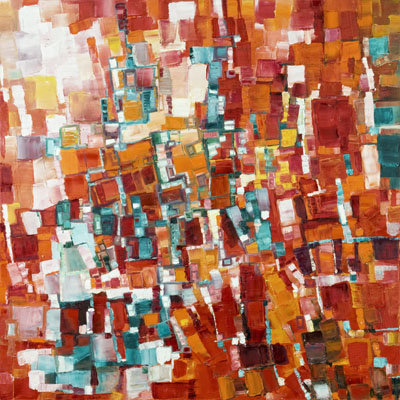
Many people make the same claim when they see a Rothko or a Jackson Pollack: they snort and say, “I could have done that!” But the thing is, they didn’t. And I would argue that they couldn’t. Sure we can all draw rectangles, maybe even color them in, but I know I can’t mix those paints: that saturated sunshine yellow, the white like shimmering silk, that vermillion red as rich as blood. I can’t scrape a pallet knife to create dimension, I can’t achieve proportions and balance, I can’t intuit where to place the white blocks, the orange blocks, the turquoise blocks, evoke tension with shape, movement with spatters or brush strokes or angles; I would not be able to stop when it was time to stop, to restrain myself from muddying the colors.
Art Credit: Kymm Swank, Structure 2 (Swank’s work appears in the Draper apartment, season 5 of Mad Men)
I was walking with my friend last week and I told her, “We finally got curtain rods and throw pillows for our living room.” We panted and pumped our arms. “All we need now is art,” I said.
The new spring heat was getting to us, and she perked up. She’s a photographer and likes talking art. “Oooh, what kind of art are you looking for?” she asked.
Art Credit: Mark Rothko No.5/No.22
My heart thumped as I thought about the Rothkos I binged on, the Rothkos I browse on a weekly basis since seeing his painting on Mad Men. His yellows like sunlight blazing on the wall, the electric reds, the horizontal blocks that make me feel stable, that make me feel like the ground is solid beneath me, unlike vertical compositions I’ve seen that make me feel like I’m sliding off the edge of the world.
“Well,” I said, “I really want something abstract.”
She cocked her head at me. “Go on,” she said.
“We get bored with things,” I told her. “We’ll buy a print we like and a year later we’re over it.” I thought of the wooden boats from Maine, the fat fruit from Naples. “A picture of an object will always be that object, you know?”
Art Credit: Autumn textures by AbstractArtM on Etsy
In a writing craft piece for The Daily Post, Let the Reader’s Imagination Do the Heavy Lifting, Krista Stevens advises the writer to hold back, to leave things open to the reader for interpretation. To let the reader create his or her own experience. The evening I read her piece, we watched an episode of Mad Men and I started noticing the art on the walls in Don’s office, in Peggy’s office, in the meeting room at Sterling, Cooper, Draper, Pryce. I thought about art in the terms Krista had written about, and how abstract art leaves interpretation to the viewer. Whereas a painting of an object puts you in a box — a boat is always a boat, a tree is always a tree — with abstract art there is no box. Concrete art is relatively closed, it is mostly interpreted for you by showing you exactly what it is (a pear, a flower), while abstract art refrains from explaining itself to you or telling you what to think. Abstract art encourages you to create your own experience.
Art credit: Butternut by Michal Shapiro (appears in first three seasons of Mad Men)
The creators of Mad Men are smart. Don Draper and the creatives display all the behaviors of successful creative types: they free associate, they alter their consciousness, they think, they stare into space, out the window, at a real life dramatic scene. They nap. A lot. And they hang abstract art on their walls.
Peggy in Don’s office with Butternut by Michal Shapiro
Throughout the offices of Sterling, Cooper, Draper, and Pryce are pieces of art that box nobody in – pieces of art that, in Krista Stevens’s words, allow the viewer’s imagination to do the heavy lifting. On the walls of every creative is art that suggests, evokes, moves, art that nails nothing and nobody down, art that can be anything to anyone. Art I want to look at more because it makes me feel something, because it affects me, because my mind opens both into it and outside of it.
This has been revelatory to me. A creation — whether a successful ad, a piece of writing, or a piece of art — does not have to be an end point, someone else’s rendering of a thing that already is. A rendering that says “This is a boat. It was a boat yesterday, and it is a boat today, and it will be a boat tomorrow and for all of eternity.” An artist’s creation can instead be a jumping off point, a piece of work that walks the viewer into his or her own story.
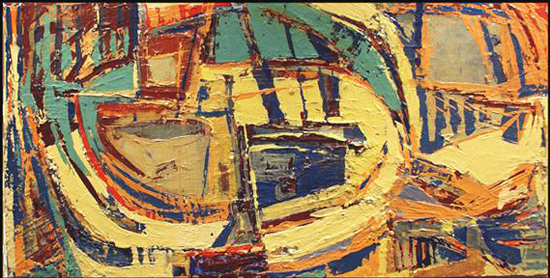
Art Credit: Abstract Painting by ARSartshop on Etsy
I want this type of art for our home. I want a piece of art that doesn’t box us in, that doesn’t tell us what it is, that we can interpret however we like. I want art that makes me feel something; I want art that affects me. I want a painting that can be a city scape today, a forest tomorrow, contemplation yesterday, passion next week. That right now is warmth, just a second ago was chaos, and in five minutes is a tunnel into the best idea my creative self ever had.
I can’t wipe this grin off my face. Remember that job I’ve been alluding to and that I’ve been working towards the past few months? I got it!
On September 4, 2014 – my 40th birthday – I begin my career with Automattic, a web company that describes its services using haiku, that has employees distributed all over the world, and whose creed begins “I will never stop learning.”
And oh yeah, Automattic is the company behind WordPress.com.
I am now an ecstatic and enormously proud member of a working family whose passion I share: to democratize publishing. In my role as a Happiness Engineer I will work my heart out to help WordPress.com users in their quest to put their work out into the world – their photography, writing, podcasts, videos; their wedding pages, book blogs, portfolios, caregiver stories; their poetry, band pages, musings, and travelogues. I’ll be there for all of them, and all of you.
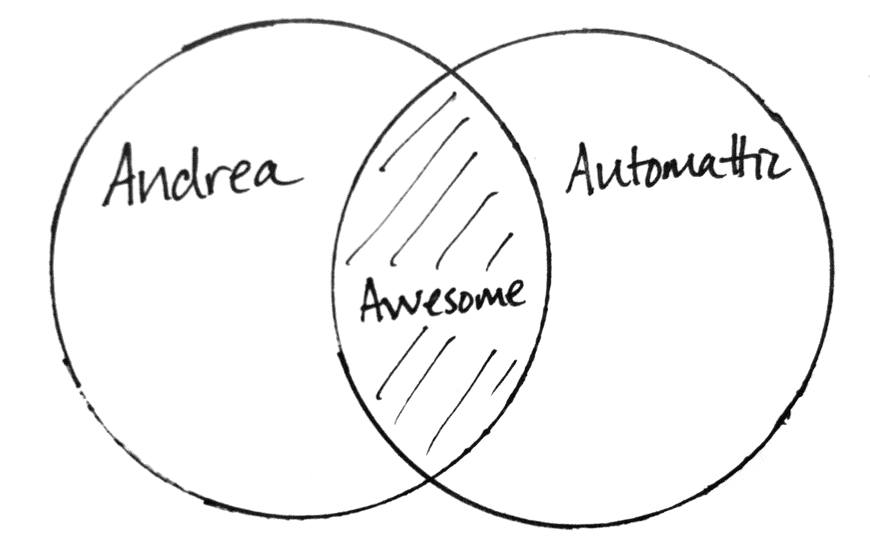
Andrea + Automattic = Awesome
I haven’t really absorbed yet that this is real. I’ve been a stay-at-home mom for 10 years, and throughout those years I have struggled with the tension inherent in wanting to be home with our children but also craving the stimulus of work that challenged my mind. Now I will have both. And it doesn’t hurt that I get to work with all these smart, funny people either. I feel like the luckiest woman alive.
I also feel like I want to give an Oscars style thank you speech. So first, I’d like to thank Cheri Lucas Rowlands who Freshly Pressed one of my early blog posts, and in so doing, introduced me to the world of possibilities within the WordPress.com community. Through Cheri’s work I later came to know others on the editorial staff, and I’d like to thank Krista Stevens, Ben Huberman, and Michelle Weber for engaging so much with me and the rest of the WP.com community, for inviting me to guest host a Daily Post writing challenge, and for sending me a care package with a copy of Scott Berkun’s The Year Without Pants and the Happiness Engineer tee shirt you see in the photo above. Those gifts and all of my interactions with editorial made me say, holy crap, I want to work with this company.
I’d also like to thank Deborah Beckett and Evan Zimmerman who took the time to talk with me at WordCamp Asheville about their experiences as Happiness Engineers with Automattic; all of the hilarious and super smart Automatticians who trained, supported, and helped me throughout my trial; and CEO Matt Mullenweg who I had the pleasure of chatting with as the final step in my hire, and who is kind, respectful, and like, the nicest guy ever.
Finally, I want to thank my family: my husband who took over most of my house-related work during my trial, and our kids who took over the rest of it. This hire is as much due to their hard work as it is to mine. I love you guys 🙂
Last summer, when the kids and I were in Florida for vacation and my husband hadn’t arrived yet, I was PMS-ing. I didn’t realize I was PMS-ing – I hadn’t gone crazy yet. I wasn’t sad for no reason, I wasn’t monstrous to the kids, I didn’t go dark places in my mind or dredge up old sorrows that only surface when I’m premenstrual.
Then I watched Out of Africa. I had never seen Out of Africa. I bawled. I sobbed. Rvers of snot and tears streamed down my face, and as I choked on the emotions pouring out of me, I realized, Holy crap, I am PMS-ing. Hard core.
The next day, I was scoured clean. I didn’t go crazy. I wasn’t sad. I wasn’t monstrous, I didn’t go dark places or dredge up old sorrows, and it occurred to me that the movie had served as a proxy for my own emotions. I was able to cry out all of my hormones. I was able to release without having to enter into my trauma.
It felt wonderful.
I am currently working like I have never worked before. I am in a trial period for a job I really want. I mean, really, really want. My whole family is pitching in to make this happen. My husband has taken over food: planning menus, going to market, putting groceries away, cooking new dinners. The kids have taken over chores: scrubbing bathrooms, mopping floors, changing linens, lugging the vacuum up and down the stairs to de-crumb the carpet.
And me? All I have to do is figure out how to build the internet so I can help other people figure out how to build theirs*. No biggie. All I have to do is excel. No pressure. Every day my mind scales another vertical learning curve. I’ve got lists, and private blogs, and goals, and resources, and 20 tabs open in my browser at any time, and at least a dozen internet tools I’d never heard of until three weeks ago, and I’ve got custom web searches for reaction gifs and thesaurus words, and I’m interacting and writing, and interacting and writing, and interacting and writing all day every day.
And it is thrilling.
And.
It is exhausting.
At the end of each day my mind is gelatinous. My husband asks me questions when he gets home from work and I stare at him vacant eyed. My brain tries to rise to him then sloshes back down into a quivering mound.
At the end of each week, my emotional cache is overflowing, and I leak in inappropriate places. When I had a breakdown in the craft store checkout line last weekend, I knew things had gotten out of hand. The strain of wanting this so badly, and working so hard, and seeing how hard my family was working, it almost broke me. And then I remembered Out of Africa.
I decided to shelve the book I was reading for my Andrea Reads America project – the book I’d been working on for four weeks already and was barely managing to read two pages of each day – and, with a knowing in my heart, I trotted down to the basement book cases, my excitement mounting as I rounded the end of the banister, to the shelf that holds our favorite fantasy books.
I pulled Guy Gavrial Kay’s The Summer Tree off the shelf for the first time in years, and just the cover of it made me close my eyes and smile.
It was everything I needed it to be. I fell into the world in the first paragraph, and I turned pages like I haven’t turned pages in months. Most exciting, though, is that unlike my previous book, which was thinky and political and cerebral, this book makes me feel. The emotions that have been building in me through the want of this job find traction in the character’s stories. I laugh, and my throat chokes, and my heart aches, and I cry. I emote.
And I release. By proxy.
*I’m not really learning how to build the internet, but I am writing from a Jell-O brain. Please forgive my exaggeration poetic license.
I just realized I posted my first Butterfly Mind entry two years ago today. We lived in Minnesota at the time and I was supposed to be packing up the house to prepare for our cross-country move. Instead I started a blog. Since then I’ve published more than 250 posts and am still loving every minute of it. Thank you, readers, for making it so much fun to be here. Here’s that debut entry.







 Butterfly Mind