My hair drifted around my head like it did when I was a little girl in the bathtub. I’d sink back underwater with my eyes open, tiny bubbles caught in my lashes, and the world would grow quiet but for the tinny gurgle of my escaped breath. My hair would swirl like a drop of food coloring in water. Now, without porcelain barriers, it drifted freely, like a mermaid’s would.
My breath rasped metallic through the regulator, an astronaut breathing underwater – ncuuuuhhh haaaaauuu. Breath and bubbles were the only sounds. The sea was cool on my tanned arms, salty on my sunburned lips, and turquoise blue in the Florida Keys sunshine. Rays of light streamed from the surface when I looked up, like sunbeams through a forest canopy, only instead of being inside an emerald, I was inside an aquamarine.
I was a young woman then – 20 years old I would guess – and after eight years of diving, of adjusting weight belts and vest bladders, I had tweaked my equipment to the point that I could control my buoyancy with my breath. If I sank towards the coral, I filled my lungs and I rose. If I floated toward the surface I exhaled until I sank. “You are cool as a cucumber,” the Jamaican had said on the dive in St. Ann’s Bay. It was the dive where I finally mastered buoyancy, and we had surfaced to the sight of a double rainbow over tropical mountains. A daytime moon hung in the top right of the scene where the sun would go on a child’s drawing.
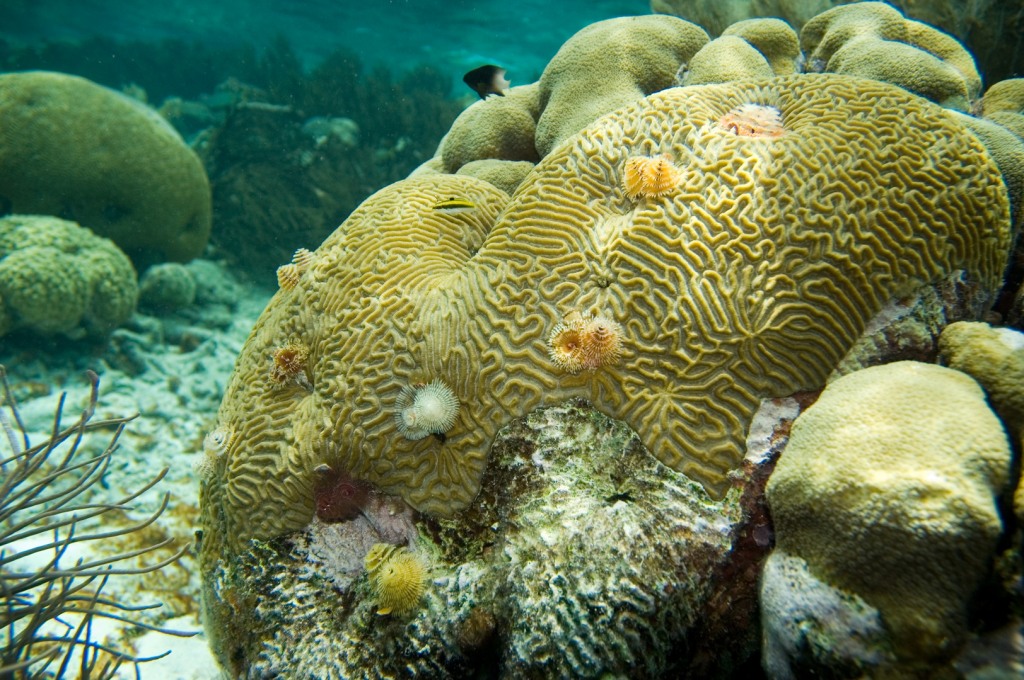
Now, my future husband explored the reef – not unlike when we go to the beach and he walks while I sit – while I floated at a coral boulder and watched the industry of its community. Yellow gobies nipped at the coral, sand blennies popped their heads out of holes then backed back in, a ruffled lime green nudibranch like a tiny lettuce leaf fluttered over the brain coral’s ridges like a two-inch magic carpet. Lobster antennae waved below me like search lights and I sometimes waved my hand just above a feather duster worm to watch it retract into its hole. After a few seconds it would send the tip of a duster out to test for danger then unfold its full feathered fan when the coast was clear.
The salt water puckered my skin, and my fingertips wrinkled like the brain coral. The canned air was cold and dry on the back of my throat and I took the regulator out to push my tongue against my palate, stimulating spit. A Queen angelfish with cobalt-rimmed scales and lemon yellow fins glided by, and later, a boat wake rolled overhead. The wave effect pulled us up and pushed us down, as if the fish and me and my billowing hair bobbed on the surface above instead of swimming 15 feet below.
Then the water calmed again. I saw my future husband hanging upside down, peeking under a ledge where lobsters or maybe a green moray eel peered back. I hovered in the blue liquid world, quiet but for the bubbling of my breath.
This was my work for Writing 101, Day two: “We’re all drawn to certain places. If you had the power to get somewhere — anywhere — where would you go right now? For your twist, focus on building a setting description.”
We went a lot of years without electronic road-trip entertainment for the kids. No game systems, no iPods, no DVD players. The closest we got to new technology was listening to books on CD instead of books on tape. And even then we listened to quaint titles like Nancy Drew and The Hardy Boys.
This low tech choice was mostly due to circumstance. We were a family of four living on one graduate student income, so we prioritized things like food and shelter and winter coats in Minnesota over entertainment gadgetry.
Had we had the money for DVD players, though, I’m still not sure we would have bought them. I secretly wanted our kids to entertain themselves the old fashioned way, even though I cringed every time they asked me to play I spy or find-the-letters-of-the-alphabet-on-road-signs games. I have romantic notions of watching the landscape change, listening to music, having conversations, taking quiet time to think deep thoughts about things like men and their socks.
But the reality of road trips with kids is that the changing landscape out the windows does not interest them, you can’t enjoy your music because the kids are constantly talking over it, conversation is replaced by boring road trip games, and deep thoughts are interrupted by complaints of “I’m hungry,” “I’m bored,” and “my butt hurts in this seat.”
That all changed today, though, as our son pulled out his brand new 3DS, hand-held Nintendo game system, complete with his very own earbuds. Since he had this fancy new birthday toy, I loaded a couple of new games on my Nook and dusted off our ancient iPod, “purchased” with credit card rewards, and loaded it with all the High School Musical soundtracks for our daughter. We found her some earbuds and she is bopping silently in the backseat, knotting a friendship bracelet as I write.
And let me tell you, our road trip was glorious. I don’t regret or feel bad about their electronics, not even for a second. My husband and I got, not minutes of quiet in the back seat, but hours. Hours of satisfaction and contentment for the kids. Huge stretches of concentration for my husband, who navigated the treachery of sleet and fog and driving rain on steep, slick mountain passes. Wide expanses of time for me to watch rivulets of rain stream across my window, trees creep out of the fog, farms and hay bales and rolling hills drenched with December rain. I listened to the spatter of rain on the windshield, the hum of tires on the highway. I had conversations with my husband.
On this trip, our kids received the precious gifts of 3DSes, and iPods, and Nooks, and of unlimited screen time.
And I received the gift of putting pen to paper, of scratching inky words on lined paper, of writing the old fashioned way, my family all around me as I fulfilled my commitment to write 30 minutes a day.
I originally wrote this during our holidays travels in 2012. Since we’re on the road again this year, I thought I’d repost it. Enjoy!
Ramon reminded me instantly of Ernest Hemingway. He wore a white beard and loose linen pants. His voice was low and smooth. He spoke simple Spanish with us, and he smiled and made political jokes, gently testing the mettle of his son’s American friends.
His apartment was much smaller than Quim and Cristina’s, and when we collapsed into it after our journey from France it smelled of pipe smoke and sizzling fish. Books filled dark grained shelves from floor to ceiling, and we shed our shoes to step onto the honey gold wood parquet. Ramon has been a professor of Mediterranean history and culture at the University of Barcelona for 40 years, and his apartment was tasteful – original paintings and nude sketches hung on every unshelved wall, sometimes as many as five or six on a single surface if it was large – and very masculine.
—-
Credit: blog.maptia.com 11 untranslatable words from other cultures
“Don’t eat too much,” Quim told me when we stopped at a rest stop in the Pyrenees around 6:30 pm. “My dad will have a feast prepared when we arrive.” We snacked on baguettes with cheese and jamon (salted ham) at a picnic table while Quim and Cristina’s daughter played on the playground. I thought he was kidding – we wouldn’t get to Barcelona til well after 9 pm, much too late for a dinner feast. Besides, I was pregnant, and I had a baguette. I did not heed his warning.
We met Quim in Maryland when my husband was working on his masters degree. Quim had been a visiting scientist, and he made a mean paella. His skin and hair were dark, as you might expect from a Spaniard, and his thinning hair stood up on top, as if it were always affected by static. He had the happiest smile and the llightest heart of anyone I’ve met, and when he laughed, I laughed. When he returned to Maryland on a subsequent trip, we invited him to stay with us for the few weeks he was in the States.
Now, he and his family hosted us on our first trip to Europe. When we told him we were thinking about visiting France and Spain, his face broke into his full toothed Joaquim grin. He insisted that we stay with him in Marseille. He and his girlfriend and daughter were our guides during our ten day trip, and that Friday, the Friday we ate cheese and ham at a rest stop in the Pyrenes, they cut their workday short to take us to the city of their hearts, Barcelona. They jittered with excitement to go back home, where they would take their daughter to visit her grandparents, and where Quim’s father had graciously invited us all to stay in his apartment while we visited his city.
After our rest stop snack, we climbed back into tiny cars, and we followed our friends onto the highway. When we crossed the border into Spain, Quim grinned and waved from the passenger seat in front of us. We were in the mountains, and the land was green – a green unbroken by buildings, power lines, or human evidence of any kind. Not Ireland green, but green with the stumpy trees of the Mediterranean, and green with the cleanliness of a recent summer rain. My husband and I thrilled to see road signs we could decipher after the foreignness of France. Even though the signs were in Catalan instead of Spanish, we could at least puzzle them out after four years of high school Spanish.
We arrived in Barcelona at dusk. The July sun set late, and after the leisure of driving on a deserted highway, following our friends on the hectic streets of a foreign city in the low light between mountains was harrying. The highway spit us onto a roundabout, and we cut across multiple lanes of traffic to make quick turns, hugging Cristina’s bumper so that nobody would elbow between us. Cris had driven slow on the highway, but now we whipped through town, zipped between cars, darted here and there with no idea where we were going or how we’d get out. My husband sweated and we hoped we didn’t lose them.
—-
As Quim promised, Ramon had a feast prepared for us when we arrived near 10 o’clock at night.
We ate on his terrace on the top floor of his apartment building – the atico. Basil and sage plants, jasmine and lantana, and hibiscus lined Ramon’s balcony. Piano music drifted up from below. “She is a concert pianist,” Ramon told us of his downstairs neighbor. We relaxed into our seats and soaked it all in.
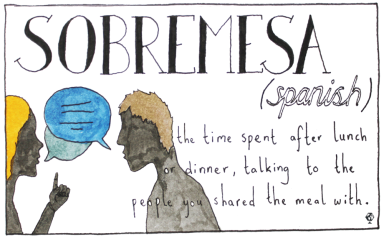
For the first course, Ramon served a zucchini casserole. When my husband and I recognized the zucchini and called it by that name, Ramon turned to his son, bewildered. In Spanish he said, “Zucchini?! That’s Italian. They must have a different word for it!” I love this culture, who when they value a thing, they give it a name. Who call zucchini calabacín, and who have a word for the time spent in conversation after sharing a meal: sobremesa. Over table.
The next course Ramon served us was a cold tomato soup-type dish from the south of Spain. The dish was cool and refreshing on a hot summer night. It was thick and almost creamy, though I don’t think it had any cream in it, and sprinkled on top were hard boiled eggs and jamón serrano, a dry-cured ham that is everywhere in Spain. Then came sardines. Not finger-long sardines in a can, but ear-of-corn sized sardines that Ramon had bought fresh at the fish market on La Rambla and cooked whole, heads and all, in his apartment in a huge paella pan.
I studied how Cristina dissected one for her daughter so I could follow her lead, but I missed what she did with the head. Mine shuddered each time I tried to scrape meat off the tiny bones of the body, and Ramon guided me in chopping the head off. I struggled with picking the small fish clean with my fork, and Quim told me “Just eat it with your hands. It’s a lot easier that way.” He grinned and wiggled his olive oil fingers, then used his thumb and pointer to slide meat off the tiny skeleton.
As everyone else ate sardine after sardine (I had to quit after one because I ate too much ham in the Pyrenees), I melted into my patio chair and listened to voices on the street below, forks and wine glasses clinking on terraces, and concert piano music floating up from an open window. I smelled fresh herbs, and the warm night air of Spain, and I was lulled by the deep man voices at our table. It was midnight by now, and I was pregnant, tired, and absolutely contented.
We slept that night with the terrace doors open, trying to stay cool on top of the sheets of the pull-out sofa bed, listening to summer sounds of Barcelona under the stars – laughter on the way to tapas bars at 1 am, glassware clinking on balconies.
Quim had a big day of sightseeing planned for the next day. “But we have to be back by 2 o’clock. My dad will prepare a big meal,” he told us. Despite Spain moving toward the half hour lunch, Ramon refused to adopt such a rush rush life. Even on weekdays he took a 3 hour break to prepare a large midday meal and nap afterwards.
I flopped my big belly over as Quim told us good night and flipped off the light. “Okay Quim,” I smiled into my pillow. “We can do that.”
I drifted on the murmur of Spaniards in the street below, and the front door clicked quietly shut as Ramon slipped away to his girlfriend’s.
I’m reading Forrest Gump. I haven’t seen the movie since it came out in 1994, and I’ve never read the book, and I haven’t gotten anywhere near the part where Bubba tells Forrest about shrimp:
“Shrimp is the fruit of the sea. You can barbecue it, boil it, broil it, bake it, saute it. Dey’s uh, shrimp-kabobs, shrimp creole, shrimp gumbo. Pan fried, deep fried, stir-fried. There’s pineapple shrimp, lemon shrimp, coconut shrimp, pepper shrimp, shrimp soup, shrimp stew, shrimp salad, shrimp and potatoes, shrimp burger, shrimp sandwich. That- that’s about it.” – Bubba in Forrest Gump
In fact, I have no idea if that scene even happens in the book, but just being on the page with Forrest, and hearing his voice, and seeing the name Bubba in chapter 3, I remember the movie. And now I’m thinking about seafood. I’m thinking about the shrimp boats of my Georgia childhood, and the crab traps baited with raw chicken, and the fishing poles sticking up from our boat’s white rod holders, and the cast nets that you held the weighted skirt of in your teeth while you got your hands in the right position to spin the white web out over the water. I’m thinking about seagulls squawking and dolphins chittering behind shrimpers, waiting for them to pull their nets in, about the sound of blue crab legs scuttling in the bottom of a white plastic compound bucket, about that dock under a bridge on Wilmington Island where Mom would buy shrimp fresh off the boat.
But mostly I’m thinking about oyster roasts and crab boils and red hot skillets for blackening Dad’s caught-today grouper, and fresh fish on the menu at riverside restaurants, and watching Mom drop blue crabs into a huge pot of boiling water, and then pulling them out as hot and red as a bad sunburn.
My husband and I have moved around a lot, sometimes near the ocean, and sometimes not. We wintered in Maine one year and took full advantage of the lobster fishery there. I remember lobster rolls from a roadside stand on our way to somewhere; I don’t remember where. I only remember seeing the stand under a bridge. The light was beautiful that day – slanted and yellow warm against a crisp blue sky. And I remember lobster chowder at a shack on a rocky jetty that jutted into a wild winter sea. Angry icy waves crashed against jagged stone, and we sipped steaming hot chocolate and slurped thick lobster stew as wind and water raged outside.
We weren’t so lucky in Minnesota, though. Minnesota is the farthest from ocean I have ever lived, and it wasn’t until we planted ourselves there that I fully appreciated what in meant to be landlocked. We wanted oysters one night, and I drove to every grocery store in a five mile radius hunting for them. I ended up at the fancy market, the expensive one – Byerly’s – because that was the only place they carried them. When I finally spied oysters on ice at the seafood counter, I wanted to buy – how many? I only knew them by the bucketful – and the oysters were a dollar apiece. I stood there a full minute in sticker shock before I finally bought the six individuals they had. My husband and I got three oysters each. Growing up we had cooked piles of them, mountains of them, filled five gallon buckets with hot oysters and tossed them in a steaming ridge along 6-foot newspaper-covered tables, over and over again. Neighbors stood around those tables with their oyster knives, shucking and slurping and dashing with tabasco, tossing oyster carapaces like peanut shells. Piles of them. And in my little bag in Minnesota, I had six.
But there, in the middle of the country, in the cold heart of winter, more than 1000 miles from the nearest brackish water, eating those oysters was like eating slippery morsels of ocean: saline, lusty, and warm.
They weren’t the best oysters on earth, nor is any of the seafood we can get where we live, so we don’t eat it often. By the time marine fare makes it through the hills, it is no longer vibrant. It has lost its vitality. We have no idea where it came from, who caught it, how many times it has been frozen. And the only fish we can afford are sad and soulless. They taste like silt from the farms they were raised in, or are dyed to look more vital, more alive.
I’m pretty sure I’ve eaten shrimp every way that Bubba describes it, and shrimp isn’t even my favorite seafood. In fact, it’s probably the seafood I care least about. I’d rather have blackened grouper that my dad caught offshore, salty and sunburned for his efforts, standing over hot coals at the end of the day, waiting for the cast iron to glow before he throws in those succulent filets coated in butter and cajun spice to sizzle and sear. Or I’d love some crab-stuffed flounder, or crab au gratin made from blue crabs my brother and I caught in our creek. Or, Mahi-Mahi Dad caught on vacation in the Florida Keys, or spiny lobsters we tickled out of crevices during lobster season down there.
But now that we live in the mountains in Virginia, even though they’re not my favorite, even though they aren’t grouper, or Mahi, or lobster, or blue crab, I’d take a pile of shrimp. Or even just three apiece, if they’re fresh.
I am reading America: 3 books from each state in the US with the following authorships represented – women, men, and non-Caucasian writers. To follow along, please visit me at andreareadsamerica.com.
Forrest Gump: A novel by Winston Groom. Six foot six, 242 pounds, and possessed of a scant IQ of 70, Forrest Gump is the lovable, surprisingly savvy hero of this classic comic tale. His early life may seem inauspicious, but when the University of Alabama’s football team drafts Forrest and makes him a star, it sets him on an unbelievable path that will transform him from Vietnam hero to world-class Ping-Pong player, from wrestler to entrepreneur. With a voice all his own, Forrest is telling all in a madcap romp through three decades of American history. – from the paperback blurb
I stood behind my husband in Minnesota, rubbing his shoulders while he sat at our desk, focused on the screen in front of him. He was transferring all my files from our desktop to the laptop I was to take with me to Virginia.
I watched branches sway in the breeze, laden with the heavy weight of broad sumac lives, fingers of blue spruce needles, or delicate walnut leaflets. Our kids and their neighbor friends, the ones they spent eight hours a day with outside, popping in for a popsicle or an apple snack before dashing out again, tromped through the yards, all in a line, singing and pumping their arms like they were in a parade. They reminded me of the lost boys in Peter Pan.
I rubbed my husband’s neck and began, quietly, to cry.
The keyboard clickety-clacked while he loaded programs onto the dinosaur laptop, then stopped when he heard me sniff.
“Are you crying?” he asked.
“Yes.”
He reached up behind him and held my hands on his shoulders. “Because of the kids?” He watched them laugh and parade with the friends they would soon leave.
“Yes,” I said. “And because of the trees.” And the move. And the unknown.
“Why the trees?”
I pointed to the tallest tree on our lot – the one all the neighbors hated because it was tall and gangly and had been carved out in the middle of its crown to accommodate power lines.
“That’s a black walnut,” I said. “It is a host plant for the luna moth.” I wiped my eyes, thinking about yet another move. “I always wanted to have a walnut tree.”
The first time I saw a luna moth was nearly 20 years ago, before I married, before I had kids, when I was an ecology student in Athens, Georgia. It was night, and I had pulled into an empty bank parking lot to hit the ATM before going out for beers. I stepped out of my car, and as I slammed the door, something in the parking space next to me caught my eye. I looked down and there on the ground, two feet from my front driver’s side wheel, motionless with its wings spread flat, was a the largest moth I had ever seen. Luminescent green, it was more beautiful than butterflies. Had it crawled on my palm, its wings would have eclipsed my hand.
I forgot about the bank, forgot about the bar. I cared for nothing but this otherworldly creature on the pebbly black asphalt. The saucer-sized moth was the color of absinthe, and even with me standing over it, even after my feet crunched, and my ton of rubber and steel gravelled over pavement just inches from its body, it did not move. It lay there, basking in the light of a street lamp, as if in a trance. I had never seen anything like it. I stood there in that dingy parking lot, under the street light, in front of a brick bank, the most ordinary, paved over, non-natural setting, and experienced a sacred moment as I witnessed this gorgeous creature who had stopped time and space for me with its luminous glow.
Since that night, almost 20 years ago, I have hoped for the gift to see another. The only time I’ve seen one, besides in photographs on the internet or pinned in glass cases at a science museum, has been in a commercial for a sleep aid. Lunesta. I remember the first time I saw that ad, how offended I was that it had exploited such a special creature for the pedestrian purpose of peddling pills. It was like using God to sell toothpaste.
Ten years after that moth, when we bought a home in Florida, I wanted to cultivate a butterfly garden. I learned that you could attract local species by planting host plants for caterpillars (milkweed for monarchs, parsley for swallowtails, passionflower for frittilaries) and nectar flowers for butterflies (lantana, echinacea, goldenrod, plumbago). After successfully inviting multiple generations of monarchs and swallowtails, Gulf Frittilaries and zebra longwings, after watching the adults drink nectar, and their caterpillars munch leaves, and their chrysalises transform squishy larvae into winged butterflies between the slats of our wooden fence, I one day saw a tremendous, absinthe green caterpillar crawl across the our garden path. Its colossal size (larger than the largest swallowtail caterpillar I’d seen) and its luminous color (it seemed to glow even in daylight) immediately put me in mind of my magical moth, and I thrilled that it could possibly be a luna larva. I rushed in to fetch my camera and field guide, but when I reemerged and got down on my hands and knees in the mulch, trying to follow its trail, I could not find the caterpillar again.
Luna moth caterpillar: photo credit Dave Wagner, 2002
Having seen my only luna moth in the foothills of the Appalachians, it never occurred to me that I might find one in Florida. I researched Actias luna to find the luna’s host plants: persimmon, sweetgum, hickory, walnut. All large specimens. None in our postage stamp yard in Tampa. I searched the neighborhood for these trees but never found them, nor did I find another luna larva.
When my husband accepted a three year postdoctoral position in Minnesota, and it was time to move away from Florida, I made a wish board of what I wanted in our new northern home: 3 bedrooms, a big kitchen, good schools, a yard for the kids, and a host plant for the luna moth. I forgot the board during our rushed two-day house-hunting trip. All we were looking for was a place we could afford in the school district that offered half-day kindergarten. A place we could spend three years and be comfortable. We moved in November, and one month later had our first snow. We didn’t see leaves or earth until the following May.
In September, after ten months in Minnesota, our kids clomped through the mud room one Saturday with their fingers stained black. “What on earth?” I asked.
“There are these things all over the yard – I think they’re coconuts!” our son said.
I walked outside with our daughter and him to find a pile of lime-sized green globes they had collected. Some had tiny fingernail gouges in them, some were chewed by squirrel teeth until a black pulp showed, some were inexpertly shredded by child fingers, and some were broken open like to show fibrous husks like… coconuts.
“Huh,” I said. “I don’t know what those are.”
A few days later I was kneading dough in the kitchen and I heard a THUNK. I looked up at the ceiling where it sounded like something had landed on the roof. I kneaded the bread some more. THUNK. I wiped my hands, THUNK, and walked to the big plate glass window that looked out on the yard. I saw one of the heavy green globes plummet to the ground, THUD, and my eyes traced its path up to a branch in a tree. There, a squirrel nibbled the thick husk of another one and sprayed flakes of the olive green skin from its mouth as it chewed.
I walked over to a neighbor’s house and asked, “What are these things?” I showed her an intact nut. It was heavy in my hand, like a stone.
“That’s a black walnut,” she said. “The kids love to try to tear them open. Be careful, though – the black stain is really hard to get out.”
I remembered the wish board I had forgotten and thought, holy shit, my magical thinking worked: we have a walnut tree.
After I realized we had a host plant on our property, after I realized my wishful intent had come to pass, I thought, “It’s meant to be! I will find another luna moth!” In spring and summer, I searched for luna caterpillars, but the crown of the tree was too high, and there were no climbing branches. I couldn’t see the leaves way up there in the sky. I could not see if luminous larvae ate them. I checked by the porch light at night for adults and walked outside in moonlight through the neighborhood.
Season after season went by, and in the three years that we lived in that house, I never saw a luna moth.
When we left Minnesota and I stood by the window with my husband, I was sad to leave the tree so soon. Sad that I never got a chance to see my moth. Sad to leave what was known. Again.
We moved into our Virginia townhouse in December. The trees were bare when we dragged furniture up stairs and decided which cupboard would hold the plates, which drawer would hold the silverware. After settling in, we sledded in the neighborhood in January, bicycled past pastures in July, gathered words in the horticulture gardens in August. I forgot about the luna moth. Had given up on it. Did not wish for a host plant when we relocated, not (consciously) out of disappointment, but because I had moved on. Because my mind was on practical things: transitioning our children, affordable housing, school districts. Soccer. Swim team. The daily grind.
Summer turned to fall in our new home, and with September came the first day of school. As we did last winter and last spring, the kids and I walked through the park in our neighborhood to wait at the bus stop. We shuffled our feet in the few golden oak crisps that had already fallen, and when the bus arrived, our children looked to the windows and saw friends they hadn’t seen in three months. Little hands stuck through open rectangles, waving. A face popped up with bright eyes and a mouthful of teeth and beckoned them onto the bus. Our kids grinned and said hi to their driver and climbed on the bus with more excitement than they were willing to admit on the first day of school.
I was relieved to see them happy, thrilled to know they had already made fast friends, proud that they had not only survived the transition, but were now thriving in their new, not-Florida, not-Minnesota home. I walked through the park that morning with my hands in my pockets, kicking crunchy leaves, at peace. I was grateful for where we landed. Thankful that our family could finally settle down in a town we loved, in a town we wouldn’t have to leave.
I watched leaves fly fluttering from the toe of my shoe, and then I stopped. There on the ground, next to the curving brick path, among the brown leaves, was a husk. A husk like the ones the squirrels threw from tree tops in Minnesota. The ones that thunked on our roof and littered our yard in September. A husk the size of a lime, but woody like a coconut. I scanned a wider area and spread among the crisp oak leaves, like peanut shells at a picnic, were hundreds of these husks. The earth was littered with black walnut hulls. The park was full of walnut trees. I walked deeper into the neighborhood and saw hickories and sweetgum. Looked out over the Appalachians and realized in our forever home, in the town we wouldn’t have to leave, we didn’t just have one tree, we had a whole forest. Ridges and valleys lush with host plants. An entire mountain range of habitat.
My heart jumped, and I smiled at the trees, and I thought, “It is meant to be.”
One of the things I love most about Florida, that I miss when I’m away, and that I fall in love with all over again when I return, is the sky. More specifically, I love the clouds. Cloudscapes in Florida are dynamic and dependable. Nearly every afternoon in summer, formations build before your eyes in a blue sky, their faces to the brilliant Florida sun. The piles are clean and bright, like bleached cotton, and you can actually watch them grow, billowy cumulus clouds piling up like a massive mound of shaving cream in a crystalline sky. Variations of light on the clouds are dramatic, ranging from a blinding white on the uppermost billows to an ominous blue black on their low underbellies.
Every day, the clouds are different. Sometimes they are far away, and they move across the sky like giant jellyfish, trailing rain like dark gray tentacles. Other times you watch them grow, you feel the wind pick up as they become cumulonimbus storm clouds, sucking air into their growing system, and you wonder, is that coming our way?
And then that blue-black underbelly is right there,and it blots out the sun. The temperature drops. The menacing cloud is low, right above you. You can see details of its texture, and there is a sense of immediacy – the cloud isn’t over there, where I can watch it from afar. It is right here, like that tree and this lizard, and like me.
A bolt of lightning blinds you, and a clap of thunder cracks, and you feel the ground and your chest vibrate with the impact. Maybe you’ll get scared if you’re outside, and you’ll run for cover. If you’re inside you watch rain pelt hot asphalt and green palm fronds. The storm will crash violently, with thunder and lightning and rain so heavy you have to pull off the highway if you’re driving in it.
Ten minutes later, maybe twenty, it will all be over. The road will steam. The palm fronds will glisten. The sky will clear for sunset, leaving a few cloud remnants, maybe some high cirrus feathers, to reflect pinks and oranges of the sun’s fiery farewell as it drops below the horizon.
And then, you forget about clouds for a while. At least until the next day, when you see a couple of white puffs here and there in the morning. And at 2 o’clock you look inland, and you see a curve of white above palm trees, a great dollop of cloud that grows before your eyes, and you pause in what you’re doing to watch the show.