When I originally started Butterfly Mind, I planned my site to be an online home for writing. I wanted words to be the focus – I didn’t foresee using photographs at all – and I selected Oulipo, a journalist theme (layout), to highlight that intention.
Recently, I’ve been feeling the limitations of that choice. I’ve started posting more images on my site, and my original theme was not kind to photography. The column was too narrow to showcase landscape layouts, and there were no options to feature images.
But aside from that, I felt an itch to move the furniture.
Back in June, Cheri Lucas Rowlands wrote about her choice to redesign her blog. She got my wheels turning, and I think I browsed the WordPress.com theme showcase at the time – just to see. I didn’t do anything with my site then, but the seed had been planted. Though I didn’t water or feed it, it grew anyway.
When I returned from Hawaii, I returned inspired. More fluid. Vulnerable to beauty. The past few nights I’ve been staying up, computer on my lap in the big comfy chair, while my husband watches The Walking Dead. I signed up for a free site, set it to private, imported all of my content from Butterfly Mind, and started playing with themes.
I tried several that didn’t suit me, then found a post highlighting themes for writers on Hot Off the Press, the WordPress.com news blog. From there I narrowed my choices down to two. I tweaked widget areas, played with featured images, rearranged menus. And I ultimately decided (with our 9 year old daughter’s help) on Hemingway Rewritten; I was a little giddy that the theme that works best for my blog is named for one of my favorite authors.
The influence of Hawaii is obvious in my color choices and header image, and what I love about Hemingway Rewritten is that it still offers a sidebar like my previous theme, but it eliminates a third column by moving the menu to the top.
Now photographs can take up more space. They can breathe. And I particularly love that I can customize a particular post’s header by attaching a featured image, like here, here, and here. Of course, that means I need to go through nearly 300 posts to attach featured images, but that’s okay – my husband has a lot of Walking Dead to watch.
My hair drifted around my head like it did when I was a little girl in the bathtub. I’d sink back underwater with my eyes open, tiny bubbles caught in my lashes, and the world would grow quiet but for the tinny gurgle of my escaped breath. My hair would swirl like a drop of food coloring in water. Now, without porcelain barriers, it drifted freely, like a mermaid’s would.
My breath rasped metallic through the regulator, an astronaut breathing underwater – ncuuuuhhh haaaaauuu. Breath and bubbles were the only sounds. The sea was cool on my tanned arms, salty on my sunburned lips, and turquoise blue in the Florida Keys sunshine. Rays of light streamed from the surface when I looked up, like sunbeams through a forest canopy, only instead of being inside an emerald, I was inside an aquamarine.
I was a young woman then – 20 years old I would guess – and after eight years of diving, of adjusting weight belts and vest bladders, I had tweaked my equipment to the point that I could control my buoyancy with my breath. If I sank towards the coral, I filled my lungs and I rose. If I floated toward the surface I exhaled until I sank. “You are cool as a cucumber,” the Jamaican had said on the dive in St. Ann’s Bay. It was the dive where I finally mastered buoyancy, and we had surfaced to the sight of a double rainbow over tropical mountains. A daytime moon hung in the top right of the scene where the sun would go on a child’s drawing.
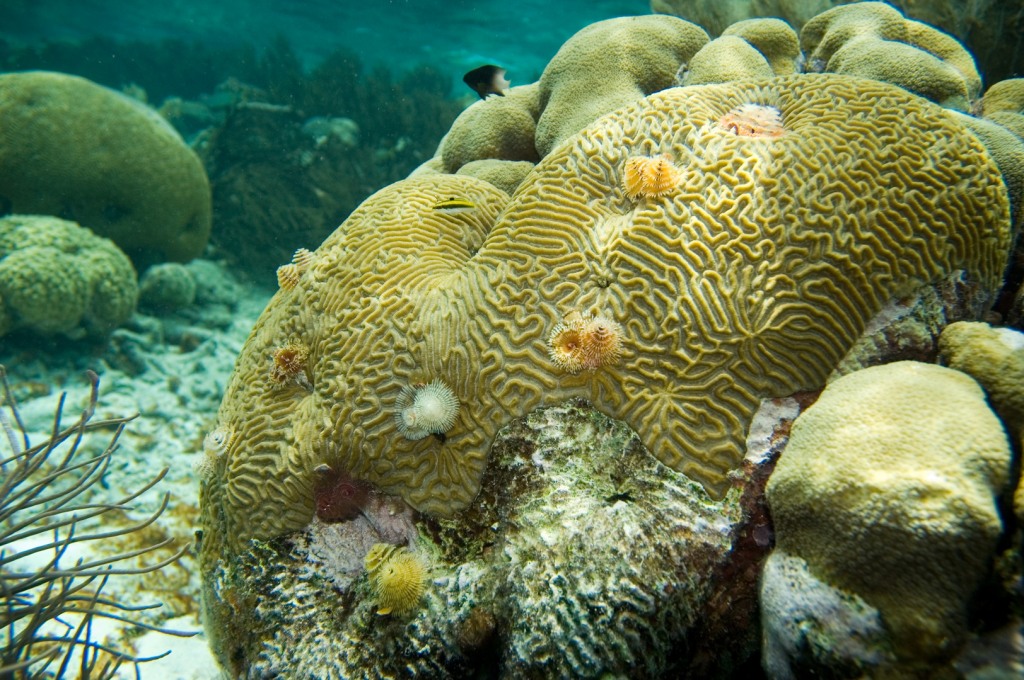
Now, my future husband explored the reef – not unlike when we go to the beach and he walks while I sit – while I floated at a coral boulder and watched the industry of its community. Yellow gobies nipped at the coral, sand blennies popped their heads out of holes then backed back in, a ruffled lime green nudibranch like a tiny lettuce leaf fluttered over the brain coral’s ridges like a two-inch magic carpet. Lobster antennae waved below me like search lights and I sometimes waved my hand just above a feather duster worm to watch it retract into its hole. After a few seconds it would send the tip of a duster out to test for danger then unfold its full feathered fan when the coast was clear.
The salt water puckered my skin, and my fingertips wrinkled like the brain coral. The canned air was cold and dry on the back of my throat and I took the regulator out to push my tongue against my palate, stimulating spit. A Queen angelfish with cobalt-rimmed scales and lemon yellow fins glided by, and later, a boat wake rolled overhead. The wave effect pulled us up and pushed us down, as if the fish and me and my billowing hair bobbed on the surface above instead of swimming 15 feet below.
Then the water calmed again. I saw my future husband hanging upside down, peeking under a ledge where lobsters or maybe a green moray eel peered back. I hovered in the blue liquid world, quiet but for the bubbling of my breath.
This was my work for Writing 101, Day two: “We’re all drawn to certain places. If you had the power to get somewhere — anywhere — where would you go right now? For your twist, focus on building a setting description.”
WordCamp. It wasn’t a camp for writers, or even for word nerds. It was a camp for WordPress wonks, and I loved every second. I must have said ten times, “I feel like I’m on this level,” as I swished my hand parallel to the ground, back and forth at my waist, “And all of you are up here,” and I swished my other hand above my head. “But that’s okay,” I’d say, and I’d smile, and I’d mean it.
I was one of only a handful of writers there, one of a handful of bloggers, and instead of intimidating me, being among all those web designers actually made me feel special. At a writers’ retreat there would be so much opportunity for comparison, for reading someone else’s work and thinking I’ll never be that good, that the thought of a writers’ retreat kind of frightens me. But at WordCamp I didn’t compare myself to these people who write, but in a different language: they write in code.
The rooms, full of creatives, hipster beards and mustaches, fun colorful fingernails and patterned blouses, glasses, web designers, plugin writers, theme developers, who all make beautiful, elegant things only with a different medium from mine, they energized me instead of making me feel less than. I never felt stupid despite how much I did not know. Instead I felt awe, an emotion I predict will appear on the list of core values I plan to construct as soon as I finish this free write.
One of the speakers, Alicia Murray, when she spoke about work life blog balance she posted a slide with a quote from Albert Einstein: a fish is going to feel stupid if it tries to climb a tree (or something like that – find quote) –
Everybody is a genius. But if you judge a fish by its ability to climb a tree, it will live its whole life believing that it is stupid.
– and I could totally relate. She was advising us not to compare, which is a very, very difficult thing to do when I’m surrounded by talented writers. But in a room full of talented code poets, I don’t compare myself. I just thank the internet gods that these poets exist so that they can make us beautiful websites on which we can write our words.
The conference, I should say for all the bloggers who follow me, was not a writing event, and it wasn’t a blogging event either. In fact, it was not a WordPress.com event. It was geared more to the nuts and bolts of designing, developing, and using websites powered by WordPress using WordPress.org (there’s a difference between WordPress.org and WordPress.com, in case you didn’t know). As @Ashevillean tweeted
Wordcamp: NOT a writing event. WordPress-friendly conference for tech professionals: developers, designers, content creators, & more #wcavl
I knew that going in, and I loved that aspect of it, but I just wanted to let all of you know that in case you are considering attending a WordCamp. There were content and beginner tracks, but you need to know ahead of time that the language you hear might be unfamiliar. I used to have a self-hosted website for my soap company, a site that was powered by WordPress.org, and so I was familiar with the language many of the speakers used: plugins, FTP, PHP.
And, with your everyday WordPress.com blogger, very little of that applies.
When we had the self-hosted site I felt like half my time was consumed with managing the website: which plugins to use, which ones had glitches, how to resize my images to fit the theme, who to host the site, how to alter colors, fonts, headers. All by hand. All with very little knowledge. And while we had complete control over the look and functionality of our site, it ate a lot of time I could have spent making soap, or better yet, writing. It was a powerful, robust platform for our e-commerce site, but for blogging, I’m thrilled to use the streamlined WordPress.com and know all that is taken care of. I don’t have to sift through 500 “follow” plugins to find the one that works. If something goes wrong with my site I don’t have to disassemble it and reconstruct, piece by piece to find where the problem was. It’s all there for me and all I have to do is pop in my words.
That being said, I like to know how things work, and I learned a ton this weekend about things I can do within my WordPress.com site to tweak and improve if I so choose, and I understand the back end of a website much better now. I feel empowered by that. On top of sitting in on some great content sessions, I took a refresher on basic CSS so if I want to customize colors or fonts, I can. I learned some SEO tips so I can become more findable when folks are searching for creative nonfiction or literature resources. I learned the basic anatomy of a blog-perfect-story, and how to find balance in my life when I add a job to the mix of blog and family.
And the takeaway I am perhaps most excited about: a link to how to determine my personal core values. Those values will provide guidance as I try to navigate my career path, my blog posts, my writing. Because it’s when you’re writing about what you care about that your voice will come through, and when you have a niche-less (i.e. everything) blog like I do, the thing that holds it all together is not a topic or a product or a theme, it’s the author’s voice. The continuity, the It thing in a flitting, butterfly-minded blog, is the voice. And the way to find and use that voice is to write about your passion, the things you value most. Like family; like words; like nature. Like awe.
This may seem a strange request, but I am a writer who loves words, and I wondering if there is an industry term for the crusty glob of lotion that clogs the tip of a dispenser. Because you attempt to design products to prevent these clumps, I thought you might have a name for them. If so, would you mind sharing the term with me?
Thank you, Andrea Badgley
~
Sometimes I feel like a lunatic, like when, on the day I wrote a collage on Lunacy, I sent the above email out to several soap and lotion dispenser manufacturers. I have no need for the term. I’m not working on a piece about lotion or its dispensers; I have no place for the name once I have it. I just want to know: what is the word for that crusty bit?
When I sent out that email, I was researching lunar words for my Wednesday word work – moon, lunacy – when I came across this entry in the dictionary:
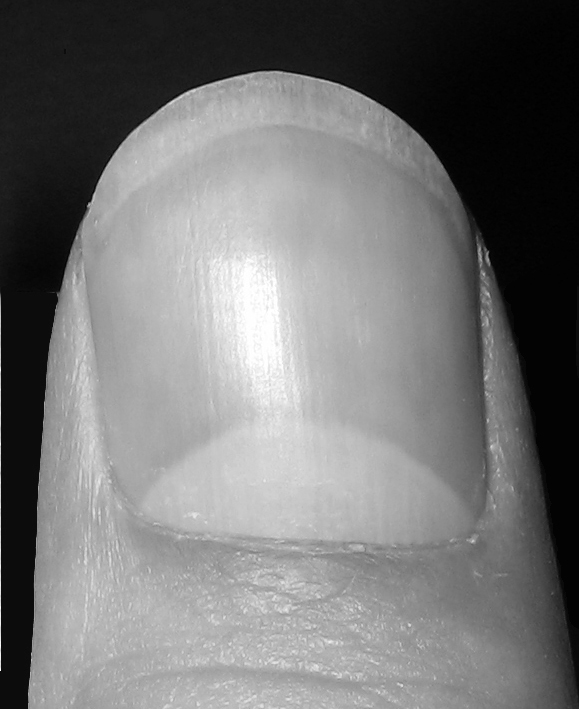
lu·nu·lan. A small crescent-shaped structure or marking, esp. the white area at the base of a fingernail that resembles a half-moon.¹
lunula
Who would have thought there was a word for that half-moon at the base of our fingernails? I was awed by this for some reason, that this seemingly useless body part (is it even a part?) would have a name. In a quest for a decent photograph of a lunula, I followed the word down the internet rabbit hole and, as I gagged over photos of thick, yellowed, and sometimes even green finger and toenails, I discovered that our nails are evaluative tools for doctors: the health of a patient’s fingernails can be indicative of nutrient deficiencies, diabetes, anemia. And it occurred to me, when a doctor evaluates, she needs a name for each body part; she can’t be writing a report and say “that little white thing at the base of the fingernail, the half-moon shaped bit, is not the right shape.” She’s a busy woman. She needs to have language to say “Lunula is malformed.”
This precision of language is my favorite takeaway from Strunk and White’s gem, The Elements of Style:
Omit needless words. Vigorous writing is concise.²
In order to be concise, writers, like doctors, need to have language that allows for this precision. We need to have words. We need to have names.
Everything has a name. Even the snipped tips of green beans. On a recent radio quiz show episode, a guest player canned green beans for a living. The host asked, What are the tips of green beans called, the end things that we cut off? I hate those things – surely you guys have a name for them. Snips. They are called snips once they’re snipped off (EVM when they are still on: extra vegetative matter).
When you need a name for a thing, you go to the people who work closely with that thing, like doctors for human anatomy, or green bean canners for green bean anatomy. And for lotion dispenser diagnositcs? You go to lotion dispenser manufacturers. In writing group, we talked about words, and precision of language, and how everything has a name. Like the globby chunk of dried lotion that clogs the dispenser. My friend Lesley said, There must be a name for that. I’ll bet people in the lotion industry have a name for it.
I have not yet received a reply to my emails, but that day, when I was under the lunar influence, I thought a good name would be operculum, like the door attached to a moon snail’s foot, the door that seals off the entrance to its shell. If I do not hear back from the lotion pump people, and if I ever have occasion to write about the crusty bit that clogs a pump’s tip, that is what I’ll call it. An operculum.
*log·o·phile n. a lover of words.³
¹ “lunula.” The American Heritage College Dictionary. Third Ed. 1993. Print.
² Strunk, William, Jr.; White, E.B. (2000). The Elements of Style (Fourth Edition). Boston: Pearson. p. 23.
³ “logophile.” Dictionary.com Unabridged. Random House, Inc. 26 Mar. 2014.<Dictionary.com http://dictionary.reference.com/browse/logophile>.
I stood in sunshine on the sidelines of our son’s soccer field – the first game of the season – and a mom I had not met yet smiled and thrust her hand toward me. “Hi, I’m M___,” she said. “Thanks for all the email organizing you did for the team last week.” Her glasses glinted in the sun and her eyes were bright and friendly. We stood together with our arms crossed against a chilly March breeze and watched our ten-year-old boys warm up. The sunshine and our boys’ laughter made me feel melty.
“So you’re an author?” she said. My melty body seized. I am? I looked around. Who told her that?
“Uhhhhhh.” I said. And then I remembered my email signature: Andrea Badgley, Author at Butterfly Mind and Andrea Reads America. “Well, author might be too strong a word,” I said. I squirmed. “I write a blog. Well, two blogs.”
I smiled weakly. I don’t usually talk about my blogs except with my writing group and a couple of close friends, and I felt too center-of-attention talking about them on the soccer field sidelines. I shoved my hands in my pockets, then crossed them across my chest again.
“So what do you write about?” M___ asked. Her body faced me and she still smiled. She was truly interested.
“Uhhhhhh.” I said. My mind raced. What do I write about? What do I write about? I could not think of a single thing I write about. A tiny Buddha! I wrote about a tiny Buddha. But what relevance does that have for M___? Writing. I write about writing. My God, how lame! Who cares about writing except writers?
“Uhhhhhh,” I said again. “Well today I wrote about the lunacy of the writing life.” I grimaced. I probably looked like I had gas. None of the parents would want to be my friend after reading that. “And, uh, I wrote about a little Buddha figurine last week.” I saw bewilderment in her eyes. Totally bombing here. “I write about whatever is on my mind, I guess.”
She tilted her head and furrowed her eyebrows. “And do people care about those things?” she asked. “Do people read your blog?” She seemed doubtful. I didn’t blame her after the pitch I gave her.
“Well, yeah,” I said, practically apologizing for what I put readers through. “My blog’s name is Butterfly Mind because I’m kind of all over the place.” I smiled weakly again.
“Oh, I like that,” she said. “Have you seen The Butterfly Effect?”
And then, to my great relief, we were off on another subject.
All week I’ve thought about our encounter, and how that’s not the first time I’ve been caught unprepared when someone asks me in real life what my blog is about. In real life and real-time, I have to answer on the spot instead of being able to chew the tip of my pen and stare off into space while I craft a succinct response. In real life, someone is looking in my eyes, is smiling at me, is genuinely interested in what I’m going to say, and I feel like I always let them down. I decided, No More. I’m going to craft a response now, while I have the leisure to answer in the way that is most comfortable to me: on paper.
I’m going to repeat this aloud while I clean, while I shower; I’m going to practice this until I can rattle it off without thinking. Next time I’m at the soccer field, in the dentist’s chair, at the hair salon, or on the highly unlikely occasion when I’d be in an elevator with an interested stranger, I will have an answer when, in real life, someone asks, “What do you write about?” Next time, I’ll pitch it right.
This week in our writing group we worked on openings. We each selected an unpublished work, excised our first paragraph to a separate sheet of paper (to keep the work discrete and achievable), and rewrote our openings. We began with the first sentence.
This was hard work. That one sentence carries a heavy burden, a pack laden with all the supplies for a journey before the reader has consumed a single morsel to lighten the load: tone, setup, character, summary, the launch, a hook. The essence of the entire piece.
1. For inspiration, I pulled favorite novels off the shelf and copied first lines into my notebook, like this one from A Prayer For Owen Meany:
I am doomed to remember a boy with a wrecked voice – not because of his voice, or because he was the smallest person I ever knew, or even because he was the instrument of my mother’s death, but because he is the reason I believe in God; I am a Christian because of Owen Meany. (John Irving)
Wow. Right? I mean, I was ready to put everything down and start reading Owen Meany again. But then I realized I don’t write fiction, and I certainly don’t write novels, so maybe I should find inspiration in the type of work I do write: creative nonfiction. I made a list of essays and nonfiction pieces that have stuck with me, and I dug through internet bookmarks and compilations of The Best American Essays to find their openings. Here are the ones I wrote in my notebook. Notice the compelling titles; the title carries tremendous weight as well, and when combined with a great opening, a title can be unstoppable.
Maybe the rejection letter was curt, churned out like a widget, or maybe it was wordy, with a misused semicolon, and penned in a respectable Serif font.
My favorite kind of “travel writing” — or I suppose writing about place — embarks on an inner journey, and uses a physical location as a diving board into one’s depths, into their mind.
I didn’t see the jellyfish, but I felt it—a searing pain at my ankle that shot up through my leg, bringing me, in a matter of seconds, to my knees in the sand.
8. “Small Rooms in Time” by Ted Kooser in River Teeth (The Best American Essays 2005)
Several years ago, a fifteen-year-old boy answered the door of a house where I once lived and was murdered, shot twice by one of five people – two women and three men – who had gone there to steal a pound of cocaine.
I’m sorry about that time I ran over a piece of wood in the road. A pound of marijuana in the trunk and a faulty brake light—any minute the cops might have pulled us over, so you were edgy already, and then I ran over that piece of stray lumber without even slowing down.
Enjoy, and I hope you find inspiration from these too.