This week’s SupportDriven writing challenge focuses on tools, and specifically on the tools we use for time and task management. When I moved into a leadership role this summer, my day-to-day work changed significantly, and in any given week I’m trying 2 or 3 different tools to find an effective combination that helps me get the right work done on the deadlines I’ve committed to.
This past month, I think I finally found it. The combination includes prioritization (3 priorities per day), a personal private website using the WordPress P2 theme, and a calendar. I also use several supplemental apps to make super quicks notes that remind me to add things to my TODO lists.
Task management
If you have more than three priorities, then you don’t have any.
— Jim Collins, Good to Great
Tools
- WordPress.com site using P2 theme and checklists.
- Any.do (for quick reminders to add to-dos to my P2)
- Trello (for goal-tracking)
Prior to about four weeks ago, my daily task lists were long and overwhelming. Each day I’d log in and be faced with an endlist to-do list and I would waste time just trying to figure out, “Where do I begin?” Then, in an internal workshop on doing all the right things, my colleague Brie mentioned that she names 3 priorities to guide her days and weeks.
That idea resonated with me, so I experimented with different ways of implementing it. I respond well to checklists, so I started with various checklist apps including idonethis, any.do, and Wunderlist. I liked aspects of each of them: idonethis has fantastic Alfred integration, any.do is a lightweight and lightning-fast way to remind myself of to-dos from my phone, and Wunderlist allows me to drag to-dos into place in a list so that I can prioritize.
But I really wanted to consolidate my to-dos with my personal mission, my goals, and a list of deadlines so that I could plan for the due dates rather than have them sneak up on me. I also have several recurring items, and I wanted an easy way to copy those recurring checklists and then add items to them depending on the tasks on deck for the week.

Ultimately, after my colleague Amy mentioned she uses a personal P2 as a task manager, I landed on setting up a free, private WordPress.com site using the P2 theme. The site includes all of the components I need to keep me focused on the work I need to do to be effective in my role, with checklists, priorities, goals, and deadlines all in one place. I set up an example site at examplebadgleyp2.wordpress.com if you’d like to see a template for what it looks like in practice.
I still use any.do for when I’m on the go and remember, “Oh, I need to add that to my to-do list,” and I use Trello to track progress on my personal goals.
Time management
Tools:
- Priorities from P2 (to remind me of the right work to do)
- Google Calendar (to plan my days)
- ATracker (to track my time)
Once I’ve got my priorities for the following week outlined, I add them to my Google Calendar to tell me when to do what. I plug in all one-to-one meetings, team hangouts, town halls, workshops, and other scheduled events. Next I add my lunch hour to make sure I don’t skip food, then I then go through the daily priorities from my P2 and plug priorities into open slots on the calendar.
Any remaining open slots after meetings, lunch, and priorities will remain open. When those times arrive in the week, I fill them with other to-dos and with the million unexpected, unplanned-for things that happen throughout each day that need to be responded to.
At a higher time-management level, I front-load my week with tasks so that I can save Fridays for planning, thinking, and learning. I also tried hard to make at least one day of the week meeting-free so that I could use that day as a flex day when I work on the weekend. As a lead with 8 or 9 one-to-one check-ins per week and two standing hangouts (our team call and a leads call), I was not able to accomplish a totally meeting-free day, but did minimize on a couple of days so that I don’t miss too much if I flex on those days.
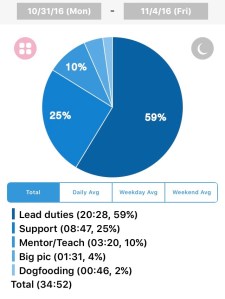
I use the ATracker app on my phone to track my time so that I can look back each week and see where I spent my time. I aim for balance among leading, direct support, big picture planning, teaching, learning, and dogfooding (using our products). If I spent too much or not enough time on certain areas one week, I know to keep an eye on myself the following week to avoid making the same mistake again. Last week I had a pretty good balance; I didn’t focus on learning, but I did do a good job of abstaining from work on my flex day:
Communication in a distributed workplace
Tools
- P2 (asynchronous text communication with coworkers; replaces email)
- Slack (synchronous text communication with coworkers)
- WordPress desktop app (publishing and following P2s for work)
- Simplenote (notepad for hangouts or for drafting internal blog posts)
- Zoom (video communication with coworkers)
- Google docs (collaborative editing)
- Google sheets (data sharing)
- Skitch (image annotating)
- Cloudup (image sharing)
- Polldaddy (polls and surveys)
- Doodle (scheduling dates/times when multiple people are involved)
- Time.is (determining what time it is for colleagues around the world)
As you can imagine, working with colleagues all over the globe in different time zones — all from their own homes or co-working spaces, who are sleeping when you’re awake and awake when you’re sleeping, who you don’t see in the office every day and don’t have coffee or lunch or beers with, whose laugh you can’t hear or frown you can’t see — requires some creativity when it comest to communicating. At Automattic, we have a mantra: communication is oxygen.
As a result, we communicate a lot. On Slack, which is where we “talk” to each other all day via text, emoji, and GIFs, I’ve sent 114,330 messages since I started my Happiness Engineer trial in July 2014. On P2, I’ve published 822 posts, 2,434 comments, and 287,928 words.
I share these stats because what I love about using text to communicate is that it’s archived and searchable by anyone in the company. Verbal conversations are ephemeral, are subject to memory lapses, and are not searchable by others. With P2 we are able to find where things have been discussed and see, in writing, workarounds, steps, discussions, and decisions, and we can contribute to those conversations whether they were started four minutes or four years ago.
The tools on this list can be used by anyone, not just folks in a distributed workplace, and I encourage you to click through and play!
This is my entry for the Week 2 SupportDriven writing challenge: “Tools: What tools do you use to manage your tasks and time? (can be personal or professional, electronic or non-tech).”





 Butterfly Mind