last night
when I tucked you in under your pink quilt
with the green frogs on it,
I crawled into bed behind you and
we spooned.
I scratched your smooth back
while I sang
Scarborough Fair – Parsley, sage, rosemary and thyme –
and stroked your round cheek
with the back of my hand
after the final refrain.
Then we felt each other’s muscles
and giggled.
Paper-thin ice
juts from the curb.
Delicate,
like sheets of sugar glass,
it glistens in the sun.
Sodden white clumps drop
from trees – splash!
into slushy puddles
in the yard.
Slick branches drip. Drip. Drip.
Snowmelt trickles down roofs.
Street gutters gurgle and gush.
The neighborhood burbles merrily
like a clear mountain stream.
I wrote this on March 1, 2012 in Minnesota, and originally named it “March 1.” This year in Minnesota, “May 1” may be a more appropriate title.
Instead of staring into a cold glow of pixelated light this morning, I kept the computer shuttered away in its desk and sat by the window, where blackness transitioned to grey, and grey blushed warm and pink as dawn approached. I turned on a lamp, pulled Natalie Goldberg’s Writing Down the Bones from the shelf, and folded my legs underneath me on the couch to write, pen in hand, ink on paper, in a marbled composition book.
I went to bed last night not knowing what I’d write about today, and I woke up in the same state of emptyheadedness. I didn’t know much, but I did know that staring at the same computer screen I stare at every morning at 6am wasn’t going to inspire me. I needed to change things up, to disrupt my routine. To jibe.
While I waited for my coffee, I flipped the pages of Goldberg’s book till I found an exercise that looked easy. Page 87. Lots of empty space with two lists of words. One list nouns. One list verbs. Sweet! I like lists.
The exercise, entitled “The Action of a Sentence,” instructs you to fold a piece of paper in half. I did this in my composition book. On the left side, write a list of ten nouns. I wrote:
On the right, write a list of ten verbs. Goldberg actually instructs you to “Think of an occupation; for example a carpenter, a doctor, a flight attendant,” and then write verbs that accompany that occupation. I missed that part though (remember, no coffee yet?) and just wrote some verbs:
jostle
drape
billow
slice
sizzle
nick
stitch
thrust
peel
jibe
Then? Put your nouns and verbs together in sentences, and voilà! You are writing.
A stiff wind peeled fresh dogwood petals from their branches.
With velvet ink, she stitched sentences onto paper.
The cold martini billowed warmth into her belly.
The candelabra draped the room in light, and in shadows.
Chartreuse shoots sliced the black earth, stretched toward the light, and unfurled triumphant cotyledons.
A butterfly jibed, frantic to find shelter as the storm gathered strength.
She thrust the Dutch oven into the coals, angry that he had swindled her. Furious that she had misjudged.
Sunlight sizzled on a sapphire sea.
Her goggles were jostled in the maelstrom of elbows and feet, already leaking two minutes into the open water swim.
Staring out the window, he nicked his knee, tap, tap, tapping it with a sharp, dried fingernail clipping.
This 72 inch geographic relocation, from sitting at the computer to sitting by the window, and the changes that resulted from it – natural light and an incandescent lamp; a paperback (not electronic) writing book, opened to page 87, tented on the couch; my hand moving across paper; lists of nouns and verbs, and the physical action of stitching them together to sew sentences – has electrified me. Has shuffled my synapses.
I feel a high level of productivity coming on.
Goldberg sees writing as a practice that helps writers comprehend the value of their lives. The advice in her book, provided in short, easy-to-read chapters with titles that reflect the author’s witty approach (“Writing Is Not a McDonald’s Hamburger,” “Man Eats Car,” “Be an Animal”), will inspire anyone who writes—or who longs to. (from Natalie Goldberg’s website)
From the podium, I looked out into an audience of about 60 people. Their eyes focused on me, and from their facial expressions – a smile in the second row, fascination in the fourth – I saw that they were absorbed. Nobody sipped coffee, or coughed. Nobody shifted position. I continued reading.
“The air was heavy, thick with heat and mud. We skirted exposed oyster beds in the shallow water, moving slowly enough that we could hear the oysters snap and pop.”
My mouth was dry, but I was reading better than all of my practice sessions, and I didn’t want to throw my momentum by taking a sip of water. All weekend I tried to suppress my nerves as we cheered our son’s team at a soccer tournament in Charlotte. I did not succeed in hiding my stress from my husband, though, and he asked what was wrong.
“I’m just nervous about my reading on Sunday.” I attempted a smile.
“I wondered,” he said. “You seemed really nonchalant about the whole thing.”
And I was nonchalant. At first. Talking in front of a crowd doesn’t bother me. I used to give informational meetings several times a week in front of total strangers when I worked for The Leukemia & Lymphoma Society. But as the Valley Voices reading approached, and I practiced my piece over and over and over again, finding another fault with each and every read-through, I realized that reading your own work, for which you’ve mined every word, for which you’ve excavated your soul, is a very different thing than giving a sales pitch for your employer. Sharing your own work on a blog already makes you feel vulnerable, even though you get to be secreted away in the privacy of your home when others read it. So to stand in front of a crowd and expose your creation out loud? It makes you feel squishy and naked, with every flabby flaw exposed.
My husband asked, “Why are you so nervous now, when you weren’t before?”
“Because I heard the other writers read at rehearsal, and they were really good.” I studied the cobalt blues in the hotel hallway carpet. “I don’t have any confidence in mine.” I didn’t say it, but I thought, maybe mine was was the only nonfiction submission they received. Maybe that’s how it slipped in.
“You’re just sick of looking at it, and you’re nervous about reading. Don’t beat yourself up.” He hugged me. “It was selected, Andrea. The judges liked it. That’s why you’re there.”
My mouth was parched. Only two pages to go. I felt a little faint. I looked up again and saw the same rapt attention. I had passed the place where I thought the piece sagged, and the audience was still with me. Their silence was electric. I could feel that I was reading well. Thank God. It didn’t suck.
When I finished, I croaked out a small “Thank you,” then sat in my chair, quaking, relieved that I was done. I was able to enjoy the other writers’ work, and was grateful for the beauty in their poetry, and the laughter they surprised out of me with their humor.
After the reading, I was speaking with one of the judges, thanking her for reading all of our work, when a woman tapped my shoulder and told me, “I loved your piece. I was right there with you. I could smell those marshes, and I’ve never been there.”
“Thank you. Thank you so much for telling me that.” I beamed at her.
Later, one of the organizers of the event gave me a big smile and told me I had read well.
“Thank you, Jane! My God, I was so nervous. I couldn’t believe it even made it in.”
“Why not?”
“Because it doesn’t have a point! It’s just pretty. No tension, no drama, no climax.” None of the elements of a successful story.
She looked surprised. “It doesn’t have to have all of that. I was with you on that boat, I was engaged the entire time. I could hear the motor, I could smell the marsh. I experienced that boat ride with you. We all did.”
On the way home, I mulled the problems I had seen in my piece. I painted a picture, yes, but is setting enough without a story? Is “pretty” enough without a punch at the end? I chewed on Jane’s words, “It doesn’t have to have all that.”
And then, I thought about visual art. I pictured nudes reclining, and a still life of golden pears, and how the beauty in well-rendered scenes moves me. I thought about Van Gogh’s oil painting of a café terrace at night. Its rich blues and vibrant yellows, the halos of the stars, the luminescence of light from the cafe spilling onto the dark cobbled street. There is an inherent tension between the welcoming café glow and the inky darkness of night, a drama in the contrasts, if you really want to analyze it. But mostly, I just find the painting pretty. There is a beauty in it that doesn’t need a story. A beauty in it – the contrasts of light and dark, of blue and yellow, a couple walking toward the cafe, a triangle of green fir on the edge of the painting – that is a story.
It occurred to me then that with all the ugliness in the world around us, sometimes, pretty is enough.
The Café Terrace on the Place du Forum, Arles, at Night, c.1888 by Vincent van Gogh
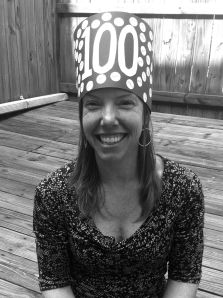
I made a hat. Kindergarten-inspired 100 posts, 100 words hat
This is my 100th blog entry since my first, One last move, in June of 2012. Woohoo! To mark the occasion, I read my previous 99 posts and plucked a favorite word from each. I was fascinated by trends in word choices. For example, I discovered an apparent affinity for gerunds (words ending in -ing) and that I gravitate towards adjectives and adverbs rather than selecting “concretes” – strong nouns and verbs that require no further descriptors. I had to search hard to find nouns and verbs for this list. I aim to improve on that in my next 100 posts.
When our kids were in kindergarten, they made hats like this one on their 100th day of school (only they didn’t write favorite words in the dots.) I always thought they were funny. Also, for my friend who challenged me to write a post of 100 words, check out the word count on that first paragraph.
Press release from the New River Valley Voices regarding the reading this Sunday at which I will present “Riding in Boats Through Salt Marshes:”
Six local Southwest Virginia authors will present original work at the spring 2013 New River Valley Voices Reading on Sunday, April 21, at 3 PM in the Blacksburg Public Library’s Community Room. The seven fiction, poetry and non-fiction pieces were selected from more than seventy submissions by final judges Jim Minick and Tiffany Trent, both local authors.
The authors featured are Kendra Atkins-Boyce (fiction), Andrea Badgley [that’s me!] (creative non-fiction), Larsen Bowker (poetry), Ann Goethe (fiction), Diane Goff (fiction), Alison Long (poetry), and Rob Neukirch (fiction).
The reading is free and open to the public; light refreshments will be served.
Jim Minick, author of The Blueberry Years, and Tiffany Trent, author of several young adult novels including The Unnaturalists, will attend and have books available for purchase and signing.
New River Valley Voices formed in 2011 under the leadership of Su Clauson-Wicker, Jane Goette and Lesley Howard. Tony Distler joined them in 2012, providing the finalists with coaching on presentation of their pieces. Their mission is two-fold: 1. To provide NRV writers with a quality forum within which to share their work — a place both literal and figurative between the extremes of highly-competitive literary journals, and an open microphone venue. 2. To grow and nurture NRV audiences to enjoy local literary arts and to support local writers.
The Blacksburg Public Library is located at 200 Miller Avenue in Blacksburg.