I’m wearing slippers today, and a sweater and corduroys. I blow-dried my hair after my shower so my head wouldn’t be cold, and left my hair down to keep my neck warm instead of pulling it immediately into a pony tail.
I poured boiling water into my mug today to warm it up before I poured my coffee in. The mug, which is my favorite mug, which our daughter made for me and is pink with tulips on it, and which I’m debating putting away until spring so I can delight in it again when March or April arrives, warmed my hands as I cupped it between them and stood at the back glass door, steam rising from my mug to warm my face, and looked out at the misty garden.
Yesterday during my workday, I had to get up several times to move and climb stairs and run in place because my feet were cold. I almost turned my space heater on. After work, I read under a blanket curled up with a kitty. When I climbed into bed last night, the sheets felt like slabs of ice.
When I woke up this morning to go for my swim, I heard the click and then the whoosh of the heat coming on. Today, I’ll put the heated mattress pad on our bed. It won’t be long before we’ll have our first fire in the fireplace.
My husband and I woke without an alarm yesterday morning, ate a quick breakfast, and got in the car to drive the two hours to Grayson Highlands where we would hike Mt. Rogers. As I packed my daypack, he told me it would be in the 40s and really windy. I grabbed a couple of extra long sleeved shirts to choose from, along with ear warmers and gloves. But mostly I was excited to bring my camera; I remembered this hike being stunning.
We arrived at 10am to blue skies and fierce wind — wind so strong that flags stood straight out and snapped and cracked in it, that trees whipped sideways, and that it ripped the door out of my hand when I opened it to get out of the car. I could hardly close the door against the wind. I had underestimated the weather and did not bring my wind breaker even though my husband told me it would be cold and windy. I feared I would be miserable the whole time.
I put on every layer I brought, and we got moving to keep warm. As soon as we started hiking, I was warm enough despite the cutting wind. It helped that the day was glorious. On our way to the state park, we drove through rolling hills planted with Christmas tree farms, and wound our way through mountain s-curves as gold leaves fluttered to the ground.
We hiked through a tunnel of Rhododendron and I could see my breath. I brushed up against a fir and smelled Christmas trees. The trail was lively with backpackers coming off the mountain after camping the night, bundled warm against the biting chill.
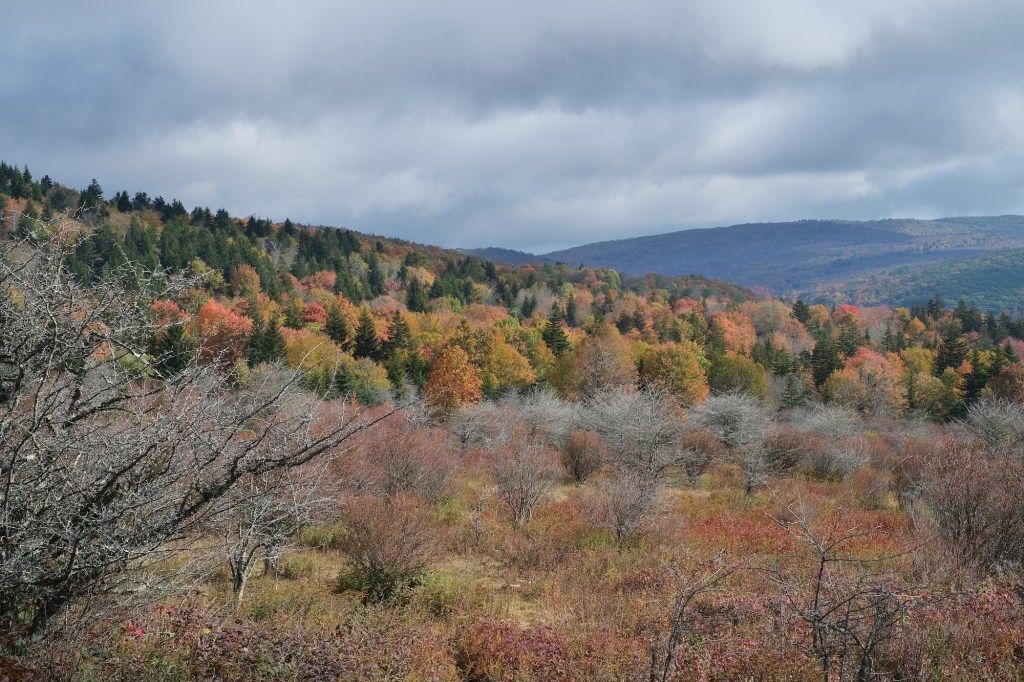
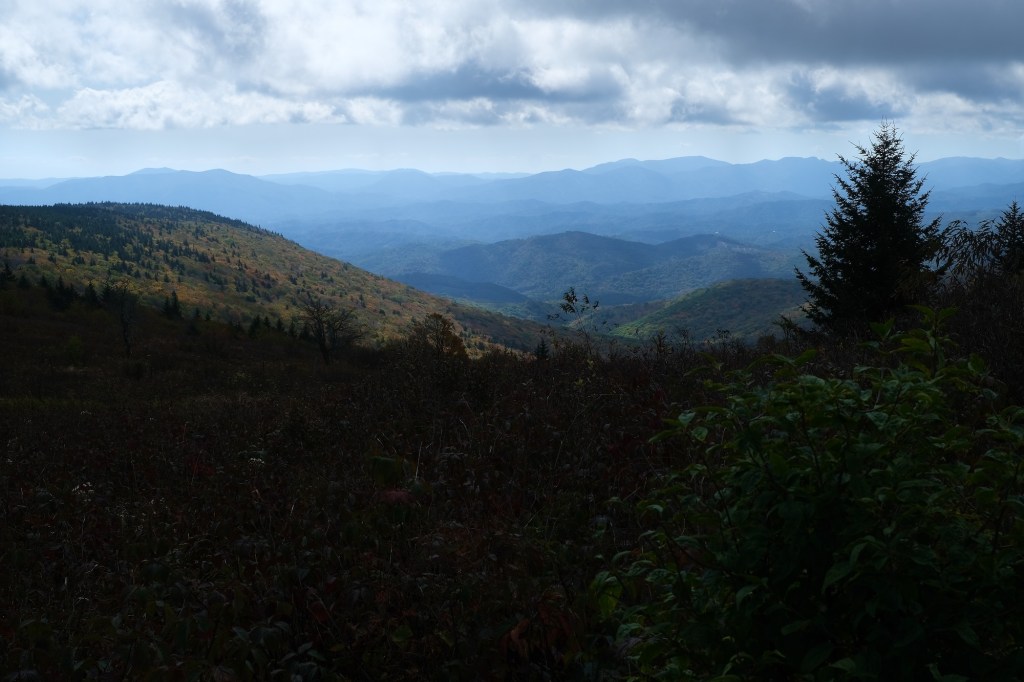
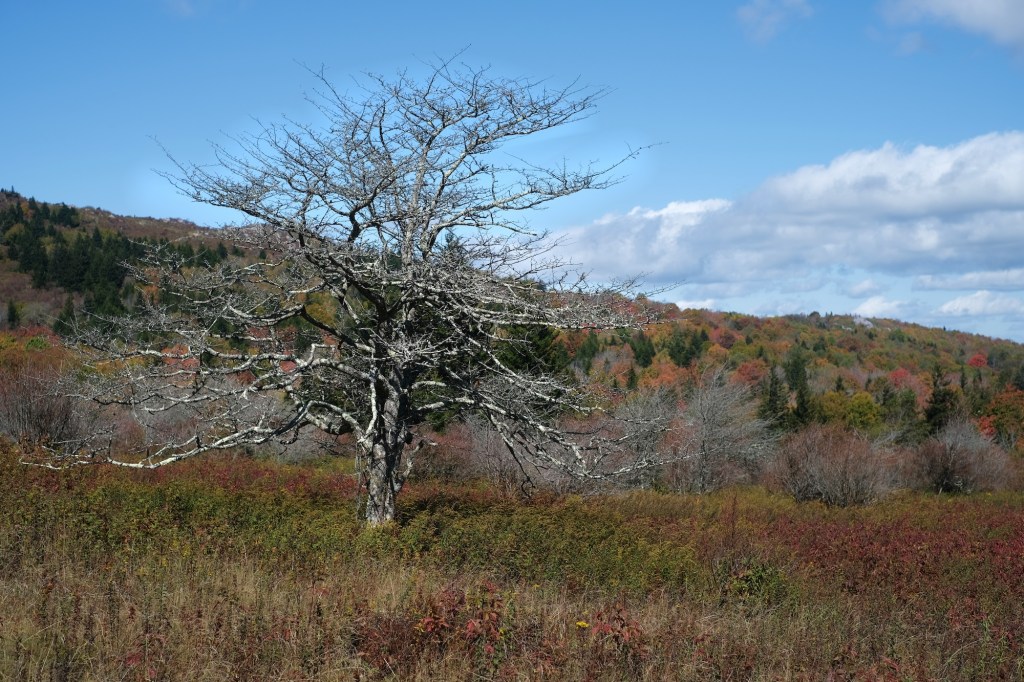
The vistas were spectacular, just like they were last time we hiked this trail ten years ago. Last time we hiked was in June, when fresh spring greens and pinks were emerging. This time, we saw yellows and oranges and brilliant reds mixed in with the evergreen of the firs. The brilliant reds were so intense, they were almost florescent in their redness. It turns out they were not leaves, but clusters of shining berries.
We passed over exposed meadows broken up by giant boulders, then down into glens filled with firs and rhododendrons and ferns and moss. We passed through a rocky notch that opened into a golden glade where the the forest floor was covered in fallen yellow leaves and the October light slanted through the trees.
The light all day was glorious. At one point I thought I had my amber-lensed sunglasses on, but I did not. I hadn’t even brought them. I just wore my regular glasses. Everything had a golden glow.
When we were out on exposed balds, the wind was so sharp and cold it made my eyes water. We hiked fast, though, and that kept me warm. We passed backpacking campsites that smelled of damp forest morning, nylon tents, and campfire. Smoke twirled up from the ground. We heard the zip of tents opening and the murmur of morning voices.
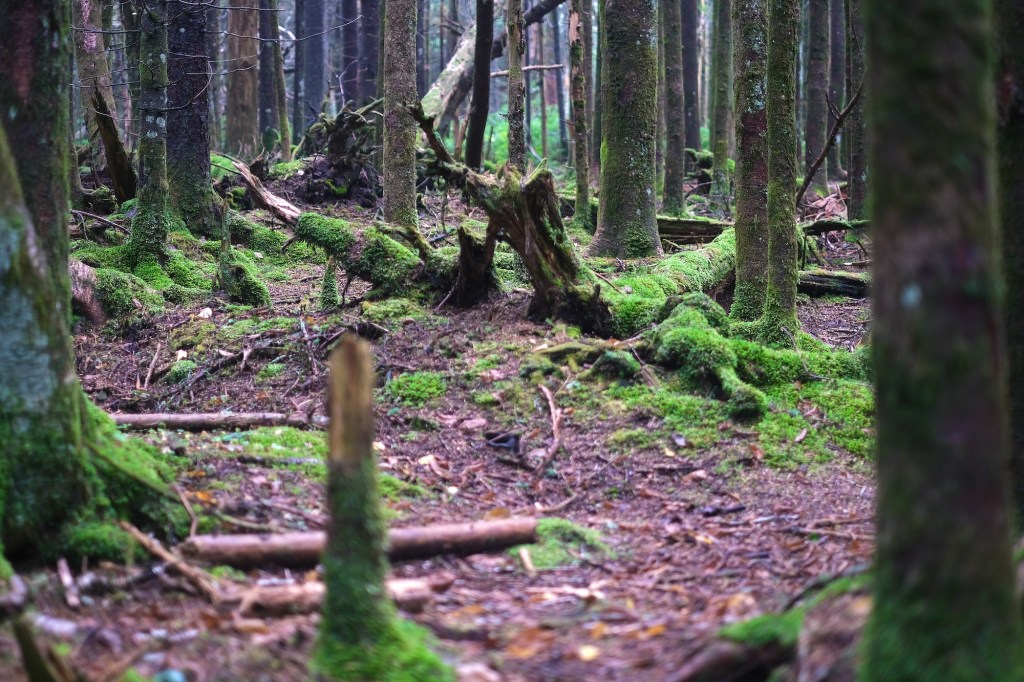
When we got into the fir forest near the top of Mt. Rogers, the crowd was absent. We’d been following the white blazes of the Appalachian Trail all day, but the trail to the top of the mountain was a spur trail, and we only saw a couple of other people on it. Unlike most summit hikes around here, the culmination of this trail wasn’t a view; it was a boulder, the highest point in Virginia, in an evergreen forest that felt primeval. The forest looked ancient with its moss covered stumps, moss covered tree falls, mossy trail and stones and tree trunks. The ground was wet and everything dripped; the mountaintop was often in the clouds, and not much light seeped through the dense fir needles to dry it out after being drenched in mist.
When we emerged from the forest, the light was warm and bathed the mountains in its amber glow, but I struggled all day to capture it. For once I hardly cared because the hike itself made me fall ecstatically in love with the world at least three times because I was so overwhelmed by the beauty. This is hands down my favorite trail I’ve ever hiked. I want to hike it again and again. I didn’t need photos to capture the light, I just enjoyed it.
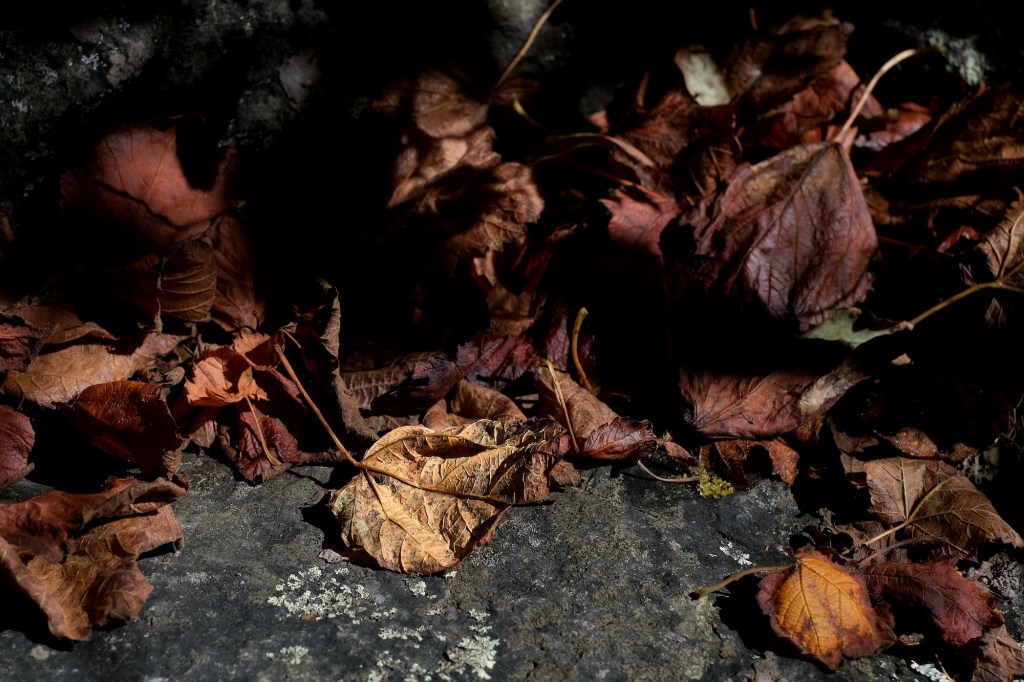
But then, near the end, when I figured I just wasn’t going to get any shots I was excited about, I saw a pile of brown leaves on a stone in the dappled forest light. One textured leaf was spotlighted by the October sun. And I got it.
Eleven days ago, I shared a photograph of a chrysalis I found dangling in the compost. I’ve been checking it every day. Yesterday, the green sheath turned clear, and I could see the butterfly’s black and orange wings inside.
Today, I ate lunch perched on top of our deck table like I usually do when the weather is nice. The crickets were back at it with the chirping after their silence this morning in the fog. The oak has a few fully red leaves now. I only remember it going straight to brown in the past; I don’t remember it stopping through red on the way. Either the summer rains made a big difference this year, or it goes quick and I miss the red every year, or I’ve just not paid close enough attention. But this year there are glossy ruby-red leaves, and they’re beautiful.
The sun was hot on my shoulder; it was too warm for the jeans and tee-shirt I wore. The more I sat while I ate, the more things I saw that I wanted to do on my lunch break: fill the bird feeders, water the salvias and blanketflowers I transplanted, check on the chrysalis. When I’d set my plate down after eating, the wind lifted. It added a beautiful shushing to the air as it rippled through the oak leaves on the tree. I decided grab my camera and check on the chrysalis.
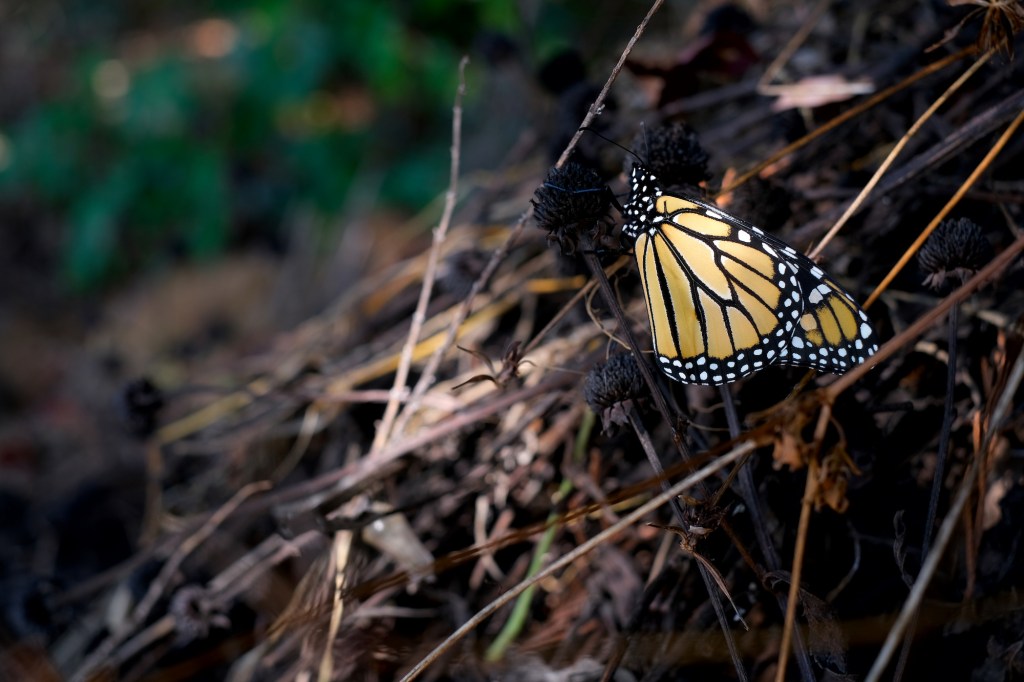
When I hiked up to the top of the hill, I saw the freshly emerged butterfly drying its wings a few inches from its empty chrysalis. An hour in either direction, and I might have missed it.
Empty monarch chrysalis on compost heapNew monarch butterfly
It’s 3 o’clock in the afternoon and I’m sitting outside under the dogwood tree. It’s been weeks since I’ve pulled out my cushion and sat in the Adirondack lounger my husband made me last year. The sky is blue. Wind rustles the dry Karl Foerster grass next to me, the lemon balm, the dogwood leaves. A grasshopper just leapt out of the columbine and landed on the foot of my chair. It’s walking towards me. It’s buggy eyes are trained on mine. I hope it doesn’t jump.
I can’t concentrate for fear it will leap at my face. Writing on my lap is a challenge now because I had to stop using my left hand to keep my journal in place — I have to use it now to hold my book up as a shield. My journal slides around as my right hand tries to scribble in it. I peek over my book and the grasshopper is still staring straight at me, like it will leap any second, and even though I know it might jump, I know I will still squeal and drop my pen and bat at my face if it does. Ooh! It’s turning. Slowly. Away. And now it has sprung into the Karl Foerster grass.
The breeze feels good on the hairs behind my ears. And on my toes. I hear frogs and crickets and the soft shushing of leaves. My mums and asters look lovely in their bronzy deep red and bright October purple. End of summer bumble bees and honey bees buzz around and land on them. My husband and daughter just called out from the driveway that they’re going to get Boba and wonder if I want any. I do. They will bring it back; I don’t have to get up.
Sunlight slants through the dogwood leaves and into my right eye. The leaves aren’t as full as they were midsummer. They’ve shrunk a little and are coppery red with green spines. Sunshine glints off the rim of the glazed bird bath. The wind has died here, but I hear it ripple through the tall trees across the street, and now it has arrived. I feel a breeze on my shoulder. Little skippers dart among the flowers. The air is filled with crickets chirping. A suet cake dangles from a dogwood limb, under the canopy of autumn red and green leaves. The tree has made bright red ovoid berries. The sun is still in my eye, but it’s not too bad, it’s October.
Daily writing prompt
What details of your life could you pay more attention to?
I took my coffee out on the back deck this morning. I stood in the sunshine in bare feet and sweatpants. The railing and chairs were wet with heavy dew, so I tried not to lean on anything. I didn’t climb up on to the table to sit on my normal perch.
I watched steam rise from my coffee cup into the cool air, and I looked out over the back garden. The green grass of the lawn sparkled in the morning light, covered in dew drops that rainbowed in the sun.
I love the ruby color of the sedums this time of year, especially alongside the crimson mums I put in last weekend. I want more of those colors. In every season I think, “I need to plant more stuff that peaks right now.” But for real, I want to do that for autumn. I’ve got gaping holes in the back left bed, next to the purple lollipop vervain. I’d love to put Mexican feather grass there. Mexican feather grass is my favorite, especially in the fall when it has turned golden and wispy and it waves like ponies’ tails.
The light is gorgeous in October. It’s almost noon now, and instead of the light being harsh and white like it is midday in summer, the world has that golden October glow. I sit by the window now and listen to the wind shush through the dogwood leaves. The back door and all of our windows are open wide, and fresh air blows through the house. A cat purrs on my arms, and I watch the bronze tassles of miscanthus grass shimmer and wave.
My husband and I woke before the sun this morning and couldn’t get back to sleep. We filled water bottles and I made a PB&J while it was still dark out. Since we were up anyway, we decided to go hike the most popular trail around here; we’d get there long before the crowds.
We bundled up in fleeces and sweatshirts and woolen hats, and buckled into our little convertible Mazda with the top down. We rolled out of the garage into a thick fog, and when it thinned enough that we could see through it, I saw the full moon in the mist, a little more than halfway down the western sky. It was still a half hour until sunrise, and we drove in the dusky morning light.
Heat blew from the convertible’s vents, and I turned my seat warmer on. We dove through swooping curves and up and over rolling hills as the sky pinked and the moon glowed. There it was to our left, in the mist above a mountain meadow. Now it was behind us, above the trees and the curved ribbon of road. The fog thickened again.
I stuffed my hands in my hoodie’s pockets and felt cold mist on my cheeks. The world felt magical with the wind rushing by and no roof over my head.








 Butterfly Mind