I started swimming laps again in April. When I slipped under and pushed off the wall, I remembered how much I love being in water. My habitual practice set came back to me immediately, despite it being over a year since I last swam.
I signed up for an annual pass, and swimming is now part of my daily routine.
After two months of swimming four days a week, though, I saw no improvement in my stroke or my lap times, which seems like it shouldn’t even be possible. After two months, I should see at least a little improvement, right?
Perhaps this is obvious, but it became clear at some point that things wouldn’t change without me changing something. I watched some technique videos and started incorporating new drills into my practice.
Over the past week, I made one small change that cut 2 seconds off of my lap time: I paid attention to finishing the stroke. One thing I like about swimming is that it’s very technique-driven. This anchors me to the present moment. I’m paying attention to almost every body part as I move through the stroke: what is my leading hand doing, where are my hips for the kick, are my feet just flopping around, is my recovering arm relaxed and actually recovering?
Before I watched the technique videos, when I swam, I primarily paid attention to my pulling hand as it entered the water, then my elbow to make sure it was at the best angle to get a good strong pull; as soon as that hand was under my body, my attention would shift to my kick or my recovering arm that was out of the water. What I neglected was the follow-through of my pulling hand, which needed to complete its cycle. That hand still had a lot of water it could push against to propel me forward.
As soon as I paid attention to the follow-through, my performance immediately improved.
Ours is a berry-loving family. Strawberries, blackberries, blueberries, raspberries: our son would live on these if he could. Now that he’s home from college, and I’ve started eating more berries because I’m trying to eat the rainbow (such deep, gem-like colors!), and my husband puts berries in his cereal and oats, and our daughter puts berries in her smoothie bowls, we go through quite a few pints of berries each week. This becomes expensive when those pints are $3.50 or $4.00 each.
During berry season, though, I get giddy when the label on the blackberries says $1.49 per 6 ounces. Blueberries $2.50 for the same. Raspberries $2.50 for double that volume. And when the strawberries come in, $2.50 for quadruple the volume.
The strawberries go a little slower in the house when there are blackberries, raspberries, and blueberries around. I think this is because the latter three are self-contained units: small enough to toss in stuff without having to slice them, no stems, no work. Just pop them in your mouth, on your yogurt, in your smoothie. You don’t even have to open the compost can to dispose of the green tops.
So when the strawberries come in, and I see those giant 32 ounce containers, I put one in my cart, then go to the baking aisle and buy Ghirardelli dark chocolate melting wafers. When I get home, everyone gets a surprise treat of chocolate-covered strawberries.
I often fall into the trap of thinking I must travel to inject novelty into my life. Sometimes I remember, though, that I can inject novelty by looking at my own surroundings with a tourist’s eye.
Yesterday was a gorgeous spring-summer day, and I had the whole day to play. We live near a college campus, and lucky for me, there is a horticulture garden there. I wanted to soak up sunshine, like a plant, so I slung my camera over my shoulder, and walked the two miles to the six acres of tended beds. When I travel, I like to walk instead of driving. On foot, I can see things slowly and up close, hear all the bird songs that go with the place, smell the flowers that are in bloom, or the lunches cooking in restaurants I walk by.
When I do this at home, I get a chance to appreciate where I live, and am reminded how ridiculously beautiful it is.
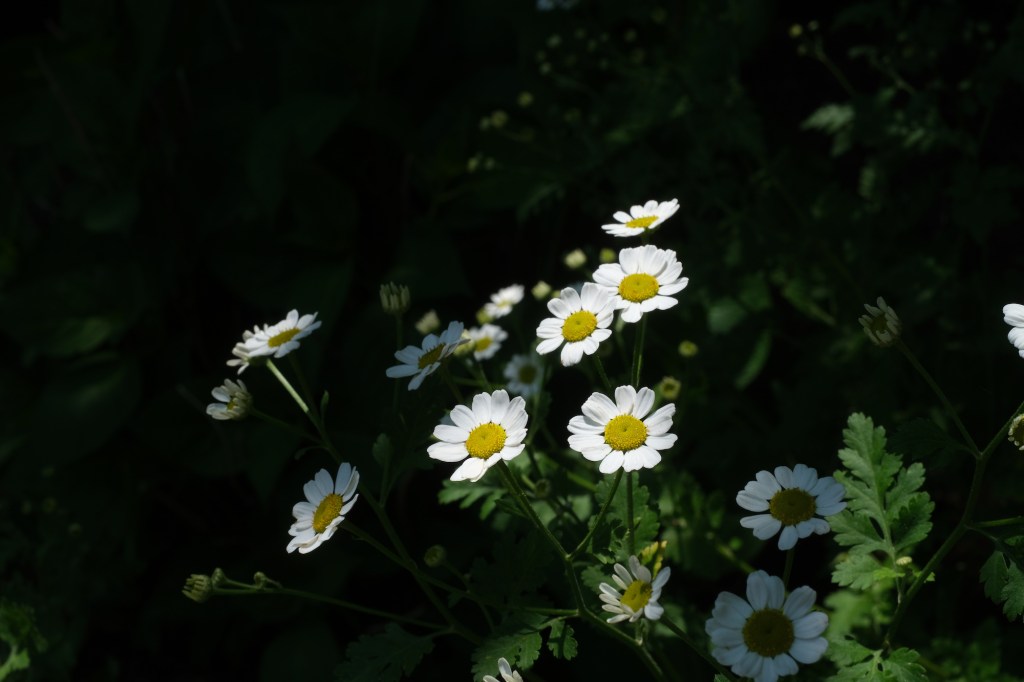
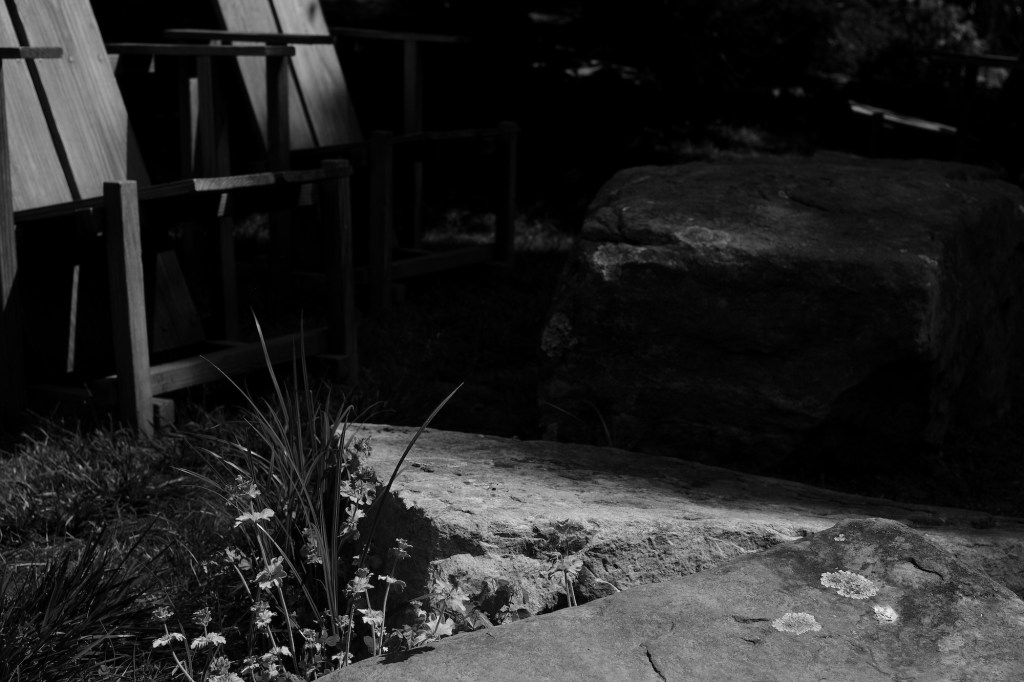
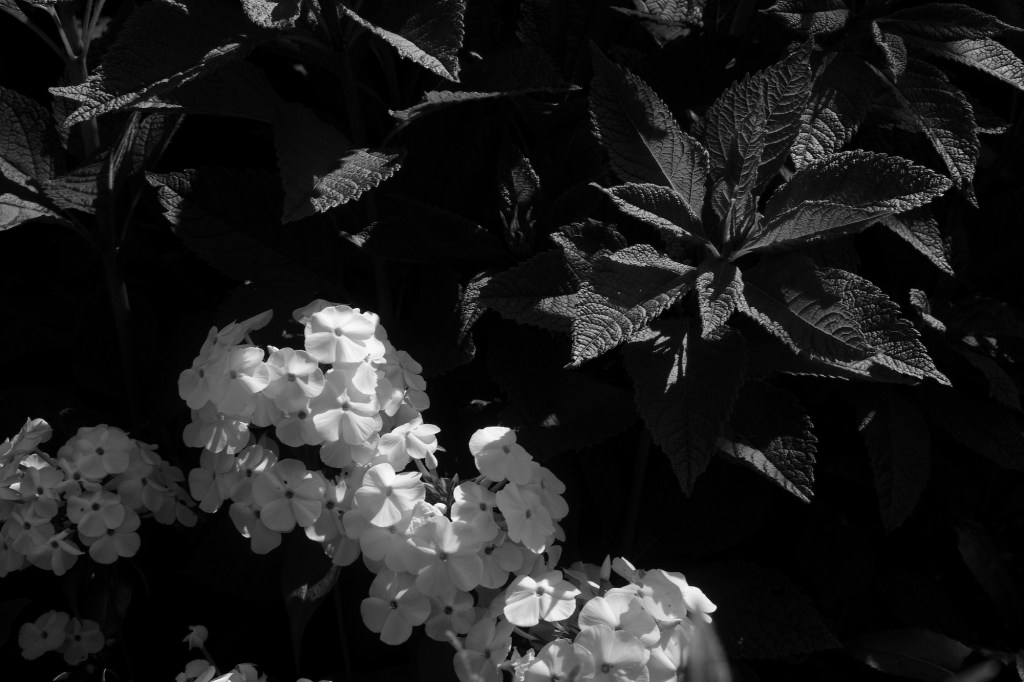
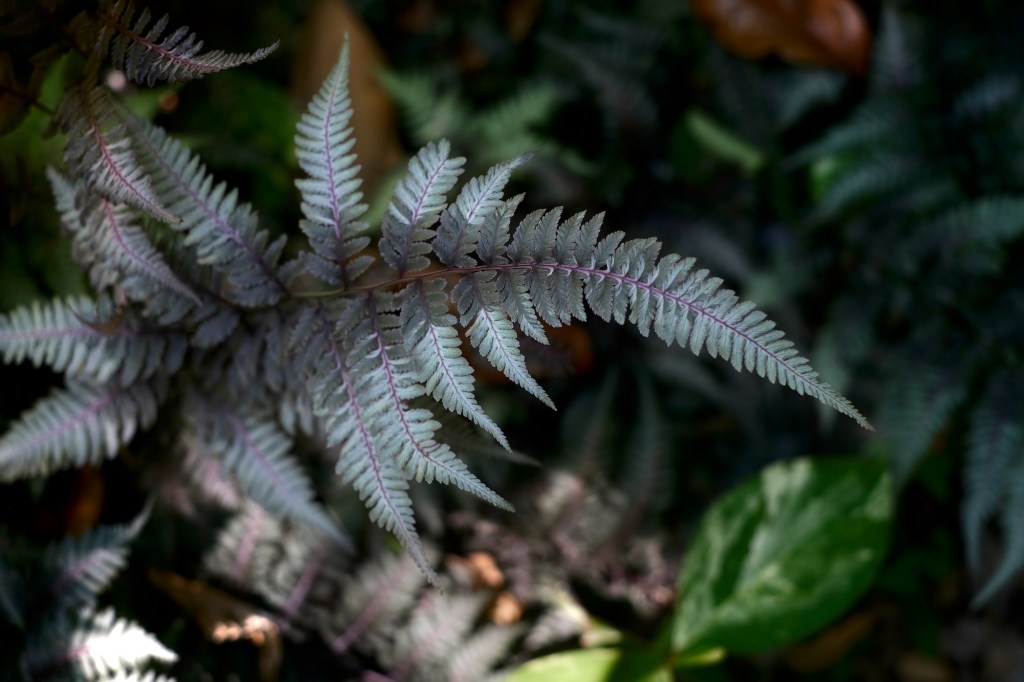
Feverfew in my garden.Sunlight and lichens on rocks.Silvery fern.Big green leaves.White phlox and textured leaves.Berry cascades.Silvery fern.Sunlight on garden chairs.
Tis the season of coffee and books in the garden. Tis the season of cabbage and sulphur butterflies, unmarked and unremarkable when compared with the splashy swallowtails and monarchs that will come later in summer. But still, the little pale green and yellow butterflies flit and flutter, unencumbered and free. They inspire one to enjoy flowers and sunshine, a sip of something sweet.
Tis the season for bees to buzz, to dip into the purple trumpets of salvia, the yellow buttercups of rue, the diminutive white daisies of feverfew. Tis the season of birdsong trills and the putter of private prop planes on Saturday jaunts from the nearby one-runway airport.
The sky is blue. Midday sunlight is blinding bright on the ivory paper I write on. The sun is warm on my pale winter skin. A hint-of-summer breeze lifts the edge of my flowery skirt.
I’ve got my afternoon coffee, my book of short stories, the butterflies and the bees, and for the first time in months, nothing I have to do today but enjoy it.
Daily writing prompt
What are the most important things needed to live a good life?
I’m tired of feeling bad about consuming other people’s creations instead of making my own. I was originally going to write about fiction I read this week, then I realized I’m also reading some non-fiction, which made me think of the podcasts I listened to, which led to the ear and eye art, so I figured what the heck, I’ll just hit it all.
Reads
I finished the novel Demon Copperhead by Barbara Kingsolver this morning, and it was well worth reading. I had no idea it was set right here in Southwest Virginia when I picked it up. I love all of Kingsolver’s books that I’ve read, and especially the ones that take place here in Appalachia. In this one, she dives deep with the main character into the world of foster care, the opioid epidemic, and what it’s like to live in one of these small Appalachian towns. Apparently it’s a loose retelling of Dickens’s David Copperfield, but I’ve never read that, so it’s definitely not necessary to have read it in order to appreciate Kingsolver’s book.
Last weekend I read Hemingway’s “The Killers” in an anthology of American short stories I bought a few weeks ago. Despite his flaws, and there are many, I can’t help but be awed by Hemingway’s ability to tell a story through what he doesn’t say. He leaves the perfect amount of empty space for the reader’s mind to fill.
In non-fiction, I’m working on a book about AI that my statistician friend recommended: Prediction Machines: The Simple Economics of Artificial Intelligence by Ajay Agrawal, Joshua Gans, and Avi Goldfarb. I’m only a few chapters in, but already it’s fascinating to me to think of the role of prediction in intelligence and learning. We as humans are continually taking in data, processing it, and making predictions based on what we’ve taken in. Prediction is what a reader’s brain is doing when it fills in the blanks in a Hemingway story. Prediction is what makes generative AI possible.
Listens
When I walk or run, I like to listen to podcasts, and this week I listened to a couple of great ones. My favorite was a special for Pride month: The Seagulls from Radiolab. It’s about homosexuality and gender fluidity in nature, and it’s funny, infuriating, sad, beautiful, life-affirming, and thought-provoking. I laughed. I cried. I adored it.
I enjoyed Hidden Brain’s Seeking Serenity: part 1 about a neuroscientist who sought to understand the mind from the outside using scientific tools, from the inside by working with master meditators, and the pushback he got from both communities when they were confronted with the other. I’ve also recently started listening to Articles of Interest, a podcast about what we wear, and this week’s episode was about Prison Uniforms, and the role clothing plays in how we feel and are seen in the world. I would have never thought to go deep into what prisoners wear and what kind of impact those garments have on them, though it makes perfect sense after hearing their stories.
Watches
Shakespeare is everywhere. The Weird Sisters, Hamnet, Tomorrow and Tomorrow and Tomorrow. I can’t remember what I read recently, but it referenced the wyrd sisters in Macbeth, and I recently read Hamnet without remembering the story of Hamlet, and I’ve read The Weird Sisters probably half a dozen times. I’ve been thinking lately about how I want to revisit Shakespeare so I can connect some of this stuff and see what the big deal is. The last time I experienced any of his original work that all these things are referencing was probably high school, 30 years ago. Our son came home from college with a book of Shakespeare plays he bought at a used bookstore, so last weekend I told him, I’m watching Macbeth, the one by Roman Polanski, if you want to watch with me. He was non-committal, said he might not watch the whole thing. But next thing you know, he’s on the edge of his seat to the very bitter end, just like me. I’m a fan. I get now why Shakespeare is a big deal. I want this to be my summer of Shakespeare; I think I’ll watch Hamlet next.
We finished Ted Lasso this week, and my god, what a great show. I won’t say anything about it for those who haven’t watched yet. It’s just the best. Funny. Hopeful. Lots of swearing. Loveable, hilarious characters. Probably my favorite TV show of all time.
We also finished Better Call Saul, which was infinitely better than Breaking Bad. Saul is so, so good. Where Breaking Bad made me despise everyone in it (except Jesse and Hank and Marie), and I didn’t finish it because everyone was so annoying, I loved everyone in Better Call Saul, even the very, very bad people. The characters in Saul are more complex and deep and human, and even the bad people have kernels of beauty. Plus it’s funny, which I very much appreciate.
On our way to pick up our son from his first year of college, I realized that this fall, in just a few short months, our daughter will begin applying to colleges as well. This time next year, she will be a high school graduate. When I celebrate my 50th birthday next September, both of our kids will be gone from our house, and my husband and I will be rattling around this place by ourselves.
It used to be that I craved the days when our kids would be bigger and I’d have more time to myself. Now, as they have their own lives, and my day-time grows longer, my life-time grows shorter. I think a lot about this now, about how this is my one precious life (that I’m aware of). All those wishes, all those things I think would be cool to do, now is the time to do them instead of just daydream about them.
Like having a convertible again. My first car was a convertible VW beetle, and despite it being out of my life for more than 30 years now, my bug still makes me happy. I feel stupidly lucky to have had that car in my life. I remain attached to it, it’s bright happy color, its personality, its easy access to sunshine over my head. Convertibles make me feel free and alive. So when we started thinking about getting a second car for my husband and me (we share a very pragmatic Suburu), and we daydreamed about what we would want, we both wanted something sporty, and I really wanted a convertible. My husband spent weeks researching and locating options, and the weekend we picked our son up from college, we also went to test drive a few sports cars.
And we got one. A little used Mazda roadster, a beautiful coppery red, with black and tan interior, and a black convertible top that you can put up and down in less than 30 seconds. Sometimes after work, when I want a little empty-my-mind time, I’ll grab the Miata key, put the top down, and just take it for an evening drive in the fresh mountain air.
I’m trying to do more of what fulfills me these days, and less of what drains me. We’re focusing a lot in our family on experiences, whether that’s through trips and travel, or through material purchases that are bigger than themselves in that they create opportunities for joy rather than just being something to possess. Having not given much thought to it until I saw this writing prompt in my blog dashboard, I think that’s the legacy I want to leave our kids: a zest for life and living.





 Butterfly Mind