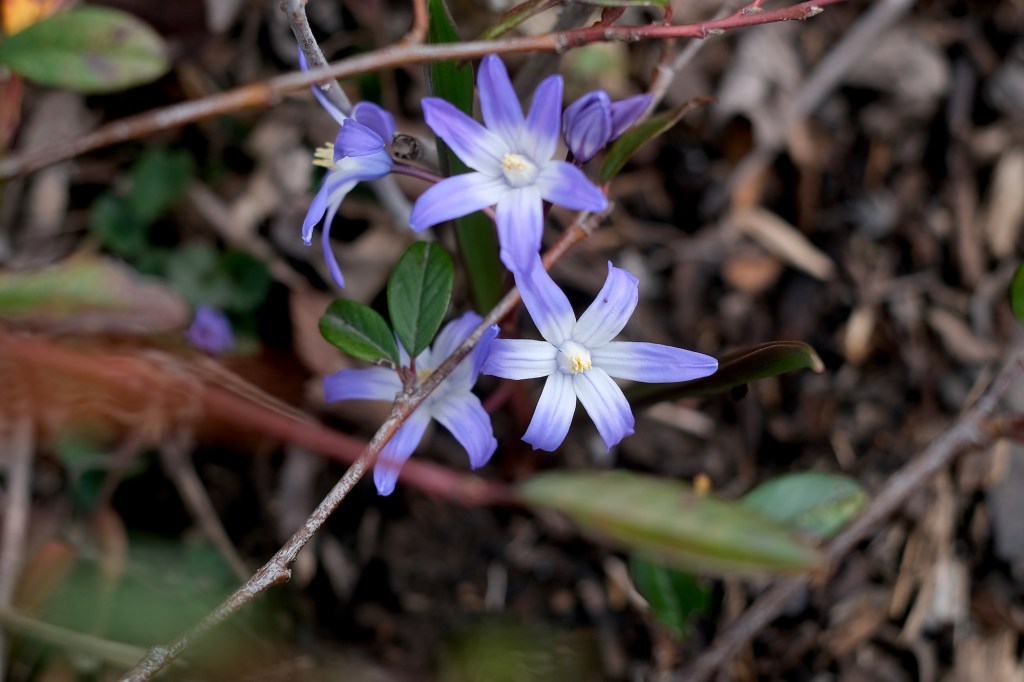
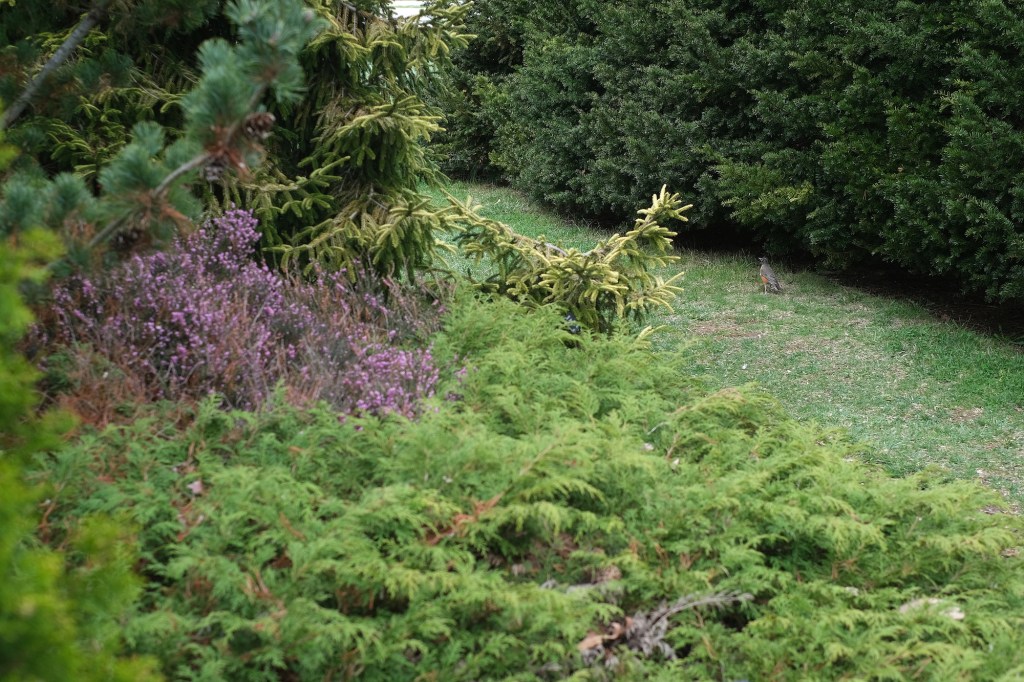
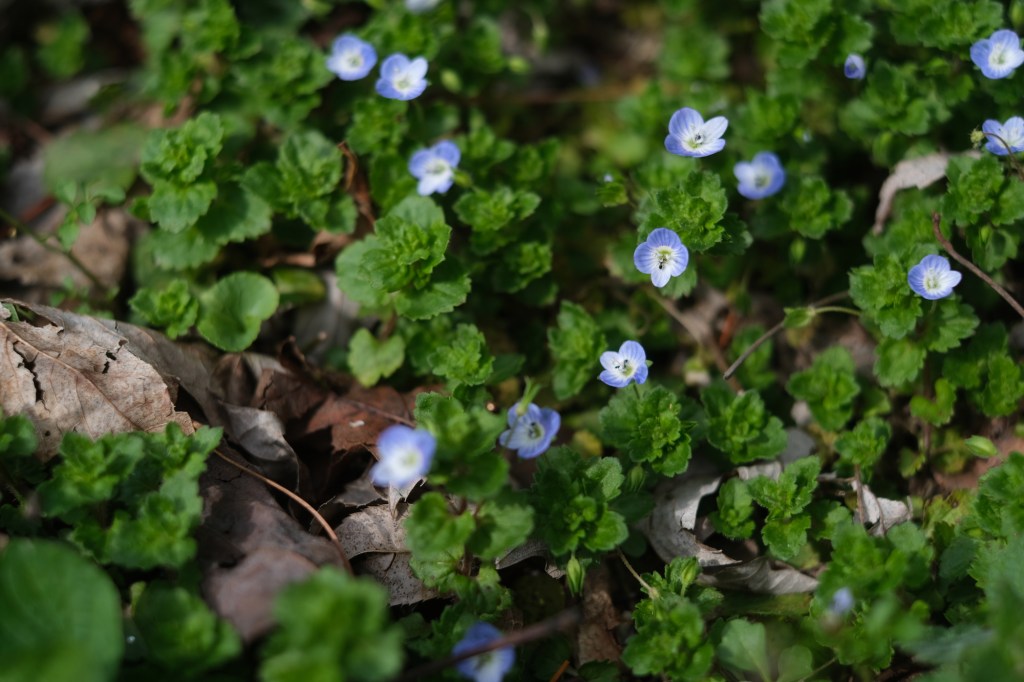
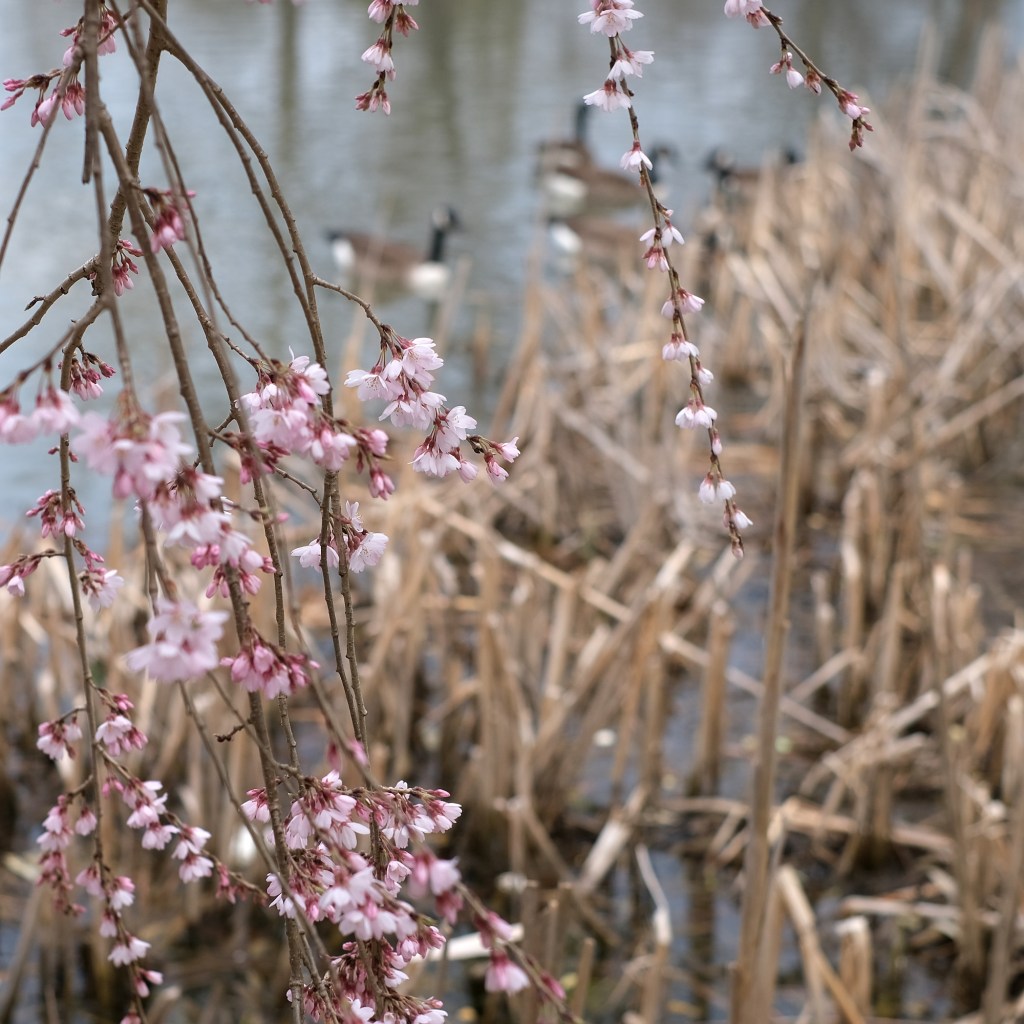
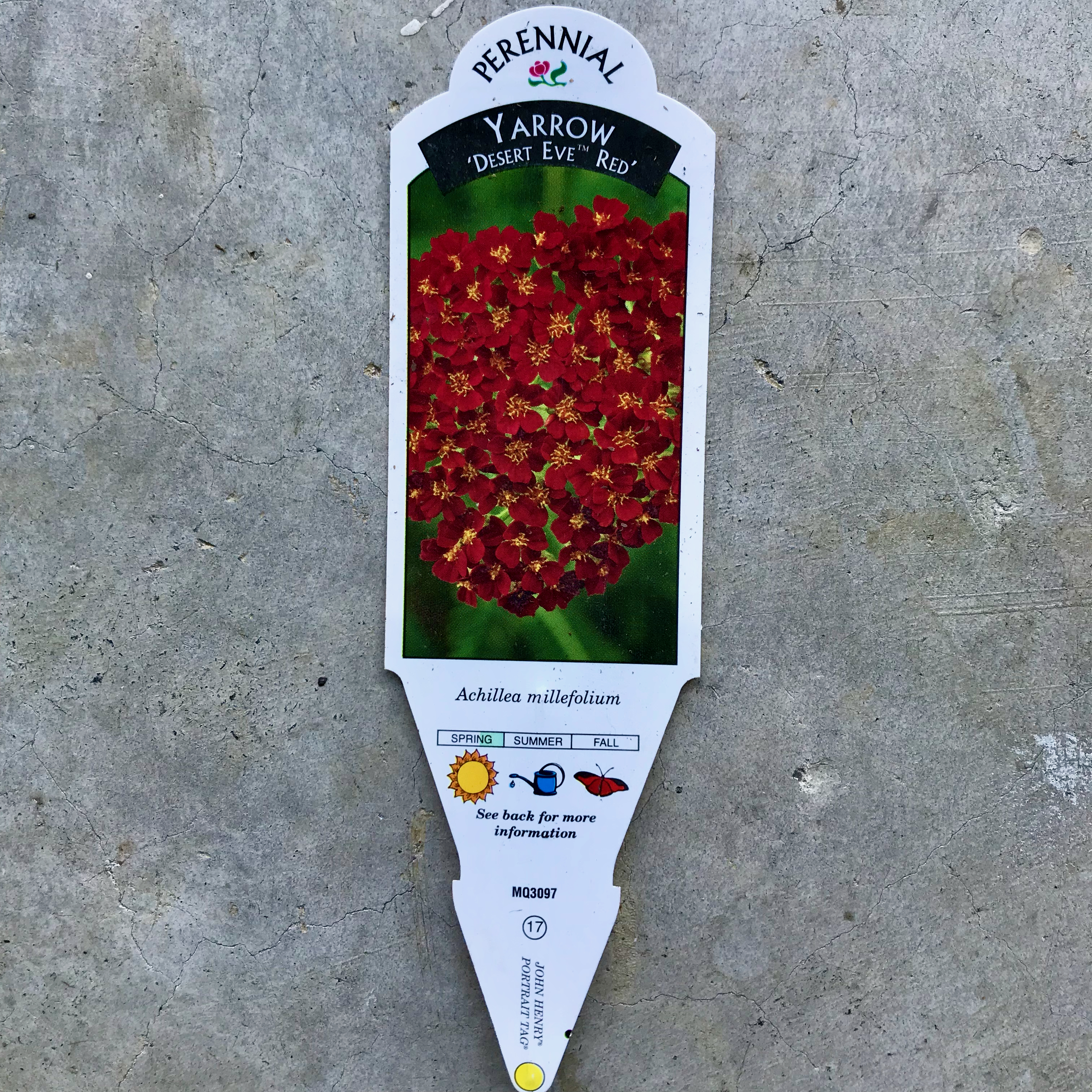
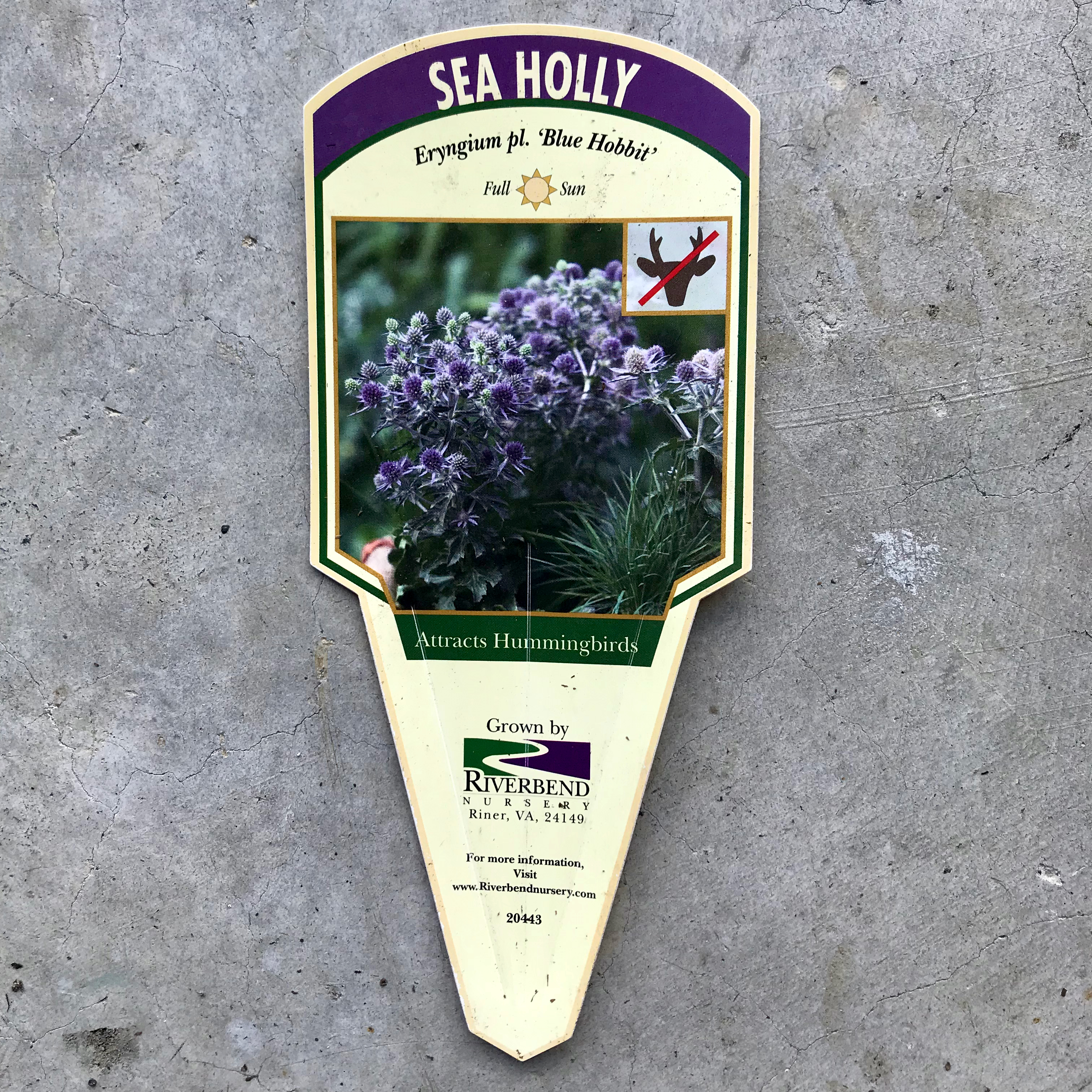
Today was warm and windy. The dry winter grasses whipped like ponytails out back. When I took the compost out on my lunch break, I carried my camera, too. I thought the snowdrops might have come up, and I was delighted to see that they have.
One crocus has opened as well, despite its greenery being nibbled to the ground.
My mind can finally rest about the garden. Friday was warm, and Saturday was above freezing. Both days I dug holes and moved plants. Then Sunday, as it snowed, I finally found a way to plot out my ideas for how to change everything.
The thing I love about gardening, aside from the fact that I get to be outside, and it connects me to the earth and all the little creatures — worms, birds, bees, bunnies — is that I can change it every year, like moving all the furniture around in a room to create a space that feels new and different.
At the end of every summer, I think, “Everything in the garden is good, I don’t need to change anything next year.” And then February comes, and I’ve been inside too long, and I decide everything, in fact, could be better. If I just transplant these daisies which are blocking the sun for half the bed, and pull out these Russian sages that are hidden by the Black Eyed Susans, and put some perennials in the new bed because really, that one was fine for its first year, but the annuals-from-seed took too long to come in, and then they were messy and too tall and reality didn’t match the tidy vision I’d laid out on graph paper.
My main objective this year was to break up a huge clump of Shasta daisies that look gorgeous during the 2 week period they’re in bloom, but the rest of the season are poorly placed — they get too tall and block a large swath of prime bed space. Their placement bothers me every year until they bloom, and then I can overlook it while they make me happy with their bright cheery blossoms, and then after the blooms fade, they irritate me again.
So Friday, when it was warm, I started breaking up the Shasta daisies, all 40 square feet of them. I completely rearranged the new bed I created last February on my latest grass-killing spree, and anchored the bed with a clump of transplanted daisies. I filled in the rest of the bed with flowers that will complement them in bloom time and in color, so that I don’t have to wait until July for something to happen like I did last year.
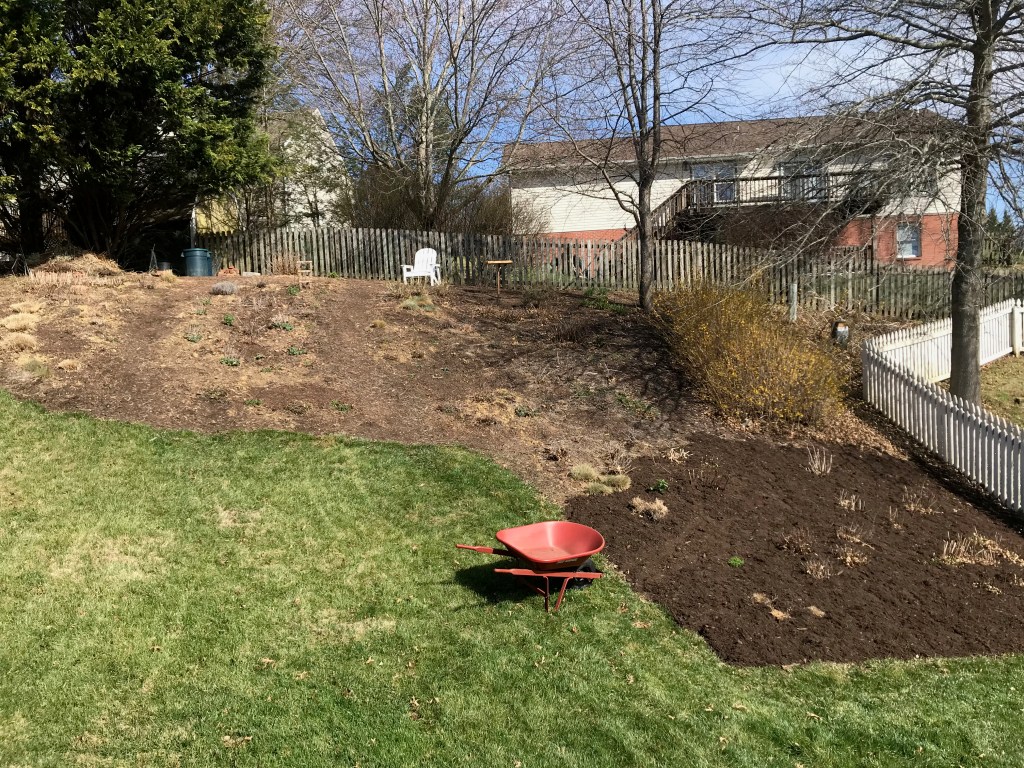
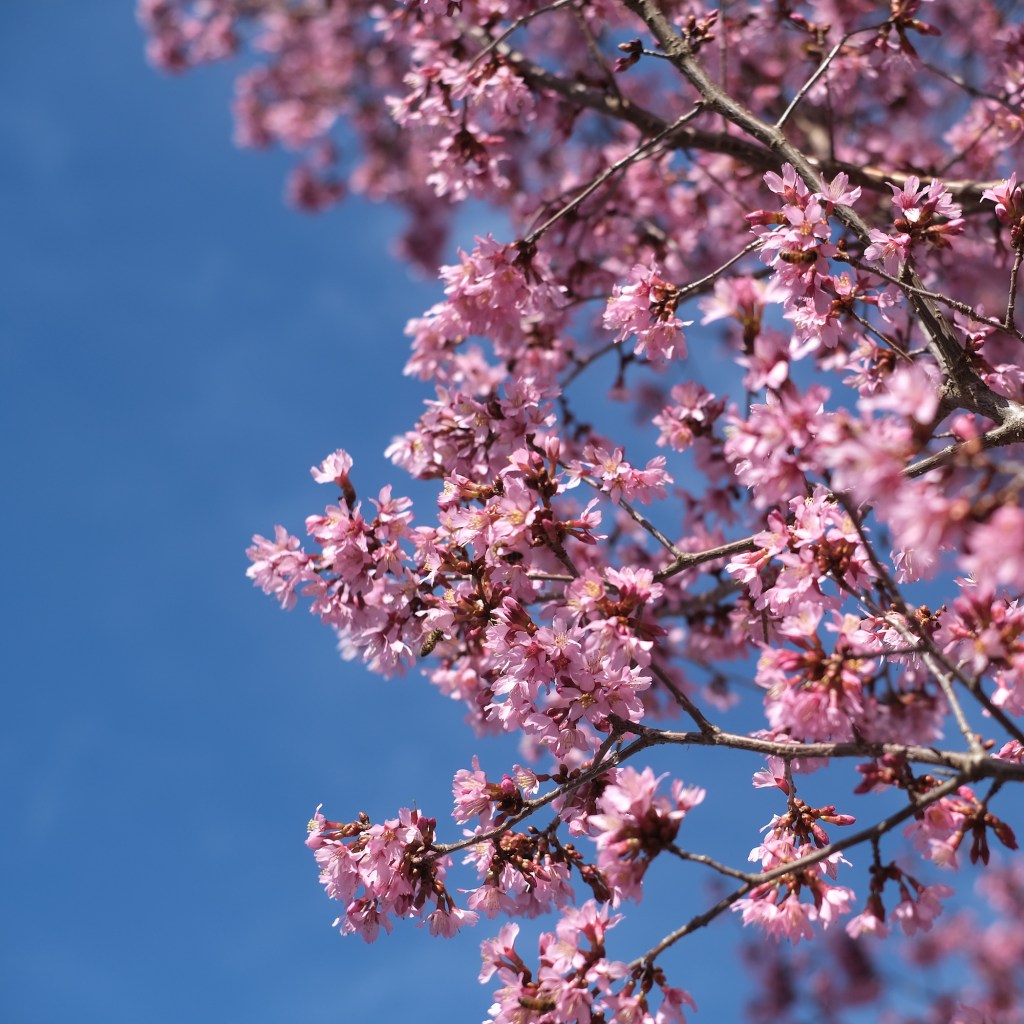
And, on Sunday, I finally figured out a way to plot out plants in a way that I can visualize how they’ll look in the space. I photographed the back beds, then annotated the photos using Preview on my mac. I had to combine two pictures to get a full panorama of the back hill, but I think I’ve finally (mostly) gotten to a point where next time it’s warm enough to work in the garden, I know which plants to move and where. The images aren’t perfect — the perspective is weird because of the hill and the angle, so the spacing isn’t super accurate — but they’re good enough for me to finally be able to rest my mind, now that the ideas are documented instead of me having to hold the vision in my brain.
Now I just need good weather and time. I’m dying to get everything moved and for stuff to start growing again.
Done! These are the plants I’ve already moved (except for a few I still need to buy)To do: move every single one of the plants represented as a circle on this photo 😬
I walked the garden yesterday. The sky was blue, the air warm(ish), and the brown ground was golden with sunlight. When I got to my destination at the top of the hill, where I’d planted bulbs last year, I found what I was hoping for: new green.
The snowdrops are pushing up little buds. The crocus and daffodil leaves are emerging.
IT’S HAPPENING. Warmth and growth and green and flowers are on their way!
I only got four hours of sleep last night. My mind raced with garden plans. I could not stop it. On my lunch break, I’d gotten out our measuring tape and walked the garden again. I needed dimensions to draw the beds on graph paper because I want to redo everything. Back inside, I sketched and plotted and tapped the pencil eraser on my chin. I drew and erased, drew and erased. Checked seed catalogs and garden designs on Pinterest. Drew and erased, drew and erased.
I continued to draw and erase long into the night, without a pencil and graph paper, as I lay in bed trying to go to sleep. I finally fell asleep after midnight, and was awake again at 4. My mind immediately went to the garden.
Today will be warm, and I need to be out there digging and cutting and moving plants. I’ll start work early today so I can end early. I need to get in the garden and out of my head.
I finished reading Lao Tsu’s Tao Te Ching this morning. I marked it “Read” on Goodreads, and wondered, when the rating scale popped up, how does one decide how many stars to give an ancient religious text? Do people give star reviews for the Bible, the Torah, the Koran? (They do!).
Compared to something like the texts above, the Tao Te Ching is accessible and easy to read. It’s 81 pages, it’s simple, and it just might contain all the wisdom we need to navigate our time on earth. It is elegant in its simplicity. For that, I give it 5 stars.
That said, the Tao Te Ching is fairly repetitive, meaning those 81 pages could probably be cut even further. The messages in it really are very simple and don’t need to be said five different ways: opposites define and cannot exist without each other, best to accept them both; attachment leads to suffering; go with the flow instead of forcing; we reap what we sow. For the repetition, I’d give it 3 stars. Except that sometimes we need a thing to be repeated, and maybe from different angles, in order for it to click or for us to truly absorb it. Also, my summary does not get the point across quite as eloquently as the poetry of the Tao Te Ching. So maybe the repetition isn’t such a bad thing. I could be convinced to give 4 stars on the presentation of the material in this regard.
The hardest part to grapple with is the translation. I think I read one of the most popular ones (Gia-Fu Feng and Jane English), but I ended up googling some of the chapters because I couldn’t make sense of them in the translation I read. Though I say the messages in the Tao Te Ching are simple, the chapters themselves read like riddles, and I could only gain any meaning from some of them by reading multiple interpretations. So for translation, I don’t really know how to rate it because I don’t have the expertise to say whether my inability to decipher something was due to the translation or due to the original text or due to me just not getting it yet.
I ultimately gave it 4 stars, but I don’t know if that accurately reflects how I feel about it. It aligns with how I see the world and the universe and our place in everything, so it feels like I should give it a 5. I don’t know, I feel weird about rating it at all.
I bought roses yesterday. February 1st marks a turning in the year, where we’re nearly halfway between the winter solstice and the spring equinox. It is the hump day of winter.
I bought roses because I wanted fresh flowers. I am not desperate for winter to end like I’ve been in the past. Instead, I’m enjoying the cold and the down time while I think how delicious the first warm day will be, and how beautiful the blossoms when they begin.
Until then, to savor both the winter and the coming spring, I might just keep buying flowers.
Tomorrow my husband and I will take a train to Washington, D.C. Train travel in the US is pretty rare, at least in the part of the country where we live, and I’m a little bit giddy about the adventure. We’ll get to watch the countryside go by while reading and doing our own thing, and without having to worry about traffic or parking when we get there.
We have tickets to see the National Symphony Orchestra perform Beethoven’s Ninth Symphony at the Kennedy Center in D.C. I was excited for this symphony in particular because it’s the one I’ve heard over and over again on the Clockwork Orange soundtrack. I have lots of fond feelings about A Clockwork Orange, which I know is weird because it’s a messed up book and movie, but my Grandma had the soundtrack in her record collection and it was her favorite. The album cover is seared into my memory, and I love that my grandmother loved it. Whenever I hear Beethoven’s “Ode to Joy” I think of both her and A Clockwork Orange.
Alas, thanks to Omicron, they switched our concert to Beethoven’s Third instead of his Ninth. The Ninth has an epic choral section that they didn’t want singers belting out in an enclosed space in the time of Covid. I’m slightly disappointed but not terribly. The Third Symphony is said by some to represent Beethoven grappling with his deafness and emerging whole on the other side, which still boggles the mind that this great composer couldn’t hear his own music. Going to the Kennedy Center and listening to the National Symphony Orchestra perform anything is a special event. We get to hear them perform Beethoven.
But that’s not all! We will have a lot of time to wander while we’re in Washington, and one of the first places we’re going to go when we get off the train is Fahrney’s Pens, a shop where US presidents and Washington Post columnists have bought their fountain pens. My husband gave me a Waterman from Fahrney’s for Christmas one year, which he ordered through the mail. In fact, I’ve done all of my pen and ink shopping by mail since I became enamored with fountain pens two years ago, and I can’t wait to go into a real shop and see real pens instead of browsing on a screen or in a paper catalog.
I’m not sure if I’ll take my laptop or if I’ll want to blog while we’re away, so whether I’ll actually blog every day in January remains to be seen. This post will mark 27 days in a row, which I’m pretty proud of regardless of what comes next.