My reading life is dictated by when ebooks are available at the library. My favorite days are when a hold becomes available the day I finish my current read. Those days feel like I won a scratch-off lottery ticket.
I get a little nervous when my next book becomes available too soon, though. Too soon would be two or more days before I finish the book I’m working on. Having the next book sit there and wait for me creates all this build-up and expectation. What-ifs creep in, like what if I’m not in the mood for that book when the time comes for me to read it?
All of this is to say that I have a book lined up, and it’s been lined up for a couple days, and it’ll probably be a couple days more before I finish my current book and can start it. In other words, it’s in the too soon window. It’s Cloud Cuckoo Land by Anthony Doerr, and I’ve been on the waitlist for it for a few weeks. I don’t remember where I heard about it, probably the #books chat channel at work. When it became available, I looked it up on Goodreads to remind myself what it was and why I reserved it. I made the mistake of reading some of the one and two star reviews (this is a danger of getting a book before I’m ready for it) and now I feel ambivalent about it. Sigh.
Wind buffets the house. Tree limbs rattle outside the windows, snow swirls in great gusts, and the chimney sounds like a coke bottle when you blow air over its opening. Snow glitters in the porch light before sunrise, and the world outside is bright in the diffuse moonlight.
Today’s Bloganuary prompt is “What is a superpower you’d love to have?” We didn’t lose power in the winter storm, and I’m safe and warm inside. Some of the places I most want to visit, or maybe even live one day, are icy cold. But the cold keeps me from going outside despite how beautiful and magical the world is when it’s covered in snow. It glitters.
So right now, as I sit in my slippers and PJs and think about living in Maine, and surfing in winter, and the wildness and sparse human population of extreme northern and southern latitudes, being impervious to cold sounds pretty great.
I think that’s a circumstantial wish, though. If it were summer right now, and the garden were in bloom, and I were outside in the sunshine and colorful flowers, I don’t think I’d care about being resistant to cold.
Flight would be a pretty cool superpower. I’m short, for one thing. Flight would let me get up above the crowds, jump off of mountains, soar over natural wonders for a full, unobstructed view, reach the jar in the top back of the cupboard without having to climb on a chair.
Breathing underwater would be awesome, too. I’d love to explore the ocean without the encumberance of SCUBA gear. And if I could breath underwater and be impervious to cold, I could explore the kelp forests and see the giant marine invertebrates of the Pacific Northwest.
None of those superpowers really help other people though. Is that a necessity of a superpower? If I were to have a superpower intended to help make the world a better place, I’d like to be able to help people understand one another and be kind despite our differences.
That sounds like a lot of work, though, so maybe I’ll just stick to cold-imperviousness, flight, and sea lungs.
I was restless and excited yesterday in anticipation of the coming storm. We had hot cocoa in the pantry and firewood in the hamper, and I wanted to lean fully into cozy. I wanted to bake, and I wanted to bake bread. Specifically, I wanted to bake oat bread.
My first appliance as a grown-up was a bread machine. I still remember the whir and thump of the paddle on the knead cycle. The sound filled the house and promised good things to come. That was probably 25 years ago. I made bread in that thing constantly. The house would smell warm and yeasty while the dough rose, then golden and tantalizing while it baked. We’d stand around waiting for it to finish so we could thunk it out of the pan, slice it, and slather it in butter and honey.
On my first Mothers Day as a mom, my mom graduated me to making bread without a machine. She gave me the 25th Anniversary edition of the Tassajara Bread Book with the inscription, “I learned how to bake bread using the original edition of this book.”
Inscription from Mom in my tattered copy of Edward Espe Brown’s Tassajara Bread Book
It’s been a while since I’ve baked bread. Maybe years. I bake dinner rolls for the kids on Thanksgiving and Christmas, and cinnamon rolls on Christmas, if that counts as bread, but I can’t remember the last time I baked loaves of bread. In recent years that I did bake bread, I had learned more about how bread works, and was baking from more precise recipes and techniques in Peter Reinhart’s Bread Baker’s Apprentice, Crust and Crumb, and Whole Grain Breads. He knows bread. His methods, which include starting the dough the night before, work.
But yesterday, I didn’t want to start on Saturday and finish on Sunday. I wanted oat bread, and I wanted it the same day. I also didn’t want fussy and precise. I wanted the loosey goosey hippie freedom of the Tassajara Bread Book.
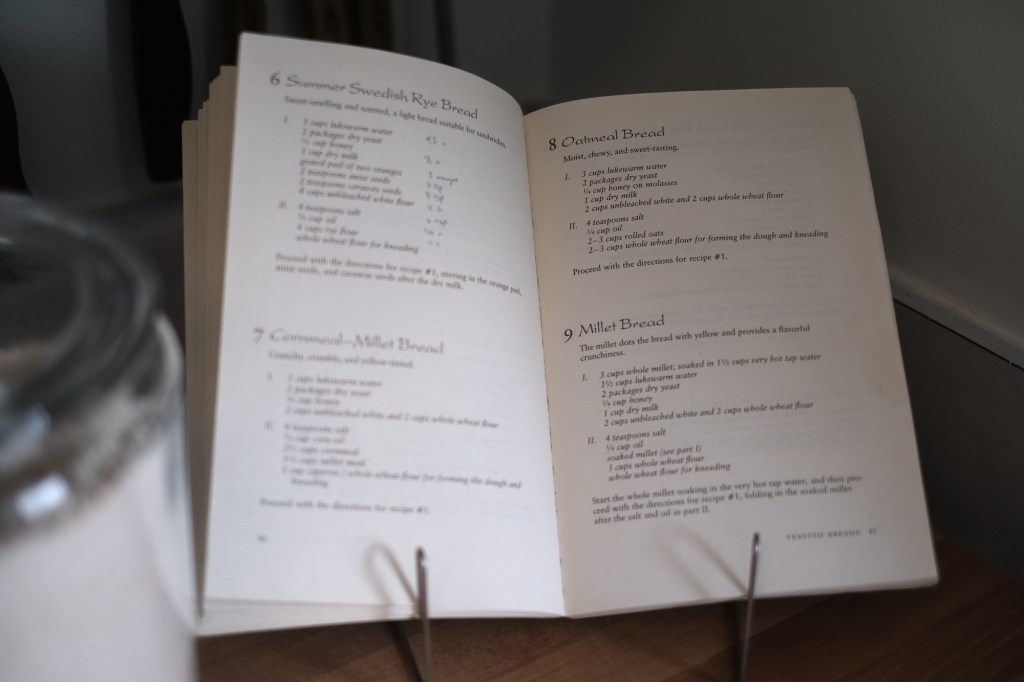
Oatmeal Bread recipe from Tassajara Bread Book. I had forgotten about the Summer Swedish Rye on the opposite page. Now I want that one, too.
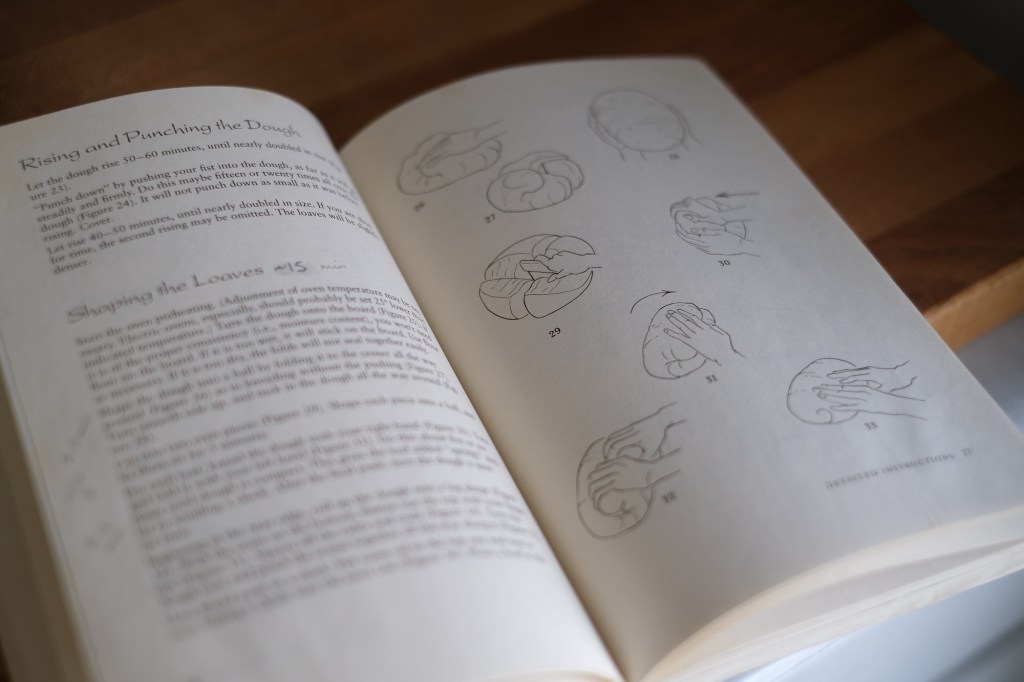
Bread-baking from this book yesterday gave me exactly what I wanted. There was no stress, no wondering, “Am I doing this right?” I glanced at the kneading and shaping diagrams to remind myself how to do them. I didn’t care about the perfect crust or the perfect crumb, whether I stopped kneading at the right time, whether my loaves would come out fine-tuned and perfect.
How to rise, punch, and shape dough
I got to smell the dough, and get my hands in it, and punch it. I got to feel the smooth worn cover of my book. I thumbed through the pages while the dough rose. I found my old notes, spatters of cinnamon and oil and butter, recipe adjustments, Grandma Janet’s recipe for multigrain bread penciled in the back end paper, my mom’s inscription in the front. I delighted in the warm zen of the author, and little poems scattered throughout:
Rock and water wind and tree bread dough rising
Vastly all are patient with me.
Edward Espe Brown, the Tassajara Bread Book
And at the end, after a few hours of mostly resting the dough, we had golden brown oat bread. This morning, I cut a slice off the loaf. I spread butter across it, then drizzled honey over it, and I watched the snow come down.
Freshly baked oatmeal bread.Rolls from extra doughHoney on one half, blueberry jam on the other
The air smells heavy this morning. Temperatures hover around freezing, and the air is clear, but I feel moisture. Earlier this week, I could only poke my nose out the back door to sniff the air; it was too frigid to put any more of my body outside. Today the air is cold but doesn’t sting. I walked out on the dark deck in my pajamas to take a bigger breath. I wanted to smell the coming snow.
They say a big winter storm is coming. Earlier in the week the forecast called for a foot of heavy, wet snow and high winds, a great combination for downed power-lines. The pet store was hopping yesterday when I joined everyone else in town to stock up on kibble. The substitution list for my online grocery order was long this morning. They’re out of soup and pasta, among other things. Luckily hot cocoa wasn’t on the “Sorry, we’re out” list.
Now the forecast has switched to about three-quarters the amount of snow, and substitute the rest with sleet and freezing rain. It’ll start tomorrow. I brought armloads of dry firewood into the garage, and the hamper in the living room is full. I covered the outdoor stack with a tarp.
On Thursday, the kids’ school had already sent out an email to prepare families that the storm could affect school as far out as Tuesday. A friend at work asked if we don’t get snow often, and I replied that we do, but we live in the mountains where there are steep winding roads, northern-faces that don’t see sunlight in winter, lots of wind, and lots of trees. Power outages are likely, and travel will be treacherous.
I need to remind everyone in the house to charge their portable chargers. I suppose we should gather candles and flashlights. Oh, and I can’t forget to plug in my e-reader! That would be catastrophic. I’ve got it loaded with three unread books.
I’ll pick up our groceries this morning. I’ll get wine, and some Irish cream for coffee and hot chocolate. We’ve got plenty of matches, and sterno. I’ll lay a fire today.
One of the biggest challenges I’ve faced and overcome was a self-imposed one. In 1999, I rode a bicycle 330 miles through Appalachia in 3.5 days. I raised $1900 for people suffering from AIDS in the Washington D.C. metro area, then joined 1700 other riders to pedal my bike from North Carolina, through Virginia, and into D.C.
I had never done anything like this before. I was 24, newly married, and my husband was going to be away for several months for a research trip. I think I had recently gotten a bicycle I enjoyed riding, I wanted something to occupy me while my husband was away, and a friend had done the AIDS Ride the year prior. I was awed by the idea. I signed up, sent out fundraising letters, and started training.
The training certainly occupied me. I was not an athlete; gym class brought down my GPA in high school. I think it was the only class I didn’t get an A in. Athletics were not my strength or my preference, and so the thought of relying on my own body to transport me over 100 miles per day, through mountains, was a little terrifying.
But I trained. And I trained. Training and eating occupied all the time I wasn’t at work or sleeping. I rode all over the state of Maryland, I rode through Amish country in Pennsylvania, I trained inside the beltway, outside the beltway, in Delaware, in Virginia. I saw the countryside like I’d never seen it before, listened to trees whisper and bike tires hum. I climbed up hills with sweat pouring down my face and back and chest and thighs, then flew down the other side with glee as the wind evaporated the sweat and cooled me down. I marveled at how sweat works as a cooling mechanism. I rode until my legs turned to jelly when I got off and tried to walk. My bike, a compact, navy blue Cannondale, became an extension of me. I felt as comfortable on it as on my own two feet.
Prior to the AIDS Ride, I didn’t know know my body, or what it needed, or how it worked. I didn’t know about nutrition or hydration, or how good it feels to be fit and strong and tuned in to your physical self. I didn’t know the strength of my determination, and that if I set a challenge for myself, I was going to do my damndest to meet it. I didn’t know I could do hard things.
I’ve met other significant challenges in my life, and had life-altering events, but the AIDS Ride was the first, and it was the first that was strictly between me and myself. Riding onto the National Mall in Washington DC, after being on a bike saddle and sleeping in tents for three days, was one of the most momentous days of my life. I could not believe I had done it. More than twenty years later, I still remember what it felt like: the elation, the joy, the wonder, the relief. The feeling of holy shit, I did it. I really did it.
This is an easy one. My ideal day is one where I have no obligations. I don’t have a to-do list, I don’t have to work, I am not required to be anywhere or remember anything or do anything.
On a day like that, I’d want to wake to clear skies and welcoming temperatures, and I’d take my coffee with the outdoor scenery. A fresh croissant would also be nice, or some sort of flaky pastry.
Beyond that, there are a million things I might do! Garden, watch butterflies, read, sail, paddleboard, walk a new city, surf, hike, sit in an outdoor cafe and watch people. Be on or near a beach. Listen to waves. Watch birds. Explore someplace new.
In my ideal day, something delightful will surprise me. I’ll laugh a lot. I’ll love my people and they’ll love me. I’ll eat good food and savor it. In summer I’ll sit outside in the evening and watch the sunset. In winter I’ll read next to a cozy fire.
In my ideal day, I go to bed satisfied and content with the fullness of my life.