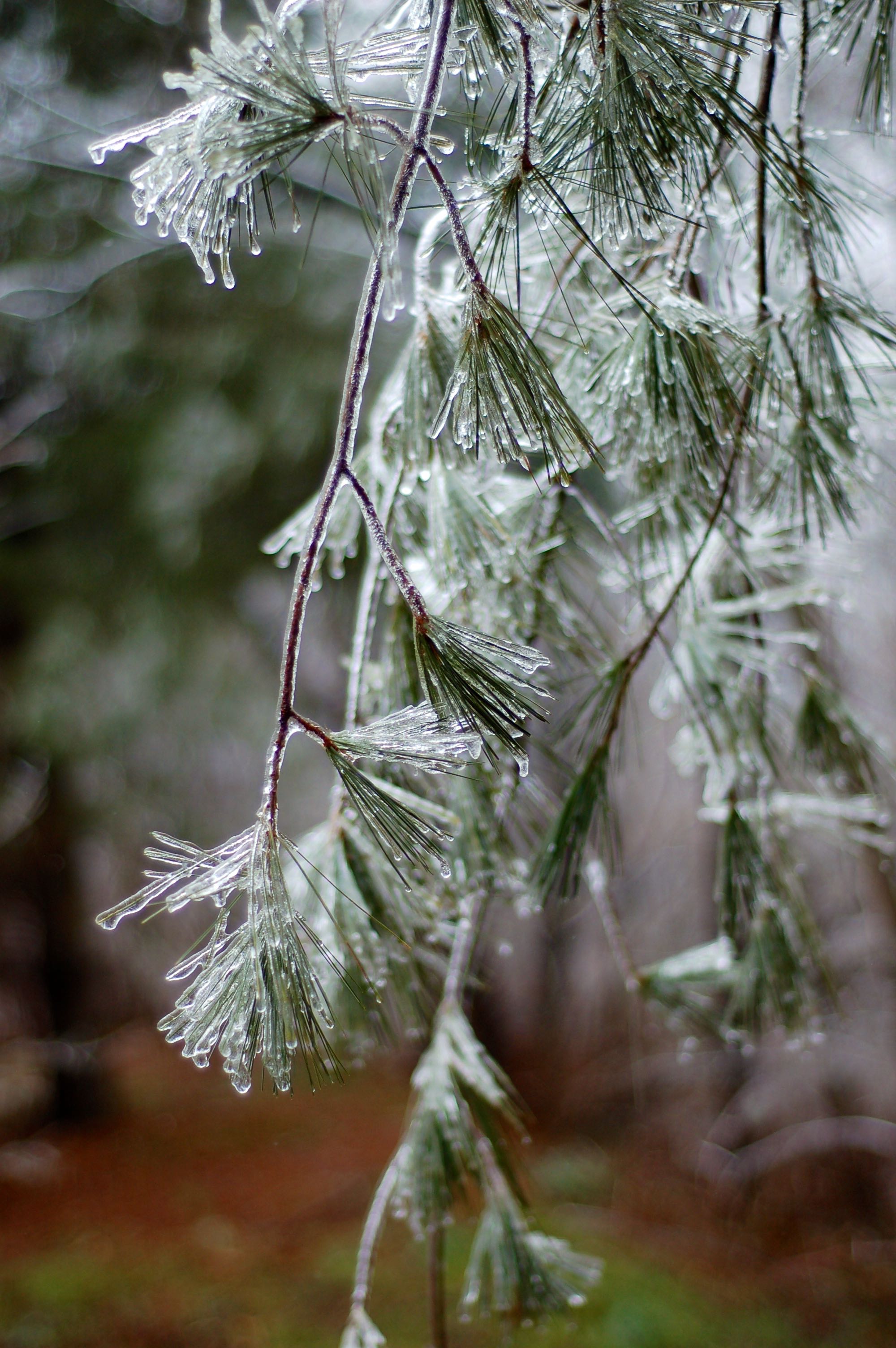
It is Saturday and the trees are encased in ice. We slept with our bedroom window open, and in the deep stillness of night, I was startled awake by the sound of a loud crash. I thought it was drunk students knocking over garbage cans, and then we heard soft voices in the parking lot. A tree limb, heavy with ice, had fallen onto a car.
My legs are crossed at the cafe table by the kitchen window. Morning light shines in. This is my favorite place to sit. On the smooth round table are my earthenware coffee mug, a cup of ice water, my prompt box, an orchid, and a copy of A Land Remembered — my current Florida read. The fridge hums. The half-loaded dishwasher stands open. I hear my husband shuffle paper in the living room. Tear a check out of a checkbook. Occasionally, he clears his throat. A kettle of pinto beans clinks and groans on the stove. The glass lid beads with steam.
I’ve got the kitchen window cracked. It is inches from my body, and I feel icy January air on my hip. The air smells clean and cold and damp. A heavy drop of water splats on the window stool. Further away I hear gentle dripping on wet soil, on cement, on pavement. The ice in the trees crackles softly, and branches sway slowly under a shimmering weight. Liquid pools in the blacktop parking lot and on our cement stoop. The ground is too warm to freeze liquid into solid, but the air is not. A stirring of wind knocks crystal shards from high branches; ice clatters against our windows. I see tiny snow flakes fall among raindrops. The weather is raw today.
Rain rattled the tent last night and pinged on an overturned cook pot. The past few times we camped it stormed the first night and I felt panicky as I lay down to sleep, breathing deep to calm myself then feeling like I couldn’t get enough air, even though we were outside where there is all the air in the world. Generally I’m so tired and the outdoor sounds are so primal and repetitive – rain rattling, frogs croaking, thunder rumbling – that drowsiness trumps anxiety and I fall asleep before a true panic attack sets in.
This morning everything is damp. The thin nylon of my sticky sleeping bag clings to my skin; strands of hair cling to my neck. My camp sandals – a pair of Crocs and a pair of Rainbows – are cold and clammy. Outside the world drips. The poison ivy leaves that surround our campsite glisten with rain and their mocking oils. The charred wood in the fire pit shines a glossy black.
I used the backpacking stove by myself this morning. It was already assembled, but still. I used my notes from last night to boil water for oatmeal and coffee while B___ finally got a chance to sleep in. He lounged in the tent while I shooed a daddy long legs off the stove, pumped the fuel, lit the burner, listened to the hiss of a Whisperlite stove in the stillness of the campground morning.
It’s weird wearing glasses on a camping trip. They seem like an indoor thing not an outdoor one. They make me feel vulnerable to the elements – they get raindrops on them and get caught on my sweatshirt as I pull it over my head. When I take them off I hurt. My eyes work hard to focus and they blur and feel like I need to rub them to make them see the world crisply, but rubbing them does not help. My head begins to ache inside, behind my eyes, and at my temples, and so I put the glasses back on again.
The kids caught fireflies in the field across from our campsite last night. I sat under the trees in a nylon camp chair and watched them in the distance, reaching up with hands poised to cup around a lightning bug, like they were preparing to catch a kickball coming down from the sky. Or leaning down, knees bent, crouched and sneaking up on fireflies in the grass. The fireflies lit and darkened all around the grassy edges under the trees where the evening deepened sooner. Our children’s laughter drifted across the field to me till we heard thunder and called bed time.
In the quiet morning, my pen scratching paper while the campground sleeps, the sun not high enough yet to pierce the fog, all of us alive and the world gently dripping, the panic of the first night has gone.
Art Credit: KendyllHillegas on Etsy, Key Lime Pie original illustration
Tart. Tangy. Zesty. Zany. Key Lime Pie: it’s yellow, not green.
You might think if I was going to write about pie in Georgia I’d write about pecan, all sugary and whiskey brown, the pecans a toasty crunch then a succulent give between the teeth, or maybe peach with its sensual slippery melon-colored sweetness. But I’m not. I’m writing about Key Lime because it’s hot and humid outside, and when its hot and humid out and I think of dessert, I think of my Dad fishing in the Gulf Stream and the sunburn and the grill and the chilled pie that followed.
Summer dinners of my coastal Georgia childhood – or at least the summer dinners my mouth still waters for – often consisted of blue crabs we caught in the creek, or fresh shrimp my mom bought from the marina under the bridge. We’d follow those warm seafood meals with ice cream or Pudding in a Cloud (chocolate pudding in a “crust” of Cool Whip), but the best days were when Dad ran the boat 4 hours offshore Savannah to where the water changed from coastal brown to deep ocean blue, dropped a line, and brought home fresh fish. He came home salty in the late afternoon, with a raccoon burn on his face from his sunglasses, and before changing clothes or rinsing the boat he cleaned the fish, scraping scales with a flashing silver knife till they popped off and glistened in the sun.
Dad brought the fish up to Mom in the kitchen where she rubbed the fillets with butter and Paul Prudhomme’s Cajun seasoning while he lit the coals in a kettle grill. He sipped beer while he watched the coals, waiting for them to glow. When they burned till each one formed an even crust of ash he nestled a cast iron skillet into them. An onshore evening breeze rustled the palm fronds and cooled his burned skin, and after a while, the cast iron skillet would begin to glow. Dad tossed the seasoned fillets into the red hot pan and they hissed, blackening within seconds. He pulled them off – moist, succulent fillets encrusted with paprika and cayenne, garlic and thyme.
The fish flaked on our tongues, soft and buttery, crisp and spicy, and on lucky nights, the dinner was followed by Key Lime Pie. There was not better accompaniment for blackened fish than that cold yellow silk pie that zinged your tongue with citrus summer and crunched sugary buttered graham between your teeth. Mom made the pie while Dad bobbed in the ocean, and it chilled while he burned.
I don’t remember now if Dad cleaned up by the time we ate dinner or if he dined with the ocean still encrusted on his skin. I do remember the clean feeling after eating Key Lime Pie, though – that crisp, cool, fresh finish to a hot, salty summer day.
This is my entry for the American Vignette: Pie challenge on Andrea Reads America. I hope you’ll consider submitting. Key Lime Pie recipe follows.
~
Thankfully, Key Lime Pie had a moment in the 80s or 90s and now you can buy Nellie & Joe’s Key Lime Juice nearly anywhere in the US. Or at least on the eastern seaboard. I bought mine at our local Kroger in the mountains in Blacksburg, Virginia. Key Lime Pie is one of the easiest of all pies to make ever. You don’t even have to cook it if you don’t want to – the key lime juice denatures the egg yolks, “cooking” the pie like ceviche. Make it with whipped cream or without, with merengue or without, it’s up to you. I prefer mine neat. Follow the recipe right on the bottle of Nellie & Joes or follow this adaptation from Maida Heatter’s Pies and Tarts:
4 egg yolks
1 14 oz can sweetened condensed milk
1/2 cup Key lime juice
1 9-inch graham cracker crust
You can use an electric mixer, an egg beater, or a wire whisk. Beat the yolks lightly to mix. Add the condensed milk and mix. Gradually add the lime juice, beating or whisking only until mixed.
Pour into the crumb crust. It will make a thin layer; the color will be pale lemon, not green. It will be fluid now, but as it stands a chemical reaction takes place and the filling will become about as firm as a baked custard. Refrigerate overnight.
Or, if you wish [Andrea’s note: this is how I prepare it], bake the filled pie for 10 minutes in a 350 degree oven, then cool and chill.
Whipped cream is optional on this, natives do not use it – restaurants do.
I remember boiled peanuts; I remember them from the barrier islands of Georgia. On hot Saturdays in summer, my family loaded our boat with beach chairs, coolers, canvas tote bags filled with towels, Doritos, and Mom’s chocolate chip cookies, and we motored off across the rippled brown water of tidal rivers. Crusted salt glittered on the white boat deck, and in the cooler, along with the cold beers and Cokes, there would sometimes be a bag of boiled peanuts. The peanuts, soft like fat tan peas, squirted salty juice when you opened their shells. On the islands there was salt on the boat deck, salt in the rivers, salt on my skin, and salt in the peanuts. And I love salt.
I remember boiled peanuts, and I remember where I ate them. After combing tan sand beaches for olive snail shells, after slapping mosquitoes in the palmetto scrub, live oak, palm tree forest, after trying to stand on our fabric raft in the tidal creeks, I returned to the cooler famished. I pulled out a cold Coke and the ziplock bag of peanuts, I carried them calf deep into the glassy brown creek, I planted my shiny red Coke can in the sand just above where land transitioned to water, and I sat down in the water with the bag of peanuts in my criss-cross-apple-sauce lap. I sat in the salty water in my neon pink one piece and I ate my boiled peanuts.
I remember I grabbed whole handfuls of the sodden peanuts, and I held them underwater: to season them even more. I split the shells by pinching the seam or by slitting them with my fingernail if they didn’t pop when I squeezed, and I sucked those squishy, salty, brown peas out. Sometimes, if it was a three- or four-nutter, I popped the whole thing in my mouth, shell and all, and sucked the salty juices out like sucking the sugary flavoring out of a popsicle. Then I cracked the shell between my molars and ate the soft nuts. A pile of wet shells accumulated on the sand above my Coke can, and I collected them when I finished. Leave only your footprints and all.
Eating salty boiled peanuts in Georgia’s salty tidal waters was one of my favorite childhood rituals, and I think of those marshy creeks every time I eat boiled peanuts now, landlocked in the Appalachian mountains of Virginia. Our children love boiled peanuts – we buy a large steaming styrofoam cup of them at a roadside stand every summer on our road trip to visit grandparents in Georgia and Florida – but our kids have never eaten them the way I did growing up; they’ve never eaten them butt planted in salty water at a tidal creek’s edge, a cold Coke can within arm’s reach in the sand. Our kids love boiled peanuts, and our kids love salt. And I think this summer, on our trip to Georgia, we will give them boiled peanuts on the islands, and I will show them the best place to eat them.
I am seeking guest contributors for my Andrea Reads America site. This is my entry for the first of a series of writing challenges I will be hosting there as I attempt to collect stories from all 50 states. I hope you will consider submitting. For details on the first prompted challenge, please see American Vignette: I remember. A Writing Challenge.
On a highway called A1A, the one you’ve heard about in Jimmy Buffet songs, that ribbon of road that hugs the Atlantic Ocean on Florida’s east coast, somewhere between Little Torch Key and Key West, in that 24 mile stretch of road, there is a stairway that climbs into sky.
I remember that stairway, emerging into open air, from open wooden walls, sand brown, by the water’s blue-green edge. As you came over a bridge headed west, there it was on the left bank – a stairway to heaven. I don’t know if there were other houses around, or if it was really alone there. It stands alone in my memory. A house with a stairway through its middle, but without a roof or second story walls to cage it. Had the house been destroyed by a hurricane, or had the construction crew from Key West gotten drunk and stopped working on it ten years ago? There was no soot, it did not burn, I remember that.
We drove over the bridge, my parents and I, on our way to brunch, and the morning sun behind us shone peach on the house walls. The stairwell, with its two by four banisters, glowed apricot with turquoise Gulf of Mexico water in front of it, a wisp of white clouds behind it, and the sky a deep blue in the pre-noon slant of light.
I wanted to climb that stair, to start at the bottom, enclosed by walls where no one could see, then wind my way up, where the walls dropped away, and I emerged into sunlight. I’d look out over the moppy heads of palm trees, listen to coconuts drop, lean against the banister and look for shadows in the water – a sea turtle, or a manta ray, or a manatee beneath the surface. The sun would warm my crown, and my arm hairs would glisten gold, and I would smell salt and sea.
At night, the air would be different. Cooler. The glare, the heat, the intensity of sun and sizzle would soften, and there would be a scent of sweet floral beneath warmth rising from sand. Music would drift from a nearby rooftop. Wavelets would lap gently at the shore.
At night, I would turn my eyes upward into the sky instead of down into the sea, and I’d climb the stairs into the stars.
In the antique store on the corner of Franklin and Main, among cut glass candy dishes and earthenware moonshine jugs, were rolling pins. Wooden, dinged, well-used. In each room they were stashed in groups of three or four, standing on end in a tin bucket, or displayed like vintage wines on an iron rack. Their handles were worn smooth from a grandmother’s floured grip rolling pie crusts, rolling cookies, pounding nuts to crack them open or crumble them to dust. The pins had history, were golden with the oils and warmth of caring hands.
Or of drudging ones. How many of these were wielded as weapons? How many mothers chased a drunken husband with one, or a naughty child, Mother’s hair wild, curls coming loose from her braid in the hot kitchen where soup bubbled and the steam made her hair sproing?
Looking at these pins, inanimate now, tucked under a harvest table in an antique shop, I saw love and work. I saw fleshy palms and red cheeks, flour poofs and golden pastry. I saw Christmas Eve with shiny copper cookie cutters shaped like stars and candy canes. I saw meat pies and bubbles through slits in the crust. I saw buttery dough with rough edges as strong feminine forearms, muscled like Popeye’s on spinach, rolled, pressed, and turned the smooth sheet. A bosom heaved, and there may have been grunting if the dough was too tough. The pin would clank on the counter, the handles would rattle. Children would sneak corners and pinch edges off, and nibble and giggle while Mom raised the wooden pin, “Don’t you touch that crust!” And she’d try to look mean and menacing, but it was Christmas and she’d break down and start giggling too.
How many stories were in these wooden pins? Were they all from Virginia? Maybe some traveled here from Appalachian Ohio, or West Virginia. Maybe even from Minnesota, like me. Would I feel their history if I touched them? If I bought one and used it – that honey one there, with handles so polished with use they fairly gleamed – would my pies and cookies be enchanted? The pins looked smooth to touch, and they were comforting in their roundness. I could cup my hand around a cylinder and run it down the pin’s length. Would it be cool or warm in this antique shop? Would it tell me a story?
A resolution that came out of my writing workshop was to take an artist’s day out every week. Last week I visited Antiques on Main in Christiansburg, VA where the rolling pins caught my eye and inspired this piece.




 Butterfly Mind