Sometimes we want what we want even if we know it’s going to kill us. We can’t escape who we are. – Donna Tartt
I took a break from Andrea Reads America to read The Goldfinch, the 756 page tome that was all the rage in 2013, for book club. Holy shizzle. By the final 200 pages you could barely pry the book from my hands.
Set in modern day New York City, in an abandoned neighborhood development outside Vegas, and a little bit in Amsterdam, The Goldfinch is the story of Theo Dekker, son of an absent alcoholic dad and a stable, art-loving mom. At age 13, Theo is suspended from school, and as he and his mom kill time at an exhibit before meeting the principal, the museum is bombed in a terrorist attack. Theo survives, but his mother does not. In the rubble among the dead, there is one man who is still alive, though dying, whom Theo bonds with in the still settling dust of the aftermath. The man, an antique and art dealer, gives Theo a ring and tells him where to take it when he escapes the museum, and he insists that Theo take The Goldfinch, the masterpiece Theo’s mom had been admiring, off the wall – to save it from destruction, yes, but also because the painting pairs with Theo’s soul.
The saga that follows is impossible to resist – PTSD, a 13 year old orphan living with a friend on Park Avenue, an alcoholic dad who whisks Theo off to Vegas, a friendship with a Russian boy named Boris, drugs and drugs and drugs, and always the painting, tugging, gripping Theo in its clutches as surely as alcoholism grips his father, as opiate pills grip Theo, as the chain grips the little yellow goldfinch to the wall.
The Goldfinch is dark alleys and golden sunlight, it is the constant grapple with who is good and who is bad, who is the right one to love, who is the wrong one; it is about how can I be any other than who I am. The Goldfinchmade me want to be reckless. It made me grateful that I’m not. It gave me a new favorite character – Boris – though in real life I would never feel safe with him. The Goldfinch is art and sublimity. It is about being shackled to things against our will – objects, memories, addictions, genetics – and finding beauty in the darkness.
In it, Tartt captures the addict perfectly – the distortion between the addict’s internal world and his external actions, his justifications, his own belief that he is good even while he is behaving badly, the lying, the covering up, the brilliant high, the tar black low, the emotional depths, the passion for who and what he loves, the aspiring to great ends via shady, ugly means.
The Goldfinch, as any great art will do, showed me a life I’ll never know while making me see my life differently. The thing about this book, aside from Tartt nailing the the struggle of the addict, the wrestling with trying to be good while knowing you are acting badly, is that Tartt shows us we can never escape who we truly are, and what can we do about that?
The Goldfinch: A Novel by Donna Tartt. “A young boy in New York City, Theo Decker, miraculously survives an accident that takes the life of his mother. Alone and determined to avoid being taken in by the city as an orphan, Theo scrambles between nights in friends’ apartments and on the city streets. He becomes entranced by the one thing that reminds him of his mother, a small, mysteriously captivating painting that soon draws Theo into the art underworld.” (Goodreads blurb)
I have a confession to make. A major motivator in my Andrea Reads America project is my ambition to read more Great American Literature. I’ve read Faulkner and Ellison and Steinbeck; I’ve read Cather and Walker and Lee; but Philip Roth – who’s he? John Updike? Never tried him. Toni Morrison? I want to read more of her work. As I work my way across the USA, reading three books set in each state, I aim to finally get to some of the big names that I might otherwise never read.¹
Pulitzer Prize fiction winners and finalists set in specific US statesNational Book Award fiction winners set in specific US states
Following the lead of researchers Kidd and Costano, who published a recent paper in Science suggesting that reading literary fiction improves empathy, I turned to the Pulitzer and National Book Award lists to find examples of Great Literature. I compiled lists of winners and finalists, and based on blurbs, reviews, and Goodreads tags, I noted the setting of each book in my spreadsheet.² If the narrative was set primarily in a specific state within the United States of America – not in generic-town-USA, not overseas, but in a specific location within the US – I plotted it on the maps above.³ Books that are based mainly on a journey across states are, for the most part, not included.⁴ Full list of titles follows.⁵ ⁶
I am reading America: 3 books from each state in the US with the following authorships represented – women, men, and non-Caucasian writers. To follow along, click on the Andrea Reads America tab on the left. For more resources on reading geographically, please see Resources for taking a literary tour of the US.
————————————————————————————————————————–
¹ No, I do not plan to read every book listed here. Are you crazy?
² If I am wrong on any of these, please correct me. In cases where I haven’t read the book (i.e. most of them. 88% in fact.), I cannot be sure how much of the narrative takes place in a particular setting. Also, the stars on the maps do not indicate specific cities or setting within a state, only that the book is set in the state. I’d be here forever if I scaled down to city level, and I’ve got reading to do.
³ The spread is fascinating, isn’t it? What’s up, Western States? Also, look how many Pulitzer winners are set in New York: NINE if you include finalists. The committee was hooked on Maine for a while there, too. And the state with the most National Book Awards? Illinois. What does it all mean, people?!
⁴ My personal familiarity with the books came into play here. Though the story travels from Texas to Montana, I included Larry McMurtry’s Lonesome Dove for Texas, mainly because the point of view is clearly Texan, and because McMurtry evokes Texas so beautifully that the state becomes a character in the story. I wonder if John Steinbeck’s The Grapes of Wrath works similarly for Oklahoma, as it is told from the Okie perspective as Oklahomans journey west to California. I do not remember the book well enough to feel comfortable plotting it in either Oklahoma or California. If you have strong feelings on this, please let me know in the comments.
⁵ Pulitzer Fiction Winners and Finalists by state setting
AL – To Kill a Mockingbird by Harper Lee (1961)
AL – The Keepers of the House by Shirley Ann Grau (1965)
AK – The Snow Child by Eowyn Ivey (2013 finalist)
DC – Advise and Consent by Allen Drury (1960)
FL – Guard of Honor by James Gould Cozzens (1949)
FL – Swamplandia! by Karen Russell (2012 finalist)
GA – Andersonville by MacKinlay Kantor (1956)
GA – The Color Purple by Alice Walker (1983)
IL – An Unfinished Season by Ward Just (2005 finalist)
IN – The Bright Forever by Lee Martin (2006 finalist)
IA – A Thousand Acres by Jane Smiley (1992)
LA – A Confederacy of Dunces by John Kennedy Toole (1981)
ME – Tinkers by Paul Harding (2010)
ME – Olive Kitteridge by Elizabeth Strout (2009)
ME – Empire Falls by Richard Russo (2002)
MA – The Edge of Sadness by Edwin O’Connor (1962)
MI – Middlesex by Jeffrey Eugenides (2003)
MS – The Optimist’s Daughter by Eudora Welty (1973)
MS – The Reivers by William Faulkner (1963)
MO – The Way West by A. B. Guthrie (1950)
NE – The Echo Maker by Richard Powers (2007 finalist)
NJ – The Brief Wondrous Life of Oscar Wao by Junot Diaz (2008)
NJ – American Pastoral by Philip Roth (1998)
NM – House Made of Dawn by N. Scott Momaday (1969)
NY – The Mambo Kings Play Songs of Love by Oscar Hijuelos (1990)
NY – Ironweed by William Kennedy (1984)
NY – The Stories of John Cheever by John Cheever (1979)
NY – The Amazing Adventures of Kavalier & Clay by Michael Chabon (2001)
NY – Martin Dressler: The Tale of an American Dreamer by Steven Millhauser (1997)
NY – All Souls by Christine Schutt (2009 finalist)
NY – The Privileges by Jonathan Dee (2011 finalist)
NY – Mr. Ives’ Christmas by Oscar Hijuelos (1996 finalist)
NY – At Weddings and Wakes by Alice McDermott (1993 finalist)
ND – The Plague of Doves by Louise Erdrich (2009 finalist)
OH – The Town by Conrad Richter (1951)
OH – Beloved by Toni Morrison (1988)
OK – Mean Spirit by Linda Hogan (1991 finalist)
PA – The Killer Angels by Michael Shaara (1975)
TN – A Summons to Memphis by Peter Taylor (1987)
TN – A Death in the Family by James Agee (1958)
TX – Lonesome Dove by Larry McMurtry (1986)
TX – Collected Stories by Katherine Anne Porter (1966)
UT – The Executioner’s Song by Norman Mailer (1980)
VA – The Known World by Edward P. Jones (2004)
VA – The Confessions of Nat Turner by William Styron (1968)
WY – Close Range: Wyoming Stories by Annie Proulx (2000 finalist)
⁶ National Book Award Winners by state setting
CA – In America by Susan Sontag (2000)
FL – Shadow Country by Peter Matthiessen (2008)
GA – Paris Trout by Pete Dexter (1988)
GA – The Color Purple by Alice Walker (1983)
HI – From Here to Eternity by James Jones (1952)
IL – The Man With the Golden Arm by Nelson Algren (1950)
IL – Herzog by Saul Bellow (1965)
IL – The Eighth Day by Thornton Wilder (1968)
IL – So Long, See You Tomorrow by William Maxwell (1982)
LA – The Moviegoer by Walker Percy (1962)
LA – Victory Over Japan: A Book of Stories by Ellen Gilchrist (1984)
MA – The Wapshot Chronicle by John Cheever (1958)
MI – Them by Joyce Carol Oates (1970)
MN – Morte D’Urban by J. F. Powers (1963)
MS – Salvage the Bones by Jesmyn Ward (2011)
NE – Plains Song by Wright Morris (1981)
NE – The Echo Maker by Richard Powers (2006)
NJ – Goodbye Columbus by Philip Roth (1960)
NY – The Magic Barrel by Bernard Malamud (1959)
NY – World’s Fair by E. L. Doctorow (1986)
NY – Let the Great World Spin by Colum McCann (2009)
NC – Paco’s Story by Larry Heinemann (1987)
NC – Cold Mountain by Charles Frazier (1997)
ND – The Round House by Louise Erdrich (2012)
PA – Ten North Frederick by John O’Hara (1956)
PA – The Centaur by John Updike (1964)
PA – Rabbit is Rich by John Updike (1982)
RI – Spartina by John Casey (1989)
WV – Lord of Misrule by Jaimy Gordon (2010)
If you’ve read any of these and have opinions on them, please let me know. I’ve read a few and thought Bah, what’s the big deal? while others have blown me away. I’m curious what your thoughts are. Thanks!
I am reading America: 3 books from each state in the US with the following authorships represented – women, men, and non-Caucasian writers. To follow along, please visit me at andreareadsamerica.com.
Book blurb for Andrea Reads America, due out sometime in the very far future:
From the Alabama bayou to the Alaska tundra, from the Texas desert to the Washington rain forest, Andrea Reads America explores the United States: in books. Curious about the American landscape and seeking the perspectives of men, women, and authors of color alike, writer and literature-lover Andrea Badgley spent four years reading her way across the US in three books per state. She read literary fiction, mysteries, westerns, romance; she read white, black, Native, Latino, Asian American, Indian American; she read women; she read men. The result is a glimmering multicultural mosaic that reflects the diversity of the United States, sharp edges and all, and the humanness that brings us together – love, family, community, respect – no matter our color or creed. Part travel guide, part literature review, and part cultural exploration, Andrea Reads America will take you on a journey into the American experience.
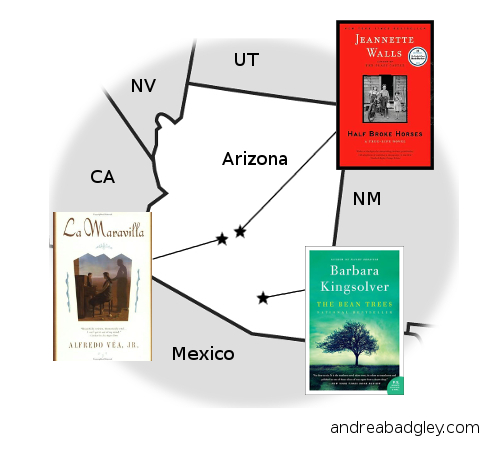
As a coastal person, I was uncomfortable reading Arizona. The dry cracked land, the absence of emerald-green, and the silence where dripping should be were disorienting to me. I think my soul might dry up and blow away if I were to move to the desert. But where I feel withered and desolate, the people who are native to the land find magic – the sky is so big that shamans walk among the stars, and the first summer rain is so significant it signals the beginning of a new year.
Aside from The Bean Trees, the books I chose for Arizona were challenging for me. I don’t know if the landscape made my mouth too dry, or if the books I chose weren’t my kinds of books, or (and this is my hunch) if it’s because I read them in winter, when I would normally curl up with The Shipping News and cold snowy books, but I found myself wishing for something else, a different kind of place. A place of blues and greens, not of reds and browns. I will say, though, that what Arizona lacks in water, it makes up for in characters. The three books I selected from Arizona were filled with scrappy, no-nonsense folks for whom parched land, prickly plants, and flash floods cultivated a toughness that I don’t have, but I admire.
They also cultivated in me a hunger for Tex Mex food.
Novel: Half Broke Horses
Author: Jeannette Walls, born Phoenix, AZ
Setting: 1920s through 40s Arizona
Categories: Historical fiction
Half Broke Horses, set in Texas and Arizona, is a true life novel of Lily Casey Smith, author Jeannette Walls’s sassy, swaggering pioneer grandma. Fans of Walls’s memoir The Glass Castle will appreciate going deeper into the Walls family history with Half Broke Horses, which takes us back to the beginning, when Walls’s grandmother, Lily, broke horses on her family ranch as a girl, and as a young teen rode 500 miles, alone, on her horse, Patches, from Texas to Arizona to take a teaching job in the 1920s. Walls calls this a novel because it was necessary that she fill in details and recreate dialogue, but the voice and wild events, like Lily’s grand entrance in her ranch town’s premier of Gone With the Wind, to which she wore a dress she made from curtains, are authentic and amusing. Lily is spunky and resourceful, a pioneer woman, and I loved her sass:
“Don’t you ‘little lady’ me,” I said. “I break horses. I brand steers. I run a ranch with a couple dozen crazy cowboys on it, and I can beat them all in poker. I’ll be damned if some nincompoop is going to stand there and tell that I don’t have what it takes to fly that dinky heap of tin.” (Lily Casey Smith to a flight instructor who pooh-poohed her when she wanted to take flying lessons from him)
Half Broke Horses is filled with great lines like this, some that characterize Lily, as the one above, and others that characterize the land and the varmints who called it home:
As I sat by my little fire at night, the coyotes howled just like they always had, and the huge moon turned the desert silver.
Arizona, with its wide open spaces and no one peering over your shoulder, had always been a haven for folks who didn’t like the law or other busybodies to know what they were up to.
I didn’t think this was as compelling as The Glass Castle, but I appreciated Walls’s ability to paint the Arizona landscape, and sear me with the desert suns’ heat, and show me a woman with sand, whose grit ensured her survival in an unforgiving place.
Novel: La Maravilla
Author: Alfredo Véa, Jr., born 1952 near Phoenix, Arizona
Setting: 1950s-1960s, outside of Phoenix, AZ
Categories: Native American Fiction, Hispanic Fiction
Set in the late 1950s and early 1960s beyond the fizzled out end of Buckeye Road – beyond where asphalt turns to dirt after Buckeye Road has left Phoenix – La Maravilla is a novel of the displaced fringes who congregate along this sandy road in the Arizona desert: negritos and indios, prostitutes and transvestites, Arkies and Okies, and Beto, a young boy who lives with his Mexican healer grandmother and his Yaqui Indian grandfather. Beto’s mother has abandoned him there in her quest for a shiny, new, dust-free life in California. Beto’s home at the end of Buckeye Road and his Mestizo-Yaqui-Filipino-American heritage reflect the author’s own background: Alfredo Véa, Jr., an American author with Mexican, Native American, and Filipino heritage grew up with his grandparents in the Buckeye barrio outside of Phoenix, just as Beto does.
Peppered with Spanish and Yaqui phrases; brimming with frijoles, burritos, and an elaborate Mexican fiesta complete with sixty pounds of pork and beef that simmered all morning “with fifty cloves of garlic, ten chopped onions, cups of crushed comino and a handful of cilantro;” and populated with a Catholic Mexican curandera (healer), the Mighty Clouds of Joy Negro Church, and Huichol, Yaqui, and Tarahumara Indians who go out into the desert to fly on spirit journeys, and eat peyote, and initiate Beto into these ways as part of his manhood ceremony, La Maravilla serves a rich, flavorful, satisfying banquete of Arizona culture:
The woman in black looked up into the high, endless sky. The skin of the hand that shaded her eyes was browned and softened by the tannins of her life.
Neither Manuel nor Josephina was the same person in their different languages.
The Arkies were kind of like Mexicans, the boy felt; they could suffer and do hard work and they always fed everybody’s kids.
Ghosts are like tumbleweeds. No one pays attention to the plant when it’s green. No one even knows what it’s called. But when it’s dead it receives a name and people who see the weeds rolling across open fields are suddenly stricken with loneliness.
I wish I could mourn for him like those crazy Mexicanos. The bake death and eat it. They roll it in sugar and put it on sticks for the children to lick at.
I admit that there were long portions of the book that dragged for me; I admit that were I not reading this for my Andrea Reads America project, I might have abandoned the book; and I admit there were many times when I wondered where Véa was going with this, and why he inserted this scene and that character. I’m still not sure I know, and I think the book could have been distilled for more potency, but like many books that I’m not sure I like when I’m struggling through them, my mind has returned many times to La Maravilla. I loved Véa’s use of Latino and Yaqui words, how they gave the narrative an authentic feel for being among the characters. Like Two Old Women, the other book I’ve read so far by a Native American author (Alaska), La Maravilla is filled with wisdom, spirituality, and a deep respect for elders, family and sticking together as a community.
Novel: The Bean Trees
Author: Barbara Kingsolver, lived 20 years of adult life in Tucson, AZ
Setting: late 1970s Tucson, Arizona
Categories: Fiction, American Fiction
Set in 1970s Tucson, Arizona, The Bean Trees is the story of Taylor Greer, a plucky, lovable twenty-something who drives away from her rural, dead-end Kentucky home town in her ’55 Volkswagen bug with “no windows to speak of, and no back seat and no starter.” She leaves Pittman County, where folks “had kids just about as fast as they could fall down the well and drown,” and heads west where, at a pit stop somewhere in Oklahoma, a small Cherokee child is deposited in the front seat of her car by a native woman – the child’s aunt – who tells Taylor to the child away from here. The old woman will not take no for an answer as she turns and walks away to face the child’s father – and abuser.
Like so many of Kingsolver’s works, The Bean Trees is a gratifyingly readable book; I think I finished it in three or four nights. Filled with funny Kentucky colloquialisms and the dry desert air of Tucson, The Bean Trees can feel light in its page-turning readability, but flowing beneath that lively tone are undercurrents of weighty issues. True to form, Kingsolver weaves in the strong pulse of nature,
At three o’clock in the afternoon all the cicadas stopped buzzing at once. They left such an emptiness in the air it hurt your ears. Around four o’clock we heard thunder.
If you looked closely you could see that in some places the rain didn’t make it all the way to the ground. Three-quarters of the way down from the sky it just vanished into the dry air.
Everything alive had thorns.
and heart wrenching themes of social justice:
Mrs. Parsons muttered that she thought this was a disgrace. “Before you know it the whole world will be here jibbering and jabbering till we won’t know it’s America… They ought to stay put in their own dirt, not come here taking up jobs.
When people run for their lives they frequently neglect to bring along their file cabinets of evidence.
Set in a border state and dealing with issues of immigration and human cooperation, The Bean Trees is a story of friendship, and heart, and symbiosis. It is a story of plants and people thriving in poor soil and thorny country, not because they are tough, or better adapted, or because they are strong enough to do it alone. They survive because they open themselves to being helped, and to helping each other out.
For Further Reading in Arizona
Books that have been recommended to me but I have not yet read: Concrete Desert by Jon Talton Almanac of the Dead by Leslie Marmon Silko Mojave Crossing by Louis L’Amour Goats by Mark Jude Poirier Bisbee/17 by Robert Houston The Devil’s Highway by Luis Alberto Urrea (nonfiction) Crossers by Philip Caputo
I am reading America: 3 books from each state in the US with the following authorships represented – women, men, and non-Caucasian writers. To follow along, please visit me at andreareadsamerica.com.
I am looking for titles set in each US state by authors from that state. Can you help? Scroll down for details on the project. Thank you!
Alabama: Alberty Murray
Alaska: Velma Wallis
Arizona: Alfredo Vea, Jr
Arizona: Leslie Marmon Silko
Arkansas: Henry Dumas
Arkansas: Maya Angelou
Arkansas: Janis F. Kearney
California: Chitra Banerjee Divakaruni
California: Octavia Butler
California: Amy Tan
Colorado: ?
Connecticut: Ann Petry
Delaware: Bertice Berry
D.C.: Edward P. jones
Florida: Zora Neale Hurston
Georgia: Alice Walker
Hawaii: Kiana Davenport
Hawaii: Kaui Hart Hemmings
Hawaii: Lois-Ann Yamanaka
Idaho: Janet Campbell Hale
Illinois: Richard Wright
Illinois: Gwendolyn Brooks
Indiana: ?
Iowa: Bharati Mukherjee
Kansas: Langston Hughes
Kentucky: William H. Turner
Louisiana: Lalita Tademy
Maine: ?
Maryland: Frederick Douglass
Massachusetts: Dorothy West
Michigan: Ben Carson
Minnesota: Louise Erdrich
Mississippi: Jesmyn Ward
Mississippi: Richard Wright
Missouri: ?
Montana: James Welch
Nebraska: ?
Nevada: ?
New Hampshire: ?
New Jersey: Junot Diaz
New Mexico: Rudolfo Anaya
New Mexico: M. Scott Momaday
New York: Oscar Hijuelos
New York: Nella Larsen
New York: James Baldwin
New York: Toni Morrison
New York: Colson Whitehead
North Carolina: Harriet Jacobs
North Dakota: Louise Erdrich
Ohio: Toni Morrison
Oklahoma: Linda Hogan
Oregon: Heidi Durrow
Oregon: Mitchell S. Jackson
Pennsylvania: M.K. Asante
Rhode Island: Jhumpa Lahiri
South Carolina: ?
South Dakota: Charles Eastman
Tennessee: Alex Haley
Texas: Ito Romo
Texas: Jovita Gonzalez
Utah: ?
Vermont: Jamaica Kincaid
Virginia: Edward P. Jones
Washington: Sherman Alexie
Washington: Jamie Ford
West Virginia: ?
Wisconsin: Nina Revoyr
Wyoming: ?
One of the most challenging aspects of my Andrea Reads America project* has been finding works of fiction set in each state written by non-Caucasian authors who are either from the state or have lived there as a resident (*my project is to read each state via male, female, and non-Caucasian authors). When I wrote about this difficulty in a previous post, Where are the ethnic authors?, several readers asked that I compile a list of the titles I have so far so that they could help fill in the gaps. (Thank you @LissGrunert and The Afro-Librarians for the suggestion. I’m holding you to your offer now.)
I have not been looking super far ahead, so as of the original posting date of this entry (January 13, 2014) there are a ton of gaps beyond Arkansas, which is as far as I’ve gotten in my research. I have found non-Caucasian authors from 22 states (and the District of Columbia) and am lacking titles for the remaining from 28. If you have favorite titles that meet the following criteria, please leave me a note in the comments below (or via Twitter at @andreabadgley) and I will add them to the list. If you know a title set in a specific state but do not know where the writer is from, don’t worry: please give me your titles anyway and I’ll research the author’s background. All genres are welcome:
Non-Caucasian author (African-American, Asian American, Latino, Native American, Indian American, etc.)
Narrative set in a specific US state
Author born in or has lived in the state in which the title is set OR author writes about personal ancestors in the state
For a minute I considered waiving the residency requirement in favor of only reading fiction, but after my husband said, Whoa, hold on a minute there Tiger, I changed my mind. He reminded me of the original spirit of my quest, which is to experience the United States through the voices of its people. I think the fairest way to maintain consistency and the authentic experience of each state is to read work written by authors who were born or raised, or who lived or died in that state. So whether you’ve got nonfiction or fiction titles (including short story collections), please feed them to me here, as long as they meet the criteria above. Thank you so much for your help, and here we go!
Please pass this list around to any readers you know so we can fill it in and provide a resource for folks who’d like to diversify their reading. Thank you!
*I am reading America: 3 books from each state in the US with the following authorships represented – women, men, and non-Caucasian writers. To follow along, please visit me at andreareadsamerica.com.
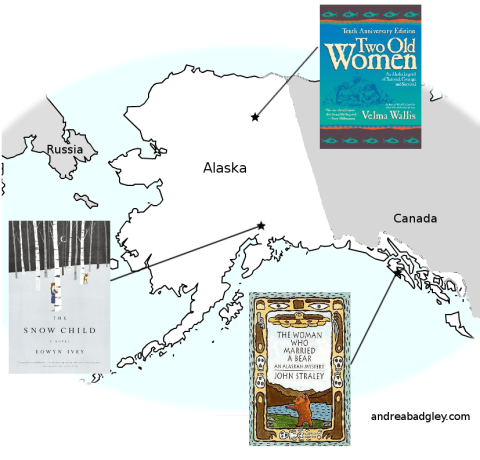
I have to tell you, I was really excited when I realized my Andrea Reads America tour would have me reading Alaska in winter. I love cozying up with icy books when it is cold outside – I reread The Shipping News nearly every winter – and Alaska literature has not disappointed. I’ve gone back and forth between shivering, swearing “I’m reading a warm book after this!” and succumbing to the wild brutality of Alaskan winter, my thirst for its realness and its close-to-the-earthness unquenchable. Reading books populated with marten and wolverine, bear and fox, glaciers and tundra, I’m learning a new vocabulary: breakup (aka Spring, when the ice breaks up and avalanches downstream), ptarmigan (grouse), and babiche (rawhide strips used for cording, as in making snowshoes). I am scribbling descriptions of ice and snow and the piercing cold because the frosty words paint pictures of a place that is exotic, full of a wonder and wildness I will never experience here in Virginia.
While my Alabama reads dealt with social themes – racism, community, and doing the right thing – my Alaska reads contend with themes of wilderness, survival, legend, and the strong pull of the natural world. The landscape is as much a character in each book as the humans are, and I was pleased to find books set not only in isolation in the far north of Alaska and inland on a homestead, but also one set in more populated areas, on the raw coast. I’m a sucker for coasts.
Novel: The Snow Child
Author: Eowyn Ivey, raised in Alaska
Setting: 1920s Alaska homestead
Categories: Literary fiction, Pulitzer Prize finalist
I didn’t think I liked magical realism, but it turns out I just hadn’t found the right book to pull me in, ground me in a reality, then sprinkle magic in a way that is wondrous and enchanting, and leaves you puzzling throughout – is it magic or is it real? The Snow Child was this book for me.
Set in the wilderness of 1920s interior Alaska on the Wolverine River, The Snow Child is the story of a aging couple who have moved west from Pennsylvania to homestead in Alaska in an effort to escape the emptiness left by their stillborn child. A two hour horse ride to the nearest “town” and then a train ride away from Anchorage, Mabel and Jack become isolated even from each other, grieving while they labor separately to make workable land from wilderness. One night, they succumb to the magic of a snowfall, and in laughter and joy, they build a child from snow. The next morning, the snow figure is gone, and a wildling girl appears in the forest.
The Snow Child chronicles the growing affection between Faina (the wildling) and the elderly couple, who over the years grow to think of her as their own, though she comes and goes without notice, and though they live with opposing stories of her flesh-and-blood father who Jack buried and the idea that Faina is a snow maiden of their creation, as Mabel read about in a Russian Fairy Tale. A tale that never ends well.
The magic in this book isn’t just the obvious fairy tale quality of it. The magic is in the crystalline descriptions of Alaska in winter. Author Eowyn Ivey may not be Eskimo, but I would argue she has a thousand words for snow. Her descriptions are like snowflakes on the tongue – delicate, feathery crystals that sting in their loveliness:
“The December days had a certain luminosity and sparkle, like frost on bare branches, alight in the morning just before it melts.”
“Dawn broke silver over the snowdrifts and spruce trees.”
“The child was dusted in crystals of ice, as if she had just walked through a snowstorm or spent a brilliantly cold night outdoors.”
“The cranberries were tiny red rubies against the white snow.”
“Around the curve the valley opened up, and in the distance spires of blue ice glowed.”
This is a biting and beautiful book of love: love for neighbors, of husband and wife, for children, and love for the wild pull of the land, the forest, the snow, and the wilderness. It is one I will come back to when I want the magic of winter.
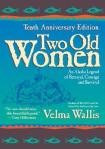
Two Old Women, a tale of Athabascan Indians written by Velma Wallis, a native Athabascan author, takes place north of the Arctic Circle in the interior of Alaska. It tells a tribal legend passed orally to Wallis by her mother, of two elders who were abandoned one lean and brutal winter by their tribe.
“That day the women went back in time to recall the skills and knowledge they had been taught from early childhood. They began by making snowshoes.”
At the time they were abandoned, the old women depended on the youth of the tribe to care for them. Because of this dependence, with The People on the brink of starvation, the Chief determined the women were holding the tribe back, threatening the survival of the many for the demands of the few, and he left them to die, old, crippled, and alone on the open tundra. The two women could barely walk, even with canes, when they were left behind, but the taste for survival was sharp in their mouths, and they gathered their strength and elder-wisdom to stay alive. They made snowshoes from babiche a grandson had left them, and used the shoes to trek to a safe winter-over spot; they caught rabbits in snares; they slept in snow pits they dug with gnarled hands and lined with spruce boughs for bedding.
What I love about this story, aside from a portrayal of the very real struggle for survival for indiginous people living without permanant shelter – nomads north of the Arctic Circle – was the focus it places on elders. The elders in our communities have seen much more than the youth have. They know more, they have lived more, they are wiser. It is easy for young ones, in their arrogance and vigor, to toss the old aside, thinking they are outdated, their knowledge obsolete, their presence a hindrance holding the young ones back rather than a source of wisdom that could propel them forward. Wisdom that could nourish and equip them for the unknown that lies ahead.
I imagine this story would be powerful as an audiobook, told with native Athabaskan inflection and in its traditional, oral story form.
My head is a cup left out on a stormy autumn night; half full of water, and a spider.
The fact is, I can’t. Especially when the novel is a murder mystery set in October in the port town of Sitka, off the raw southeastern coast of Alaska. Unlike the previous Alaska books I read, which were set in isolation in the interior of the state, Staley’s novel portrays peopled coastal regions in Alaska: cities with pubs and coffee shops, police departments and wharfs. Eskimos and other natives populate scenes in diners, bars, and airplanes, always reminding the reader you’re in Alaska.
Since it’s a mystery novel, I won’t go too much into the plot, except that it involves a murder (duh), Tinglit Indian legend, and Cecil Young, an alcoholic private investigator with a penchant for poetic thought
“Her skin was as white as a sea anemone, and as soft as the pool of warm air you pass through while rowing across the bay.”
and a knack for nailing scenes
“As the bottle got lighter our gestures became wilder, our eyes widened and we imagined were were expanding into our own stories.”
“The landscape seemed to press in and make Juneau seem like a smaller, less sophisticated town than it really was.”
“The water boiled with little silvery fish dense on the surface like a trillion dollars in quarters spilling onto a sidewalk… There was a massive exploding breath and the damp smell of fish and tideflat… Whale. Humpback whale, feeding on herring.”
I read this as winter descended on Blacksburg, Virginia, and it was a perfect curl-up-on-the-couch cozy mystery read. The language in this book is beautiful, enough so that I was intrigued by a mystery writer who wrote so poetically, and I discovered that Straley has studied poetry and was the Alaska State Writer Laureate from 2006 to 2008.
The Woman Who Married a Bear is the first in a series of Cecil Young mysteries.
For further reading in Alaska
Books I’ve read and recommend: Ordinary Wolves by Seth Kantner Into the Wild by Jon Krakauer (nonfiction)
Books that have been recommended to me but I have not yet read: The Raven’s Gift by Don Reardon Two in the Far North by Margaret E. and Olaus Johan Murie (nonfiction) Drop City by T.C. Boyle The Only Kayak by Kim Heacox (nonfiction) Journey to a Dream by Mary Lovel (nonfiction) My Name is Not Easy by Debbie Dahl Edwardson Don’t Use a Chainsaw in the Kitchen by Rosalyn Stowell
I am reading America: 3 books from each state in the US with the following authorships represented – women, men, and non-Caucasian writers. To follow along, please visit me at andreareadsamerica.com.
In the summer of 2013, my parents packed up their RV and took the adventure of their lifetime: the two of them and their yellow lab, Blondie, drove from Georgia to Alaska and back again. Mom wrote and photographed their journey on her blog, Wandering Dawgs.
 The Goldfinch: A Novel by Donna Tartt. “A young boy in New York City, Theo Decker, miraculously survives an accident that takes the life of his mother. Alone and determined to avoid being taken in by the city as an orphan, Theo scrambles between nights in friends’ apartments and on the city streets. He becomes entranced by the one thing that reminds him of his mother, a small, mysteriously captivating painting that soon draws Theo into the art underworld.” (Goodreads blurb)



































 Butterfly Mind