Fart Cards, featuring Snart, Butt Trumpet, and Squeaker
Our son walked in the front door, red cheeked and grinning, after soccer practice. His blue gym bag was slung over his shoulder, and he still wore his shin guards and cleats.
“Hey Mom, you know those fart cards your friend gave you?”
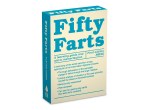
My local writing buddy, after reading my Lost Balls post, and about our family’s love of cards, gifted me with a deck of “Fifty Farts” cards at our last critique session. The cards have provided endless entertainment in our highly mature household, including an evening where the kids’ dad and I thought it would be funny to explain to them what a shart was. Which, of course, meant that we had to say the word “shit” to them. And explain what that was.
When we told the kids, “Shit is poop,” a lightbulb went off over our son’s head and he said, “Ohhhh, so that’s what it means.”
I asked, “Where have you heard the word before if you don’t know what it means?”
He shrugged. “Kids talk about bad words at the lunch table, but nobody knows what any of them mean.”
Great. Nobody’s going to let their kids to come to our house anymore.
I dried my hands after washing the dishes and smiled at my son’s flushed, grinning face. “Yeah, I know the cards.”
“Do you think they have ‘swart’ in them?” and his grin widened.
My mind raced, trying to figure out what a swart might be. My husband, who is on our son’s wavelength, said “Is that a sweaty fart?”
“Yeah,” Owen said, and nodded his head, his eyes crinkling with glee above his toothy smile.
“Uggh!! Gross!” I said. And laughed. I looked at his flowy soccer shorts and imagined them fluttering with his swart as he ran up the sidewalk to our house.
“A swart makes a funny sound,” our son said. “Like rapid machine gun fire,” and he grinned again, turned around, and climbed upstairs to change.
“So, have you noticed that irony is super trendy now?” I dealt Phase 10 cards to Amy and my two kids. “‘The Ironic Generation.’ I keep hearing that. What does that even mean? That people want to live off the grid, yet they can’t survive without Facebook and Twitter?”
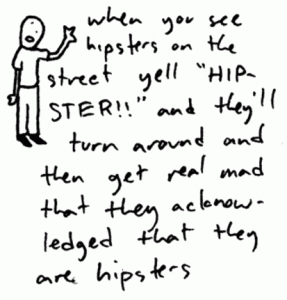
Amy fanned and arranged the cards in her hand. “It’s a hipster thing.”
“What’s a hipster?” Our son’s big eyes looked up at me.
“Well,” I said, “Every generation – do you know what a generation is?”
“Yeah, it’s like a thousand years or something.”
“Not quite,” Amy and I laughed. “It’s a group of people of a certain age. Like, you and all your friends, and all the kids in elementary school right now are your generation. Daddy and me and Amy and all of our friends are our generation.”
He discarded. “Okaaay.”
“Each generation has a group of, I don’t know,” Rebels? Outsiders? “A subculture that kind of defines the generation. In the 20’s it was flappers.” I played a card and looked across the table at Amy. “When were beatniks?”
“Beatniks were in the 60’s,” she said. “And hippies were the 60’s and 70’s.”
“Punk was the 80’s. And now,” I said, “it’s hipsters.” I peered over my cards at our son to see if he understood. He did not.
“There were tons of hipsters in the Twin Cities,” I told him. “They think they’re really cool. Like, they were cool before cool was cool.” He had no idea what I was talking about. He’s nine.
I played a card and asked my friend, “Do you know how the hipster burned his tongue?”
She raised an eyebrow, waiting for my answer.
“He ate pizza before it was cool.” I giggled hysterically. Our son rolled his eyes.
Amy was more useful to him, describing the hipster look – the skinny jeans, the PBR tee shirts. “And then there are the older hipsters, like Ira Glass and my husband, with the glasses, and the beard, like my husband has.” She moved some cards around in her hand. “Although he had the glasses and the beard before they were a thing.”*
I giggled again, thinking she was making fun of herself, saying that her husband had adopted the hipster look before it was cool. I looked up from my cards to acknowledge her cleverness, but she wasn’t smiling about it. She was laying down her sets, getting ready to go out.
“So, back to irony,” I said. “I’ve always loved irony, but I never know how to explain it. If somebody asked me to define irony, I could give an example, but I couldn’t define it.” I laid down my sets of four and discarded. Amy looked thoughtful, turning her eyes up as if she could look into her brain, rifle through files, and find a definition for ironic.
“Only Hipsters Know Irony,” writing and “art” by J. David Ramsey
“But the irony I know is not anything like that Alanis Morissette song,” I said. “ ‘It’s like 10,000 spoons when all you need is a knife.’ What the hell is that? That’s not ironic. That’s just annoying. Ironic has some sort of, I don’t know,” I gestured toward my heart. “Mystical quality.”
Amy’s eyebrows shot up and she grinned. “Let’s look it up!”
I gave her the dictionary, and she riffled pages while I shuffled cards. Her face turned scowly.
“What the hell?” She said. “Listen to this:
“Ironic. 1. Characterized by or constituting irony. 2. Given to the use of irony.
“That doesn’t tell you anything,” she fumed. “It uses irony in the definition!”
My son arranged his new cards. “It’s your turn Amy.”
“Oh, sorry,” she said, then smiled and stroked the book. “I have this dictionary now, you see,” and she played a card.
“Well, look up irony then,” I said.
She followed the words with her long finger.
“Irony. 1.a. The use of words to express something different from and often opposite to their literal meaning.”
I had had a couple of whiskey sours at this point. “What? That confuses me,” I said, and took another sip. “This is an example of irony to me. I have this friend whose mom was a super fructavore – she loved fruits and veggies and ate them all the time. They were her snacks, her desserts, always a component in her meals. Tons of fiber, you know? Well, she died from colon cancer.” I laid down a card. “That’s ironic.”
“Okay, listen, though. Here’s the third definition of ironic:
“3. Poignantly contrary to what was expected or intended.”
“Poignant! That’s going in my Lexicon.” I jumped up to get my Moleskine. “Poignant is one of my favorite words. It’s like irony – it has this mystical quality,” and I gestured toward my innards again. “It makes me feel.”
“Mom! It’s your turn!”
“Sorry babe.” I played a card and thought of the example of irony I had just told. “My friend’s mom contracting colon cancer after a lifetime of fruit eating is, well, poignantly contrary to what was expected. That’s a perfect definition! That’s the irony I’m talking about. It’s all about the poignancy.”
“You really need to read the usage examples here,” Amy said, pointing at the entry in the dictionary.
I thought about all the young hipsters in the Twin Cities as play went round the the table. I thought about the sad irony that they try desperately to avoid anything mainstream, yet they have become so mainstream they even have a look. Glasses, skinny jeans, fixed gear bicycles. iProducts.
When it was my turn again, I fingered my cards, then hitched up my skinny jeans so I could start the music back up on my iMac. I smirked, “Well, I’ve loved irony for, like, 20 years. Irony spoke to me before it became a ‘thing’.”
And then I laid down my cards and laughed.
Usage Note: The words ironic, irony, and ironically are sometimes used of events and circumstances that might better be described as simply “coincidental” or “improbable,” in that they suggest no particular lessons about human vanity or folly. Thus 78 percent of the Usage Panel rejects the use of ironically in the sentence In 1969 Susie moved from Ithaca to California where she met her husband-to-be, who, ironically, also came from upstate New York. By contrast, 73 percent accepted the sentence Ironically, even as the government was fulminating against American policy, American jeans and videocassettes were the hottest items in the stalls of the market, where the incongruity can be seen as an example of human inconsistency. (The American Heritage College Dictionary)
When I was researching this post, I came across some pretty hilarious stuff. Like the wikiHow article 9 Ways to Be a Hipster. I also found a fascinating opinion piece in the NY Times: How to Live Without Irony by Christy Wampole. Both great reads if you are curious about hipster counterculture.
After our son’s doctor pronounced him perfect at his seven year checkup, she said, “We don’t need to see him again for a long while. These next few are the golden years of childhood.”
She tipped her head toward our boy, “They become much more independent over the next few years – pouring their own milk, picking out their own clothes – yet, they are still innocent and childlike, and they want very much to please you and their teachers. They ask a lot of questions, and they want to learn, and,” she smiled, “you get to see the emergence of their unique personalities.”
And you can have real conversations with them. You can tell them, “Fix yourself an Eggo!” on Saturday morning while you sleep in. And when your son is nine, his jokes progress from nonsensical knock-knocks to a nuanced sophistication of timing and subtlety that surprise his dad into laughter and leave you saying, “Huh?”
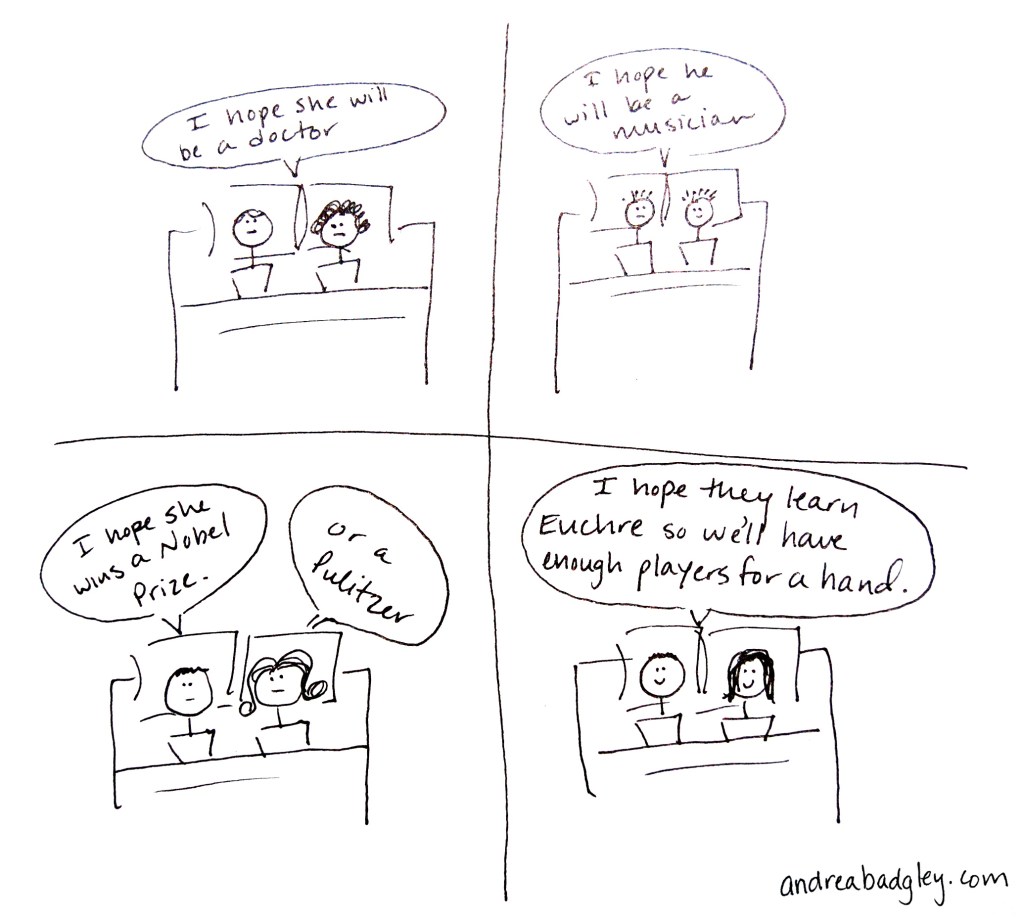
But most importantly, you can begin to teach them cards.
I wasn’t much of a card player growing up. I loved gin and rummy for the first few hands, and then I’d get bored with them. My husband played poker on and off for several years, but I never participated. That was his man-night-out thing. I couldn’t relate to the depth of his card love until we spent Thanksgiving with his family in Chicago a few years ago.
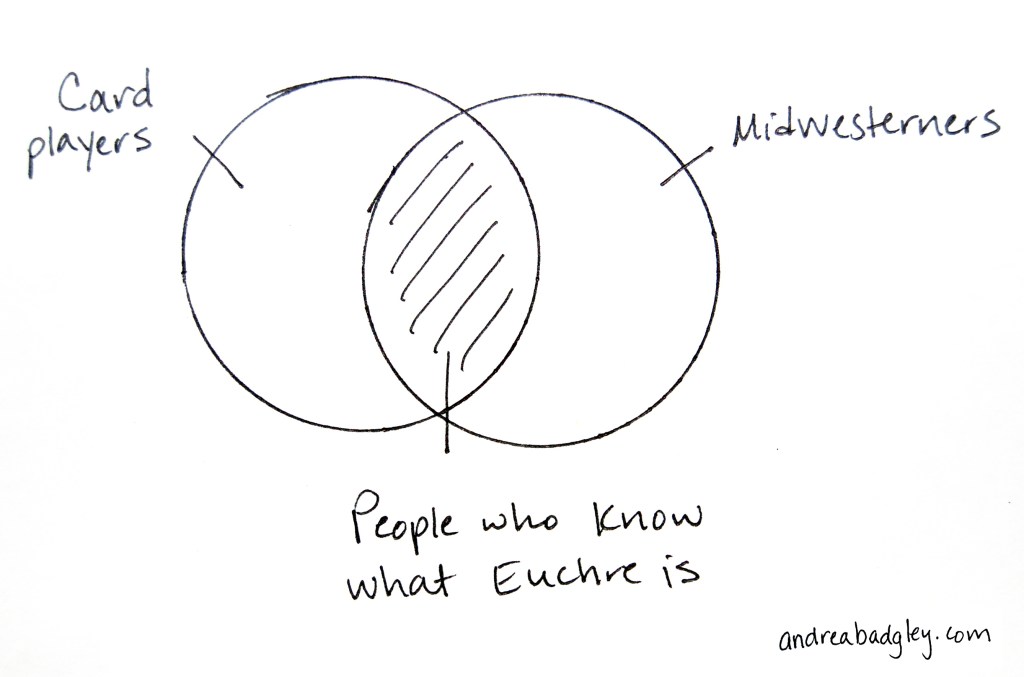
Over the few days we were there, amongst all his aunts and uncles and cousins, and Grandma Janet drinking appletinis, and my aunt-in-law and uncle-in-law and me making emergency brownies at ten at night when we got hungry for baked goods, there were, as soon as the first beer cap was popped, the first gin and tonic poured, the first wine bottle uncorked, at all hours of the evening and late into the night, three card tables going. At the highest table, two steps up from the living room and four steps up from the den, Grandma Janet and rotations of three aunts and uncles played bridge. At the other two tables, lower in elevation (and in status) the rest of us played Euchre, our drinks leaving wet rings on the card tables. Euchre is an intricate card game for exactly four players, with trumps and bowers and tricks and strategy, and teams where communication with your teammate is prohibited, yet, unless you declare, “I’m going alone,” you are dependent on your partner to win.
In other words, an insanely fun game. I was hooked immediately. And now that our kids are in these golden years of childhood, it is time to train them up for Euchre.
When our children were younger, I think my husband’s soul died a little bit every time he had to play Go Fish or Old Maid or War. But the kids know how to hold their cards now. I remember that was a huge first step, one that I took for granted until I saw their tiny starfish hands struggle with fanning the cards so they could see the suits and numbers. There would always be a clump of four cards stuck together, then one sticking way up, a snaggletooth in an already jagged row. Diamonds and spades would tumble to the floor when our son let go with one hand to pull out a heart to play.
Those days are over now, as are, my husband hopes, our days of Go Fish. While I was away last weekend, he taught them Go Boom, where one person leads a card, and the other players have to follow the card that is led, either by suit or by number. Kind of like UNO. Whoever wins the trick gets to lead next, with the ultimate goal of being the first person to get rid of all your cards. Go Boom taught the kids some of the language of Euchre – “lead,” “trick,” “suit” – and about card ranks, leading, following leads, and most importantly, the strategy of how to lead.
They ate it up like candy. Like ice cream. Like apple pie with candy and ice cream on top.
So this week, while our daughter was at a playdate, I taught our son a no-trump version of Whist. After one hand of basic leading and following, where an 8 of clubs beats a 2 of clubs, he said, “There’s not much to this, is there?” I smiled and stepped it up to Knock-Out Whist, a kid’s Whist that introduces trump cards. I told him, “Okay, if I lead with the Ace of diamonds, you have to play a diamond. If you don’t have a diamond, you can play trump and take my ace. Even if your trump is as low as a 2, you beat my ace and win the trick. That’s what trump means – it beats anything but a higher trump. You got it?”
His eyes gleamed. “Yes. What do I do if I don’t have a diamond or trump?”
“Just throw away your crappiest card,” I said.
He played beautifully, like his father. And he beat me. Twice.
“Oh, you’re going to like Euchre,” I told him.
He looked up at me. “Can you bet money in Euchre?”
Later that night, we taught Knock-Out Whist to his sister. In addition to teaching trump, I figured it was time to throw in dealing etiquette as well. “Do NOT count the cards when someone else is dealing. It’s really annoying. Also, deal first to the person on your left.” I laser-eyed our daughter. “Not to yourself.”
When we were unclear on one of the rules, my husband pulled out his 700 page Hoyle’s guide to “popular games of skill and chance” to sort it out. He lay on his side on the couch, flipping through til he found the section on card games.
“Ha!” He crooked his mouth into a side smile. “No wonder I like Euchre. All these other game descriptions are half a page long. But Euchre -” He licked his finger and started thumbing pages. “Euchre is 1, 2, 3, 4, 5, 6. Six pages of instructions.” He smiled a full smile, his eyes gleaming like our golden-aged son’s, and dove into the rules of Whist.
This is the book we’ve used to find age-appropriate card games to play with our kids. You can play dozens of games with a simple pack of cards, so if your family (i.e. you or your partner) is sick of all the same old board games, I recommend this as a jumping-off point. The rules aren’t super clear for some of the games (which is why we had to dig further into Hoyle for Whist rules), but it’s a great place for ideas.


 Butterfly Mind