I recently finished a book, Clear Thinking by Shane Parrish, that had a surprising twist at the end. It’s a self-development book I read for work, so was reading in the context of how I show up at my job, and particularly for the purpose of developing decision-making skills. I expected your typical business-y productivity book (which it is, though it’s wiser and more insightful than most I’ve read), so I was surprised at the end of the book to see a chapter called “The Happiness Experts.” What does happiness have to do with good decision-making?
Parrish distills good decision-making down to two things: knowing how to get what you want, and knowing what’s worth wanting — what really matters. The consideration of happiness helps us make decisions based on what really matters.
The happiness experts he seeks wisdom from at the end of the book are elders in their 70s, 80s, and 90s: people have lived a long life, who are facing death, and who have the perspective of many years of living to know what really matters. One of the items those elders list as important* is to savor daily pleasures instead of waiting for big events. We spend the vast majority of our lives in the mundane day-to-day. If we want to tip the balance towards more happiness, the every-day is the place to find it.
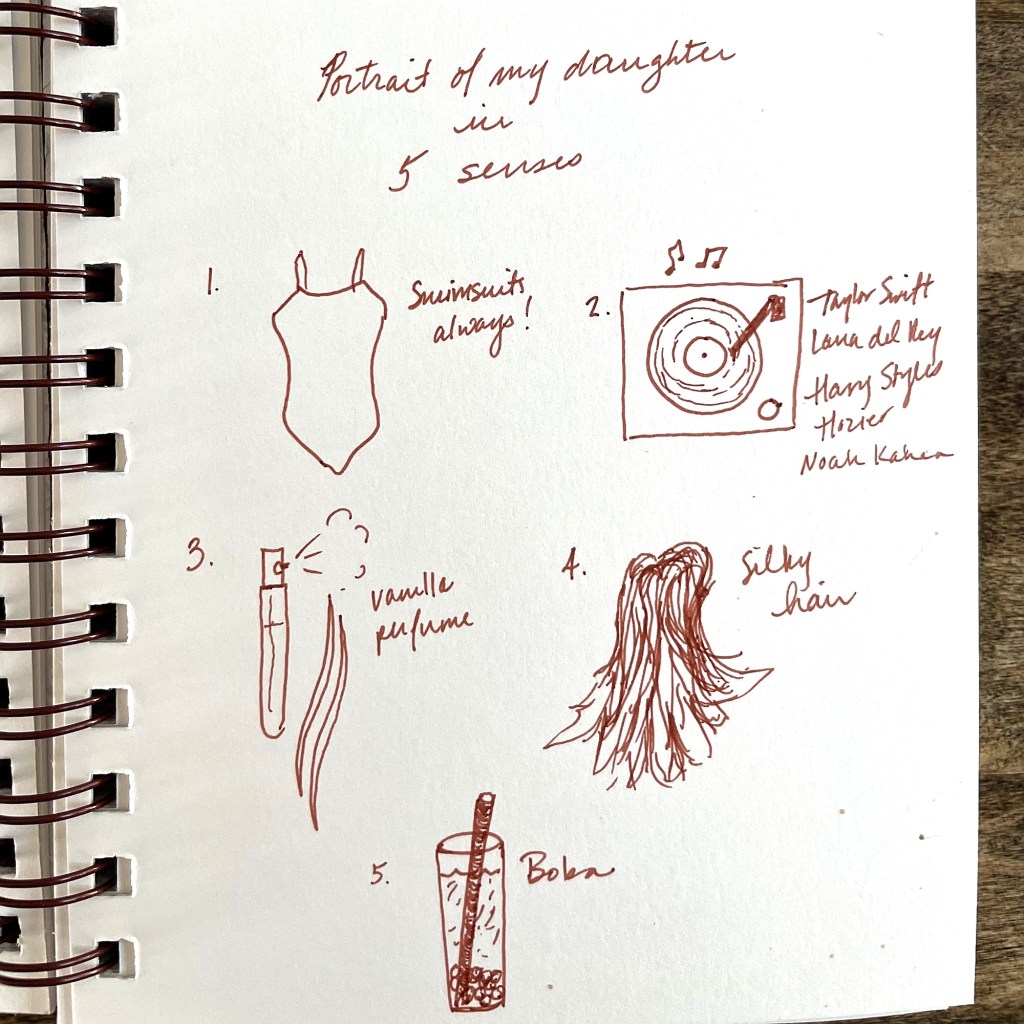
I am all in on this. I love the mundane. I love lounging around in my leisure time and laughing with my husband and kids. I love writing and drawing with my pretty inks. I love sitting by a crackling fire and reading novels. I love standing at the back window and watching the birds, squirrels, and bunnies. I love walking around my neighborhood and seeing the trees and mountains, smelling the air, and listening to wind in the leaves. I love finding beauty in the shape of an ink bottle, delight in my peanut butter and honey toast, awe in nature, curiosity in people-watching, comfort and coziness in my slippers, a surge of love when I smell our daughter’s vanilla perfume, hear her shoulder her swim bag, or taste the latest flavor of bubble tea she’s drinking.
The second week of the 30 days of drawing challenge I joined was all about delights. Needless to say, I had fun with this week. I had two long flights so I had lots of time to play with, and I spent more than 10 minutes on some of the drawings. I was absorbed in the activity of making marks on the page, and it brought me pleasure, and I had time, and I had no reason to stop. I feel good about that decision.
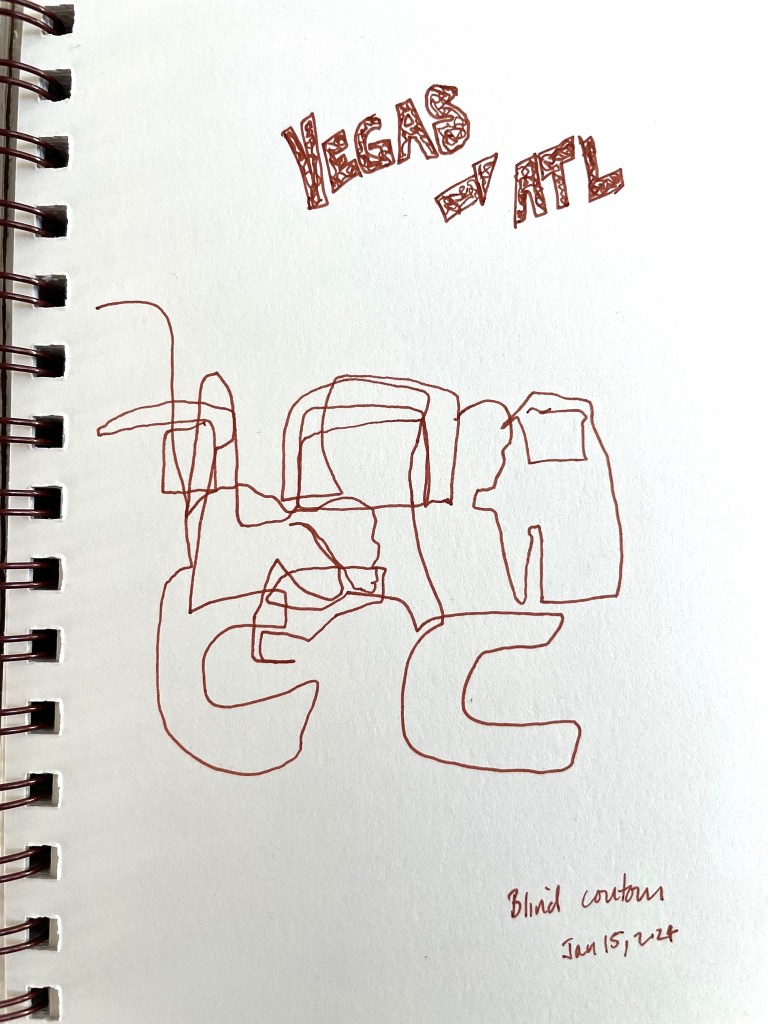
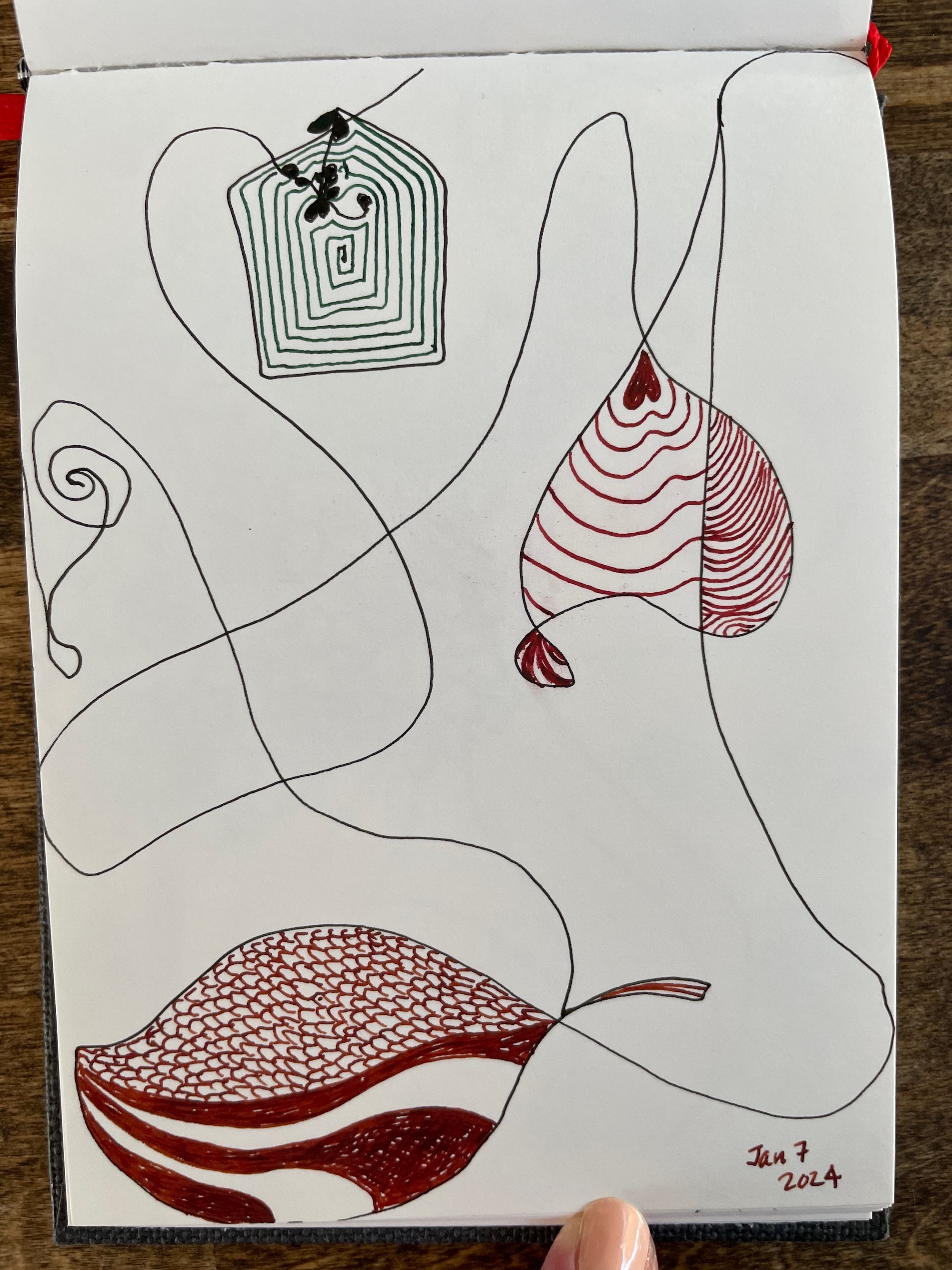
Day 7: something that delights meDay 8: delicious delightsDay 9: delight in natureDay 10: blind contourDay 11: clothes that delight (my slippers)Day 12: delight through our senseA week of drawing delights
*Other items on the list of things elders say matter in life are saying things now to people you care about, spending maximum time with your children, working in a job you love, and selecting your mate carefully.
Bloganuary writing prompt
What do you enjoy doing most in your leisure time?
Of the two intentions I set for 2024, I am succeeding at one of them: I draw nearly every day. My friend and team lead, Kristina — the one who got me hooked on drawing to begin with — sent me an Instagram message to tell me about a January, 10-minutes a day, anti-perfectionist 30-day drawing habit… community? course? Substack? I don’t know what to call it, but it’s run by Wendy MacNaughton, the illustrator of Salt, Fat, Acid, Heat. After first saying, “but I’m not a subscriber!,” then landing a free 30 day trial*, I said hell yes! And I started drawing, fearlessly. Because the whole point is to have fun and stop editing yourself.
As with many online drawing lessons I’ve dipped my toes into, this one introduced us first to line. Or at least I thought it did. I can’t find a corresponding lesson, but I have this drawing of different kinds of lines that I’m sure came from WendyMac’s lessons:
Different kinds of lines
From there, I set a timer for 10 minutes for each assignment, turned off my brain, and drew based on the prompts she gave. It reminded me a lot of the talk I gave at WordCamp US, and then again at WordCamp Europe: Publish in 10 minutes per day. The keys are 1) to have a prompt to work from, and 2) to reject perfectionism. Set a timer, let it rip, don’t worry, and boom, you have a blog post (or a drawing).
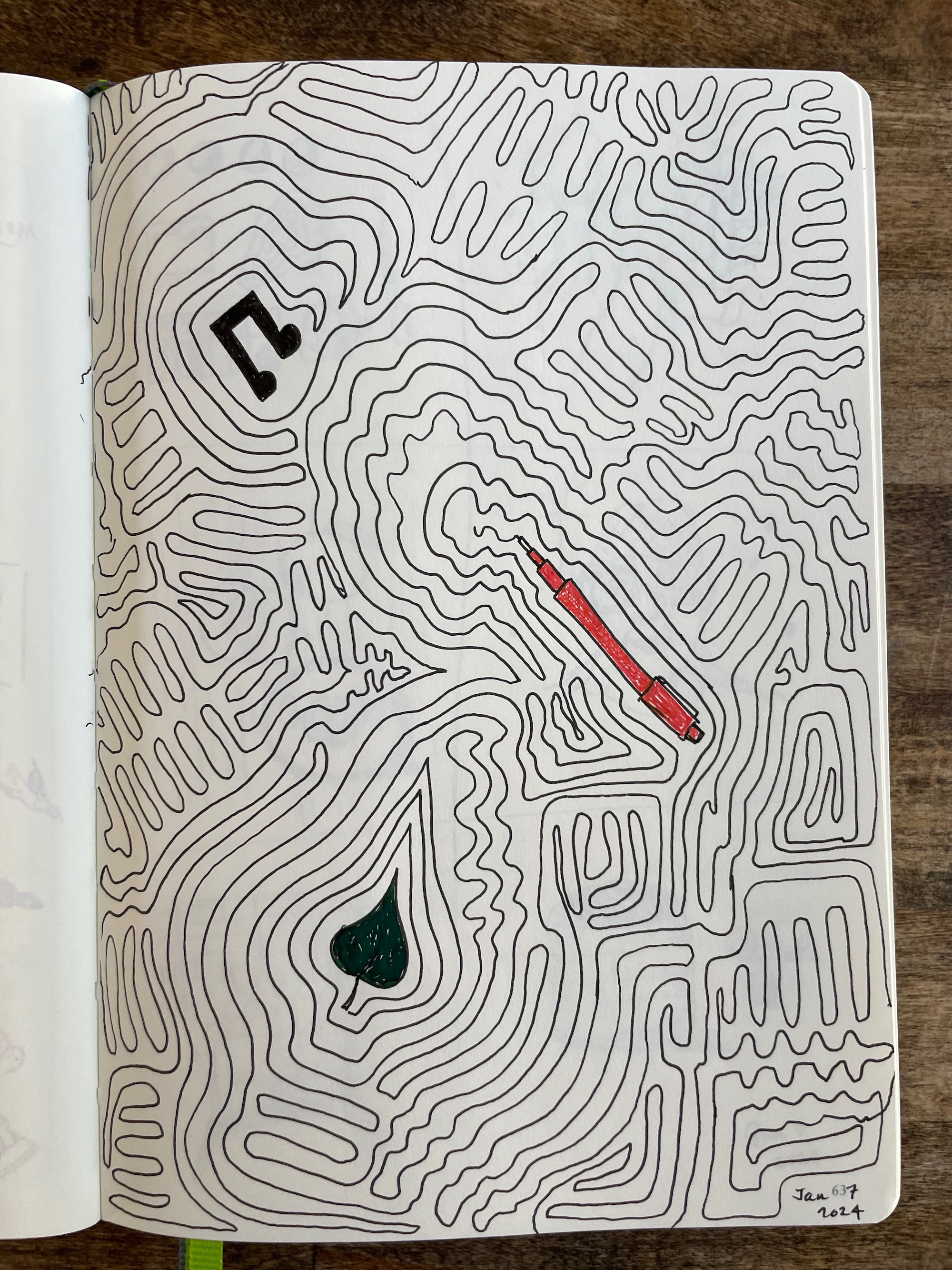
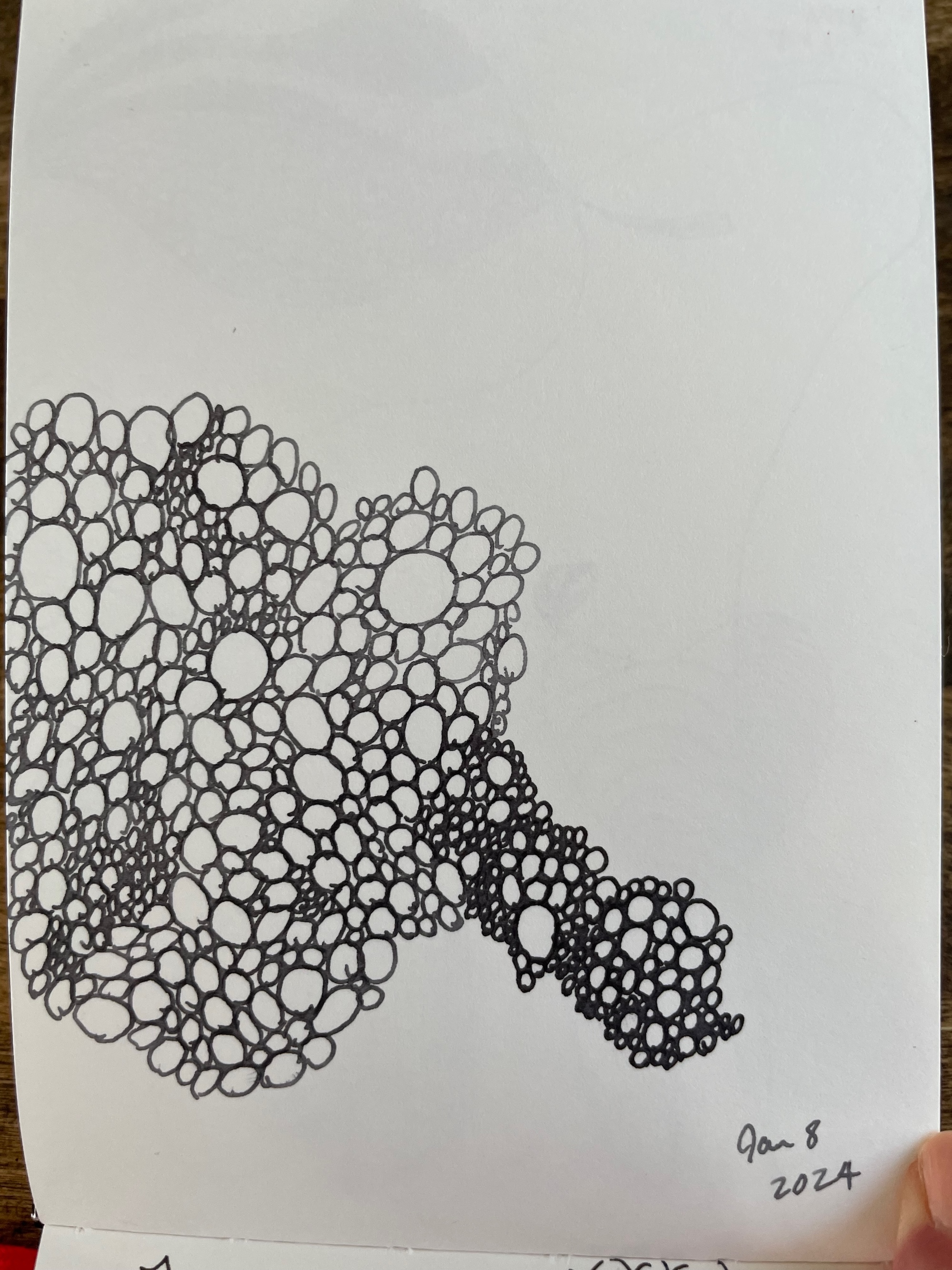
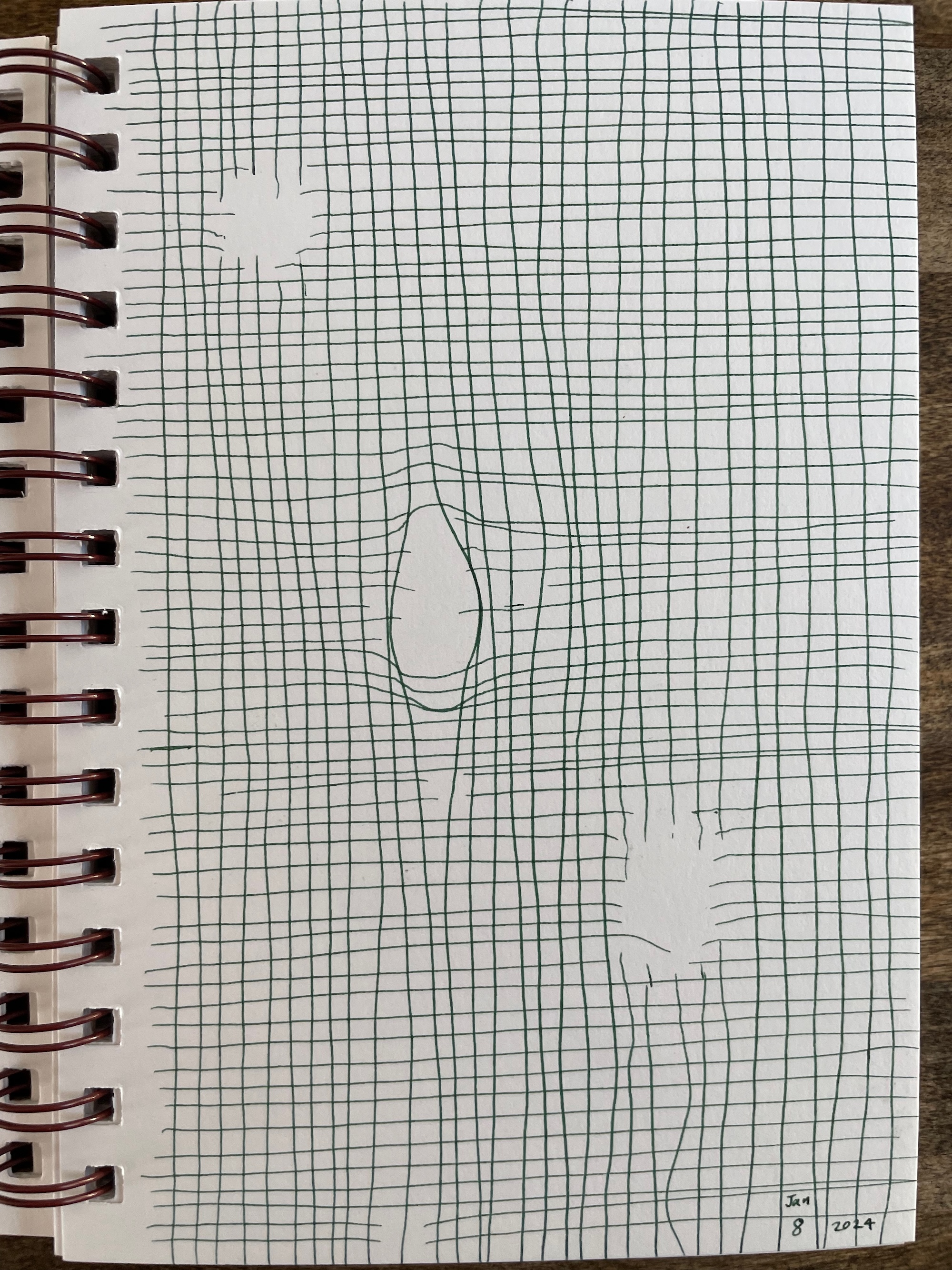
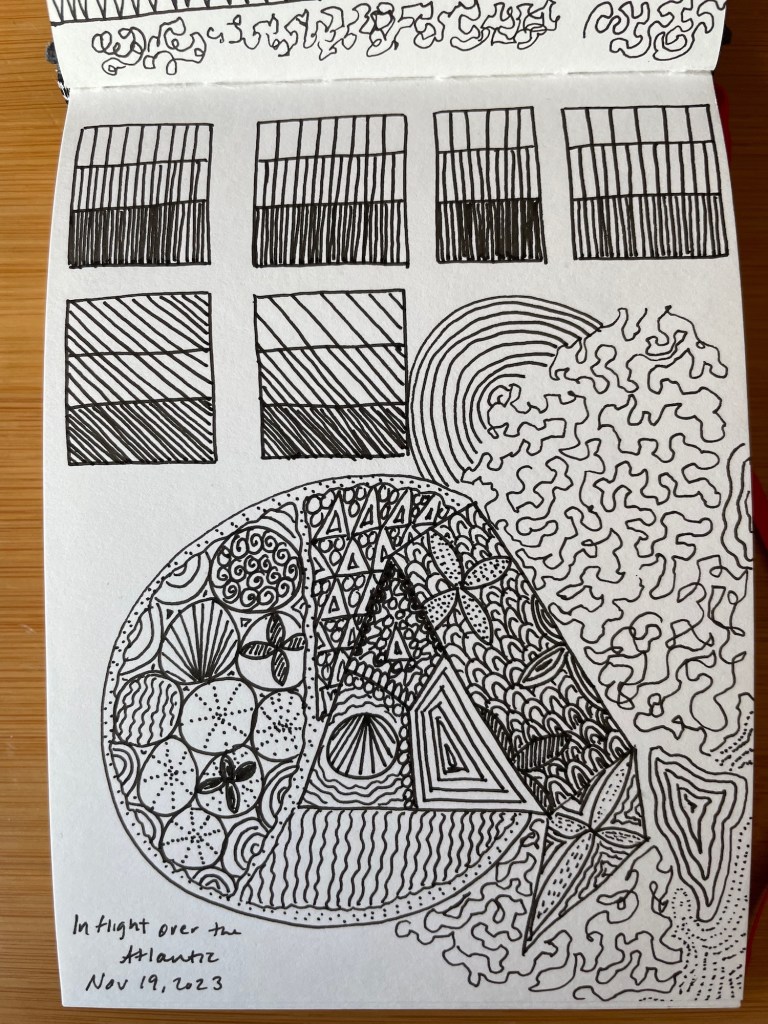
One of the keys to having fun creatively is to not be precious or embarrassed by what you’ve made. So in that spirit, I’m posting the drawings from my first week with WendyMac. The theme of the week was doodling. Doodling is fun. It’s low pressure, there’s no comparison to reality, and it’s easy to flow with. I’ve found I really enjoy lines, and I like to doodle on airplanes. I turn on some music, or the fireplace video if available, and let my pen wander. Doodling passes the time while also putting me in a flow state. I found some entrancing doodlers on Instagram, and I am inspired.
The first assignment of the 30-day habit was to draw, in 10 minutes, what I want to do more of and less of in 2024. My More list is basically stuff I like to do for fun: listen to music, enjoy nature, travel, go for walks or hikes. And now, draw.
Below are my doodles. I have so much to learn 😂. For starters, I’ve learned about paper, and about not drawing on both sides of lightweight paper. I’ve also learned that 10 minutes is not very long. I think that’s the trick to it: 10 minutes is a short amount of time. It’s the starting that matters. Committing to 10 minutes helps you get started. There were a couple of days in week 2 where I said screw the 10 minutes, I’ve started, and I’m having fun, and I’m going to keep going. But the 10 minutes is also to give constraints and say, hello, this isn’t a masterpiece and don’t spend 2 weeks on it. Just 10 minutes. You don’t need to be perfect. Loosen up. Have fun.
Day 1: intentionsDay 2: doodle into drawingDay 3: doodle futureDay 4: circlesDay 5: get griddyDay 6: doodle finale
My biggest challenge in life seems to be having too many things I want to do and not enough time to do them all. Because of this, I rarely get bored, but it also means I’m constantly making decisions: do I do this or do I do that. Do I read or do I write. Do I write or do I draw. Do I exercise or do I journal. Do I blog or do I transcribe diaries. Do I hike or do I read. Do I read or do I garden.
My latest hobby is drawing, and I have specific ambitions with that. I want to play with pen and ink drawing to make pretty entries in nature journals. I like flipping through my little sketchbook and seeing pictures instead of reading lots of words, and I love the meditative act of drawing.
Of course, this means more physical books to store on a shelf. My shelf of diaries and written word journals is now overstuffed: I cannot fit any more notebooks, composition books, or now, sketchpads on it.
To help me overcome the constant challenge of choosing what to do with my time, and also, to help me accomplish my goal of creating a beautiful nature journal, with botanical sketches and drawings of little birds, I’m going to set only two intentions for 2024:
Draw. Take online drawing courses, do tutorials, draw with graphite, dabble in colored pencils, and progress to pen and ink. Early in the year, start a nature journal where I draw something that strikes me or fills me with wonder at least once per week, preferably once per day.
Transcribe 20 of my old diaries so I can empty some shelf space for sketchbooks. I found an app that can transform handwriting to typed text, and I will use that so that I can keep images of my handwritten pages while also transforming it to searchable text. When I found the app, I had originally set a goal to transcribe 45 journals in the year, but then I started one to test how long it would take, and I’ve been working on the one for over two weeks, so 45 is probably a little too ambitious. Twenty seems doable.
That’s it. I don’t need to set any intentions around reading or gardening or exercising or blogging because I’ll do all of those things no matter what. Drawing is a new habit that I want to nurture, though. I get absorbed in it, and it’s fun, and it’s very satisfying to see myself improve as I practice. I want to make space for it in 2024.
Getting old is the pits. There are many things I love about aging, the biggest being that I know and like myself better than when I was younger. I love that we’re at a point in our lives that we’ve built something: we get to enjoy the fruits of our labors, with a comfy home and awesome kids. Life just isn’t as hard now as the struggle of young adulthood when you’re still trying to figure everything out.
However. Aging also comes with a deteriorating body. Aging brings failing eyesight and aches just from sitting. Now that I’ve started drawing, I’ve picked up yet another hobby that involves being seated and that requires a stable surface to create on, good lighting, and excellent vision, which I no longer have.
I read, I write, and now I draw, and I find myself moving from seat to seat in our house, trying to find a comfortable place to do any of them. Sitting on the couch with a lapboard hurts my shoulder and my back, and it’s not by the window where I can get natural light during the day. The chaise lounge is by the window, but it also hurts my back and neck, and at night, forget about it for lighting — the lamp is behind the chair, so my body casts a shadow on any drawing or writing I try to do. Our dining table is good for lighting during the day thanks to the natural light that pours in through the sliding glass door, but the chairs are hard, and the table is constantly covered in crumbs. My desk in my office would probably do, but I don’t want to be in my office for my me time. It’s in the basement, the lighting is too bright and sterile, it is separated from everyone, and it is where I spend all day for work. I don’t want to be in there for my leisure activities.
When I picture my ideal space for writing and drawing, I picture a small rectangular table by a source of natural light, like you always see in movies where writers have a little desk facing a window, or snugged up next to one, so they can look out when they stop to think. At first I pictured a little round cafe table, but the circular surface would likely be less utilitarian than I’d need it to be for supplies. I’d have a sturdy chair that was supportive yet cushioned, and there would be a good lamp on the table for when there’s no daylight. Ooh! I’d probably also like a magnifying glass, one of those ones mounted on an arm so I could put it in place, hands-free, for drawing. The space would be in a living room, a study, or a library, maybe with a fireplace — a cozy room that’s warm in winter and that’s not isolated from my family. Nearby, I’d have a little storage space for journals, fountain pens, sketchpads, and pencils.
I don’t know how or where I’d set up a space like this in our current home, but I’m doubtful we’ll live in this house forever. Once the kids are both launched in their lives and we know a little better where they’ll be, we might start looking to relocate. I’ve been thinking a lot lately about what kind of space I’d like to create on the next leg of our life journey, and a little nook for reading, writing, and drawing is definitely on my mind. I look forward to a day when I don’t have to move all my writing or drawing supplies from one seat to another, and my shoulder and neck don’t hurt, and I don’t have to strain my eyes to do these things I enjoy.
Daily writing prompt
You get to build your perfect space for reading and writing. What’s it like?
I’ve started drawing. On my recent work trip to Germany, my team lead told us she did a random thing in the airport that she would have never expected to do. She needed a new nib for one of the fountain pens she uses for drawing. When she was in the Berlin airport, one of the airport convenience stores had a whole display of LAMY fountain pens. That in itself was pretty unusual — have you ever been to an airport convenience store that sells fountain pens? She was delighted! LAMY is the pen type she needed a nib for. And at this airport convenience store in Berlin, not only did they sell the pens, they also sold nibs. So while she waited for her flight, my lead was able to complete the task of purchasing and changing her pen’s nib.
I have a LAMY fountain pen. I wanted to see a LAMY fountain pen display in an airport. But more than that, I was intrigued by the thought of using my LAMY pen for drawing. This isn’t the first time this has occurred to me (see My friends are all drawing from October 2020). Back then, though, I got discouraged pretty quickly. My focus was on a finished product: I expected a drawing that looked like the thing I was drawing. When that didn’t happen, I stopped drawing.
On our trips to Palma and Munich, my team lead would take time every day to draw or paint. She had a sketchpad that I immediately coveted. It’s small and flips open like a journalist’s notepad: you lift the cover up instead of to the left. It’s the perfect size for traveling or keeping in a purse so that you have it with you at all times. We talked a lot about her drawing and painting practice, how soothing and meditative it is for her. She continually used her phone to snap photos of things she wanted to paint or sketch: tangerines on a tree, a cocktail glass, teammates. The more we talked, and the more I saw her seeing things she wanted to draw, the more I itched to try it again. Not for the finished drawings, but for the process.
When we went to Munich, she wanted to go to an art supply store, so my teammates and I tagged along. I was toying with the idea of buying myself a pocket-sized sketchpad like hers. And maybe a couple of drawing pens.
At the shop, I found a German-made sketchbook exactly like I wanted: small and unintimidating. I also picked up three Sakura pigma micron fineliners. I wanted something different from my fountain pens. The shopkeeper bagged my tiny purchases in a plastic bag for me to protect them from the rain.
When we emerged from the shop, I was excited. On our meetup in Palma, our team lead led us in an exercise to do blind contour drawings of one another: we spent one minute looking at a teammate and drawing them without looking at the paper and without lifting our pens from the paper. The results were hilarious and fun and forced us to reject perfectionism. This exercise opened the door for me to not take drawing so seriously. I laughed and signed the portrait I made of my teammate as if it were a work of genius.
As we walked down the sidewalk away from the shop, my lead was excited for me. She talked about how how much fun it is to be fearless in drawing, to not worry about what it looks like, but to just do it for the hell of it, because the process is fun, or meditative, or whatever good feeling it gives. It got me to thinking about writing, and how much writers block ourselves by self-editing before we even write a word on the page. The joy in writing for me is not getting it perfect: the joy is in letting words spill out. Maybe I’ll fix them up, maybe I won’t, but I enjoy just letting the words flow.
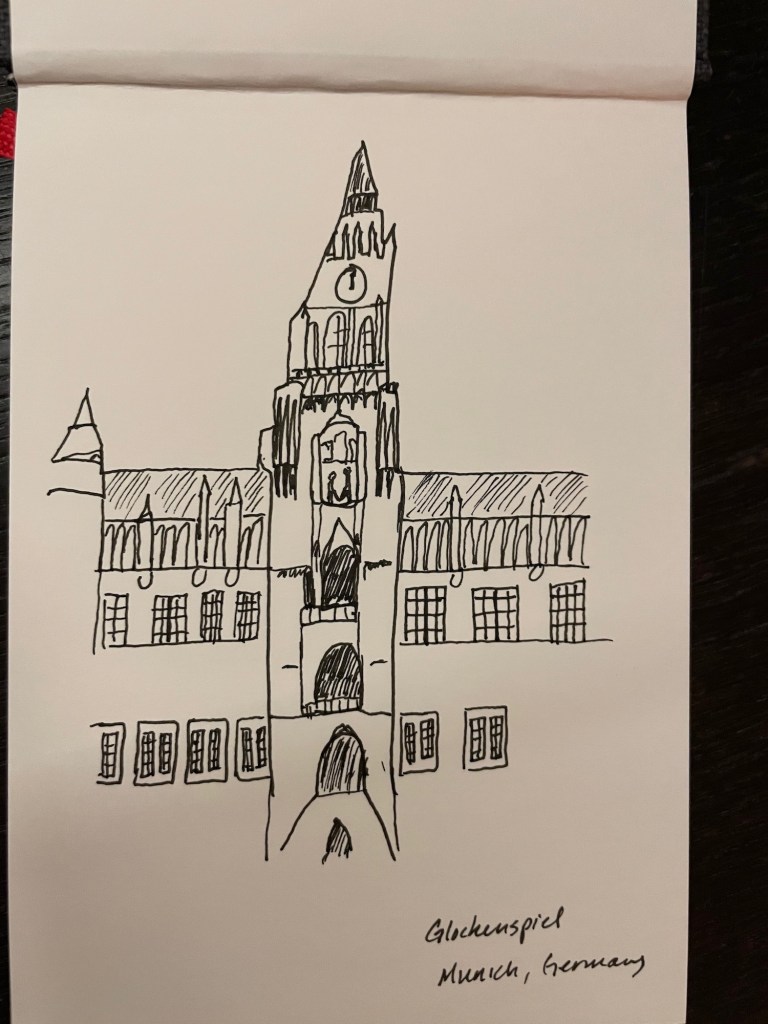
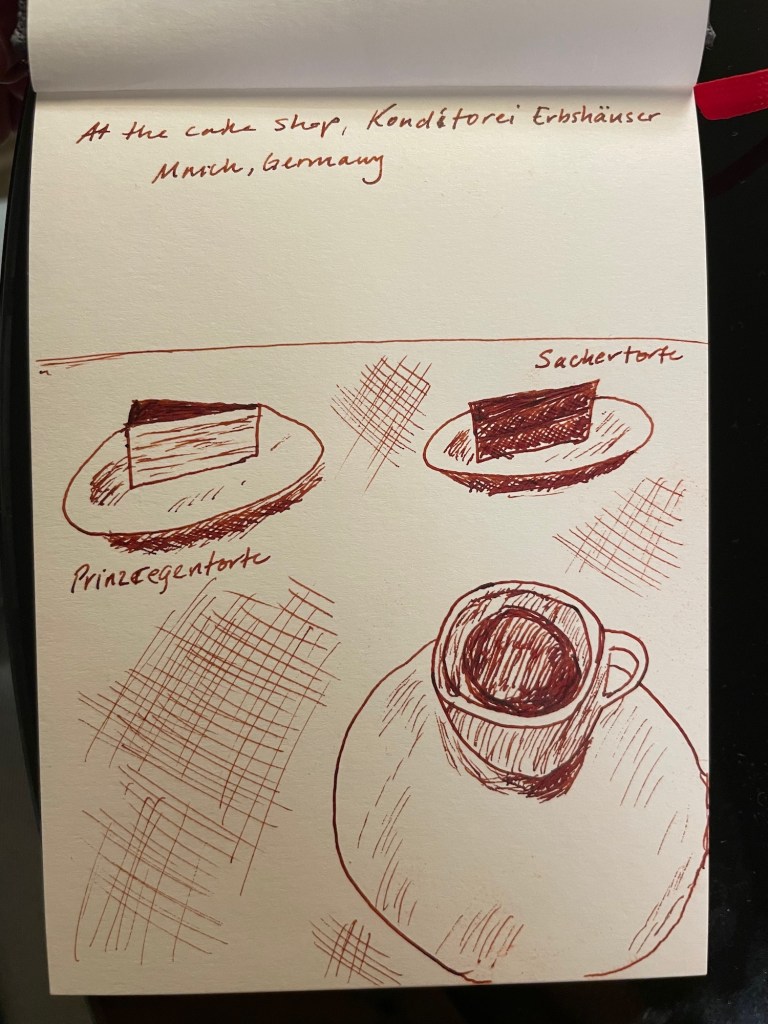
As soon as I got back to my hotel room, I sat down and drew. I drew the Glockenspiel. The next day, I drew my coffee cup and cakes from the cake shop. The third day I drew a Munich surfer, the fourth a swan on the lake I walked every morning, the fifth a leaf with raindrops on it. On the 10 hour flight home, I picked up doodling, and I spent hours just drawing lines and shapes. The plane was frigid as we flew over the Atlantic, so I plugged in the headphones and turned on the crackling fireplace relaxation video they had on the in-flight entertainment. I’d read for a little while, then pull out my sketchpad and doodle to the snap and pop of a video fire, then read some more.
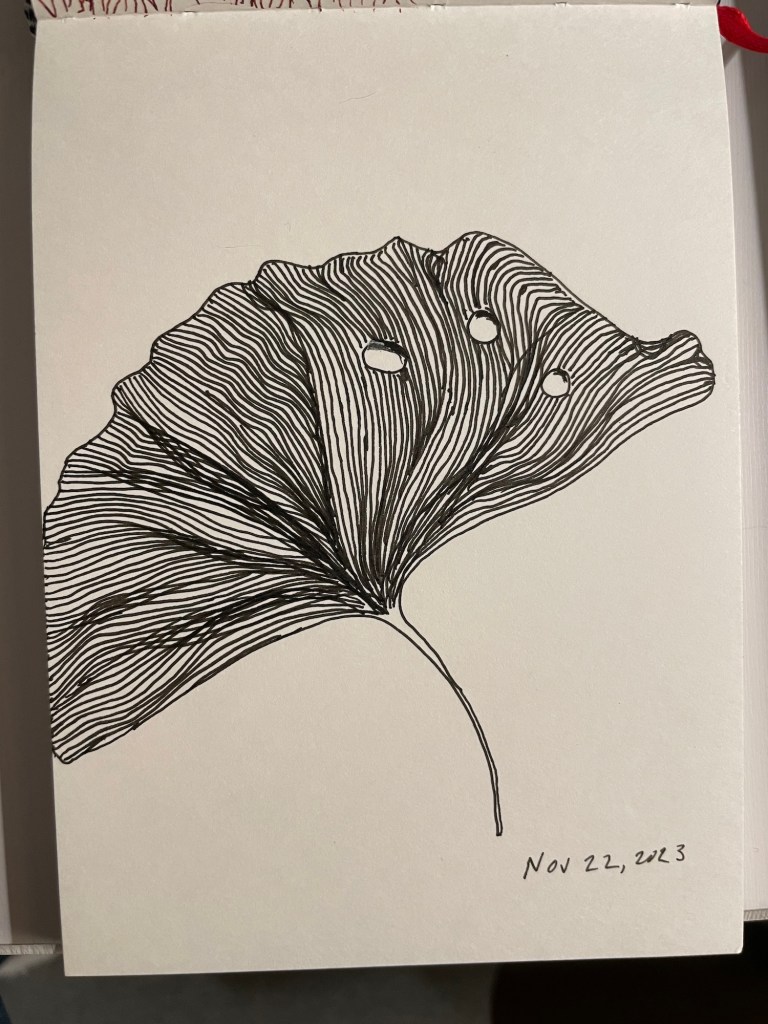
Since I’ve been home, I’ve drawn every day as well: a ginkgo leaf I saw by our son’s car, the apple pie from Thanksgiving. With each drawing I do, I find a technique I want to learn. I want to learn how to do textures, I want to learn how to shade. Sometimes I find myself wishing my drawings were better, and I have to remind myself that perfection is not the point. Aiming for perfection makes it feel more like work than play, and it’s no fun anymore. But when I draw just because I like the feeling of the pen on the paper, and when I try to improve one little thing at a time — like texture, like shading — I feel invigorated, and I love it.
Some drawings. The coffee & cake drawing and the tangerine were done with my LAMY Safari fountain pen
P.S. I did see a LAMY fountain pen display in the Munich airport!Fountain pens in the airport, home of Leuchtturm paper… Germany is my kind of place.
P.P.S. I approach my blog posts these days like I approach drawing: they’re messy, and don’t necessarily make sense, and they’re far from perfect. When I aim for something clean and tidy and meaningful, something “well-written”, I end up not blogging. And I’d rather blog than not, so here we are.
After the holidays, when the fun part of winter has ended but there are still at least three months of bare trees, no flowers, and cold that keeps us indoors, I start getting antsy about the garden. I stand at the windows and stare out, plotting, planning, making mental lists of seeds and plants to buy, wondering, “should I kill more grass for another flower bed?”
Usually I make lots of notes in pencil in a composition book, in words, never easy to find again when it’s time to actually do something in the garden. Those notes are always planning for a future rather than enjoying the present moment, which, like it or not, I must live through to get to the spring and summer where green will sprout from the ground, flowers will bloom, butterflies will flit and flutter, and I can sit on the back deck in short sleeves and bare feet to soak it all in.
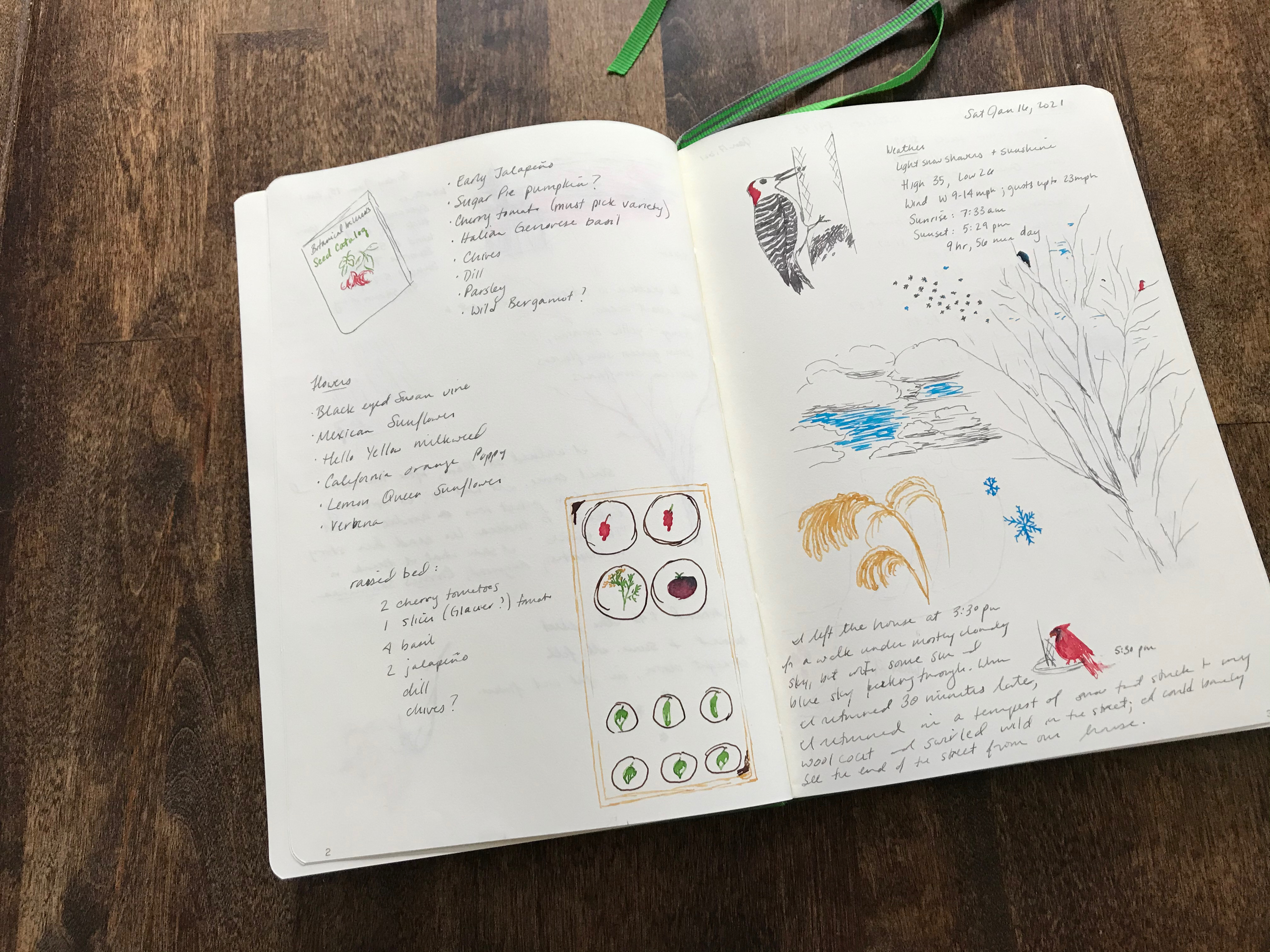
This year I wanted to try something different. Every January, I have to consult old calendars to see when I did what for the garden: when did I start seeds indoors? When did I order mulch? When did the forsythia bloom? This year, I want to create a visual journal of these winter months. I want to be able to flip through it and see what was going on and when. I also want to acknowledge the beauty of winter so that I can better bear these dormant, cold months.
And, let’s be honest, I wanted another excuse to use my fountain pens. I’ve filled multiple lined journals with inked words. What if I use all these colors to make pictures, too?
When I organized my ink samples on Friday, I changed the inks in almost all of my fountain pens. I loaded pens with the colors I see outside in January — Honey Bee (golden), Walnut (brown), Moon Dust (gray), Cardinal Kestrel (red), and Coral (ok, I don’t see this one as much, except at sunrise). I switched out the turquoise blue in one pen for more of a sky blue.
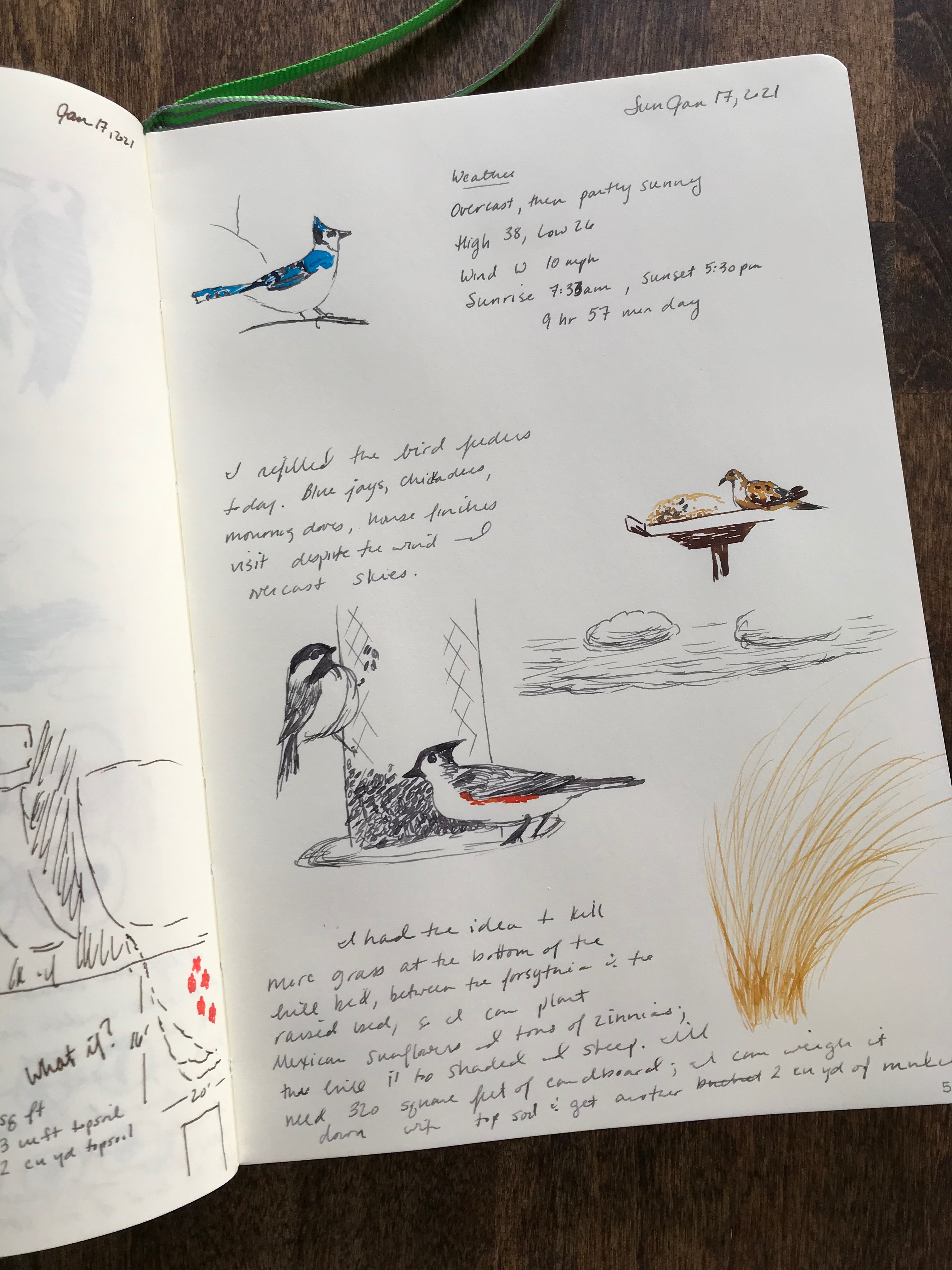
Then, I took inspiration from my friends who draw, and I drew little pictures. I drew birds at the feeder, a bloodtwig dogwood I saw on a walk, the dry golden grasses that are still beautiful, even in winter.
The very first picture I drew, of the salmon sky at sunrise on Friday, is pretty terrible. Drawing is hard! You really have to look (and translate what you see through your body and into a correctly-proportioned rendering on the page). As I attempt to draw, I realize that when writing, it’s easy to leave gaps. I can write “cardinal” and that will conjure a mental image of a red bird, with a few distinguishing characteristics filled in, depending on how familiar the reader (or writer) is with cardinals. But when I’m trying to draw a cardinal — what color is its beak? And what shape? And how long? What’s the shape of its head? Its body? What color are its legs? You can’t really continue with your drawing without knowing those things. You can’t leave an empty space where a beak would be.
Those details force me to pay attention in a way I haven’t in the past. Drawing demands me to see more fully. I like that. Plus, paying attention really does make me appreciate the beauty of winter, even if I’d much rather the world outside to be green and warm.












 Butterfly Mind