I’m going on vacation today, and one of the things I’m most excited about is that I’ll have free time over the next few days to write, and to play with my blog(s). Before heading out of town, I opened my laptop to add my other sites to the menu here on Butterfly Mind, and as I added them, I realized I have five blogs. Five.
If you’re interested in sailing, gardening, words, or American literature, I’ve got blogs for you! While Butterfly Mind is the place where I share whatever thoughts alight on my screen or notebook pages, these other blogs chronicle journeys on the water, on the land, and in books:
Andrea Sails: these are the logs of our adventures on the water. The entries help me keep track of what I’m learning as I venture into this new-to-me world of wind- and human-powered boating.
Andrea’s Gardening Blog: this site is often the result of me blogging with dirt on my hands, from my phone, in the garden, right after I’ve put plants in the ground. I love having a searchable record as each month comes around where I can take a look to see what the garden was doing this time last year: what was blooming? How has everything grown since then? When did I sow those seeds?
Andrea’s Lexicon: these are words I collect that I think are cool. Sometimes I hear them in conversation, sometimes I find them in books. Most of them appeal to me because they’re fun to say. Haberdasher! See what I mean?
Andrea Reads America: this is the chronicle of my journey through the US in literature in three books per state. The three books must be set in the state and be written by an author who is from the state or who has lived in the state. For each state I am reading men, women, and non-Caucasian authors. I’m going in alphabetical order. I’m reading Michigan now, though I still need to write up my Massachusetts reads.
Alright, time for me to hit the road. I’m going to have a hard time deciding which one(s) of these to write for while I’m gone.
It’s that time of year again, when I get to sit under the dogwood tree and soak up the garden. I am amazed by how much is already happening out here from perennials we planted last year. They are thriving after having a year to get established, and many things are flowering that didn’t flower last year: all of the thymes — creeping, lemon, and regular old — , the rosemary, and the lavender is about to burst into bloom. Blueberries have formed, and the rue is already bushy, covered in yellow flowers, and crawling with caterpillars. It’s not even June.
Caterpillar on rue
Lavender buds
Blueberries forming
A breeze blows on the back of my neck and rustles the dogwood leaves above me. The morning sun is hot on my arm. I need to apply sunscreen. I’m on butterfly and bird watch.
It may be too windy for butterflies, or may be too early in the year, but we’ve got treats for them when their ready. I never appreciated the advantages of perennials, that they come back each year without me having to do anything. In Florida, we didn’t have winter to kill everything back. In Florida, gardening was a year round endeavor. I’m not sure perennial had meaning there.
I never knew how glorious they could be — a one time investment of work for a lifetime of beauty! The yarrow and indigo Salvia are already bonkers with blooms. The Echinacea and blanket flower have plump buds, the cat mint and Russian sage and Guara and columbine wave pink and purple flowers in the breeze.
Yarrow and bird bath
Blanket flower buds
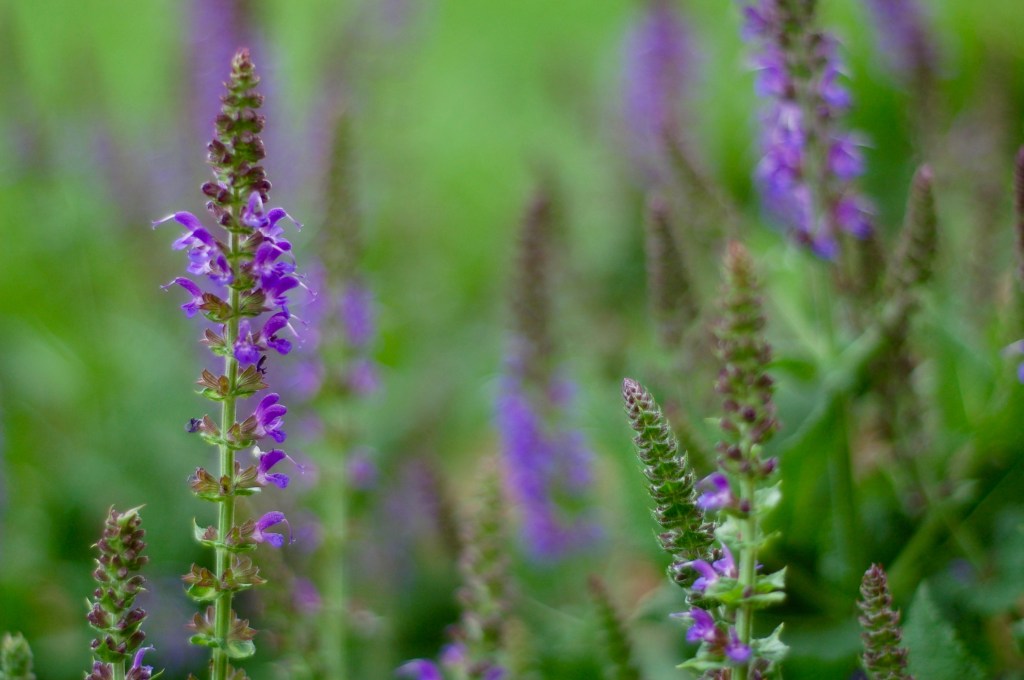
Bee and indigo salvia
Guara
Echinacea
Columbine
I decided to put even more perennials in since they come back so full and vibrant each year — and because I can divide them and get free plants out of them — but I’ve also reserved a swath in front of my dogwood roost for annuals. I like to be able to try something new each year, and this year I went with yellows, reds, and oranges, with some white to break it all up. All butterfly flowers of course: scarlet sage, orange Cuphea, white Pentas, yellow, orange and pink zinnias, yellow Lantana.
The zinnias I planted from seed, and spent some time yesterday moving around to space the seedlings out. They’re doing well, but I am impatient for them to grow and bloom. That’s what money buys you in the gardening world: time. The more you spend, the less time you have to wait. I spent about $1.50 on a seed packet, and six weeks later I have about 50 zinnia seedlings 2-3 inches tall. I don’t know how much longer I’ll need to wait for them to blossom, but at blooming time I can guarantee I wouldn’t be able to buy even one flowering zinnia for $1.50.
I’m eager for the Lantana to fill out and cover the ground in front of the bird bath our daughter made me for Mother’s Day. I’ve put stones in it so butterflies can use it, too, and have a place to rest while they sip. So far I haven’t seen any birds or butterflies bathing or drinking, but I keep the water fresh anyway.
Bird bath, yarrow, and zinnia patch
Despite my impatience for things to grow and bloom, I think this is my favorite time of year in Appalachia: the time when I can sit in the garden and steep in the growth that’s happening all around. It still boggles my mind that a kernel as tiny as a sesame seed can become a knee-, or waist-, or chest-high organism with broad green leaves, bright flower petals, pistils and stamens and complex mechanisms for fertilization, and a renewable food source for other organisms. Life is miraculous to me. A kernal to a bush, an acorn to a tree.
Our yard is not a wilderness. A manicured garden is not the first thing that comes to mind when I think “nature.” But our garden is alive. And our intention with it is to attract more life. I want bees and butterflies, wasps and worms, spiders and sparrows, monarchs and moths. I can’t get enough of watching the world around me interact, of soaking it all in and wondering at the marvel of our existence.
This is my entry for the Daily Post prompt, Infuse.
It just wouldn’t be April without a photo essay of the status of the garden. Here’s where everything stands right now, after last week’s drenching rains: herb blossoms, shrubs in bloom, and perennials building up their flowers.
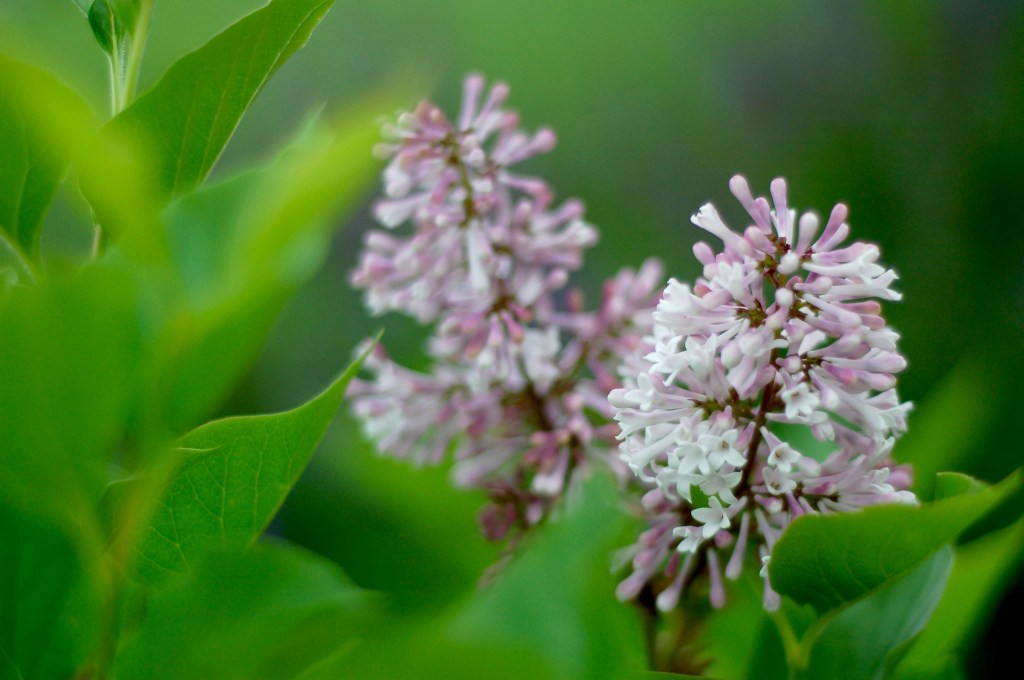
Creeping thymeDwarf lilacIndigo salviaYarrowSedumSome kind of asterEchinacea budThymeFlower box with petunias, alyssum, vinca, and marjoram
The drenching has finally subsided. For three days it rained. Maybe four. The kids’ school was cancelled Monday due to flooding. Yesterday our grass was shin high and thick. It looked too dense to push a mower through.
During the rains, I watched the garden from the window. So much green against the darkness! The knee-high yarrow is a silver mound that looks like it could pick up its skirt and walk away. The catnip domes to mid-thigh. The Echinacea is lush and dense with long, dark, blue-green leaves that don’t yet have age spots or brown edges from the blazing summer sun.
One evening I couldn’t stand it anymore. I yanked my raincoat off its hanger in the hall closet, pulled on my green rubber boots, opened my polka-dotted umbrella, and I walked the garden in the rain. Drops pattered on the taut nylon of my umbrella, and my boots squished in soft, wet earth.
It had been 10 days since we sowed our wildflower seeds, and I wanted to find sprouts. And boy did I ever find sprouts. In the area we scattered zinnia seeds, several pairs of cotyledons had emerged. In the wildflower bed, dozens of tiny stems pushed up through the mulch. Beneath the ground their seeds have split open, sending a shoot towards the light and roots into the earth. Germination. “The process of something coming into existence.” What a beautiful word.
The seedlings are fragile at this stage, as they anchor themselves, brand new and vulnerable in the big, new world. They will need to grow leaves to gather sunshine and make food; they will need to spread roots to gather water and make a foundation. And they will need space for both: above ground to collect light, and below ground to absorb their drink.
This means I need to weed.
I’ve not yet figured out how to do that, especially since I’m not sure which of the seedlings are the weeds and which ones are the wanted. I can dig out the established weeds, though: the grass that’s creeping into the flower beds, the dandelions and spiny thistles that will never die. Up on the hill there are other weeds I’ve not dealt with before, broad-leaved and fast-growing: wild rhubarb and others I haven’t identified. Like the dandelions, these hillside weeds will be my nemesis throughout the growing season. I will have to be relentless with the spade, digging them out at their roots, refusing to let them take hold and dominate the hill and its new inhabitants.
The fog was thick this morning, and the grass and garden shone neon green as the sun rose and finally cast light on the quenched earth. On Friday I have a flex day. It will be warm and sunny, and I can’t wait to get out there and make space for our seedlings. To give them the chance to put down some roots.
This is my response to The Daily Post’s one-word prompt, roots.
I’m in the garage, sitting in a camp chair, two wooden boats and a husband behind me, spring rain falling on the garden in front of me. I’ve worked outside for three sunny days, and now that I’m finished and the rain has come, I can’t stand to go inside.
Raindrops on hosta
Rain drips on the weeded mint bed under the stairs. Music plays behind me in the garage, and my husband raps his knuckle on the sailboat in time with the beat. His real work — the work that makes him rich — is with his hands, like mine is with writing and gardening. He’s tinkering with the boat trailer, sanding the sailboat, hammering into the plywood on the wall to hang another tool. I hear the hammer thunk on his wooden work bench when he lays it down; a wrench clangs on the concrete floor.
Droplets cling to the handles of the wheelbarrow, and I am enjoying my rest. I’ve spread mulch on all the beds, I’ve weeded, scattered seeds, watered, planted goldenrod and roses and columbine, transplanted bee balm and bottle brush, pruned forsythia, cleaned leaf litter out of the herbs, filled a vase with mint. My hands feel arthritic, but the garden is beautiful. The redbud blooms magenta, the rosemary has dainty lavender blossoms, our daughter’s columbine is crowned with purple and white flowers, and the roses pop a hot pink. Our neighbor’s dogwood flowers spread open in a spring green, the sky is storm grey, and thunder rumbles over the mountains.
When I was weeding, I got a good look at the ground level of the beds, and among the weeds I found an Echinacea volunteer, and I think the Joe Pye weed might be coming up as well. The wildflower seeds I planted by the mailbox ten days ago are starting to sprout as well. From this point on, I will be able to go out every morning and inspect the garden: what’s sprouting? What’s flowering? How are the seeds we planted? How are the transplants doing?
Joe Pye emerging?
Seedlings by mailbox
Echinacea volunteer
Raindrops on hosta
Mulch pile after all the beds are done
Seeds watered in in front bed
Dogwood flowers
Milkweed coming back
Blueberry flowers
Bottlebrush transplanted to the hill
The sun is out now. It is warm on my bare toes. Rain drops glisten on the bright green grass, and the porch rail is a brilliant white against the stormy sky.
I ache in every muscle of my body. Even the joints of my fingers are sore. It’s that good kind of soreness, though, the kind that reminds me I did manual labor yesterday. I must have trudged up and down that hill sixty times between mowing, pruning, going back and forth for tools and iced water, going up and down for food and to consult my gardening books, turning the water off and on to water in seeds, and finally, wheeling barrow after barrow of mulch.
I also broke the hoe. Hoeing is hard work. Too hard for the hoe, apparently. I feel pretty good about my body outlasting a metal and wood tool, but my back feels it today.
The hill is very steep. It is too steep to push a wheelbarrow or lawnmower directly up the face. I pushed the wheelbarrow in switchbacks to get each load of mulch to the patch I was covering.
But it is done! The hardest part of my vacation gardening ambitions is now complete. As I suspected I would, I did go to the nursery.
“Just to look,” I told myself.
“We’re not going to buy anything,” I said to my daughter when I asked if she wanted to go with me.
And as I suspected I would, I bought something. A goldenrod. I’ve been wanting one for two years! How could I pass it up? We’ve never had one because we’ve never had a meadow garden, and it would look silly in the flower beds we do have. But I’ve always really really wanted one.
“We need something to anchor the hill while we wait for the seeds to sprout.” That’s how I justified it to myself.
“It’s good for butterflies and birds,” I told our daughter. That’s how I justified it to her.
So I bought a goldenrod that was bursting out of its pot. When I shook the plastic container off, there was hardly any soil: it was nothing but a tangled mass of roots. “I think I can make four plantings out of this one purchase,” I said to myself. I couldn’t pull anything apart to divide the mass, so I cut through the pot-shaped root ball instead. I hope the plants survive. I really don’t know what I’m doing in the garden. I’m shocked anything lives under my care. Goldenrod is supposed to be pretty hardy, though, so I’ve got my fingers crossed it’ll be okay.
I transplanted some bee balm from out front, and then I called our daughter up to plant the seeds. I spread cleome (spider plant) seeds next to the fence since those plants can get to be 5 feet tall. Then our daughter scattered milkweed, dill, liatris (blazing star), zinnia, and the wildflower mix. All of these should be good for butterflies and hummingbirds.
After I cursed the hill with every single wheelbarrow full of mulch, and swore under my breath every time I slipped or almost fell down the hill trying spread the mulch, I finally watered it all in at about 6:00pm. I inspected my fingernails as I watered. They were shredded and filled with dirt.
After my shower, I stood on the porch and observed my work: a big empty patch of yard that is now a different shade of brown than it was before, rough at the edges because I was too tired to cart one more load of mulch up the hill. It does look better, I suppose. I just hope those seeds sprout.