In January, I set a timer for 10 minutes and drew what I wanted to do more of and less of in 2024. It was easy to fill out the More column. I’ve always got more I want to do and learn and experience: draw, paint, listen to music, walk, hike, start a travel journal. The Less column was trickier. But one thing I drew in that column was my hand holding my phone and scrolling Instagram.
Recently, while scrolling Instagram, I saw one of those silly little list memes: 20 tiny habits to change your life (or something like that). The list included things like make your bed, step outside at daybreak, and at the end of one day, write a 3-3-3 for the next day: one big goal you’ll spend 3 hours on, 3 small tasks, and 3 maintenance items.
The list had a bunch of fun and inspiring things on it, along with everyday things like drink water before a meal. One habit-to-build that jumped out to me was this: before I pick up my phone to scroll something, read a passage from philosophy or a religious text. I liked the sound of this a lot. At first I thought, I’m sure poetry or any other type of reading could be substituted here, but I’ve never read philosophy, and I am interested in the teachings of different religions, so I’d learn something new if I followed the idea as written.
I don’t really know where to start with either of those things, philosophy or religious texts (that I’d be interested in — Buddhism comes to mind), but I wanted to try this switch, from scrolling to reading a passage, so I looked to our shelves and found a couple of books I can revisit for now: The Prophet by Kahlil Gibran, and the Tao Te Ching. I’ve also got a couple of poetry books — Mary Oliver’s A Thousand Mornings, and Basho’s On Love and Barley.
I’ve started working on this new habit this week with The Prophet, which I haven’t looked at in probably 20 years. When I remember, as I reach for my phone, I pick up The Prophet instead. Everything about the experience is lovely. I feel a peace and beauty when I read it that’s soothing. I remember this same peaceful feeling from the other books on my shelf as well.
Our bookshelves are pretty bare, though, since I read mostly fiction and mostly on an e-reader. Once I’m through with these four books, I’ll need to find others.
I’ve been feeling the itch to blog, but as usual, haven’t because of the perennial “what will I write about?” problem. I checked my blog’s dashboard today to see what the built-in writing prompt was, because maybe that would spark something, and lo, here I am.
The writing prompt asks, Is your life today what you pictured a year ago? I have no clue what I pictured a year ago for my life. I looked back at my blog, which is turning out to be a really useful supplement to my actual memory. Our daughter wanted tiramisú for her birthday again this year, and I could not remember what recipe I used that she liked so much last year. I vaguely remembered that I might have blogged about it, and sure enough, here it is.
So anyway, I looked back at my blog for this time last year, and discovered that as of December 14 last year, I had blogged for 30 days straight. Thirty days! How on earth did I do that? How did I find something to write about 30 days in a row? The 14th was the last of the 30 days; I picked back up again on December 20 and wrote about a crackling fire, and then the solstice on the 21st. I didn’t write about my future self, except that in my solstice post I jotted down our menu because I liked it and wanted to document it for future years. But if I know myself, I probably pictured myself being cozy at home for the holidays. I probably hoped for myself that I’d be writing and blogging, that we’d be warm and safe with a twinkling Christmas tree and crackling fire, that our kids would be home and happy, that we’d be satisfied in our jobs and lives.
When I think of where I expect to be a year from now, that’s what I picture. Only a year from now, we will have done a bunch more stuff in between. Our daughter will have graduated from high school, and we will have taken her on her graduation trip, possibly to Costa Rica. This time next year, I hope she’s having the college experience of her dreams, and that she loves college as much as our son does. I hope our son will still love his college experience and roommates and friends, and that he will have a chance to get the summer work he’s aiming for. He may have even had a chance to study abroad. I hope my husband and I will have gotten to travel again and take fun trips, like our trips to NYC and Pittsburg this year. I picture myself still employed and finding meaning in my job, and I picture myself still writing, drawing, photographing, and appreciating birds and leaves and books and food.
This time last December, I hadn’t explicitly thought about what my life would look like in a year, so it’s hard to say whether I’m there. While my general life stuff is likely where I pictured — we are cozy, the kids are home and happy, we have a twinkling Christmas tree and crackling fires most nights — I probably hoped for myself that I’d still be blogging regularly. In that sense, I’m not where I thought I’d be. I don’t know why blogging is important to me and why I always want to be doing it. I do enjoy using my blog as a sort of searchable reference book for my life, and that only works if I actually publish, so maybe that’s part of it. It helps me remember what I was thinking about and cared about at different times.
But I don’t think that’s the reason I care about blogging. I joked once that I do it for the likes and comments, which is definitely true (thank you to everyone who reads here ♥️), but I don’t think it’s just that either. There’s something about moving from a private journal, which I’ll never go back and read, to publishing on my own little public corner of the web, where I take a little more care with my writing, where I reference posts, where I have a community that’s not limited by geography. Blogging is both expression and validation. I can express myself in a journal, so maybe it really does come down to validation. Or maybe being able to share stuff that others resonate with? That feels really good too. Is that the same as validation? I don’t know, but I really like that part — the connecting. The being human together.
Whatever the reason, the fact is that I care about blogging. Even so, after all these years (this will be my 1046th post on this blog), it’s still hard to overcome the “is this worth sharing?” question. When I saw today’s prompt and realized I had no recollection what was on my mind a year ago, I was really glad for all the times I did post. Something is better than nothing.
I looked up the definition of inspire today. I wanted to know, if I were to answer the question, “Who inspires you?” that I knew precisely what question I was answering.
Before looking it up, I had two thoughts about what it means to feel inspired. The first is an onrush of awe and a sense of enormous potential. That kind of inspiration comes with a feeling of tapping into to the divine, and it fills me with gratitude and wonder.
I wasn’t sure if that’s actually inspiration, though, because it doesn’t necessarily come with any sort of change after it happens. For a question like, “Who inspires you?” I thought inspiration might not be what I was thinking at first — a feeling of awe and beauty and wonder — but instead that it should include an element of action. If someone inspires me, it seems like they should make me change my behavior.
It turns out that inspiration is both of those things:
in·spirev.1. To affect, guide, or arouse by divine influence. 2. To fill with enlivening or exalting emotion. 3.a. To stimulate to action; motivate. b. To affect or touch.
The American Heritage College Dictionary Third Edition
So, that’s not helpful! Except in the sense that it bought me some time because I’m really terrible at answering questions like “what’s your favorite” or “who inspires you.”
For the first type of inspiration, the one that fills with enlivening or exalting emotion, creators inspire me. Being moved by beauty or excellence is one of life’s greatest pleasures, and people who create are my heroes. When I experience an exquisite work of fiction, painting, cinema, drama, musical composition, songwriting, photography, writing, or comedy, I am filled with wonder. Artists inspire me. They help me see the glory of the human mind and how we fit in with each other and with the world.
For the second type of inspiration, the one that stimulates action and motivates, this one is as important as the first, but in a completely different way. People who spark change lead by example; they are role models simply by existing in the world and being who they are. They exhibit behaviors we can observe, be affected by, see the consequences of, and then emulate ourselves. I have dozens of role models who are close to me in my life who inspire me in this way. I will not name them here because the list would be too long, and each person inspires different parts of my behavior: humor, humility, candor, tact, communication.
But the people closest to me, the ones who live in my house with me, and who I’m lucky enough to have in my life on a daily basis, are the ones who inspire me most. My husband inspires kindness and generosity. Our kids inspire humor and honesty. All three of them motivate me to be a better person. And when I say inspire in this case, I mean that every day, I edit my behavior to act differently and better because of them.
Last week, after I published on my blog for the first time in a while, a colleague reached out at work to tell me they were glad to see me writing again. It was unexpected — I thought the notification in my Slack would be something work-related.
That simple message encouraged me to post again. It’s the reason I write this now. It probably took my colleague 45 seconds to write me a message, and it impacted me enough that I wrote two more blog posts, then this one.
I believe in positive reinforcement. I’m sure this is because I personally love praise. It’s embarrassing to admit that, but I’ve fought it my whole life and at this point, screw it. I’m 45. I just embrace it now that appreciation motivates me. If someone gives me positive reinforcement, that’s a data point. It’s an indicator that I’m doing something right or well, and so I make a mental note “Keep doing this thing, it is good.” And I will feel joy and pleasure in the doing of it.
To be clear, I’m not talking about a trophy for everyone. I think most people, children and adults alike, can see through empty or superficial praise. Praise for praise’s sake, to avoid conflict or reduce awkwardness, is not meaningful and is arguably harmful in the long run. Empty praise is not the same as genuine appreciation, and empty praise does not have the same effect for me as a spontaneous blurt of “hey, I like what you did there.”
So this is just a note to say that encouragement makes a difference. A small note of thanks or appreciation goes a long way. Don’t be afraid to tell someone if they did something you liked. You might make their day. Maybe they’ll even be inspired to keep doing that thing.
“When Jem an’ I fuss Atticus doesn’t ever just listen to Jem’s side of it, he hears mine, too.” – Scout, from Harper Lee’s To Kill A Mockingbird
My most recent reading of To Kill a Mockingbird was my first reading as a parent – at least as a parent with children old enough to talk – and Atticus Finch is my new hero.
Atticus, father to Jem and Scout, the children from whose perspective To Kill a Mockingbird is told, is one of the fairest men I’ve come across in literature. He has always been a hero: for defending Tom Robinson, a black man accused of raping a white woman in 1940s Alabama; for his calm in facing a mob of his own friends and neighbors; for his reluctance to claim the title “One-Shot Finch” dispite his marksmanship skills, and for subsequently laying down his weapon because “he realized God had given him an unfair advantage over most living things.”
He has always been a hero for these reasons, but now that I’m a parent who struggles with equipping our children to navigate their world, with knowing what to talk to them about and when, with gentling them into the inconsistencies in human nature, with teaching them to treat people with respect and fairness, and most importantly, with how to model right behavior to them, Atticus Finch is my hero all over again.
Atticus respects his children as individuals and as equals. This is not something we normally do as parents. We often put ourselves above our children, trying to make them mind, to do our bidding because “we know best.” Atticus, though. Atticus knows that sometimes the children know best.
“So it took an eight-year-old child to bring ’em to their senses, didn’t it?… Hmp, maybe we need a police force of children.”
Throughout To Kill a Mockingbird, Atticus respects his kids by talking straight with them. He answers their every question without flinching. When his eight year old daughter, Scout, asked “What’s rape?” Atticus “sighed, and said rape was carnal knowledge of a female by force and without consent.” He did not dodge. He did not shroud the topic in mystery and discomfort. He defined rape for her, and if she’d had any follow up questions he would have answered those, too.
He reacted with similar equanimity when Scout started swearing. When at the dinner table Scout said, “Pass the damn ham, please” to her uncle, Atticus told him, “Don’t pay any attention to her, Jack. She’s trying you out. Cal says she’s been cussing fluently for a week, now.”
But the thing I love most about Atticus as a parent is that he not only respects his children and their right to be themselves – he allows Scout to read the newspaper even though her teacher prescribes against it, he permits his kids to hear the verdict in Tom Robinson’s case despite his sister’s wailing protests, he allows them the freedom to be children rather than forcing them to respect their “gentle breeding” by making them “behave like the little lady and gentleman” they are – no, not only does Atticus respect their right to be themselves, but he encourages their exploration and independence because he recognizes the preciousness of children, and what a great gift they are in teaching us, as grownups, how to be humane. When Jem struggles to understand the injustice served to Tom Robinson by his own friends and neighbors, people he thought were good folk, he says to Atticus,
“How could they do it, how could they?”
“I don’t know, but they did it. They’ve done it before and they did it tonight and they’ll do it again and when they do it – seems that only children weep.”
Now, after reading To Kill a Mockingbird as a parent, I have been humbled by yet another layer of its wisdom. Now, when I am struggling as a mom, when I’m not sure what answer to give, or which battles to fight, I will ask myself, What Would Atticus Do? And then I’ll know what’s right.
I am reading America: 3 books from each state in the US with the following authorships represented – women, men, and non-Caucasian writers. To follow along, please visit me at andreareadsamerica.com.
I apologize for writing about writing again, but I’m having a moment. A moment of feeling crushed by Friday folders filled with requests – money for the art fundraiser, canned goods for the food drive, volunteer hours for the PTO, donations for the fall festival – and workload stresses for my professor husband, and soccer and swim tournaments, and party planning and gift triage (wish-list management, shopping, ordering, returning) for both kids’ upcoming birthdays smack in the middle of holiday season, and endless requests of “Mom, can I have a pear? Mom can I have a bandaid? Mom will you take me to Target? Mom, can you cut this tag? Mom, what’s for snack? For lunch? For dinner? Mom, can I have a piece of Halloween candy?” all piled on top of all the normal everyday demands of laundry and groceries and cooking and cleaning and ironing and play-date scheduling and initialing homework and driving to sports, and everyone wanting and needing and requesting, including me wanting for myself – I want to write – and I’ve got nothing left to give. To anyone. Anymore.
In the face of this, I’m having a moment. A moment of I can’t do it all. I can’t write and do everything else. I can’t fulfill my role of supporter with any kind of grace while also dedicating fully to my “writing career.” As I develop my skill set and hone my craft, I want to go deeper, but as CEO of the household, I have to pull back. And if I can’t go in all the way, I figure why go in at all.
I was thinking this way, thinking of giving up, thinking “I’m silly for even considering myself a writer, of saying I’m working towards a ‘writing career’ – it’s not a career if nobody’s paying me!” when I heard Angela Duckworth speak in a recent episode of the TED Radio Hour. The episode’s title? Success.
In her talk, Duckworth, who is a recent MacArthur Genius grant recipient, explained that IQ wasn’t a predictor for success in her seventh grade math students. This was curious to her. If IQ couldn’t be used to predict academic success, what could? She began studying other groups – military cadets, rookie teachers, salespeople – asking in every instance, “who is successful here and why?” Over and over again, she discovered “one characteristic emerged as a significant predictor of success and it wasn’t social intelligence, it wasn’t good looks, physical health, and it wasn’t IQ.”
Grit is the disposition to pursue very long-term goals with passion and perseverance. And I want to emphasize the stamina quality of grit. Grit is sticking with things over the long-term and then working very hard at it.
My husband and I have talked about this before, that it seems that talent and aptitude do not guarantee success. Though I feel he has both in spades, when everyone in our families made a big deal about his PhD, he downplayed his talents, claiming the degree was not an indicator of intellect. It merely indicated that he had endured. He had a career goal, and the PhD was required to achieve that goal, and so he just kept going until it was done. He didn’t give up, even when it was really, really hard.
The same was true for me with distance bike rides and triathlons. I’m no athlete. Phys Ed class brought down my GPA in high school. But as a young adult, when I committed to the AIDS Ride, to raising $2000 and riding my bicycle from North Carolina to Washington DC, I didn’t give up. I didn’t complete the 330 miles at the front of the pack, but athlete or not, I started, and I didn’t quit, and so I finished.
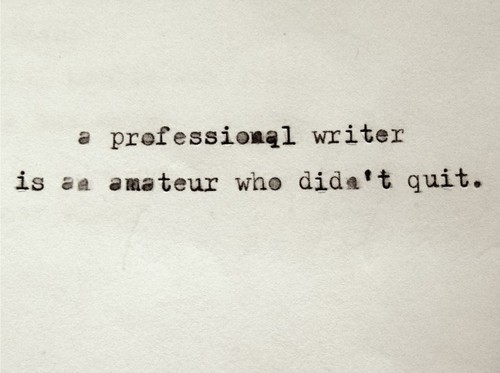
And when you start something, and you don’t quit? You finish. You succeed.
I have the same passion for writing as I did for those athletic events, only I don’t have as much time to dedicate as I’d like. I’m chomping at the bit. I want to take it to the next level. I want to write and write and write, I want to spend 3 or 4 hours a day writing, I want to pursue ideas that require concentration and focus, I want to run with it. But I also want to be Mom, and I can’t do them both and do them both well, and that makes it really, really hard. It makes me want to say I can’t run with this, what’s the use, this isn’t working, I am Mom, not writer, I quit.
Grit is living life like it’s a marathon, not a sprint. – Angela Duckworth
I’ve completed an Olympic distance triathlon. I’ve birthed two babies without painkillers. I’ve been a stay at home mom for ten years and have not thrown a child or myself out a window. I can do slow and steady. I can endure.
When host Guy Raz asked about how we might build perseverance, Duckworth replied, “believing that change is possible inclined kids to be grittier.” By knowing that change is possible we can believe that persistence will pay, we can acquire grit, we will recognize that even when failure seems eminent, we can succeed on the other side because failure is not a permanent condition.
I know change is possible. I know that every situation is temporary, including these Mom years, when our kids are young, and they need me. My perceived failure as a writer is not a permanent condition. The moment I’m having? The one I mentioned in the lead of this post? It will pass. In fact, in the time since I began drafting this piece on Saturday morning, and now, as I finish it up on Sunday evening, it already has. Change has already occurred. I no longer feel like quitting. And as for the sprinting? I don’t need to race. I want out of the gate, but I can keep warming up for a while first.
I can do slow and steady. I can endure. One day, maybe ten years from now, maybe fifteen, I will get to the point where I no longer feel the need to put quotes around my “writing career.” I’m gritty, damn it. I will succeed.
How gritty are you? Take Duckworth’s test here to find your grit score.



 Butterfly Mind