My recent read of Alone in the Classroom got me all excited about words again. Since I can’t seem to stop with the blogs, I created a new one: Andrea’s Lexicon. Each entry is short. A word and its meaning. Enjoy :-).
Tag: logophile
-
Don’t let anyone tell you words don’t have power. When my husband and I shopped for toilets recently, I could not stop giggling at the language used for selling what we all want most from a toilet: to hide the evidence. More than that, our trip to Home Depot showed me that having a gift with words doesn’t always mean writing novels. You can name paint chips. You can classify laminate flooring.
You can market toilets.
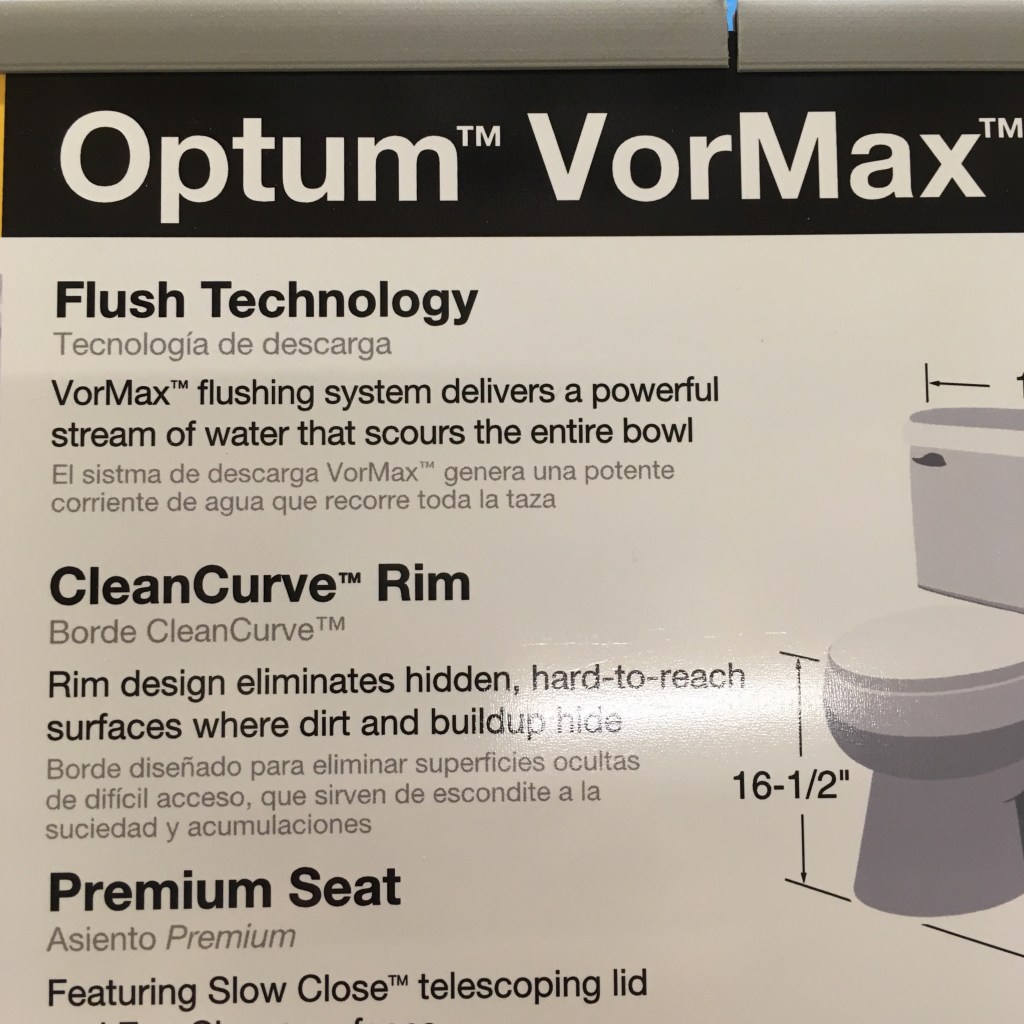
VorMax for maximum vortex flushing The Optum™ VorMax™ box needs to be read in a booming, between-plays hockey arena voice, with flashing disco lights.
VorMax™ flushing system delivers a POWERFUL stream of water that SCOURS the ENTIRE bowl.
That’s a potent sentence, even without the hockey voice. It conjures images of a high-velocity, unstoppable vortex of clean, clear water extracting everything in its path, like a movie whirlpool that’s so powerful it sucks ships to the bottom of the sea.
I puzzled a bit over the “dirt” word choice for the CleanCurve™ Rim, though. Do people usually have dirt in their toilet bowls? Perhaps that was just thrown in to draw attention away from the more graphic word in the sentence: “buildup.”

A whole bucket of golf balls? In a single flush? The marketing on this one makes me want to buy the toilet just to try to flush golf balls. It also made me laugh at the cleverness of conveying “ewww” invormation in such a sterile way. Look how white! Look how clean! Look at the sparkle in the “Fight stains with Everclean®” image! Even though it’s not golf balls you’ll be flushing, your toilet can look like this, too.
The next one is my very favorite, though.

AquaPiston: it’s a locomotive in there This toilet is going to work hard for you. You’re going to open up the tank and it’s going to be like a train locomotive, with pistons pumping, and water sucking, and the toilet bowl flushing with such force it might pull tissues out of the box and down into the vortex if you’re not careful.
I can’t remember which toilet we ultimately ended up buying, but I had a lot of fun shopping for it.
I sure would love to see all the jokes the marketing teams wrote when describing the glories of their toilets.
-
I shouldn’t be as proud as I am of this, especially since I’m usually competing against my 10- and 12-year old children, but I am the reigning Boggle champion in our household.
I ❤️ Boggle. I get into it.
Every time we sit down to play, I wonder, “Will this be the time I lose my title?” I had a fright today competing against my mom, and then my son also pulled ahead of me in round 3. Luckily it was just a scare though, and by round 5 I retained my crown.
I’m sure I’ll lose it now that I’ve written this. Our kids are going to pick up on my tricks sooner or later, and then they’ll crush me. And my husband always gives me a run for my money.
Maybe I’ll try my luck with outside players at our company’s annual meeting in September. The kids may up their game between now and then. I’ll need to pick up some new tactics.
For now, though, I’ll bask in the glory of a year-long undefeated streak.
-
My sailing education began Saturday night, on the boat, on the lake, as I asked my husband, “What’s that called? Why are you doing that? Where does this go? How do you know to do that?” And endless other questions.
As a word lover, I am giddy about the new terminology I get to learn in sailing. The language is colorful — and totally foreign to me. “If you can’t run the sheet off the clew, you probably need a boom.” (Ref.)
Wut?
For my sailing education, since most of my learning time right now has to be on land, I’ll begin with the words I learned on my first sail.
Our boat is a two-masted small sailboat with a mainsail forward and a smaller mizzenmast aft of the rudder post. This makes our boat a yawl. The presence of two masts distinguishes a yawl from a single-masted dinghy, and the position of the mizzenmast (smaller mast, behind the main mast) distinguishes the yawl from a two-masted ketch, where the mizzenmast is forward of the rudder post.
Yawl: a two-masted fore-and-aft-rigged sailboat with the mizzenmast stepped (mounted) far aft, behind the rudder post. The mizzen boom overhangs the stern.
Ketch: a two-masted sailboat with a mizzenmast stepped forward of the rudder; mizzenmast is smaller than the foremast.
Step (v. as in step the mast): mount in the boat
Mainmast: in a two-masted boat, the larger, forward mast.
Mainsail: the larger foresail rigged on the mainmast.
Mizzenmast: in a two-masted boat, the aft mast; smaller than the mainmast.
Mizzensail: the aft sail, smaller than the mainsail; rigged on the mizzenmast.
Boom: a pole along the bottom edge of a fore and aft rigged sail that improves the control of the angle and shape of the sail.
I also learned that the the hardware that holds the oars in position is called an oar lock, and I learned from a question from someone in the boat ramp parking lot that our boat has a sprit boom. I am unclear what this means.
Sprit boom (aka leg-o-mutton) — meaning still unknown to me. When I looked it up, I read sentences like this in sailing forums:
The sprit-boom is self-vanging, meaning that the geometry between the boom and the sail’s foot (which should generally be cut dead straight to prevent flapping) will keep the aft end of the boom from lifting. The result of aft boom lift is upper sail twist to leeward, spilling wind up there. The sprit-boom’s self-vanging nature will prevent this, keeping the entire sail working at all times all the way up and down it’s height.
Self-vanging? Sail’s foot? Cut dead strait? It wasn’t until the fourth reading of the paragraph above that I kind of, sort of understood what it was saying (something about the sprit-boom keeps the free end of the boom from lifting, resulting in spilled wind and loss of power, I think).
I have a whole new language to learn, and I am eager to learn it.
-
Image courtesy of HomeSpot HQ.
I lay in bed this morning looking at our bedroom’s freshly painted walls. I studied the color, trying to find accurate words to describe it in my mind.
Cream.
That’s not accurate. Cream — dairy cream in real life — is more white. This is closer to vanilla ice cream, but still darker. Richer. It’s the color of French vanilla ice cream. It’s a rich cream.
And then I realized that’s the name on the paint chip: Rich Cream.
I have great admiration for the vocabulary of whoever names paint colors. Think of the scope of words you’d need to know. Most colors are named for something concrete: an object, a noun. For example, my office color is Lime Mousse. Our son’s room, a terra cotta color, is Oxide. Like rust.
I often want to paint a room a certain color simply because I like the feeling the name evokes. Our original pick for our room was Kansas Grain, which I loved the thought of sleeping in. Warm, light, golden. But the color wasn’t right for the space. It was too peachy. Now we sleep in Rich Cream, a bowl of silky vanilla ice cream, which isn’t a bad evocation either.
I suppose that’s another element of naming colors, which makes me appreciate the skill even more: the names evoke pleasant feelings. Our daughter’s room is Jamaica Aqua; our front door is Florida Aqua. Two colors, two names, that take me to warm, islandy, happy places.
I’m not the best at home improvement projects. I scowl and snap when I paint or try to execute upgrades at home. But I do love browsing paint chips. Frosted Emerald; Waterfall; Roman column; Wood Violet.
I love the sensory experience of seeing all those colors and exploring temperatures, tastes, textures, and smells the names evoke. I’d be terrible at naming — too many options! so much specificity! — but I delight in the work that paint-namers do.
For the month of April, I will publish a 10-minute free write each day, initiated by a prompt from my prompt box. Minimal editing. No story. Just thoughts spilling onto the page. Trying to get back into the writing habit.
-
Brining turkey is all the rage these days. Funny I should pull this prompt right before Thanksgiving. I admit, there is a reason brined turkey is all the rage. Brined turkey is delicious. It is moist, it is perfectly seasoned.
Brine is one of my favorite words, and it’s not because of turkey. Brine is the salt water I grew up in. It is the salty rivers that seep into marshes on a rising tide, that nourishes the nurseries for marine life in those high grasses. Brine is the smell of ocean air when driving a coastal highway. It can be warm and enveloping, the scent of summer on Tybee, or cold and raw, the scent of winter in Maine, but it is always wet, and it is always salty.
Brine is a type of shrimp — a tiny shrimp. A shrimpy shrimp. When I think of brine shrimp, I think of those sea monkeys they used to sell in the back of Mad magazine or Archie comics. Were those brine shrimp? The pictures were always so enticing, with castles and underwater alien-like creatures that looked nothing like monkeys.
Salt seems to be a theme with me. I do love salt for salt’s sake, but I love brine for the word’s sake. For the vocabulary of it. Brine evokes multiple senses, and it connotes not only the scent and taste of salt, but the feel of humidity and liquid. The salty liquid of the sea, of marshes, of broth, of genesis.
For the month of November, I am participating in NaBloPoMo and plan to publish every day of the month. Usually, I will publish a 10-minute free write, initiated by a prompt from my prompt box. Minimal editing. No story. Just thoughts spilling onto the page. Follow along with the tag #NovemberDaily.
 Butterfly Mind