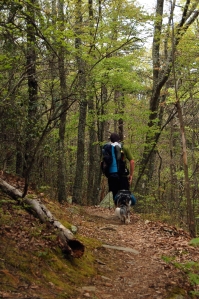
One of my favorite things about winter in the Appalachians is the juxtaposition of green against white.
Fern and snow on winter Cascades hike near Blacksburg, Virginia. andreabadgley.com
Rhododendron and snow on winter hike to Cascades near Blacksburg, VA. January 2014 on andreabadgley.com
Whether moss, lichen, rhododendron, or fern, there is something hopeful about green vegetation pushed up against a fresh white snow. It reminds me of the persistence of life, despite harsh conditions.
Icicles on winter hike to Cascades near Blacksburg, Virginia. January 2014 on andreabadgley.com
Moss, lichen, stone, snow on hike to Cascades near Blacksburg, VA. January 2014 on andreabadgley.com
Cascades trail sign in snow. January 2014
Ice sculpure in stream on Cascades hike near Blacksburg, VA January 2014
Icicles on winter hike to Cascades near Blacksburg, Virginia. January 2014 on andreabadgley.com
Icicles, snow, and stream on Cascades hike near Blacksburg, VA January 2014
I also love winter in Appalachia for the ice. The fluidity of water is frozen in still form, in crystal sculptures that capture movement, that suspend the liquid nature of water in a solid form that we can walk around and marvel over and contemplate for hours without it moving.
Icicles and snowy stream on hike to Cascades near Blacksburg, VA January 2014
Ice formation on hike to Cascades near Blacksburg, VA January 2014
Frozen Waterfall: The Cascades, January 26, 2014 near Blacksburg, Virginia
Finally, I love winter in the Appalachians for the steaming shower after a January hike. The steaming shower that turns your skin pink, and the fuzzy sweatpants you put on afterwards, and the hot dinner you sit down to, famished after hiking, with your family and friends.
Sunday was a beautiful day for a hike at the Cascades in Blacksburg, Virginia: high in the upper 30s after a fresh snow the night before. The kids packed snow balls along the way, threw them into the creek, and watched the slush drift downstream, taking it’s time to melt in the frigid water. We try to hike the Cascades during every season to witness its changes. For other photo essays from the Cascades waterfall, please see Waiting for Winter and Cascades of Green in Winter.
I stood behind my husband in Minnesota, rubbing his shoulders while he sat at our desk, focused on the screen in front of him. He was transferring all my files from our desktop to the laptop I was to take with me to Virginia.
I watched branches sway in the breeze, laden with the heavy weight of broad sumac lives, fingers of blue spruce needles, or delicate walnut leaflets. Our kids and their neighbor friends, the ones they spent eight hours a day with outside, popping in for a popsicle or an apple snack before dashing out again, tromped through the yards, all in a line, singing and pumping their arms like they were in a parade. They reminded me of the lost boys in Peter Pan.
I rubbed my husband’s neck and began, quietly, to cry.
The keyboard clickety-clacked while he loaded programs onto the dinosaur laptop, then stopped when he heard me sniff.
“Are you crying?” he asked.
“Yes.”
He reached up behind him and held my hands on his shoulders. “Because of the kids?” He watched them laugh and parade with the friends they would soon leave.
“Yes,” I said. “And because of the trees.” And the move. And the unknown.
“Why the trees?”
I pointed to the tallest tree on our lot – the one all the neighbors hated because it was tall and gangly and had been carved out in the middle of its crown to accommodate power lines.
“That’s a black walnut,” I said. “It is a host plant for the luna moth.” I wiped my eyes, thinking about yet another move. “I always wanted to have a walnut tree.”
The first time I saw a luna moth was nearly 20 years ago, before I married, before I had kids, when I was an ecology student in Athens, Georgia. It was night, and I had pulled into an empty bank parking lot to hit the ATM before going out for beers. I stepped out of my car, and as I slammed the door, something in the parking space next to me caught my eye. I looked down and there on the ground, two feet from my front driver’s side wheel, motionless with its wings spread flat, was a the largest moth I had ever seen. Luminescent green, it was more beautiful than butterflies. Had it crawled on my palm, its wings would have eclipsed my hand.
I forgot about the bank, forgot about the bar. I cared for nothing but this otherworldly creature on the pebbly black asphalt. The saucer-sized moth was the color of absinthe, and even with me standing over it, even after my feet crunched, and my ton of rubber and steel gravelled over pavement just inches from its body, it did not move. It lay there, basking in the light of a street lamp, as if in a trance. I had never seen anything like it. I stood there in that dingy parking lot, under the street light, in front of a brick bank, the most ordinary, paved over, non-natural setting, and experienced a sacred moment as I witnessed this gorgeous creature who had stopped time and space for me with its luminous glow.
Since that night, almost 20 years ago, I have hoped for the gift to see another. The only time I’ve seen one, besides in photographs on the internet or pinned in glass cases at a science museum, has been in a commercial for a sleep aid. Lunesta. I remember the first time I saw that ad, how offended I was that it had exploited such a special creature for the pedestrian purpose of peddling pills. It was like using God to sell toothpaste.
Ten years after that moth, when we bought a home in Florida, I wanted to cultivate a butterfly garden. I learned that you could attract local species by planting host plants for caterpillars (milkweed for monarchs, parsley for swallowtails, passionflower for frittilaries) and nectar flowers for butterflies (lantana, echinacea, goldenrod, plumbago). After successfully inviting multiple generations of monarchs and swallowtails, Gulf Frittilaries and zebra longwings, after watching the adults drink nectar, and their caterpillars munch leaves, and their chrysalises transform squishy larvae into winged butterflies between the slats of our wooden fence, I one day saw a tremendous, absinthe green caterpillar crawl across the our garden path. Its colossal size (larger than the largest swallowtail caterpillar I’d seen) and its luminous color (it seemed to glow even in daylight) immediately put me in mind of my magical moth, and I thrilled that it could possibly be a luna larva. I rushed in to fetch my camera and field guide, but when I reemerged and got down on my hands and knees in the mulch, trying to follow its trail, I could not find the caterpillar again.
Luna moth caterpillar: photo credit Dave Wagner, 2002
Having seen my only luna moth in the foothills of the Appalachians, it never occurred to me that I might find one in Florida. I researched Actias luna to find the luna’s host plants: persimmon, sweetgum, hickory, walnut. All large specimens. None in our postage stamp yard in Tampa. I searched the neighborhood for these trees but never found them, nor did I find another luna larva.
When my husband accepted a three year postdoctoral position in Minnesota, and it was time to move away from Florida, I made a wish board of what I wanted in our new northern home: 3 bedrooms, a big kitchen, good schools, a yard for the kids, and a host plant for the luna moth. I forgot the board during our rushed two-day house-hunting trip. All we were looking for was a place we could afford in the school district that offered half-day kindergarten. A place we could spend three years and be comfortable. We moved in November, and one month later had our first snow. We didn’t see leaves or earth until the following May.
In September, after ten months in Minnesota, our kids clomped through the mud room one Saturday with their fingers stained black. “What on earth?” I asked.
“There are these things all over the yard – I think they’re coconuts!” our son said.
I walked outside with our daughter and him to find a pile of lime-sized green globes they had collected. Some had tiny fingernail gouges in them, some were chewed by squirrel teeth until a black pulp showed, some were inexpertly shredded by child fingers, and some were broken open like to show fibrous husks like… coconuts.
“Huh,” I said. “I don’t know what those are.”
A few days later I was kneading dough in the kitchen and I heard a THUNK. I looked up at the ceiling where it sounded like something had landed on the roof. I kneaded the bread some more. THUNK. I wiped my hands, THUNK, and walked to the big plate glass window that looked out on the yard. I saw one of the heavy green globes plummet to the ground, THUD, and my eyes traced its path up to a branch in a tree. There, a squirrel nibbled the thick husk of another one and sprayed flakes of the olive green skin from its mouth as it chewed.
I walked over to a neighbor’s house and asked, “What are these things?” I showed her an intact nut. It was heavy in my hand, like a stone.
“That’s a black walnut,” she said. “The kids love to try to tear them open. Be careful, though – the black stain is really hard to get out.”
I remembered the wish board I had forgotten and thought, holy shit, my magical thinking worked: we have a walnut tree.
After I realized we had a host plant on our property, after I realized my wishful intent had come to pass, I thought, “It’s meant to be! I will find another luna moth!” In spring and summer, I searched for luna caterpillars, but the crown of the tree was too high, and there were no climbing branches. I couldn’t see the leaves way up there in the sky. I could not see if luminous larvae ate them. I checked by the porch light at night for adults and walked outside in moonlight through the neighborhood.
Season after season went by, and in the three years that we lived in that house, I never saw a luna moth.
When we left Minnesota and I stood by the window with my husband, I was sad to leave the tree so soon. Sad that I never got a chance to see my moth. Sad to leave what was known. Again.
We moved into our Virginia townhouse in December. The trees were bare when we dragged furniture up stairs and decided which cupboard would hold the plates, which drawer would hold the silverware. After settling in, we sledded in the neighborhood in January, bicycled past pastures in July, gathered words in the horticulture gardens in August. I forgot about the luna moth. Had given up on it. Did not wish for a host plant when we relocated, not (consciously) out of disappointment, but because I had moved on. Because my mind was on practical things: transitioning our children, affordable housing, school districts. Soccer. Swim team. The daily grind.
Summer turned to fall in our new home, and with September came the first day of school. As we did last winter and last spring, the kids and I walked through the park in our neighborhood to wait at the bus stop. We shuffled our feet in the few golden oak crisps that had already fallen, and when the bus arrived, our children looked to the windows and saw friends they hadn’t seen in three months. Little hands stuck through open rectangles, waving. A face popped up with bright eyes and a mouthful of teeth and beckoned them onto the bus. Our kids grinned and said hi to their driver and climbed on the bus with more excitement than they were willing to admit on the first day of school.
I was relieved to see them happy, thrilled to know they had already made fast friends, proud that they had not only survived the transition, but were now thriving in their new, not-Florida, not-Minnesota home. I walked through the park that morning with my hands in my pockets, kicking crunchy leaves, at peace. I was grateful for where we landed. Thankful that our family could finally settle down in a town we loved, in a town we wouldn’t have to leave.
I watched leaves fly fluttering from the toe of my shoe, and then I stopped. There on the ground, next to the curving brick path, among the brown leaves, was a husk. A husk like the ones the squirrels threw from tree tops in Minnesota. The ones that thunked on our roof and littered our yard in September. A husk the size of a lime, but woody like a coconut. I scanned a wider area and spread among the crisp oak leaves, like peanut shells at a picnic, were hundreds of these husks. The earth was littered with black walnut hulls. The park was full of walnut trees. I walked deeper into the neighborhood and saw hickories and sweetgum. Looked out over the Appalachians and realized in our forever home, in the town we wouldn’t have to leave, we didn’t just have one tree, we had a whole forest. Ridges and valleys lush with host plants. An entire mountain range of habitat.
My heart jumped, and I smiled at the trees, and I thought, “It is meant to be.”
The kitchen floor was cold under my bare feet this morning. I’m shivering in my PJ’s – a white tank top and thin, flowery pants. I had to close a window to minimize the chill while I write, and I considered going back upstairs for my slippers. Today is July 29.
The kids and I are on each other’s last nerves. All day, every day, is an awful lot of together time. We do well when we are outside where there are no walls to bounce our energy and irritation back at us, so we went for a family bike ride on Sunday. On our ride, I could not get over the profusion of green in Appalachia in summer. Along the bike path, where in winter the shoulders lay brown and barren, broad leaves and thick stalks now formed a dense thicket that would require a machete to pass. Waist high grasses, purple thistle, and white Queen Anne’s lace blanketed horse pastures, and wooden fences were buried beneath thick blackberry brambles, honeysuckle vines, and the candy red berries of deadly nightshade. Cattails and prickly heads of teasel swayed on stems taller than my shoulders as I pedaled by, and morning glory vines clambered over shrubs, reaching even higher.
It occurred to me yesterday, amidst this abundance of life, and again this morning with the chill creeping in through open windows and up through the floors, that summer will not last forever. This lushness, these flowers, the fireflies with their twinkling lights; the pasta making, the berry picking, the drifting, unplanned days; the play dates, the camping trips, the liberty to travel – all of these will soon fade.
On our ride, my heart swelled with pride as our daughter attacked a long, steep hill. She refused to dismount and walk her bike up it, and she pedaled all the way to the top without stopping. Meanwhile, our son had gotten off near the bottom, and I hopped off too to keep him company. I walked my bike behind him and couldn’t help but smile as he pushed his knobby-tired Trek up the hill, bopping his helmeted head in his happy-go-lucky way. I soaked them up, our determined daughter and our stop-and-smell-the-flowers son, just as I soaked up the emerald leaves and the profusion of blooms on our ride back home. Summer will not last forever. I’d better enjoy it while I can.
I feel myself moving into an information consumption phase. Whenever I move into this consumption phase after a satisfying productive phase, it is an unnerving transition. “But I should be writing, not reading about writing,” I say to myself. “If I want to write, I need to write.”
Then I whined for a few paragraphs about all the reading I was doing, and all of the writing I wasn’t doing, til I finally concluded,
I am too scattered to finish this. I will make a to-do list for writing, as well as set some goals for 2013. I need to remember that it’s okay to go through the consumption phase, that its part of my natural cycle. At some point, I will tire of consuming, I will become restless with my new knowledge, with all the thoughts bouncing around in my head, with all the ideas I’m formulating, and then I will begin to write again.
I am in this phase again right now. I am scattered. Consumptive. Too fried to write. And worst of all, I feel unproductive because I’m reading more than I’m writing. But then, I continued down the page of my diary to see the goals I had laid out. I smiled when I saw, very last on the list,
7) Allow myself to consume information about writing.
And so, permission being granted by myself to myself to read and not write, I have buried my mind these past few days in other writers’ words. When the kids are occupied, and my chores are done, I lie on the couch, put up my feet, and read. Some of these titles are not about writing, per se, but the writing and subject matter have been lauded in ways and for reasons that made me pick them up, and I am encouraged as a writer because of them.
The Age of Miracles, by Karen Thompson Walker: I read an interview with Walker’s agent Eric Simonoff in the July/August 2013 issue of Poets & Writers magazine, and in the article he walked the reader through an agent/author experience, from receiving a query to publishing a best selling novel. The author he used as an example was Karen Thompson Walker. Simonoff explained that she sent him the first forty pages of her novel-in-progress, and they completely blew him away. “Those pages exist in her first novel, The Age of Miracles, largely untouched from when they crossed my desk,” said Simonoff. “They were absolutely arresting.” After that endorsement, I picked up the book and he was right – Walker hooked me immediately. I read the book in two days. And I have to say I was one of the readers who, like Simonoff, was “greeted with… jaw-dropping appreciation for what a marvelous writer she is, and what an amazing novel she’d created.” I love a book that can suck me in, especially with exquisite writing, and The Age of Miracles did that.
My Name is Mina, by David Almond: I read about this book on a writing blog – Live to Write, Write to Live, in a lovely post, When a book unlocks your writer’s heart – and picked it up after reading it described as “a slow and quiet story that hardly seems to be a story at all.” That is a perfectly apt description of this book, and I wanted to read it because that is the type of writing that I do. To see a book not only published, but praised for this quietness, when this lack of story is what I always feel is my greatest weakness as a writer, was great encouragement to me.
I scowled at My Name is Mina during the first 50 pages or so, thinking it was simply a writer’s indulgence for putting words on a page. For meandering and writing just for the sake of writing. But the more I got into it – there’s no plot, really, just a girl, her pencil, her tree, and her “strangeness” – the more I understood and was encouraged by what Almond has done here. He made me think, and love, and empathize. He made me see the beauty in the shape of a poem about skylarks singing as they rise and as they fall. He made me slow down, and consider the world around me. He did what I want to do – he wrote a story that wasn’t a story, but is a love for language, and for observation, and for stopping to think extraordinary thoughts.
Suddenly Jamie, the writer who suggested My Name is Mina, also suggested the third book I read this week. The book whose title was irresistible to me, and that I put on hold at the library before even reading what it was about: The Sound of a Wild Snail Eating. What a title! With those simple words, Bailey evokes all the senses – the sound of a snail munching, the sandpaper feel of its rasp, the spiral of its shell, the moist smell of forest floor, the earthy taste of leaves, and soil, and mushrooms. And best of all, to hear a snail eating, you must be in a very quiet place. Especially in your mind. Sprinkled with snail haiku throughout the book (which as a lover of haiku, was a huge bonus for me), The Sound of a Wild Snail Eating is a beautiful meditation on time, pace, solitude, and the ways of nature. Bedridden by illness, Bailey found companionship with a woodland snail a friend brought her from the forest. The more she observed the snail through her immobile days and sleepless nights, the more captivated she became by the snail’s adaptation to its circumstances, both in the terrarium by her bedside, and as a species in the world. This is a quiet, thoughtful, organic book that soothed me both as a writer and as a nature lover.
As we all know, information consumption would not be complete without the internet, so here are a few of my favorite essays and blog posts from the week:
Saturday Edition – What We’re Writing and Reading by Suddenly Jamie on Live to Write, Write to Live: This is the blog post that got me going on My Name is Mina and The Sound of a Wild Snail Eating. Apparently I am a fan of the type of reading Jamie does.
It’s Not Personal by Sarah Menkedick on Vela : In this essay, Menkedick explores the “I” in men’s versus women’s writing, that a man’s “I” is serious or universal while a woman’s “I” is considered frivolous or specific to women’s issues. This is subject I am very interested in, especially as a woman writer who uses “I” a lot, and I have seen a lot of writing about it recently. As Menkedick writes in this essay, “the ‘I’ in a woman’s writing has the alchemical effect of converting it into traditional women’s work–personal essay, memoir–whereas the ‘I’ in a man’s work is a rhetorical device, a detached or quirky or ‘gutsy’ narrative decision. It’s a wily craft choice for men, a solipsistic indulgence for women.”
Yes, you have to choose. But can’t you choose everything? by Julie Schwietert Collazo on Cuaderno Inedito: Collazo, a professional writer who travels extensively for her work, and who also has a husband, a child, and a baby on the way, takes issue with journalist Michael Hasting’s advice to new writers, that “Mainly you really have to love writing and reporting. Like it’s more important to you than anything else in your life–family, friends, social life, whatever.”
‘What Do You Do?’: A Stay-at-Home-Mother’s Most Dreaded Question by Lisa Endlich Heffernan on The Atlantic: Boy, I can relate to this. Heffernan articulates many of the feelings I have as a SAHM, for as she says, “The question asks, ‘What does someone pay you to do?’” While I have made peace with many of my original discomforts of being an intelligent, educated woman who chose to stay home with our kids – the darting eyes of minglers at a party who start looking for someone more interesting to talk to when they find out I’m a stay-at-home-mom, the “Is that all you do?” reaction from others – I can still relate to much of what Heffernan writes about here. And honestly, if I hadn’t rediscovered writing, I might not have made my peace at all.
Ten Things I Didn’t Fully Appreciate Before Children by Kristina Cerise on Brain, Child: I needed some laughs this week, and I appreciated this post for a lift. Though our children have outgrown many of these, I still remember how I’d drive across town for a coffee shop with a drive-thru, and to this day I depend on NPR for “adult conversation.” For those of you with infants and toddlers, I think you’ll like this list.
That’s it for now. Have you read anything good this week? I’m still in a consumption phase – my fingers aren’t itching for the keys quite yet – so I’d love to keep reading.