I’ve been cranking along with my New Year’s Resolution to read five memoirs or biographies this year. I started with Swimming To Antarctica: Tales of a Long-Distance Swimmer by Lynne Cox, then listened to Enchantment: The Life of Audrey Hepburn by Donald Spoto. Both were more informative than entertaining, and both felt quietly deceptive, like the authors were holding back the full truth of the subjects’ personalities. The women seemed too perfect. Too nice.
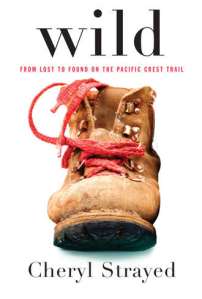
And then I picked up Wild: From Lost to Found on the Pacific Crest Trail, Cheryl Strayed’s memoir of her 1100 mile solo-hike, at age 26, after she had destroyed her marriage with infidelities, dabbled in heroin, and most critically, because her mother had died four years previous and Strayed’s life had been spiraling downward ever since (see: infidelities and heroin).
Unlike the two tame memoirs I read before it, Wild is raw. It is brutally honest. Strayed lays everything on the pages for all the world to read. She doesn’t candy coat herself or present herself as anything other than who she is.
I admit that with a title like Wild, I expected more raving, more lunacy, more squatting and grunting, eating raw meat with a dirt-smeared face and nits in her matted hair. But Strayed’s genius in this book is that she writes wildness in a much more stealthy way, solitary and quiet, like the animals whose eyes glow at her in the darkness before their silent retreat. She gets at the heart of what it meant for her to be wild, not by snarling and howling, but reflectively, by using incisive language that had me scrambling for my Lexicon every few chapters.
And that’s the real reason I loved this book. Strayed uses kickass words – vivid words with spunk, that cut to the quick, that make her experience real and honest. So rather than write a huge long review, I want to share four words I gathered from Cheryl Strayed’s Wild. I collected these words from her pages, and to me they are the distillate of what what Wild is all about:
mox·ie – n. Slang. 1. The ability to face difficulty with spirit and courage. 2. Aggressive energy; initiative. 3. Skill; know-how.
cru·ci·ble – n. 1. A vessel made of a refractory substance such as graphite or porcelain, used for melting and calcining materials at high temperatures. 2. A severe test, as of belief.
grit – n. 4. Informal. Indomitable spirit. Pluck.
pri·mal –adj. 1. Being first in time; original; primeval. 2. Of first importance; primary.
And though I’m not sure if pluck was on her pages, it went into my Lexicon, too, with an asterisked *Cheryl Strayed next to it.
I sat at the kitchen table with my journal, and when I looked up, I saw hand prints on the glass door, horizontal lines of blinds, square pattern of tiles, vertical lines of the fence. There were shoes strewn about on the porch, trikes parked haphazardly, toys littered everywhere. If I turned my eyes back into the kitchen, I saw crumbs and clutter on the counter, pots and pans on the stove, dishes, books, and bead boxes on the table where I tried to write.
And that was just geometry. Just lines and shapes. There were also color and texture to consider, but I was overwhelmed already, and I couldn’t do it. I had to look back at the clean white page on a warm wooden table. I am stunned by how much I usually block out. I might go insane if I didn’t.
As of 9 o’clock this morning, on this day of visual awareness, of paying attention to my sense of sight, I had already discovered three fundamental things about myself. The first is that I ignore an incredible amount of visual stimulus. An overwhelming amount, I discover, when I allow myself to see.
The second is that I find driving to be a highly stressful and unpleasant experience. Sitting at a traffic light on our way to the park, my heart raced when I forced myself to observe my surroundings. Not to zone out. I was overstimulated by action, by motion, even as I sat still: cars raced by, their wheels turned, people’s mouths jabbered and hands gestured inside careening cages of steel; turn signals and brake lights flashed; traffic lights swayed and changed colors; yellow earth movers jerked jaggedly in my peripheral vision. When I focused on more static objects, I saw hard, stern, concrete buildings with columns and rows of shiny rectangle windows. Bold black words jumbled neon orange road signs, telephone wires julianned the sky; parallel lines on the road bounded lanes, perpendicular lines confined crosswalks, the line of the road itself sliced through the landscape.
The third thing I discovered, when I arrived at the park, is that organic shapes and textures are infinitely more appealing, more peaceful, more zen than hard edges and cutting lines. Shocking, I know. The curves of mounded earth, the browns of wood and leaves, the peeling texture of bark, the fluff of cottony clouds in a crisp blue sky – these things soothed me after the frenetic experience of driving. I watched Spanish moss sway in the breeze – a gentle lift, like smoke swirling, its tip curling like the point of a long beard, then falling slowly and then lifting again. I watched the branches of a small oak tremble. Its leaves shivered. Down by the shining lake, shoulder-high grasses waved slowly in the wind. I wished our townhouse felt like this.
Back at home, I tensed the moment I walked in the door. The mess from this morning was still there. Toys and crumbs and dishes stacked everywhere. The more I looked, the more I saw, and I was in danger of overloading my system. I put up psychic blinders, blocked the stimulus from my consciousness.
I made myself some tea. Washed dishes and wiped the counters while water bubbled in the glass kettle. Put toys away. Straightened.
I rummaged through the fridge, easing myself back into visual awareness. It was the mushrooms that did it. Their happy little domes flecked with crumbs of earth tuned me back in to the pleasures of sight. I stood up and looked around our kitchen. I felt a loosening in me as the beauty in the room came quietly forward once the clutter was removed. Earth brown walls. Warm wood table. Pottery mugs hanging on the wall.
I made myself a snack to go with my tea, and and was calmed by the earthy shapes and textures of food – round golden bagels with a crisp bubbly crust; plump red strawberries smiling brightly; graceful green tea leaves suspended in amber liquid at the bottom of my delicate white cup. Thirteen small bubbles floated on the surface, nestled snugly together in its smooth, porcelain curve.
I wrote this in Tampa in 2008 when I spent five days conducting a sensory awareness exercise. Each day I focused on one sense and wrote what I experienced. I didn’t mean for it to be a writing project – I was mainly interested in being aware of the world, and how we experience it through our senses. It turned out to be one of the most useful writing exercises I’ve ever done. Recognizing how much visual background “noise” there was in our lives, we have now significantly decluttered our home, and I have made housekeeping a higher priority. Consequently, we now find our home a much more pleasant place to be. If you are interested in other writings from this exercise, you can find my morning in sounds here.
After three years in Minnesota, I keep wondering when winter will arrive in Blacksburg. It’s January now. Shouldn’t I be warming my mug so its cold, greedy clay won’t suck all the heat from my coffee? Or pulling our down comforter up to my ears rather than kicking it off in the middle of the night? Shouldn’t I be wearing long johns, and furry boots, snow gloves and a knee length down coat?
Shouldn’t I be worried that my eyes will freeze open?
It is a strange sensation, this waiting. I keep checking the forecast, wondering when it’s going to get cold. I will see highs in the 50s, 40s, and even 30s and think, “It’s not here yet.” The bone chilling cold of highs in the single digits, and lows below zero, has not yet come.
It wasn’t until we hiked the Cascades again today, and I heard the constant, deafening roar of rushing water – the river throwing itself against rocks, a billion wet droplets slapping cold stone, torrents surging downstream, moving, moving, always moving – that I thought, hesitantly at first, then with growing glee, maybe this is winter here.
For the sounds we heard in Minnesota, outdoors, in January, were not liquid. January sounds were stiff, crisp. Quiet.
In Minnesota, at first, we thrilled at the foreignness of the deep freeze. It was adventurous! New! I could go grocery shopping and not rush home for fear of the food spoiling!
We reveled in the richness of winter life in the Twin Cities. Snow sculptures, intricate as marble carvings – of viking ships, lions, Tom Sawyer’s fence – endured, larger than life, for days at the state fair grounds, for temperatures didn’t climb high enough to melt them. Ice sculptures of diamond dragons, and crystal palaces, glittered in Rice Park, unafraid of a melting sun. Art shanties, modeled after ice fishing huts, sat merrily, confident in their safety, atop a frozen lake that we walked on. That cars were parked on. That cracked under our feet – a deep, ominous pop – as a pickup truck drove by us on the 15-inch thick ice. The only evidence of the chilling liquid beneath was the darkness we saw as we looked down a fisherman’s hole in the ice.
And the glacial fear in my heart.
Our second winter in St. Paul, I bought a pair of snow shoes. I’d bundle up, as plump with clothing as Randy in A Christmas Story, and crunch into the silent wilderness of Ft. Snelling State Park, located on an island surrounded by the Mississippi and Minnesota Rivers. When the snow was fresh and powdery, my snow shoes wouldn’t even crunch. They’d make more of a “poof” sound with each step. On those days, I’d poof, poof, poof over to the Mississippi River, and I would gaze in wonder at its stillness. For the surface of the mighty Mississippi, in January, was solid. Frozen. There were deer tracks in the snow that had fallen on it.
In Minnesota, I remember the relief, the dissolving, the thawing of my protective shell that came with the first time I would hear water drip outside. It was a beautiful sound, the sound of fat drops of water plopping to the ground. It was a sound full of life, and hope, and warmth after so much brittle cold.
So when we hiked today, and I heard the gushing of water in Little Stony Creek, and I watched its crystal-clear liquid cascade between mossy stones, I realized, this is January. This is our winter now. I relished every splash, every bubble, every sign of fluid. I snapped dozens of photographs of this streaming January water, with renegade droplets freezing like jewels on overhanging leaves, forming icicles that glistened with the full glory of winter’s crystalline beauty.
As we approached the waterfall, and the icicles grew thicker, and the air grew colder, and I had to put my camera away because my fingers were growing numb, I knew that winter will go deeper here. I know temperatures can plummet. I’ve seen pictures of the Cascades frozen over.
But there will also be Januaries like this one, where there are liquid and ice, and you don’t have to form a protective shell to make it through.
You would think that in November, when the trees are stripped bare, and the mountains are gray with twiggy branches, and the ground is brown with dead leaves, you would think that the color green would be hard to find. At least, that’s what I thought, until with green on my mind for a photography project, I found it everywhere. We hiked the Cascades yesterday, an Appalachian waterfall about 30 minutes west of Blacksburg, and the stream-side trail was resplendent in winter greens. We saw mosses, lichens, rhododendron, hemlock – life, ever green, persisting beneath the naked skeletons of deciduous trees. We saw ferns, bridges and stone signs tinted green with algae, pools of green where the crashing down of waterfalls aerated the water, green M&Ms in our trail mix. And always at hand to capture words, my tiny green Moleskine, its lined pages scratched with haiku.
Yesterday was our eight year old son’s special day*, where he got to pick a meal and a family activity for the day. Knowing his tendency towards lounging all day in PJs, I bribed him. I told him, “If you pick an active family activity, like, I dunno, hiking Dragon’s Tooth, I’ll make cinnamon rolls for breakfast.” Lucky for us, his sweet tooth pulls more weight than his lazy bones.
We’ve taken our kids on several hikes around Blacksburg, and they always love the first third of the trail. Then it all looks the same to them, and the boredom sets in, and they begin asking for snacks, telling us their legs hurt, wondering, “Are we almost at the top? Are we almost done?” Neither of us care about pushing our kids to be any certain way except the way that they are – we won’t push them to be scientists just because their dad is, or pastry chefs just because I like donuts and cupcakes and croissants – but we really, really, really do hope that they will enjoy and appreciate the outdoors. So we try to make it fun for them, taking them to waterfalls, pointing out cool spider webs, oohing and ahhing over golden leaves, showing them boulders they can climb. Playing 20 questions if it comes to that.
And most importantly, finding new trails that will keep them excited about the woods.
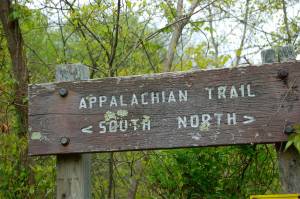
When I hiked Dragons’ Tooth with two girl friends a couple of weeks ago, a 2.4 mile trail (4.8 round trip) that involves nearly a mile of scrabbling over rocks, I knew the kids would love it. Their most recent hike was a really steep 2.3 mile hike (Angel’s Rest) with great views at the top and a beautiful trail to boot, but after a demanding 4.6 mile round trip, I think they were done with hiking for a while. We knew we had to pull out the big guns to get them excited again, so I showed our son photographs from the Dragon’s Tooth. Pictures of metal ladder rungs bolted into rocks, shots of sheer rock faces with the white blazes of the Appalachian Trail painted on them, photos of trail that was nothing but jagged ledges of stone. And the prize at the end of the hike? The Dragon’s Tooth itself – a massive sheet of rock, jutting 35 feet out of the ground like an ancient snarled tooth. That, and trail mix with M&Ms.
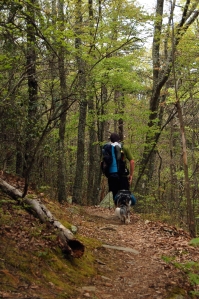
Our kids ran a good portion of the first half of the trail. They could not wait to get to the rocky part. And once we hit the boulders, and the sheer faces marked with the AT’s white blazes, and the rocky ledges, our kids may as well have been at Disney World. They were high as kites scrambling over those rocks, picking their own paths, hopping from boulder to boulder, then sprinting up the steep trail to the next technical patch. Our son declared, at least four times, “Dragon’s Tooth is the Best Hike Ever!”
The best part for me, though, was not just how much the kids loved the rocks (though that helped). It was the conversation. The morning was grey and raw, we had the trail to ourselves, and everything looked different than our normal hikes – more mysterious because of the mist and the dampness. On our way up, I pointed out some pink leaves that were still hanging on – papery ovals quivering in the deserted forest, ready to fall at any moment – and our son observed them, trying to pinpoint their exact color, when he finally proclaimed that they were peach. Not the darker orange color of peach flesh, but the delicate pinkish orange of their skin. He was specific about this.
When I exclaimed over lichens, plump and green like I had never seen them before – they were the same shape as the dessicated lichen discs we often see, and I wondered if they were those same black lichens, only hydrated – our daughter said, “They look like those noodles I like – the ones stuffed with chicken and cheese? Ravioli! They look like green ravioli.” And indeed, that was exactly what they looked like. I jotted this down for a future haiku.
On our descent, after both kids had climbed partway up the Dragon’s Tooth (our daughter wanted to climb higher, our son said he would never climb the tooth itself again – getting down off of it was too “freaky”) and after the four of us had eaten nearly two pounds of trail mix, the kids were subdued. They loved the rocky parts on the descent, but they were quieter as they scaled them. Once we were back down to the regular old hiking trail, we feared the tiredness and boredom would set in.
So we talked about farts. For probably 15 minutes. We talked about animals farting in the woods, and our son asked why we never smell them. So we said, “You can’t smell their farts if they’re not even around. Have you seen any animals today?”
“Yeah, chipmunks.”
“Well, chipmunks are pretty small. We probably wouldn’t be able to smell them anyway if they farted.”
Meanwhile, our son explored a hole in a tree, sticking his head inside to see what he could see.
“Be careful,” I said. “A chipmunk might stick his butt out and fart on you.”
And then we talked about chipmunk farts and what they probably sound like (a short pffft or bzzt, according to Dad). We talked about a bear’s fart after hibernation, and how godawful it would smell after being held in for three months. To which our son replied, “I fart in my sleep, why wouldn’t a bear?” Yes, this is true. We talked about bird farts, and how we can’t smell them because they’d be even tinier than chipmunk farts, and besides, birds are dainty and would fart high in the sky, where nobody would ever know.
And so on.
After the fart conversation died, I slowed down with our daughter and held her hand while we strolled through the leaf litter. She told me, “I know what function means now.”
“Oh yeah? What’s it mean?”
“It’s the job something does. Like on a plant, the seed’s function is to grow a new plant. The stem’s function is to hold up the plant and bring water to its different parts. The leaves’ function is to make food, and the flower’s function is to make seeds.”
And then she told me about the life cycle of a plant, all the while warming my big hand with her little one, impressing me with her first grade knowledge of botany. I thought I’d stump her when I asked what part of a plant a pine needle might be, but after thinking about it a minute, she answered “I think it’s a leaf because it comes off of the stem.” Right-o, Smart Tart.
We ambled our way back to the parking lot, glad we had hit the trail early, because now the lot was full. I smiled to myself. After hearing our son say somewhere along the way, “I love those peach leaves, and the little baby pine trees, and the ravioli on the rocks. Basically, I just love all the things that nature makes,” I had to agree with him that Dragon’s Tooth was the Best Hike Ever.
The Dragon’s Tooth, Catawba, VA
Peach leaves
Ravioli Lichens
Ladder rungs on AT
Rocky trail
Dragon’s Tooth in the clouds
*We instituted Special Days last year after feeling bad for dragging the kids around on errands, or feeling like we could never all agree on what to do on a Saturday afternoon. So now, we rotate. Each weekend, one of us gets a special day. On a person’s special day, in addition to getting to choose the brunch menu, a special dinner, or a dessert on their day, the special person also gets to choose a family activity. This motivates my husband and me to set aside a chore-free, errand-free time for the four of us to hang out, and it has been a huge hit with the kids. They’ve had a lot of fun trying new foods, going to the antique car show for Dad, going to the conservatory for me, and especially, not having to go to Home Depot or the shoe store when it’s their turn to be special. I highly recommend it.