When our daughter is at her evening swim practice, I drop her off then drive over to a nearby trail, the Huckleberry, where I pop my headphones on and either go for a run or a walk. It used to be that I could go for an hour walk, then drive over to the aquatic center and sit in the parking lot in daylight all the way until practice was over.
Now, the sun sets before 6:30, and I’m lucky if I can get a 30 minute walk in. Next week, after the time changes this weekend, the sun will have already set when I drop our daughter off.
Last night was my final evening walk on the Huckleberry, and it was a spectacular one. The clouds pinked at sunset, and starlings flew in morphing clouds in the cool autumn air.
The air is cool and heavy, the sky overcast. A crow caws, and I hear it through the open window. This morning when I sat here, I watched a V of Canada geese fly through the flat grey sky. Their honks echoed off the mountains in the fog.
On Saturdays, our daughter has swim practice about 20 minutes from our house. I used to go to a coffee shop or read on the bleachers at the aquatic center while she swam, but those aren’t options during the pandemic. So today I loaded my phone with a short story, pulled on a baseball cap to keep my glasses dry in the drizzle, and walked along the Huckleberry Trail, a local 7-mile paved trail for cyclists and pedestrians.
I listened to Tommy Orange read Louise Erdrich’s “The Years of My Birth.” The story was a perfect accompaniment to a cool misty stroll in Appalachia. Erdrich’s writing is organic. It is both humic and crisp, and she weaves together nature and spirit and the human soul. I’ve read a few of her novels, but my favorite work of hers is a short story, “The Stone,” published earlier this year. It’s mysterious and potent and feels like it comes from the belly of the earth.
Under the canopy of oaks and pines, a spray of goldenrod hugged a damp tree stump. The trees are still green — they have not started bronzing yet — but as I walked, a single yellow leaf drifted down onto the path. I crunched through a smattering of fallen leaves, and their musty forest scent curled into my nose.
In the wet air, when I crossed the railroad tracks, I smelled the tarry odor of creosote. Where the trail was open to the sky, goldenrod and ironweed lined the path in sprays of pollen yellow and grape juice purple. Pale violet asters collected mist at their knees.
But the thing that got me was the acorn. When I crossed the railroad track, I felt something the size of a marble crunch underfoot. I looked down and saw several smashed nuts, ground to bursts of yellow dust on the paved trail. A squirrel scrambled across the path. A couple of steps later, I saw an intact green acorn, complete with its jaunty stemmed cap, and I knew fall would be here soon.
Now I’m back home, in jeans and bare feet. Our windows are open, and through the back screen door, black-eyed Susans wave in a mass of 3-inch suns on stems. The mums are thigh-high now, and their once green mounds are now masses of deep red blooms. Tangerine zinnias pop bright orange on this grey day, and our own sprays of goldenrod burst like fireworks down the hill.
The Joe Pye weed and sedum and echinacea blush pink but will soon fade to brown. When the echinacea drop their petals, the goldfinches will come and perch on the dried seed cones. Small bright bundles of yellow, the little birds will sway on long stems. I don’t want summer to end. But the goldfinches on the echinacea are one of my favorite things about my garden. If summer has to end, seeing them bob on spindly coneflower stems makes it a tiny bit easier to bear.
On Father’s Day this year, the kids and I didn’t want to give their dad stuff. It was day 101 of the lockdown, and he’d already had a pandemic birthday shuttered up inside. We wanted to give him an experience, to leave the house, to do something together as a family instead of just spending money on physical doo-dads he may or may not want or need.
We found a state park nearby whose boat rental shop was open: Fairy Stone Lake. Our son, who was learning to drive at the time, drove the hour and a half drive on winding mountain roads. We thought about renting canoes, but then decided we all wanted to try paddleboards.
We loved everything about paddleboarding: the portability of the boards, how easy it is to swim off of them, their versatility — you can sit, stand, kneel, or even lie down to paddle. We loved that when you want to hang out, you can sit on the board and dangle your feet in the water, or you can lie back and chill out with your hat over your face.
Shortly after that trip, my husband and I bought paddleboards. They get us out of the house without having to get near other people, and they complement sailing perfectly because they’re better for days when there’s no wind.
We’ve paddled several times on Claytor Lake, a nearby lake we also sail on. But Claytor Lake is busy with power boats and jetskis. It can be loud, and there are lots of boat wakes to navigate when you’re standing on a floating board.
On Labor day we decided to try a new place to paddle: the New River. We’d tubed down the New River before, but we’d never paddled on it. A friend told us about a good place to put in where the current’s not too strong and there’s plenty of depth so you don’t have to worry about crashing your board over rocks and rapids.
Paddle on the New River
I loved it. When we paddled upstream, the sun was behind my right shoulder, and when I looked into the water on my left, the sunlight streamed in golden rays into the topaz depths. Sometimes the rays converged at my crown’s shadow, as if my shadow self were radiating sunlight from beneath the river’s surface.
The air temperature was in the low 80s. Not too terribly hot. On the river, though, standing on my board in a long-sleeved sun-protective rash guard and a life-vest that covered my torso and back, and the sun beating down on me at 2 o’clock in the afternoon, I was hot. I put in a few good strong pulls with the paddle to get me going into the current so I could jump in quickly to cool off, and the water was crisp and chilled. It was colder than the lake, and it made me think of my favorite scene in The Sun Also Rises, when the characters go fishing in France and chill their wine in an alpine stream.
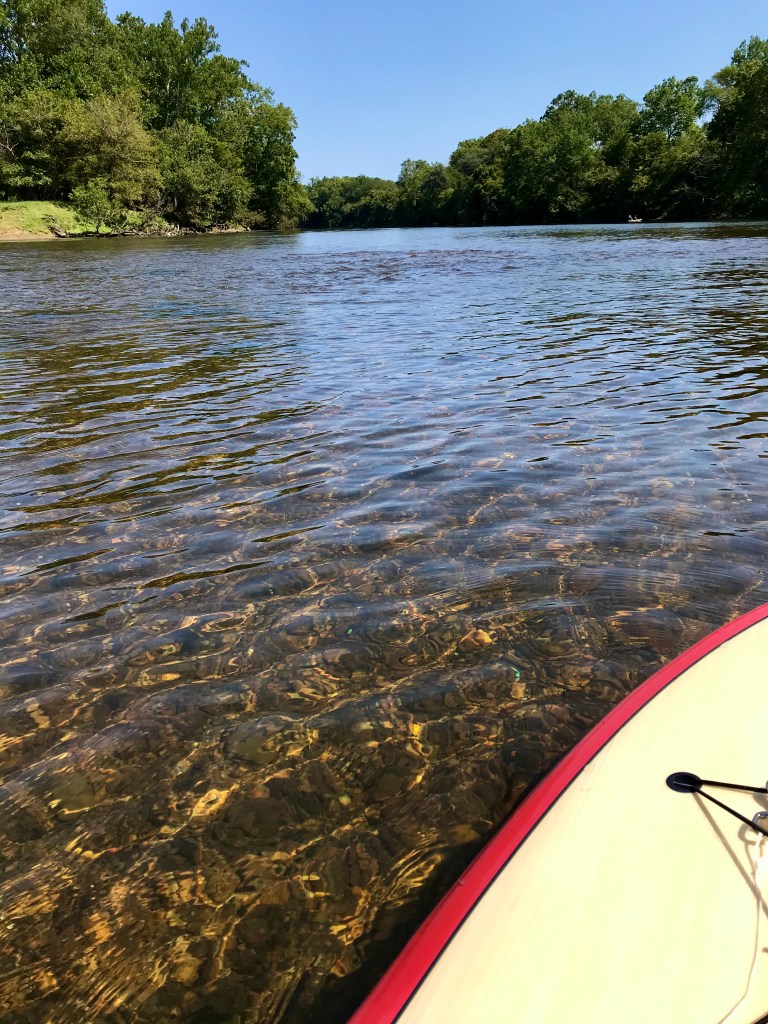
But my favorite part was the light in the water. September is beautiful for light. When we paddled into the shallows of an island in the middle of the river, the water was crystal clear. Looking out over the nose of my board, the shallows rippled golden in the light. When we stopped in shin deep water to hang out, the pebbles beneath us shone gold and bronze and copper. The colors are so beautiful, it’s no wonder those metals are precious.
But the pebbles through the clear, rippling water were even more awe-inspiring than precious metals because their beauty included light and water, two things that are uncaptureable. You can’t hold light and water in your hands. You can’t hold golden ripples. I think that’s why I love them.
I continue to wake early even though the kids no longer go to school. In pre-quarantine life, I woke early to get into the kitchen, put the dishes away, make my smoothie and coffee, and get out before the kids woke up and filled the small space with sleepy-eyed wandering and fridge-staring.
Now, with this morning time I have, I’m not sure what to do with myself. So I watch the world become light. The sun hides behind a blanket of clouds but still leaks over the horizon. The sky outside the living room is a smoky grey-blue. White flowers cover our neighbors’ pear trees. The trees look like vanilla ice-cream cones. I watch our redbud for red buds; I may see a hint of fuchsia hugging it’s twiggy limbs, but it’s still too dark to say for sure.
My husband is on the couch, under a blanket, with a cat and a laptop on his lap. Last night, as he checked to see how many pages were left in his novel, he wondered how he will get books now that the libraries are closed. Our daughter, currently asleep in bed, misses her friends. Our son, also asleep, wonders how long this will all last. As do we all.
Our rhododendrons are in bloom. Intense pink blossoms, like raspberry bubble gum. The forsythia is also covered in flowers. Bright yellow, like bananas. I filled all the bird feeders this weekend; a squirrel knocked down my newest one. Most of the trees are bare, except those pear trees and two other trees in our neighbor’s yard that are pushing out new chartreuse leaves.
I alternate between thinking “everything is going to be fine” and “this could be really, really bad.” For now I distract myself with words — I read them, I write them — and with the realness and persistence of the natural world. The sun rises. Birds twitter. Trees leaf out. Grass grows.
Our son mowed the lawn yesterday. It was the first cut of the year. It is emerald green after all the rain we’ve had, and it is lovely.
I received a surprise in the mail last week. Out of the blue, a friend sent me this book: Braiding Sweetgrass. My friend said in her gift note, “Beautiful blend of personal narrative, ecosystems, and botany. Her voice reminds me of your blog posts.” After reading a few chapters, I have to say that latter part is a great compliment. Thank you, Gracie, if you’re reading. Funnily, the author of this book also wrote Gathering Moss, which was listed by the author of How to Do Nothing as a favorite — the How to Do Nothing book I thought I didn’t need, and then realized maybe I do.
Gracie was right about the beautiful blend part. This book has become part of my daily ritual. I read a chapter with my coffee every morning before writing, and it’s a lovely way to begin the day. I get lost in the fragrance of sweetgrass, the power of ceremony to marry the mundane and the sacred, or the reasons certain flowers are striking together.
My favorite chapter so far is the one I read this morning, “Asters and Goldenrod,” about why the author pursued a the path of botany when she went away to college:
I wanted to know why we love the world, why the most ordinary scrap of meadow can rock us back on our heels in awe.
Robin Wall Kimmerer
When she told her freshman advisor, “I chose botany because I wanted to learn about why asters and goldenrod looked so beautiful together,” he scoffed and said that’s not what science is about. She, and I, argue, that he suffers from a failure of imagination, and that’s exactly what science is about: testing hypotheses to understand our world. As Kimmerer ultimately deduced,
[Aster and goldenrods’] striking contrast when they grow together makes them the most attractive target in the whole meadow, a beacon for bees. Growing together, both receive more pollinator visits than they would if they were growing alone. It’s a testable hypothesis; it’s a question of science, a question of art, and a question of beauty.
Robin Wall Kimmerer
I’m very much enjoying this gentle way to begin my days. It’s way better than scrolling Twitter.
After spending our first day of vacation hanging around our Airbnb on the leeward coast, we were ready to explore the wild side of the island on our second day. We hopped in our rental car and drove up through the northern end of Curaçao then cut over to the eastern coast: the coast that endures the relentless pounding of waves driven by easterly trade winds.
We parked the car near the ticket stand at Shete Boka national park, then set off on foot across the Mars-like landscape to witness the crashing of blue water against sharp limestone cliffs.
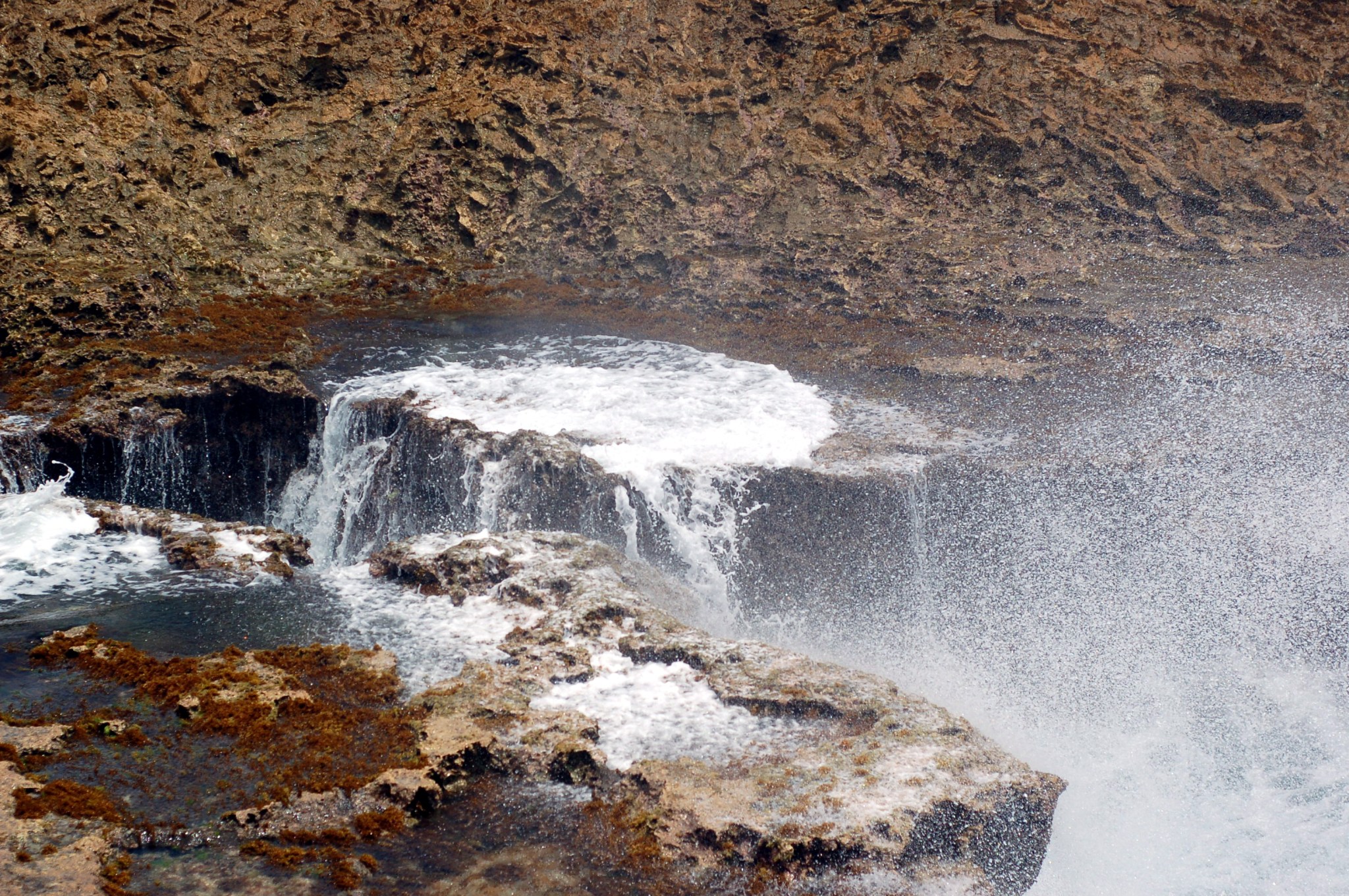
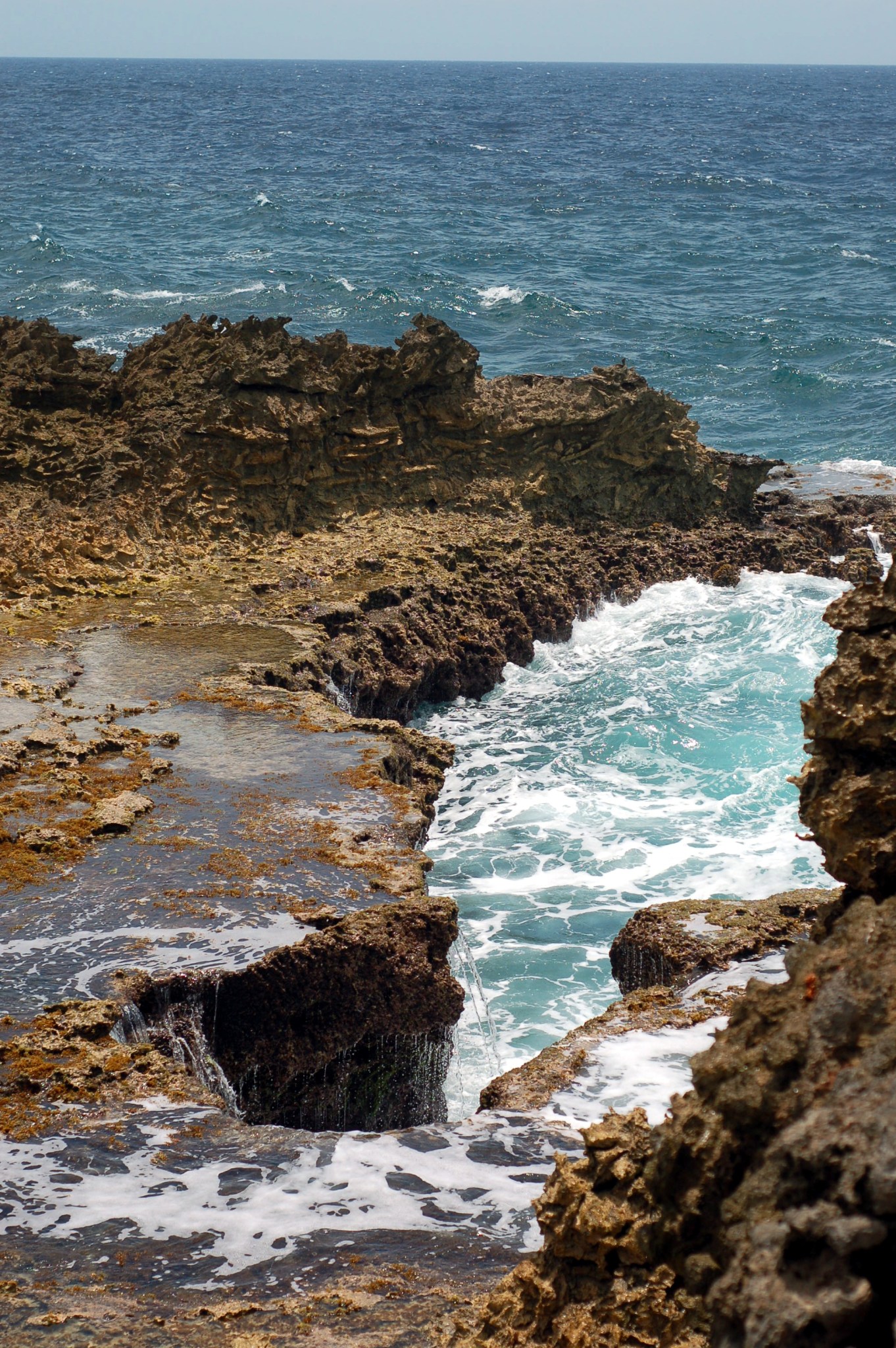
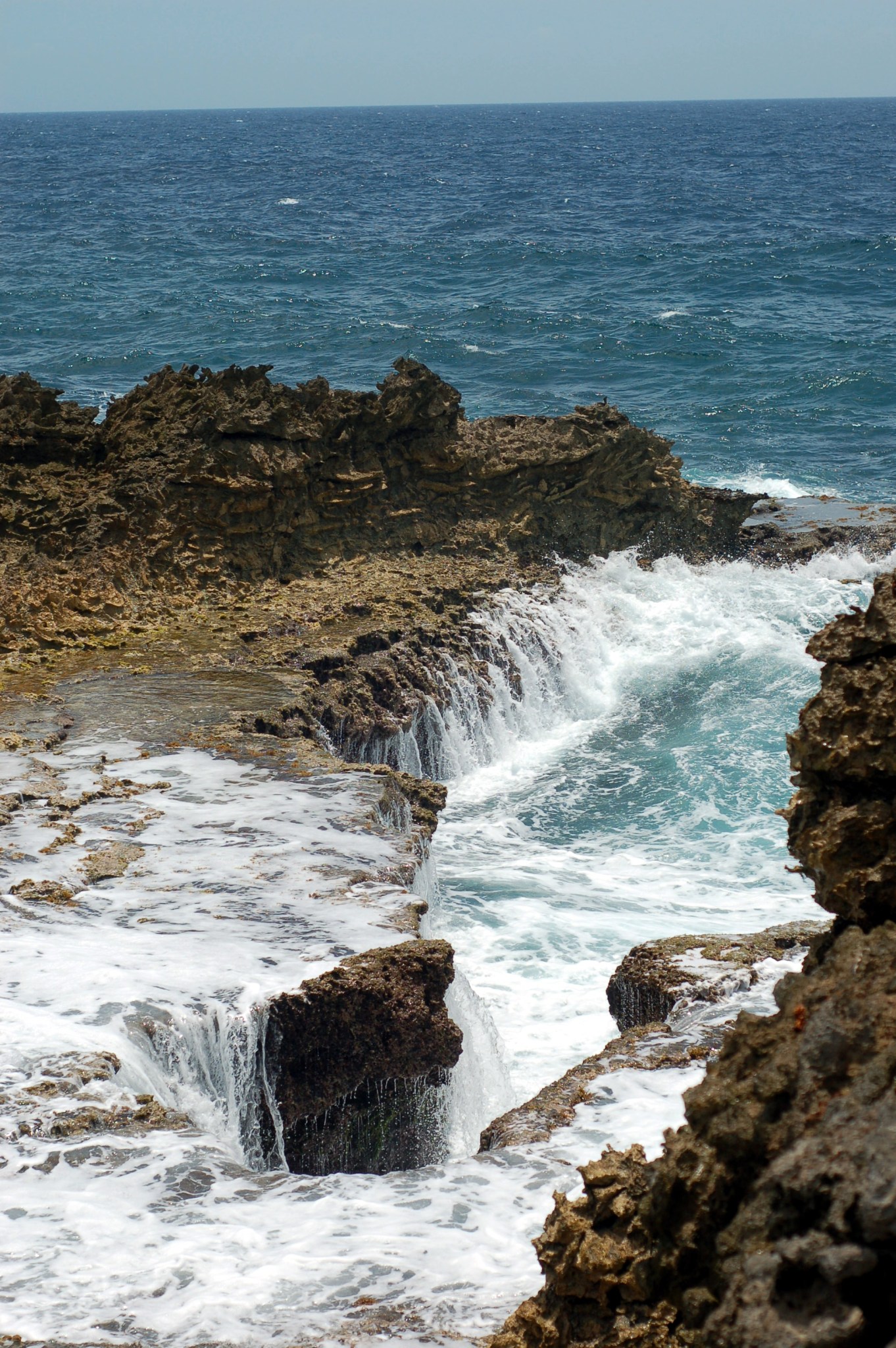
The most amazing part of the park, aside from being surrounded by the magnificence of all that ocean energy pounding against ancient rock, was a formation called Boka Pistol. Along the windward coast is keyhole shaped inlet. As waves rush in, run out of room, and continue to fill the space anyway, air gets trapped in the formation, then makes a thunderous hollow boom before the water, with nowhere else to go, crashes into rock and sprays back out to sea. BOOM-pssssshhhhhhhhhh. We watched wave after wave crash, boom, and spray, each one leaving me breathless with anticipation: how loud will it boom? How high will it splash? Which direction will it shoot?
Along the coast at Shete Boka National Park, Curaçao
The barren landscape of a desert island
Cactus and clouds
Flat pools constantly awash at Boka Pistol
Boka Pistol formation before water rushes in
Pistol shot of a wave crashing into the keyhole
And the wave recedes
Incoming swell
BOOM
And back out to sea
I can’t get enough of this glacier blue water.
Stone cairns on the land next to Boka Pistol
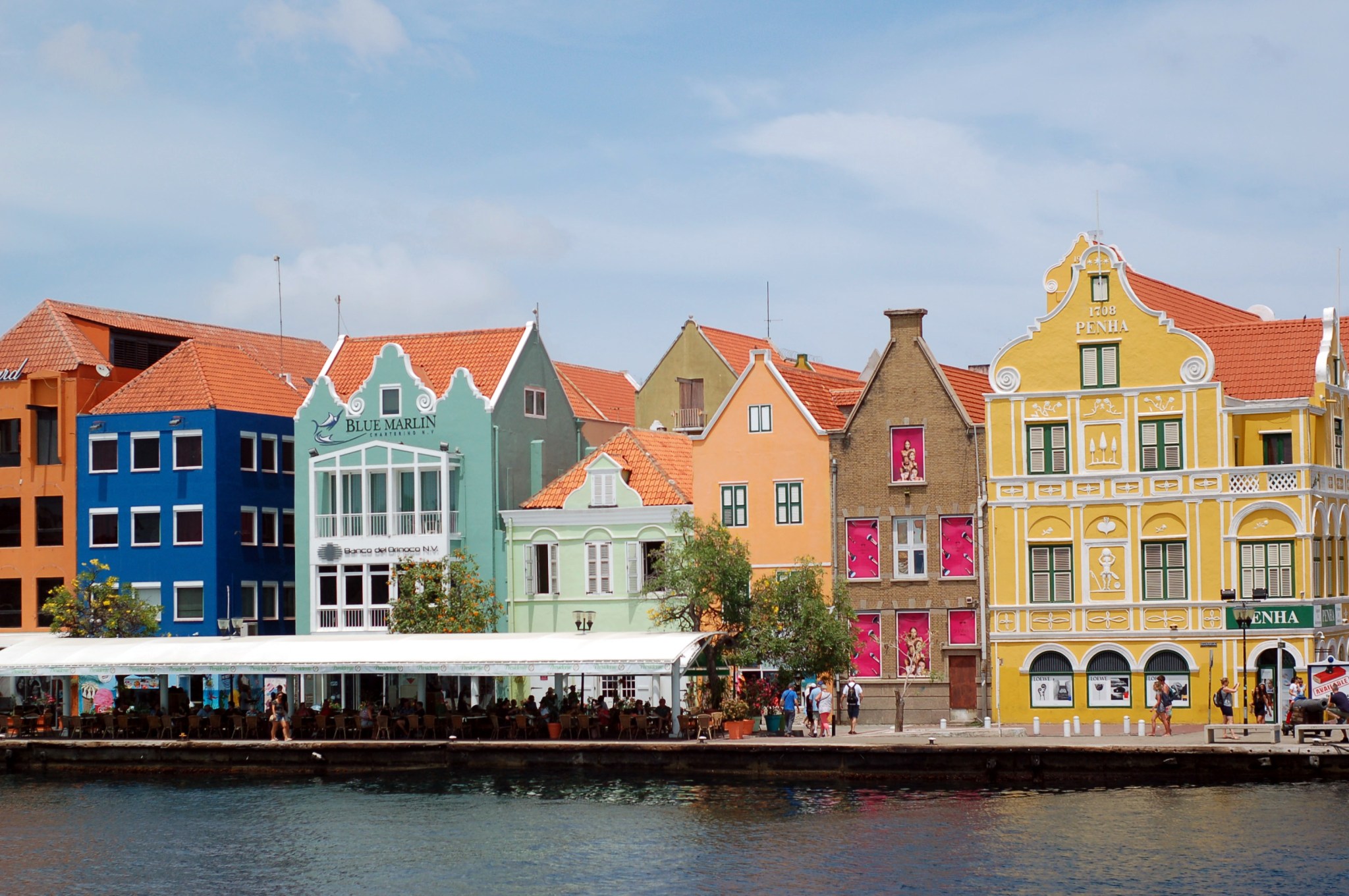
After the barren wildness of Shete Boka National Park, we went about as opposite a feel as you can get on the island: we got back in the air-conditioned car and drove down to the capital city of Willemstad for lunch. The city is adorable with its brightly colored buildings. I drank a piña colada with my lunch of snapper in a coconut sauce as we sat by the harbor and watched the floating bridge swing open for a catamaran to pass through. The air was still and hot compared to the strong ocean breeze up on the limestone bluffs of Shete Boka. My main wishes for our town visit were to see the colorful city and to see if pastries are a thing here, with its strong European influence. When our waiter couldn’t give me the name of a single pastry shop nearby, and I had already seen the pretty buildings, I didn’t feel the need to come back to town. I like the wild stuff better.
Willemstad and floating bridge from inside fort that guards the harbor entry
Willemstad. We ate lunch under the awning along the water.







 Butterfly Mind