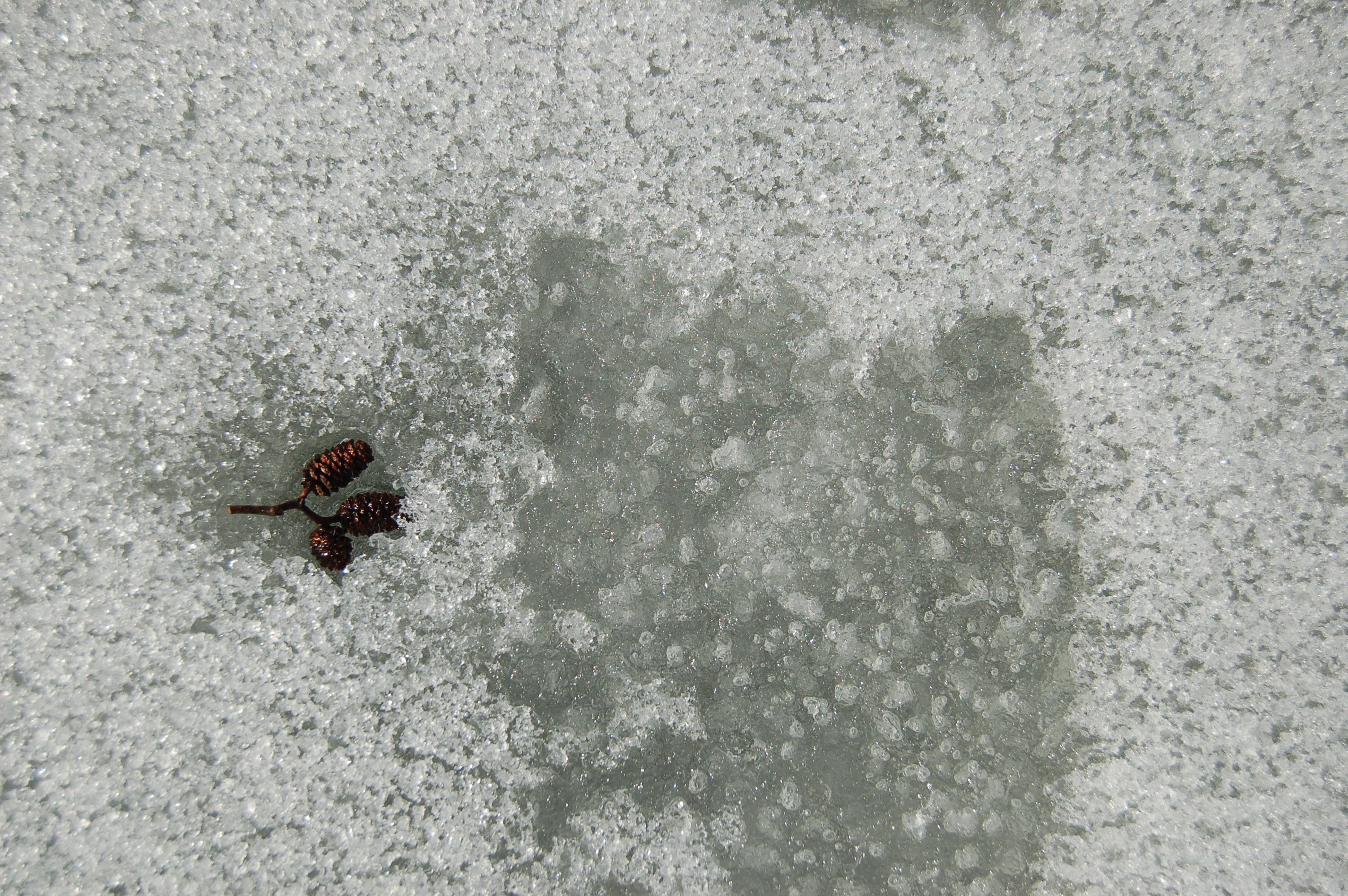
On February 1, 2014, my husband had an itch to hike the woods around Pandapas Pond. It was a sunny, 50 degree Saturday after two weeks of sub-freezing temperatures, and we had seen pictures in the paper of folks skating and ice fishing on the pond. I asked if the kids and I could ride along. When we arrived, he waved and disappeared into the forest, and our children and I wound our way down to the iced over water. College students walked across the pond’s hard shell – all the way across – and threw snowballs through sunlight. Our kids begged to go out on the ice, and all I could see was them crashing through. I was terrified. I told them to stay near the edges – the surface looked wide and treacherous, more of a lake than a pond, really, with all that shockingly cold, surely fathoms-deep water beneath a thinning sheet of cracking, melting ice. I white-knuckled my camera; I told myself, unclench your jaw. I reminded myself, Breathe, as they ran reckless, full speed, heads-back, mouths-open-in-laughter races on the sun-warmed ice; as I stepped onto pond’s slushy skin. I probably lost five years of my life that day, but our kids remember it as one of the best days of theirs.
Unknown plant, Pandapas Pond, Blacksburg, VA February 2014
Cracking? ice on Pandapas Pond, Blacksburg, VA February 2014
Walking on ice, Pandapas Pond, Blacksburg, VA February 2014
This is my entry for the weekly photo challenge: Threes
“Mom, are you taking me to soccer?” Our ten year old son stood in front of my reading chair. He was already dressed for his futsal game, shin guards and all.
I checked my watch. “Uh, yeah.” Fifteen minutes until we needed to leave. “Let me take a quick shower.”
I knew I was pushing it. Fifteen minutes to shower and dress would be crazy fast for me, especially in winter. I usually take 30, and that’s without makeup or blow drying my hair. I ran up the stairs, pep-talking myself. OK. No messing around. No getting lost in the shower. Gotta get to the game. I HAVE to move quickly, I HAVE to get in and get out.
I cranked the faucet to scald, stripped, and jumped in. Focus, Andrea. Wash hair. Wash face. Doing good.
Warm water streamed down my back. My skin turned pink from the heat, just the way I like it. I opened my eyes and watched steam fill the bathroom. Condensation dampened the back of the porcelain toilet, moistened the cardboard tissue box, crept over the mirror ’til I could have drawn a smiley face on the fogged silver glass.
I squirted conditioner on my hand and ran the smooth cream through my hair. I scrubbed my skin with a sudsy washcloth. I closed my eyes and listened. Clack clack, clackity clack as water spattered the plastic tub at my feet. I turned and faced the spray to massage my eyelids. The fan hummed, straining to exhaust the room of its fog, failing as I cranked the water hotter. So warm… The water tenderized my throat. I could stay here forever, especially if I didn’t have to stand up the whole time. Maybe I should take a bath. I could light some candles, relax with a book. I’ll have to wait a little while, though – I’ve probably almost drained the water heater.
I turned and reached for the conditioner bottle. I smiled to myself and thought about fairy forests, the ones you read about in books, where the hero enters the enchanted forest and time distorts. He dances and drinks and makes merry and could get lost in there forever, unaware anymore of the existence of an outside world, of the passing of time. Everything in the forest is the Now. The shower often feels like that to me.
I tipped my head back in the stream and then squeezed extra water from my hair before applying conditioner. My hair felt silky, slick. Wait. Did I already use the conditioner? I looked at the washcloth on its hook. It was wet, not dry. Did I already wash?
Oh shit! The soccer game!
I slammed the water off, ripped open the curtain, clawed through the fog for a towel, and swished it all over me while I ran, dripping, to the closet. Jeans, shirt, belt. Ran to the clock. What time is it? Two minutes. Two minutes left! I pulled wool socks over damp feet, threw on the clothes, dragged a comb through my hair, and checked the clock. One minute to spare!
I raced halfway down the stairs, then slowed to a walk. Pretended I had everything under control. I leaned over the railing and said, “Okay buddy, are you ready to go?”
credit: author Lydia Kang from The Word is My Oyster
If you are a parent, or have ever been around the parent of a new baby, you may be familiar with the term “growth spurt.” It is usually paired with the words, “I don’t know what’s wrong with Little Johnnie – he must be going through a ____” (growth spurt).
Babies get fussy during growth spurts. None of a parents old tricks work – change the diaper, add a blanket, remove the socks, coo, bounce, rock, swing. Things are changing inside Little Johnnie, things we can’t see, and let’s face it: it’s uncomfortable. Scary. Whatever is going on, it’s unfamiliar, maybe even painful, and Johnnie doesn’t like it one bit.
I think that’s what’s happening to me right now. Through kismet or coincidence (or perhaps because it is a basic, necessary skill), both my writing group and the craft book I’m reading are intensely focused on structure. As in, structure your writing instead of pantsing it, build it a skeleton before dressing it with skin, and your work will stand erect. Structure is the foundation and the frame; without it, building a piece is a tenuous process, like trying to build a house out of shingles, but with nothing to nail them to. You must contort yourself to hold the shingles up while you frantically staple them together.
I have never structured my work before. Ever.
At first, I was ravenous for information and experience, like Little Johnnie at the breast, gorging in preparation to grow. I told my group, I get it now! I get why revision evades me – because I’m moving shingles around without knowing what I’m nailing them to. I told them, I can’t wait to tackle this homework, 9 paragraphs on a concrete, a noun, something you can touch and taste and see:
1. Facts
2. Origins
3. Ancient perceptions
4. Facts
5. Anectdotes
6. Personal story
7. Metafacts
8. Historical story
9. Personal return to subject
Writing into a structure. I thought, look, it’s all laid out! I thought, this will be fun! This will be easy! I will write about turquoise. Turquoise is simple, it’s not fraught with personal drama that I’m afraid to get close to on this first attempt at a new way of writing. Look how great this will work! I will have paragraphs. I can move them around to observe the flow of information. I can experiment. I can play.
Three weeks and ten hours of active writing later, I’ve got not nine paragraphs but four. Four paragraphs and they are B-O-R-I-N-G.
Meanwhile, my Andrea Reads America project confronts me with a problem I’ve never had before: because I am reading deliberately, writing my reactions, and comparing works, and because I am simultaneously studying the craft of writing, I have become a critical reader.
I don’t want to be a critical reader!
I don’t want to be that peppery old snoot who doesn’t like anything except the finest, the top shelf, the Hendrick’s gin only, please. I liked it better when I liked everything. There are so many more opportunities for pleasure that way. Sure my appreciation of a finely-crafted novel is more profound now, transcendent almost, as when we ate at a five star restaurant and the food was so good we didn’t want to profane the experience by talking. Diners around us chattered while they absently forked steak that melted like butter, or sipped tomato soup that wrapped around your tongue like having God in your mouth, and my husband and I thought, they are not giving this food the reverence it deserves. They’re not even paying attention.
But not every meal can be a five star fine dining experience, and not every novelist can achieve sublimity. I used to be able to accept that, but now my tolerance for fiction that doesn’t work for me has plummeted. It’s not fair for me to expect perfection, especially because I appreciate how difficult it is to achieve, and because I fail so miserably at achieving it myself, yet I can’t help now but notice flaws and see where things don’t work in my reading life.
So I’m fussy. I’m uncomfortable. My reading and writing worlds are changing, and it’s painful, and I don’t like it one bit. Can’t I just go back to when it was easy? When I pantsed my writing and I liked everything I read? Can’t someone coo at me and make it all better?
I take comfort from our children, our Little Johnnies who fussed and flailed and suffered and screamed their way through too many growth spurts to count. And on the other side of every one of them, after they suffered their torment, our babies smiled, they laughed, they radiated serenity. They came back to their happy selves again. Only they were bigger. Deeper. Less like babies, more like people. They had grown.
Zippers and buttons clank against the metal drum of the dryer: snowpants tumbling after a morning romp in fresh snow. Our eight year old daughter, her hair a stringy mess of snow-wet tangles, blows on a pot of boiling water, trying to make the starchy foam go down after adding a cup of dry elbow noodles. Our ten year old son forks the scrambled egg she made him. “Since eggs are better when they’re hot, will you watch the noodles while I eat this?” he asked her.
It is Tuesday. A school day. I look out the window and watch snow fall.
Now they both peer into the boiling pot. They wear pajamas at lunch time. He is teaching her how to cook pasta. After – after I empty the dishwasher then reload it – I will make hot cocoa while I grind nuts for almond butter, then scrape the food processor and grind nuts for nutella; I’ll only have to wash the bowl and blades once if make the butters back to back.
I sit at the table eating a lettuce wrap with my left hand and writing with my right. A tomato slips out the end of my wrap and splats onto my plate. Our daughter groans when I ask if they’ve grated Parmesan for their noodles. “Well, you don’t have to have Parmesan,” I say. She slumps her shoulders and stomps to the cabinet where we keep the box graters. She sticks her lip out. “I want Parmesan,” she says as she jangles metals together in the cabinet, “I just don’t want to grate it.”
Welcome to the world, kid.
Our son stands on a stool and stirs the pot with a wooden spoon. Steam rises in front of his red, snow-play cheeks. The window next to him fogs up in the corners; beyond the glass panes are white-covered cars, a line of white along the top rail of the park’s split rail fence, sticky clumps of white on twiggy tree limbs.
Our son lifts a noodle from the steaming pot with his wooden spoon, steps down from the stool, and walks to the kitchen sink where he runs cold water over the macaroni spiral. He tastes it and says, “Mom, the noodles are ready. Will you come pour them out for us?” That’s the one step I’m still uneasy about: our eight- or ten-year old carrying a pot of boiling water across the kitchen and pouring its heavy, hot load into a colander. I set down my pen and my lettuce wrap, remove the napkin from my lap, and drain the pasta for them.
He takes over then, spooning noodles into bowls, drizzling olive oil, bringing his sister’s portion to her at the table. The kitchen counter is strewn with Parmesan cheese shreds, measuring cups, pots, pans, the tub of spreadable butter, a macaroni box. A dry elbow crunches under my slipper, then another. Parmesan curls litter the floor.
One thing at a time. I’ll teach them how to cook, then I’ll teach them how to clean.
Our children have finished their plates and await their hot cocoa. Soon, after the floor is swept, and the counters wiped, and the dishwasher is running (again), we will pull downy pants on, hot from the dryer, and we will traipse out the door to go sledding.
“Alright, kiddos, we’re changing the structure of your allowances.” I leaned forward on the couch with my elbows on my knees. My hands were clasped, and I opened them to say, “You get a raise with the new year” – our children bounced and clapped their hands – “BUT with the condition that you put a portion away for long term savings, and you put a portion aside for charity.”
—-
My husband and I discussed the kid’s allowance for weeks as we worked on our own budget. After ten years of supporting a family of four on one income (an income which consisted of student loans, part time graduate teaching assistantships, and when we hit the big time, a post-doctoral stipend), we are behind on savings: retirement savings, college savings, orthodontic savings. Emergency savings for car repairs and those surprise bills that always seem to arrive when you finally think you’ve got your finances under control.
Over the past year and a half we have worked to catch up on paying off debts, and now its time to start carving money out of my husband’s checks to build up a savings buffer. And though every cent of our income was already accounted for – groceries, gas, clothing, sports – we wanted to build charitable giving in as well. Using our new budgeting software*, You Need a Budget (YNAB), we cut a little here, arranged a little there, reduced our family entertainment budget, and created a little pile for charities we feel strongly about supporting.
“Most of the financial stuff I read recommends setting aside 10% of your income for long term savings,” my husband told me. He dunked his tea bag as he ran numbers in his head. “We’re doing well with that through the University’s retirement plan.”
“Okay,” I said, “we can set that same goal for the kids: 10% of their allowance towards long term savings – savings they can’t touch til they are 16 or something.” I remembered my savings account, the one my Grandmother encouraged by matching contributions to it. I adored getting my statement in the mail and seeing tens of dollars turn to hundreds. I don’t remember what I ultimately used the money for, but I loved the safe feeling that savings account gave me.
“That’s going to suck for them to watch their allowance go down,” my husband said. His eyebrows worked together, wrinkling his forehead as he worried for the kids. “It’s already hard enough for them to save up for something they want.”
“Well, that’s pretty much how it works for us too,” I said. “We think we have all this money, then we budget it out and there’s barely enough to go to a movie.”
“But they get so little.” Our son saved allowance for ten months to buy a Wii U. His resolve to save was inspiring; he opted every allowance cycle to put money in his bank account instead of getting paid in cash. For almost an entire year. It seemed wrong to shrink his income when it already took so long to save for short term purchases.
“What about charity?” I asked. “What are the recommendations for that?”
“It’s kind of all over the place,” my husband said. Suggestions range anywhere from 2.5% of income to 10% of income or 1% of net worth, whichever is greater.
“How about we suggest 5% to the kids?” I ran calculations in my head and realized even at that rate their total annual contribution would be less than $10. I sighed. “Anything less and it will barely be pennies,” I said.
“I don’t know. This could be a hard sell.”
Our previous allowance model gave them the option of $5 in cash or $6 in their bank account to encourage saving. “Well, I’ve budgeted their allowance at $6 apiece,” I said. “We could up their allowance to $6 so it won’t be such a hard transition for them. Their pocket money would end up being the same.”
“That works for softening the blow to their wallets, but it doesn’t leave much for their savings accounts or donations,” my husband said. We both worked numbers in our head and realized that at this savings rate, by the time our son turns 16, he will have only saved about $200. That won’t do much for buying a car. My husband sighed. “I guess the point is to get them in the habit.”
“Maybe we can offer matching like my Grandma did for me. If someone gifts them money, we could match whatever portion they choose to put into savings.” Now my forehead was the wrinkled one as I tried to figure out where that money would come from.
“Well, it’s when you donate some of your money to someone in need, or to a place that isn’t in the business of making money, but is in the business of providing a service that isn’t focused on profiting but on spreading awareness, or culture, or sharing art.” Our ten-year-old son cocked his head at me. He didn’t know what I meant.
“You know that radio station Daddy and I always listen to? The one with the funny Car Talk guys?” They both nodded. “That’s called public radio; they don’t sell advertising, and the only way they can provide their service is if people donate money to them.”
“Oooooh,” our son said.
“So that’s one of the places Daddy and I donate money.” I stood up and told them to hang on a second. I trotted downstairs to the storage shelves in the basement and pulled two Ball jars off the wooden slat. I cut a rectangle of paper to a length and width that would wrap around the jar and carried the three components upstairs.
I set the jars on the coffee table and asked the kids, “Is there anything you feel really strongly about donating money to? There are a million causes you could support: libraries, the arts, giving books to people who don’t have access to them, animals -”
“OOOHH! Animals!” Our daughter jumped up and down. I gave her the rectangle of paper as a template to cut a label for her charity jar.
“You can decorate it however you want, and when you get your allowance, you will put your 5% for charity in the jar,” I said. I turned to our son. “What about you, buddy?” He didn’t seem moved by additional suggestions I gave. “Do you have anything you feel strongly about supporting?” He looked at the floor and didn’t answer.
“Oh, I have an idea,” I said. “Daddy is giving some of his personal allowance money to help keep the Appalachian Trail maintained and protected. Do you think you’d like to support that too?” Besides soccer, our son’s favorite activity is hiking. He loves nature and waxes philosophical when we are out on the trail.
His eyes got big and he shook his head up and down and smiled. He grabbed his jar and ran upstairs. “Wait! Your change!” I counted out quarters and nickels from the rolls my husband picked up at the bank and jogged them up to our kids’ rooms.
A few minutes later both kids trampled down the stairs to show me their jars.
“But these have dollar bills in them,” I said. “I only gave you change.”
“I know,” our son said. “I wanted to give some more.”
We went a lot of years without electronic road-trip entertainment for the kids. No game systems, no iPods, no DVD players. The closest we got to new technology was listening to books on CD instead of books on tape. And even then we listened to quaint titles like Nancy Drew and The Hardy Boys.
This low tech choice was mostly due to circumstance. We were a family of four living on one graduate student income, so we prioritized things like food and shelter and winter coats in Minnesota over entertainment gadgetry.
Had we had the money for DVD players, though, I’m still not sure we would have bought them. I secretly wanted our kids to entertain themselves the old fashioned way, even though I cringed every time they asked me to play I spy or find-the-letters-of-the-alphabet-on-road-signs games. I have romantic notions of watching the landscape change, listening to music, having conversations, taking quiet time to think deep thoughts about things like men and their socks.
But the reality of road trips with kids is that the changing landscape out the windows does not interest them, you can’t enjoy your music because the kids are constantly talking over it, conversation is replaced by boring road trip games, and deep thoughts are interrupted by complaints of “I’m hungry,” “I’m bored,” and “my butt hurts in this seat.”
That all changed today, though, as our son pulled out his brand new 3DS, hand-held Nintendo game system, complete with his very own earbuds. Since he had this fancy new birthday toy, I loaded a couple of new games on my Nook and dusted off our ancient iPod, “purchased” with credit card rewards, and loaded it with all the High School Musical soundtracks for our daughter. We found her some earbuds and she is bopping silently in the backseat, knotting a friendship bracelet as I write.
And let me tell you, our road trip was glorious. I don’t regret or feel bad about their electronics, not even for a second. My husband and I got, not minutes of quiet in the back seat, but hours. Hours of satisfaction and contentment for the kids. Huge stretches of concentration for my husband, who navigated the treachery of sleet and fog and driving rain on steep, slick mountain passes. Wide expanses of time for me to watch rivulets of rain stream across my window, trees creep out of the fog, farms and hay bales and rolling hills drenched with December rain. I listened to the spatter of rain on the windshield, the hum of tires on the highway. I had conversations with my husband.
On this trip, our kids received the precious gifts of 3DSes, and iPods, and Nooks, and of unlimited screen time.
And I received the gift of putting pen to paper, of scratching inky words on lined paper, of writing the old fashioned way, my family all around me as I fulfilled my commitment to write 30 minutes a day.
I originally wrote this during our holidays travels in 2012. Since we’re on the road again this year, I thought I’d repost it. Enjoy!


 Butterfly Mind