I hiked alone yesterday. I needed to get out of the house.
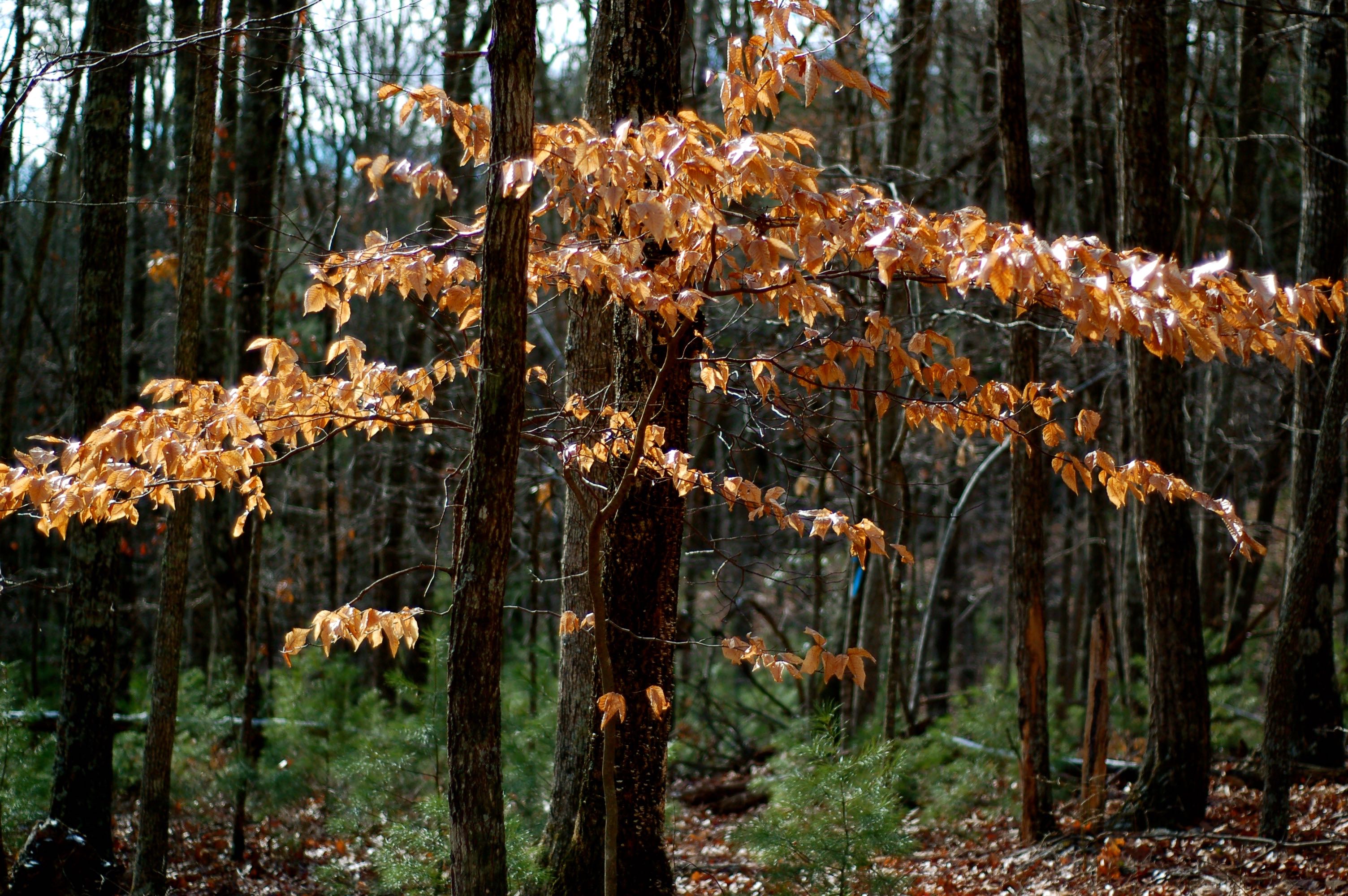
Beech tree in winter
Actually, I needed to get away from our kids. They’ve been home for what seems like weeks now (13.5 days, to be exact), and I couldn’t take the bickering and wrestling and whining and begging and pouting and grumping anymore.
Poverty Creek Trail
After two weeks of being around them 24/7 I was no fun to be around, either. I was so crotchety and cramped in that I didn’t even want to be around me, and while I considered going for a run, I’m tired of my running circuit: the same hay bales, the same sheep, the same hills and cows and horses in blankets. I needed more drastic measures yesterday. I needed to get in the car and drive away.
I wanted to be alone in the forest. And I wanted to see if there was ice on the Pandapas Pond.
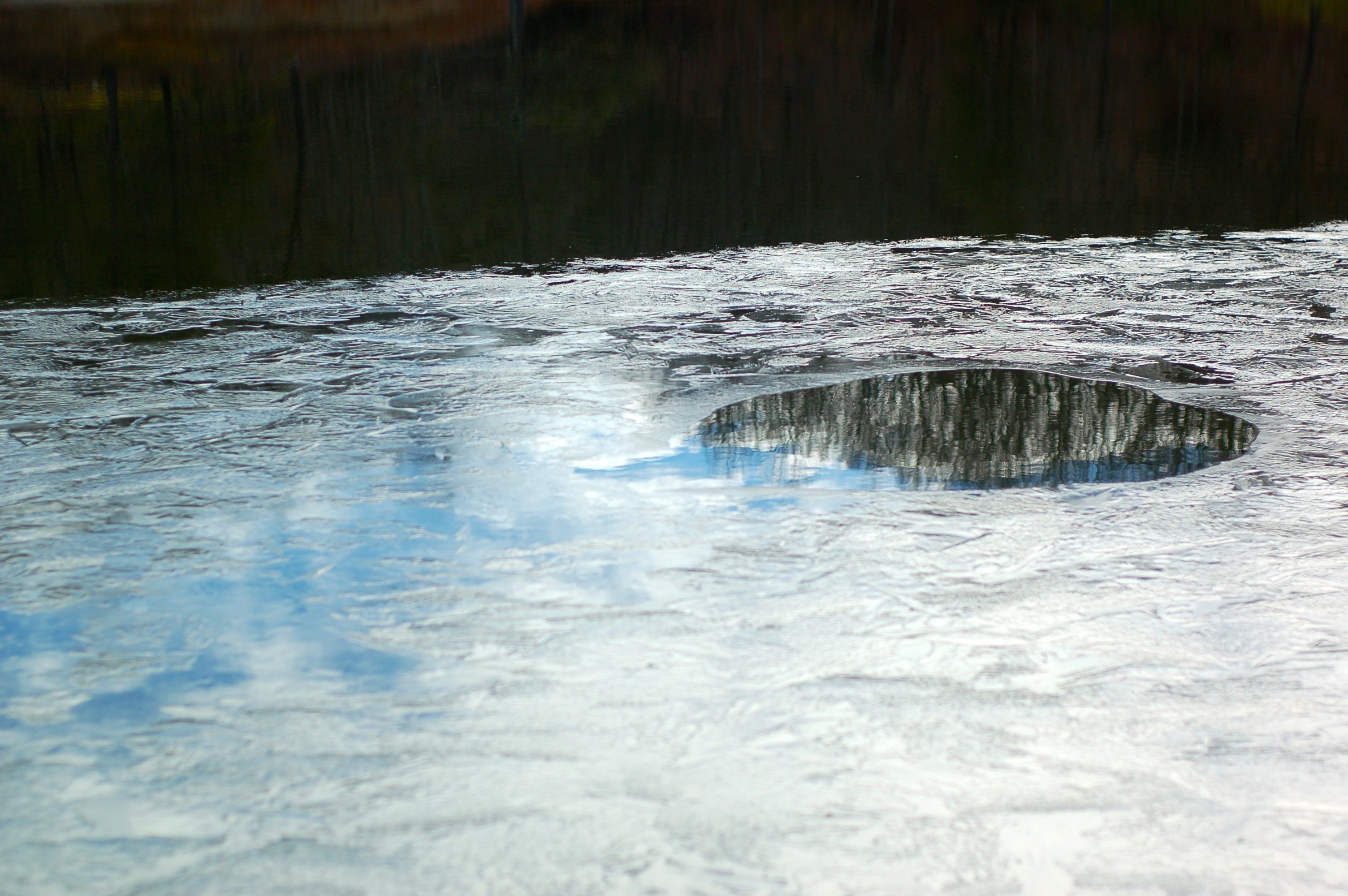
Pandapas Pond crystalizing
Winter hasn’t quite arrived in Blacksburg. It has been fairly warm here the past few nights, so I wasn’t sure how liquid or solid the pond might be. I was excited when I hiked in, gloves and hat on, camera in hand, and saw a thin sheath of new ice creeping from the shore towards the middle of the pond. I lost myself for a while watching the breeze blow ripples against the thin crust; I was mesmerized by the movement of liquid against the crystal skin.
Pond freeze in progress
The trail, too, was icy. It is heavily trafficked by mountain bikers, hikers, and runners, and low points in the path are often trampled into mud pits. I always forget that on this trail. There was no way around the first pit, so I steeled myself to sink into it. But my boot didn’t squish into the muck, it crunched over it. The shiny mud was frozen solid.
Snow cup fungi
ice crust on ground juniper
Frozen tire tracks
Beech leaves
I love hiking solo, listening to the crackle of leaves (or mud) underfoot, the thump of my boots on the trail, the sigh of wind over my ears. I stop and take photos. I breathe cold air into my nose. I feel my cheeks turn pink and nod at runners as they pass. I spend time in my head, running calculations on how many notebooks I’ll fill if I write 10 minutes per day for an entire year (~5.5 100-page composition books).
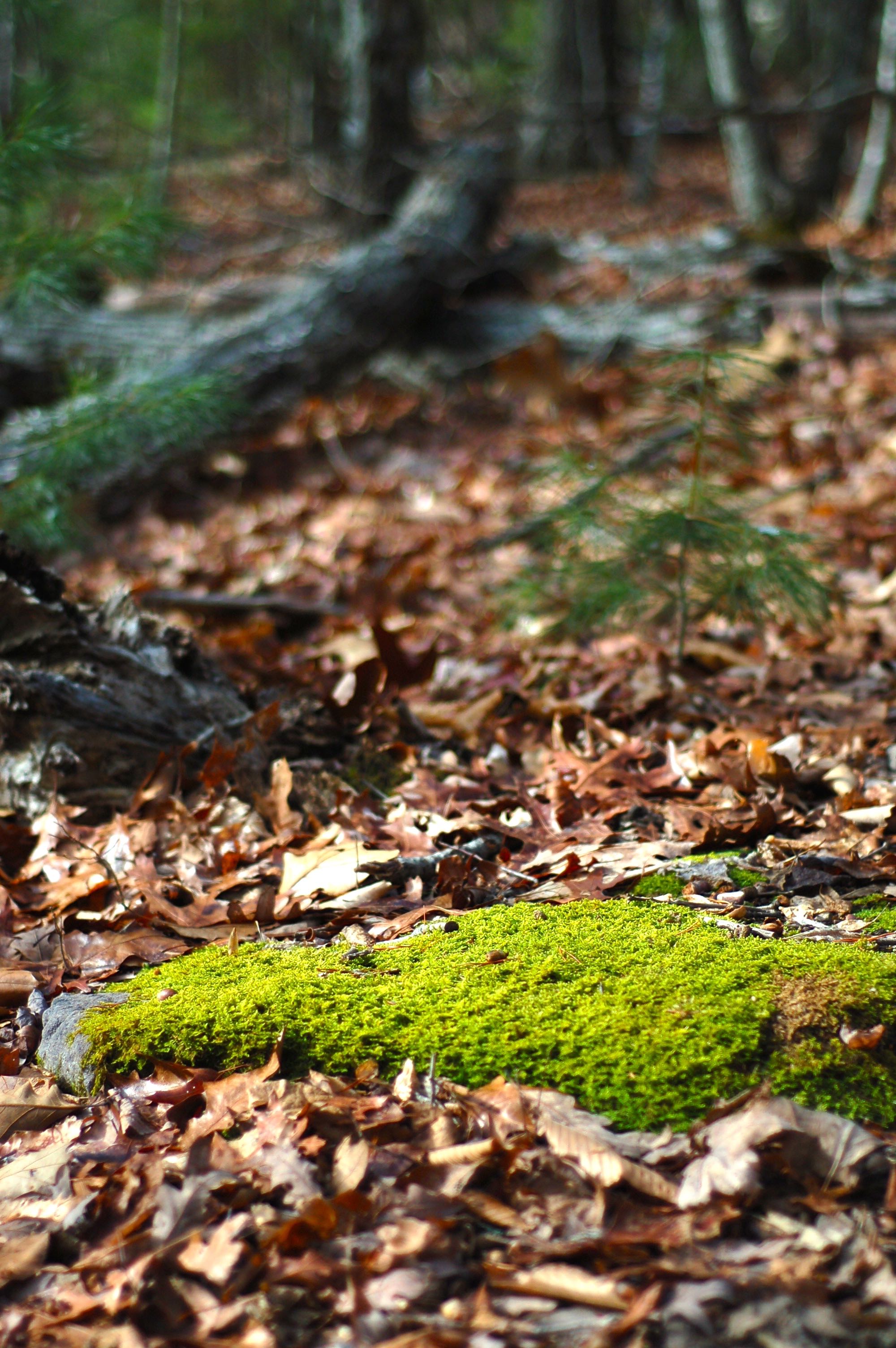
Mossy stone in the woods
Sometimes I come home from a hike recharged, ready to take on the tasks of life again. Other times I return home and wish I could have more. More quiet. More solitude. More thinking time. Yesterday, fortunately, was the former. I returned to a house full of children (ours and others’), but also to a warm kitchen where I sank my hands into bread dough, and to a husband who assured me I wasn’t a horrible person for running away.
Poverty Creek Trail
Crystalizing
Under the ice
tree skeletons
New ice
This is my entry for the Daily Post Photo Challenge: New.
We were occupied with sports and travel every weekend this autumn, and as a result, did not go on a single camping trip during the most beautiful season in Appalachia. So when it was warm and sunny on the day after Christmas, we took advantage of it and hiked for the first time in months.
Our kids were disappointed that we didn’t have a white Christmas this year, but when the temperature hit 54 degrees (12° C) on December 26 , I didn’t complain.
I was excited to finally bring my new lens on a hometown hike, and was thrilled at how well it worked in the low light of the forest.
Water falling
Riffles, Cascades hike
Froth in a sunbeam
Heart rock
Hiking hand in hand
Water over stone
In December the stream can easily be dripping with icicles. This year, there was no ice – only liquid. And our daughter stepped into it fording the stream.
Fording the stream, Cascades
Cascades waterfall
Waterfall froth
Cascades stream
Slipped in the stream
Luckily the sun shone on us – and her cold wet jeans – for the return hike to the car.
The Cascades
This is my entry for the Daily Post: Warmth photo challenge.
Swinging Bridge at Babcock State Park, West Virginia
“Hey Mom, are trees living things or living beings?”
Our nine year old son looked into the forest then up at me as we hiked side by side along a gurgling brook. His dad and sister walked a few steps ahead of us. Upstream was the Glade Creek Grist Mill in West Virginia, a rustic wooden building with a pitched roof. Today its wet planks were framed by yellowing autumn trees.
Glade Creek Grist Mill, Babcock State Park, WV October 2013
Glade Creek Grist Mill, Babcock State Park, WV autumn 2013
Glade Creek Grist Mill, Babcock State Park, West Virginia October 2013
Stream with rocks and autumn leaves, Babcock State Park, WV October 2013
“I guess that depends on what you mean by living being,” I said. “I think of a being as — ” I tried to think of words that would be familiar to him. I failed. “As a sentient being — something that has a soul.” The path was littered in gold, red, and toast brown leaves, and I kicked at a drift with my leather hiking shoe.
“Personally, I think of trees as living beings,” I told him, “but I think a lot of people probably think of them as living things.” Our son looked up the mountain into the dripping forest.
“What’s a soul?” he asked.
I sucked in a big breath. “Oh boy,” I said. Up ahead, our daughter twirled a red maple leaf between her thumb and pointer finger. “Your soul, if you believe in souls, is…” I struggled to find words. “It’s the part of you that makes you you.”
“You mean like your personality?” he asked.
“No, the spirit part. The part that is left after you die,” I said, then immediately knew what was going to come next.
“So like a ghost then!” our daughter said.
This was difficult.
“Not quite.” I searched my brain, trying to find language to describe souls to a seven and a nine year old.
“Your soul is the parts of you that aren’t physical,” my husband told them. “Your feelings, memories, friendships. The emotions you feel. Love.”
Our son tilted his head. “But isn’t all that stuff just your brain?”
I looked up to the trees again, hoping for some help. There was no wind; the trees were not talking.
“Yes, that’s one way to look at it,” I said. We like to give our kids a suite of options when it comes to spirituality and religion, to let them know that there is no hard and fast answer. No agreed upon truth that works for everyone all at the same time, and that they get to choose what they believe. “Some people believe that what Dad and I are describing as spiritual — feelings, intuition, love — is purely physical. A series of chemical reactions in our brains, nothing more.”
He kicked at leaves, thinking. I was still stuck on the soul thing. I wasn’t satisfied that we’d explained what a soul is.
“Remember when we talked about reincarnation?” I asked. The kids had asked about religion several months prior, and I told them I thought there are as many paths to God as there are people on earth. Then, in typical over-informative fashion, I gave them synopses of several religions of the world: Christianity and Judaism, Buddhism and Hinduism, Wicca, and Islam. The concepts of reincarnation and karma resonated with them more than the idea of heaven and hell did.
Our son’s ambition: to be a bug
“Yeah.” He looked up at me. He remembered the reincarnation talk. “Like I could come back as a bug!” This excited him, the idea of coming back as a bug.
“Remember how I said that when you die some people believe you go to heaven or hell, or in the case of reincarnation, you might come back as something else – another person, or maybe a bug?” I said. “The soul is the part of you that would go from one life to the next, that would go into that bug after your body died. It’s the part that would carry everything you learned in each incarnation.” I gestured uselessly to my heart. “The spirit part.”
My brain hurt from the effort of describing this. Soul, sentient, spirit. How do you explain these things? “But reincarnation is just one idea. Brain chemistry is another.”
“So nobody knows the real answer,” our son said. “What happens when we die, whether our feelings are just our brain or part of our soul.”
“Nope. It all depends on what you believe,” I said. “Nobody knows for sure.”
The leaves in the trees rustled a little. Not much, but enough to remind me of our son’s original question.
Green, red, yellow leaves Babcock state park, WV, October 2013
Appalachian Valley in early autumn, Babcock State Park, WV October 2013
Autumn leaves on grassy hill, Babcock State Park, WV October 2013
Golden tree (beech?) in sunbeam, autumn, Appalachia
“I think mostly people think humans have souls, and maybe animals have souls, but I don’t know that a lot of people think of plants as having souls. So most people would probably call trees living things.” I looked up at the green and orange and yellow and red leaves, and the strong trunks with rough or papery or chunky bark, and I saw how all those trees were nestled together as a community on the mountainside, gathering sunlight, being beautiful. I thought about the times that I have felt one with the whispering forest, when there was no doubt in my heart, or mind, or soul that trees are part of the same absolute that I am a part of, that we are kindred.
“Do you ever feel a connection to nature?” I asked our son. “Like, in your heart, a feeling that doesn’t have words, you just feel it when you’re out in the woods or by a stream or something?” It was my last hope, in this “thing” versus “being” discussion, that he would know what I was talking about.
“Yes.” He said this without hesitation, and I knew he would get it now.
“Me too,” I said. “Sometimes when a breeze blows through and the trees sway and their leaves rustle, I feel like they are talking. I don’t know what they are saying, but they are saying something.” I looked up to the forest again. “In their tree language.” Our son giggled. “I feel connected to them somehow, like they have spirits, or souls, or whatever you want to call it.”
“So when I think of trees,” I said, “I think of them as living beings and not just living things.”
Our son’s eyes flared with understanding as he looked up at me. “Yes,” he said. His body relaxed with the contentment of a seeker who has found the answer he sought. “I think you’re exactly right, Mom.”
Yellow is autumn trees to me. Originally published October 17, 2013.
One of the biggest challenges of transitioning from stay-at-home mom to full-time-working-mom has been carving out time for errands, time for exercise, and the element I yearn for most: time for creativity. Which, for me, means quiet time. Alone.
I decided to experiment this week by scheduling a work day on Saturday and taking a flex day today. I had a hair appointment at 9 AM – grooming! a first step in starting to figure out this work-life balance thing – and made a long list of errands I’m rarely able to get to anymore during the week: bank, post office, library, kids’ school.
When I saw that the day’s photography challenge was Solitude, I grabbed my camera and added “photos” to my list.
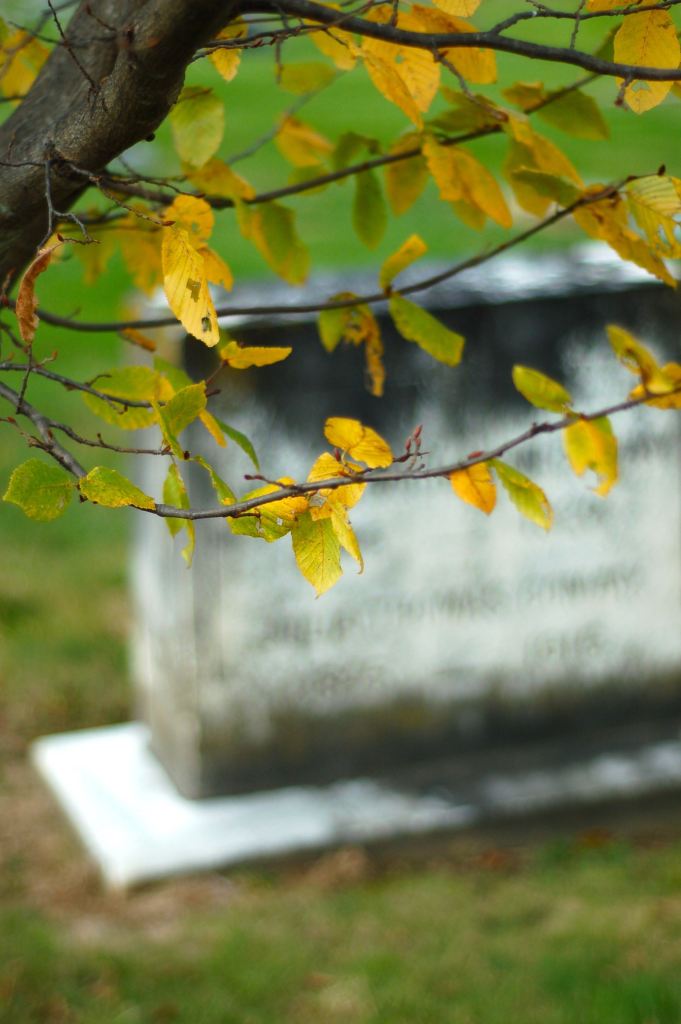
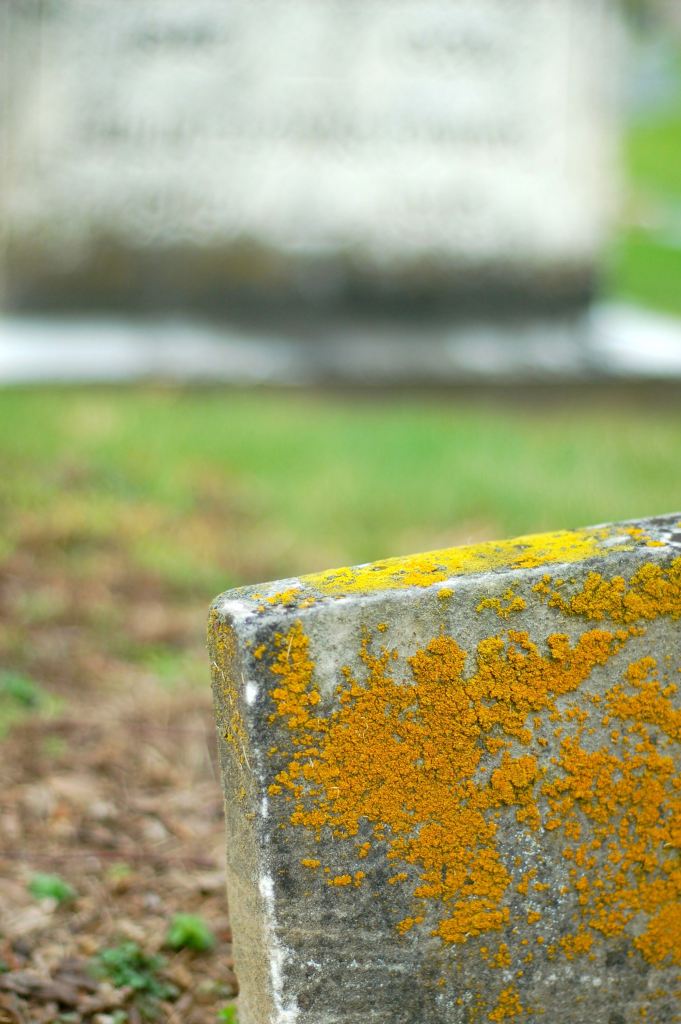
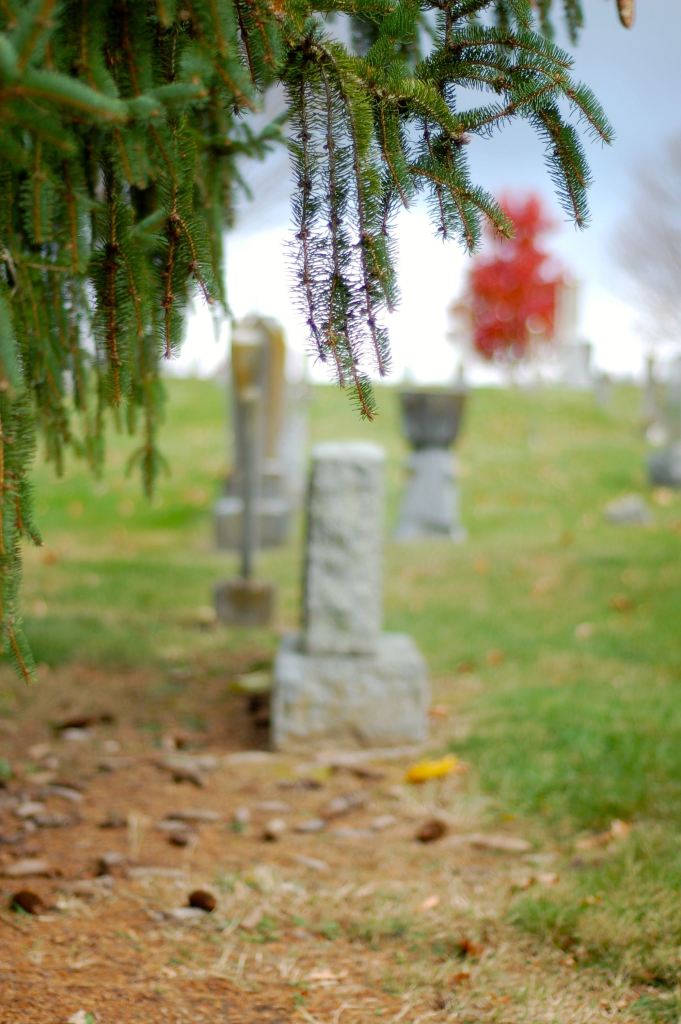
Leaves and tombstones, November, Blacksburg, VA
I was inspired by my photo-genius coworker, Jen Hooks, who blogs at lightcandy: she is not pulling photos from her archives for the Photography 101 course many of us are taking. She is aiming to get behind her lens every day and shoot new work. And with a day off, I wanted to do the same.
The first thing I thought of on this cold, misty November day, when I had the day all to myself, was the cemetery. Is that weird? It called to me with its emptiness, and its silence. Though my days have no noise, my mind feels loud. I feel like I’m rushing all the time – rushing to get the kids’ lunch boxes packed, rushing to throw the dishes in the dishwasher, rushing to get the kids to sports, rushing to take my shower, rushing to “get to work” (down in my basement office).
There’s no rush at the cemetery. It is quiet. It is peaceful. It is slow-paced.
It was exactly the stillness, and the solitude, I needed.
I shot these photos for Photography 101: Solitude, and for Jen Hooks’ Minimalist challenge.
Cloud with rainbow over Gulf of Mexico. Anna Maria Island, FL.
I am a morning person. I love to get up before the world awakes and listen to the quiet.
When we camp, I boil water for coffee on a Coleman stove that pings and hisses, then I sit quietly and watch a leaf fall, and feel the warmth creep over me as the sun rises.
Even better than that, though, is when we vacation on Anna Maria Island on the Gulf coast of Florida. I don’t have to boil water there. I have a coffee pot that does that for me. When we are at the condo, I’m often torn about whether to sleep in or get up early.
But those mornings I do get out of bed early? I bring my mug down to the beach, sit on in the shade of a big pine tree, and sip coffee while I watch clouds grow.
I hated to post a photograph of a cloud yet again, but this photograph, and the memory of the morning I shot it, is my bliss.











 Butterfly Mind