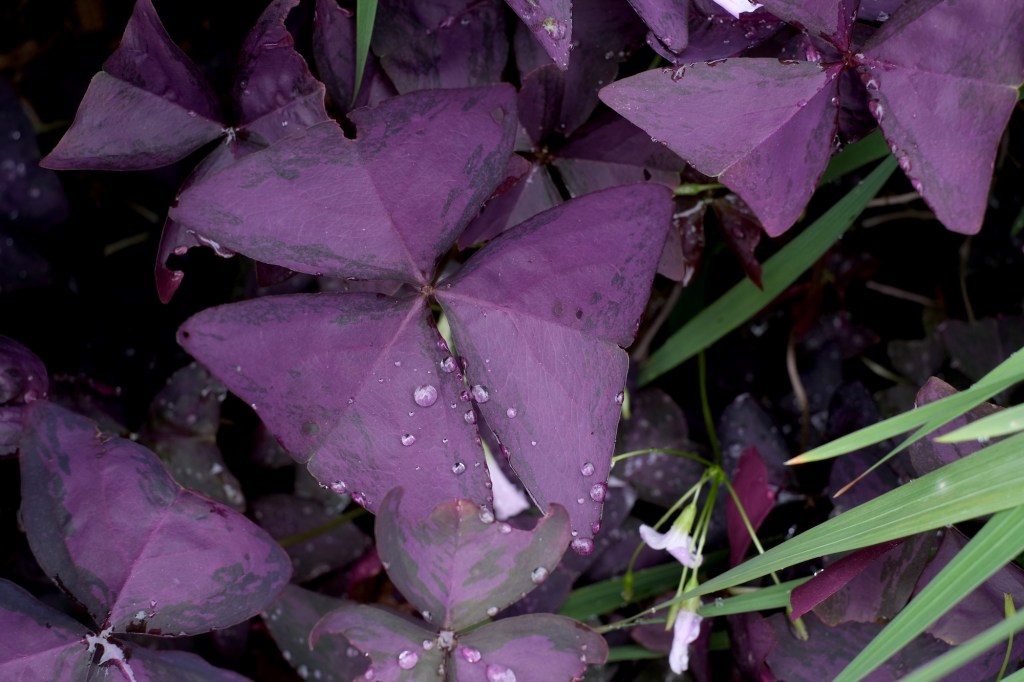
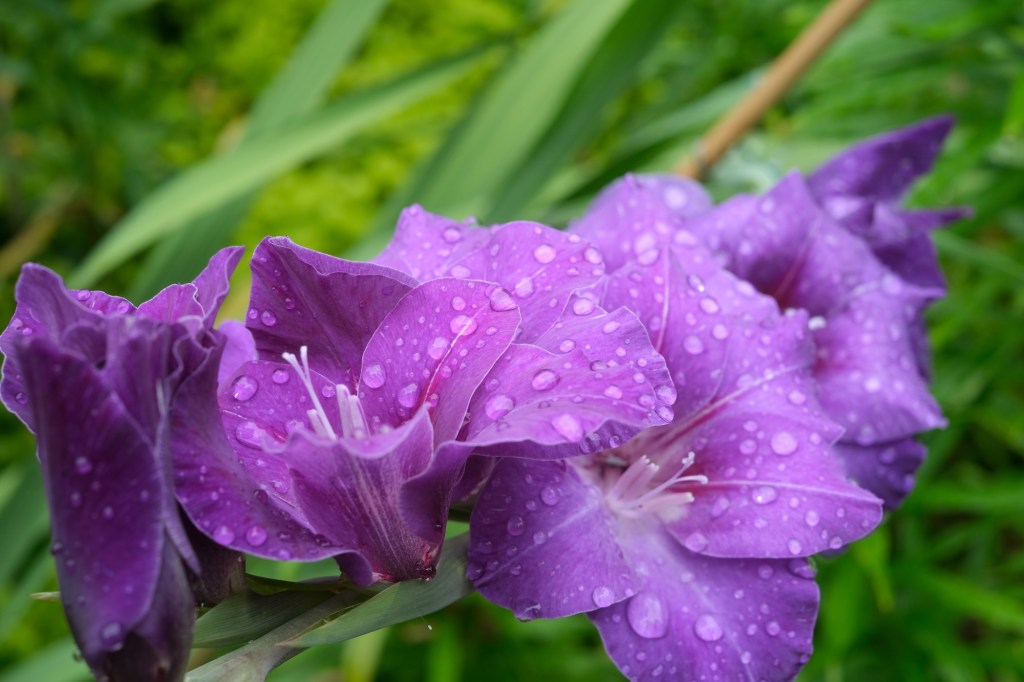
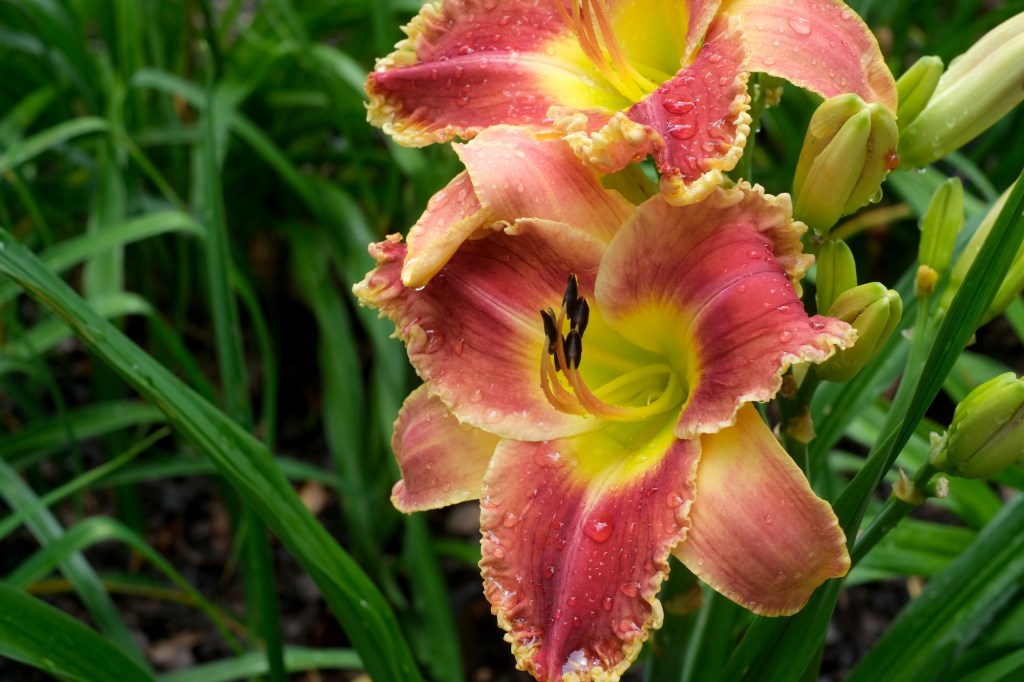
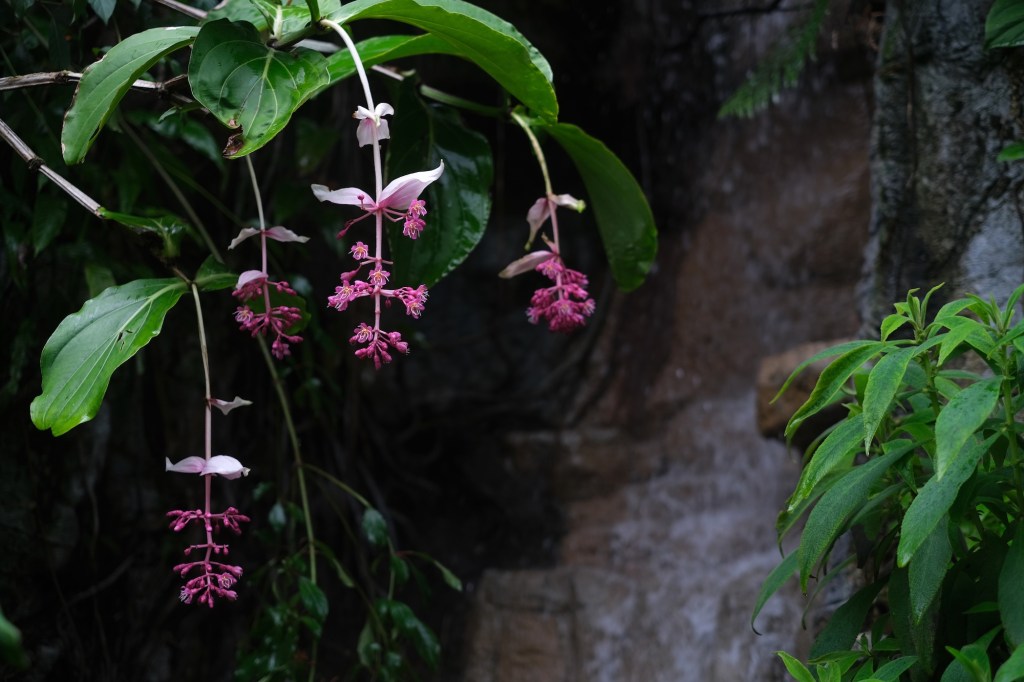
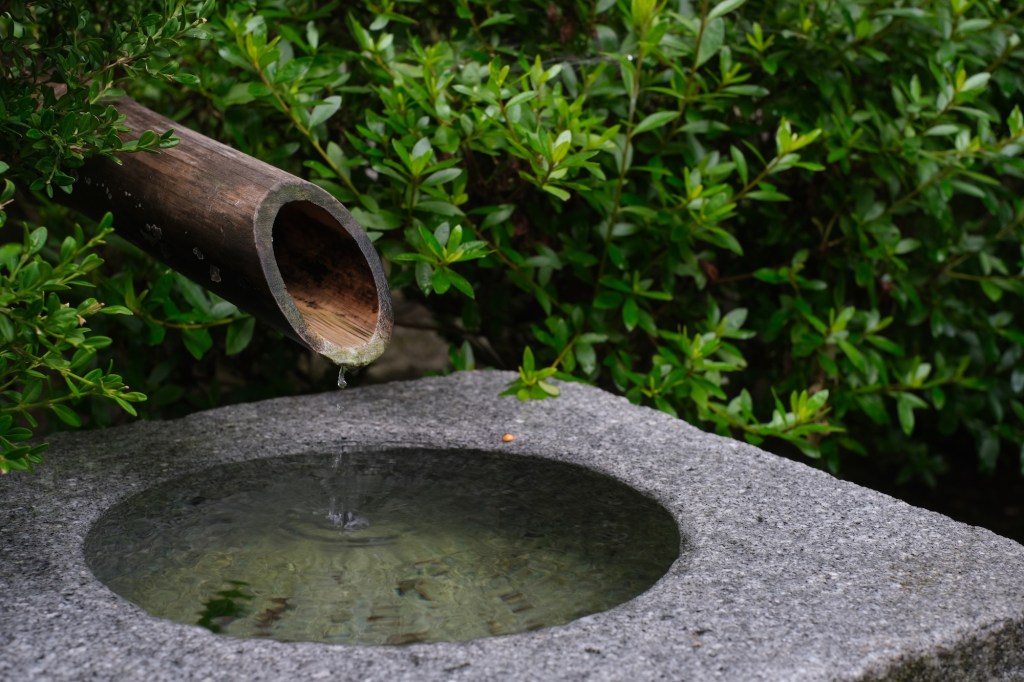
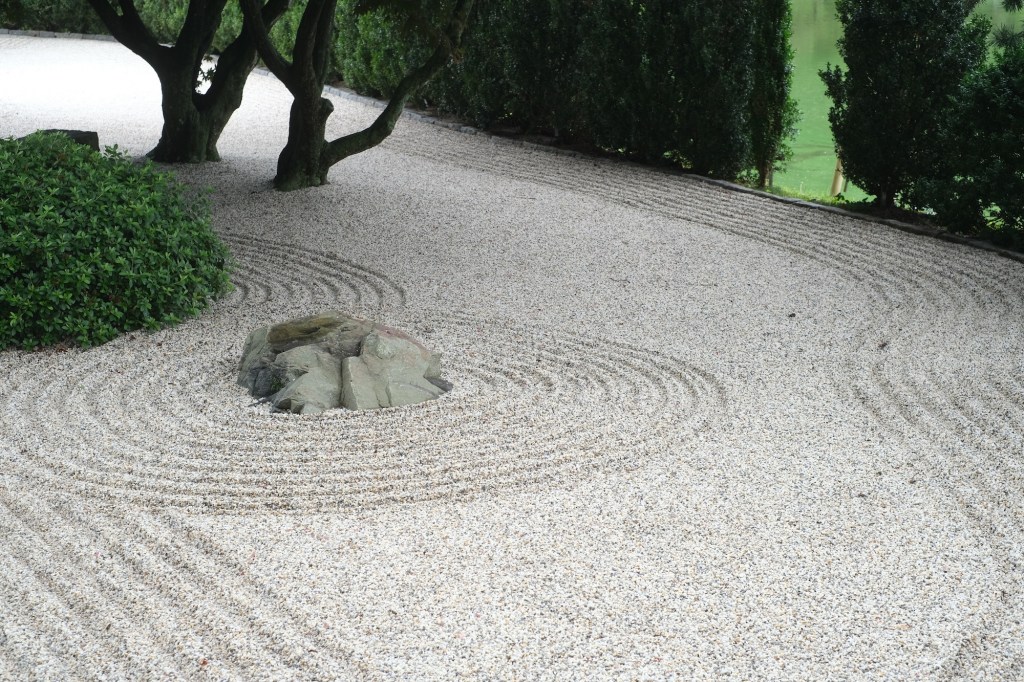
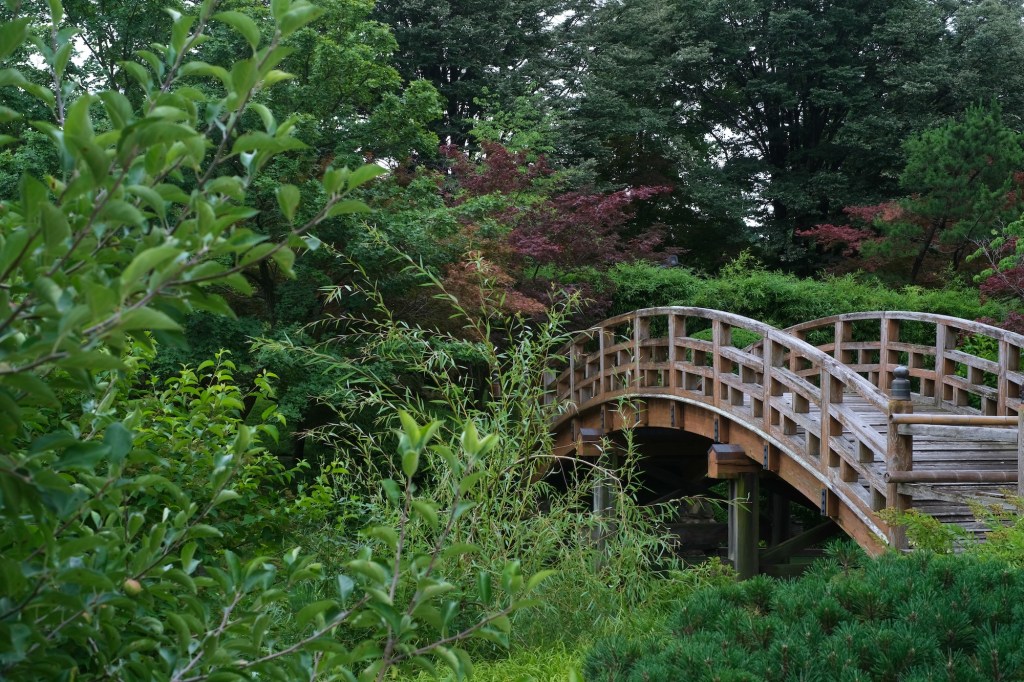
We stopped in St. Louis on our way home from a family wedding this weekend and spent an overcast afternoon at the Missouri Botanical Garden. If you are into plants and ever find yourself in St. Louis, go. Go to the botanical garden.
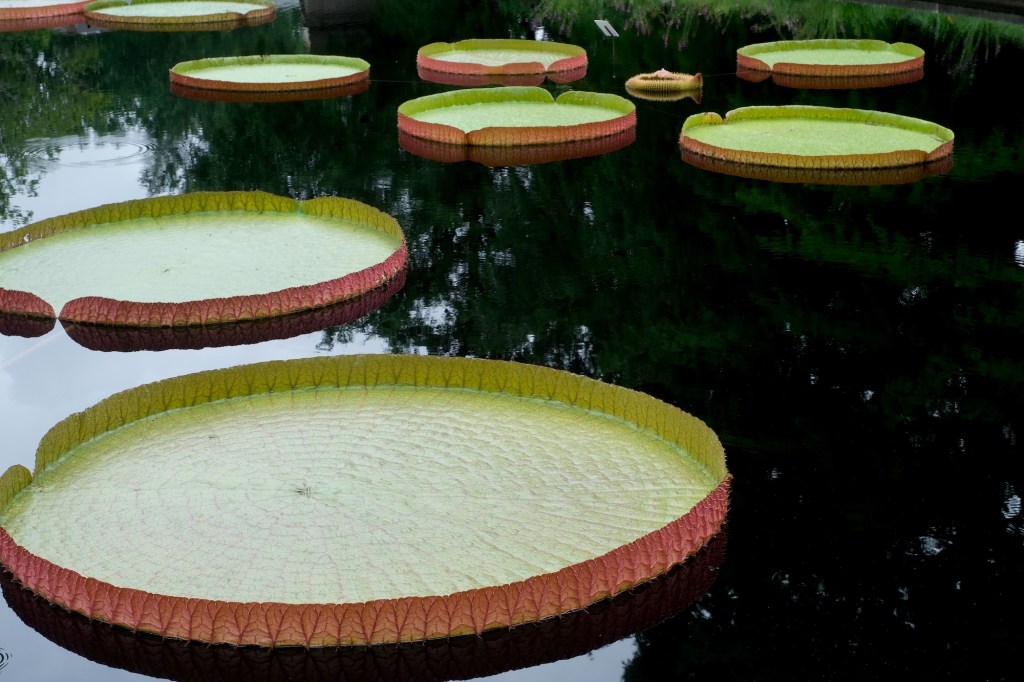
The beds burst with blooms and lush foliage. There are prairie beds, an orangery, lily pads so large you could lay down on them. There are lilies galore – large swaths of them in brilliant colors and frilly edges — and roses to bury your nose. The entire grounds are a work of art. I stopped every few steps to take photographs.
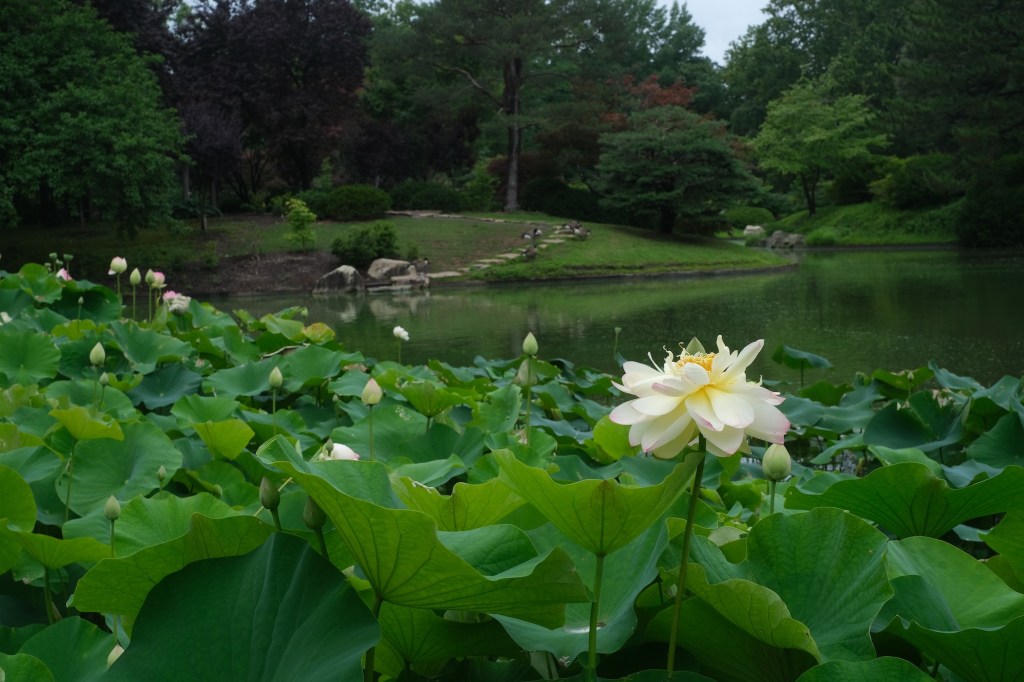
I am tempted to say the Japanese garden was my favorite. There were lotuses! And they were blooming! And the stroll around the pond was so peaceful, with the bamboo drip fountains and the raked gravel and an artful beach of smooth black stones. But then I remember the prairie beds at the entrance, filled with coneflowers, sages, and brown-eyed Susans, or I think of the bulb garden with more than 1200 varieties of bulbs: the fuschia-throated trumpets of lilies, the spires of gladiolas. Or I remember the bonkers lily pads that look like they’re from an alien planet, or the humidity-loving orchids in the orangery and the conservatory. It’s all amazing. All of it.
The first time I went to Spain was 22 years ago. It was July and sweltering, and I was pregnant with our son. We went to Barcelona with a friend who grew up there. We stayed with his Dad. We ate late-night gazpacho and fresh sardines from La Rambla on his terrace. Visiting a friend who was from Barcelona, who shared with us his favorite childhood pastries and his everyday meals and who welcomed us into his home, was one of the most magical travel experiences we’ve had.
Last week, I got to experience something similar, this time in cities I never knew I wanted to visit. My team at work traveled to Spain to meet up with a colleague who lives north of Madrid, and who couldn’t get away to travel. We had originally planned to meet up in Madrid, and he said, You should go to Segovia instead. It’s smaller and cheaper but has everything you want. Plus there’s an aqueduct! I can take you to good restaurants there. And you can come visit my city on your activity day and I’ll show you around!
So we went to Segovia. And his home town of Aranda de Duero. This time we were bundled up, and there were Christmas lights, and I drank all the Spanish wine my heart desired.
Segovia Aqueduct
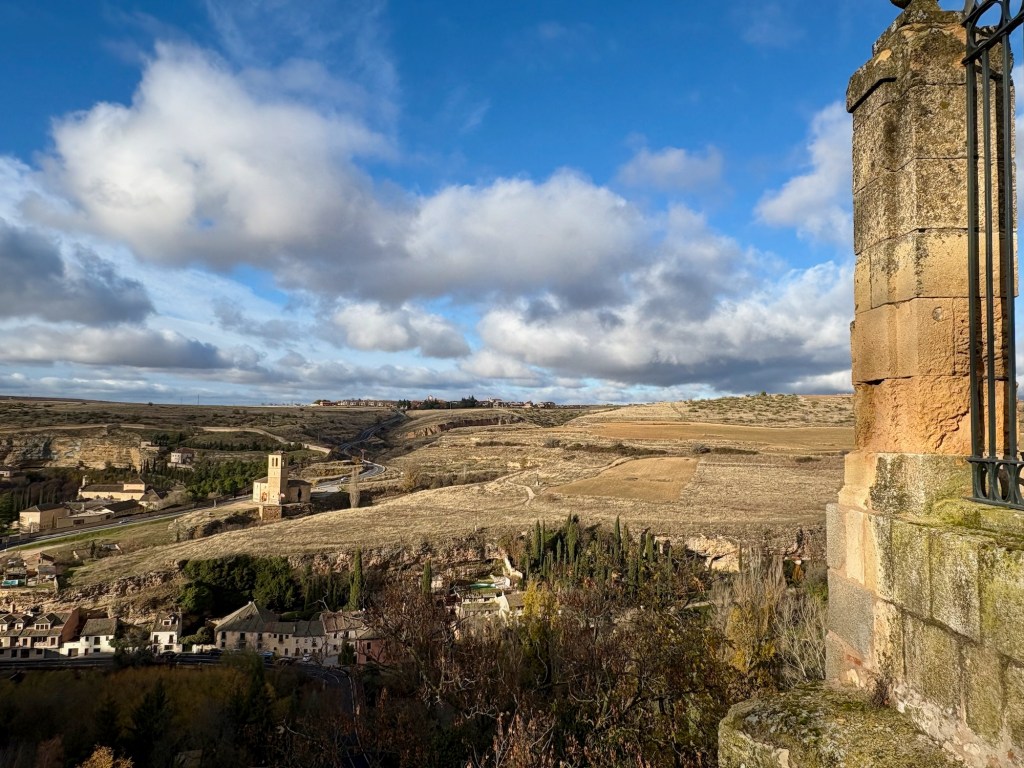
From the airbnb where we worked, we walked a block to get to the aqueduct, then we followed the aqueduct for 5 minutes or so to the heart of the city. On our first day, after working for a few hours, we took a stroll around Segovia under a crisp November sky. The ochre colors and earthy textures of the buildings and the landscape soothed my soul. I really loved it there.
Architectural textures in SegoviaI can’t get enough of the patterns and the earthy colorsLook at that light!Patterned exteriors of buildings. So many cool patterns.
As promised, Raúl took us to his home city of Aranda de Duero, the capital of the Ribera del Duero wine region, on our activity day. Raúl drove us from Segovia in his minivan, and as we approached the city, we saw miles and miles of browned grape vines propped in neat rows above the rocky soil.
Beneath the city of Aranda de Duero is a vast network of wine cellars, or bodegas, 10-13 meters under the ground. They are everywhere. Associations called peñas, which seemed similar to Elks lodges in the US, have their own bodegas where they meet, hang out, celebrate. We visited three. The first was an underground escape room, Ribiértete, which we managed to escape after copious wine. I won’t tell you any more in case you ever decide to go.
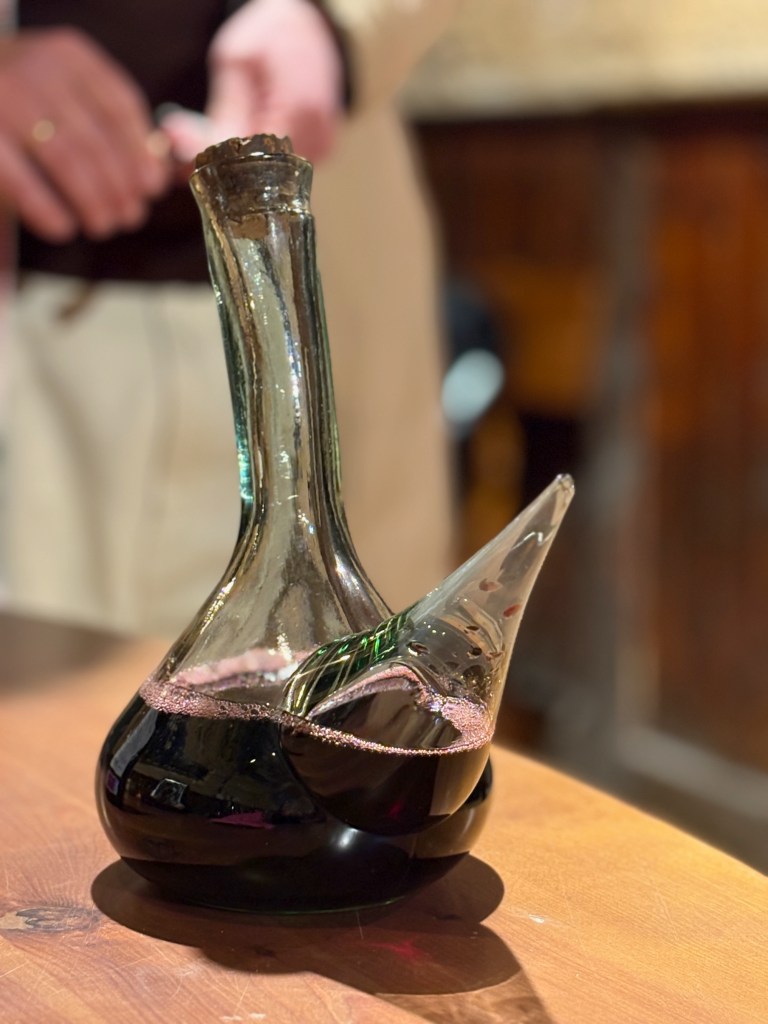
Our escape room host, Sonia, and a porron, which folks drink from in bodegas.
The second belonged to a friend of Raúl’s who was kind enough to show us around his bodega. He swiped a key card across the panel of a large wooden door, and it opened into a stone staircase underground.
Raúl had stuffed our pockets with bottles of wine from his own house, and I carried his porron in my backpack. Once we were underground and his friend had shown us around his bodega, Raúl pulled out a bottle, filled a porron, and he and his friend demonstrated how to drink out of it. You pour the wine in an arc into your mouth without touching the spout. It is not as easy as it would seem to do this without pouring wine in your nose or dribbling it all over your clothes. Luckily I wore black. I asked why this way? As soon as I said it, I realized, ahh! When done correctly, nobody’s mouth touches the porron. This makes for easy cleanup: no wine glasses to wash.
It took a lot of practice to get the technique right, but after 3 or 4 bottles throughout the day, we all mostly got there in the end.
After the escape room and the Bodega la Navarra, we went in search of tapas. Raúl’s favorite place was packed, so we walked around the block to another, where we got tortilla de patatas, the Spanish omelette with potatoes that I can’t get enough of, and some sort of small salty fish. I don’t know what it was but it was delicious. Probably anchovies. We were six people, and there was enough for each of us to have one or two bites of each, and then we headed back to the first tapas place to see if any people had cleared out.
We managed to find a standing table and ordered a larger assortment of tapas. The one I still dream about was a toast with warm goat cheese and caramelized onions. Oh my god. It was one of the best things I’ve ever eaten. There was something else with small pickles sandwiching anchovies and an olive on a toothpick. Google tells me that tapas that are skewered like this are called pintxos, and this particular one was possibly a Gilda. They are described online as “piquant”. I agree. It was briny and vinegary and crunchy and delicious. And everywhere had olives de anchoa (anchovies). I couldn’t get enough of these either. Raúl took us to his favorite olive shop at the end of our day and I bought a giant can to bring home.
After tapas, as we walked along the streets of the town’s center, Raúl pointed out doors everywhere — “That goes to a bodega. And that one. That one, too, and that one.” As he neared his peña’s bodega, he pointed across the square, “That’s my wife’s association.” He waved his card over the door, and we descended another set of stone stairs.
Raúl’s porron
We filled the porron and carried it with us as Raúl took us on a tour of his association’s bodega. One room was full of pictures of the members of the peña, lined up like in class photos at school, different events they’d hosted, and big life events, like new babies. I kept saying, “I can’t believe this is your life Raúl.” It was one of the neatest things I’ve ever experienced.
1503 map of Aranda de Duero, which is Spain’s oldest city plan and map in perspective. It is everywhere around the city, including on the label of the first bottle of wine we drank while there, the Tierra Aranda Tempranillo
I never knew I wanted to go to Segovia or Aranda de Duero, and now that I’ve been, I’m so grateful I got the chance. It would not have been the same without our friend and coworker as a guide. It was magical. Thank you, Raúl!
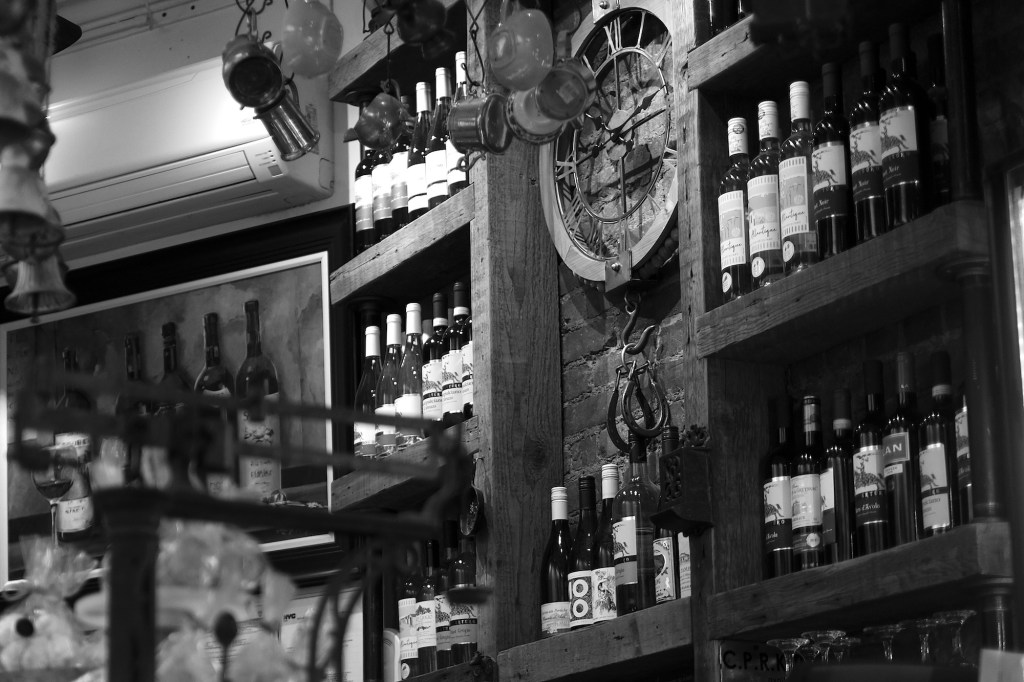
My husband and I went to New York over the weekend, just for fun. We stayed at the SoHo 54 and walked miles for 3 days straight. I’ve had a hankering lately to get back into black and white photography, so I carried my real camera with me in a shoulderbag I bought for our summer trip to Europe. I don’t always want to carry a backpack everywhere.
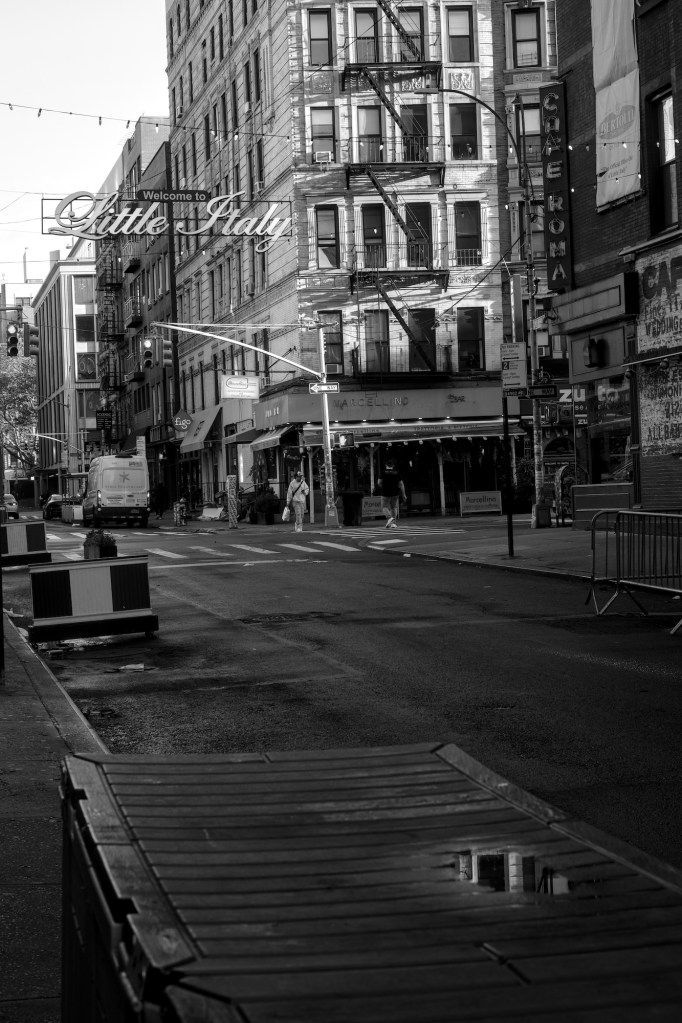
Spongies Cafe in Chinatown, where we got 3 spongies — basically angel food cake muffins — and 2 teas for $6Sunday morning in Little Italy
City photography is hard. There’s so much going on, all the time, everywhere. Cars to dodge, signs and streetlights and wires obscuring some part of what you want to photograph, being at street level, which throws off all the lines and perspective if you’re shooting upward. So I mostly stuck to other subjects.
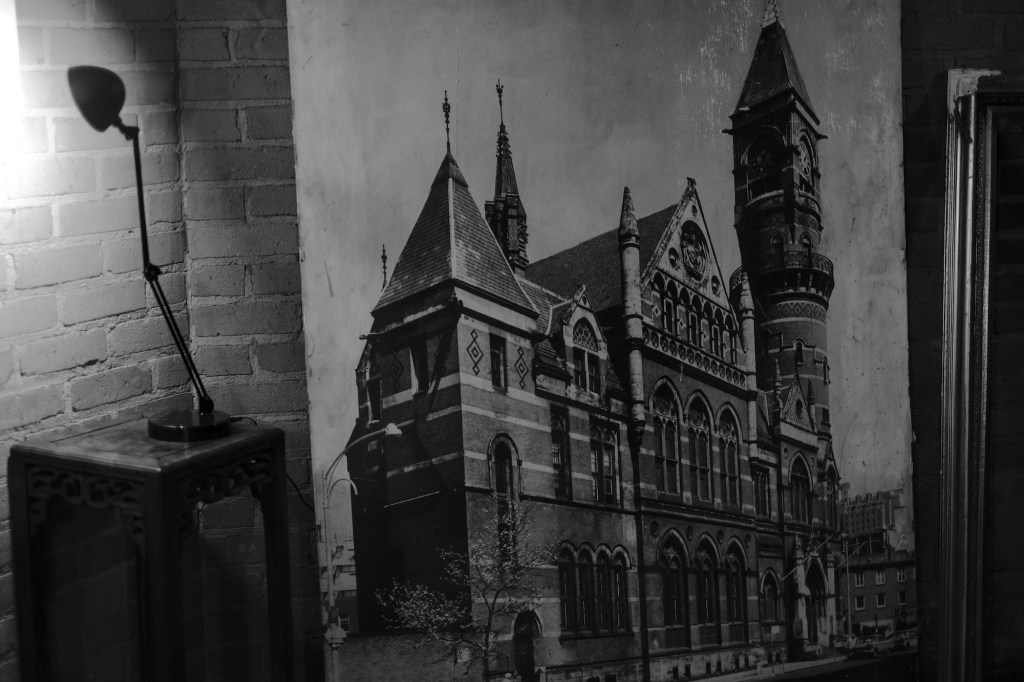
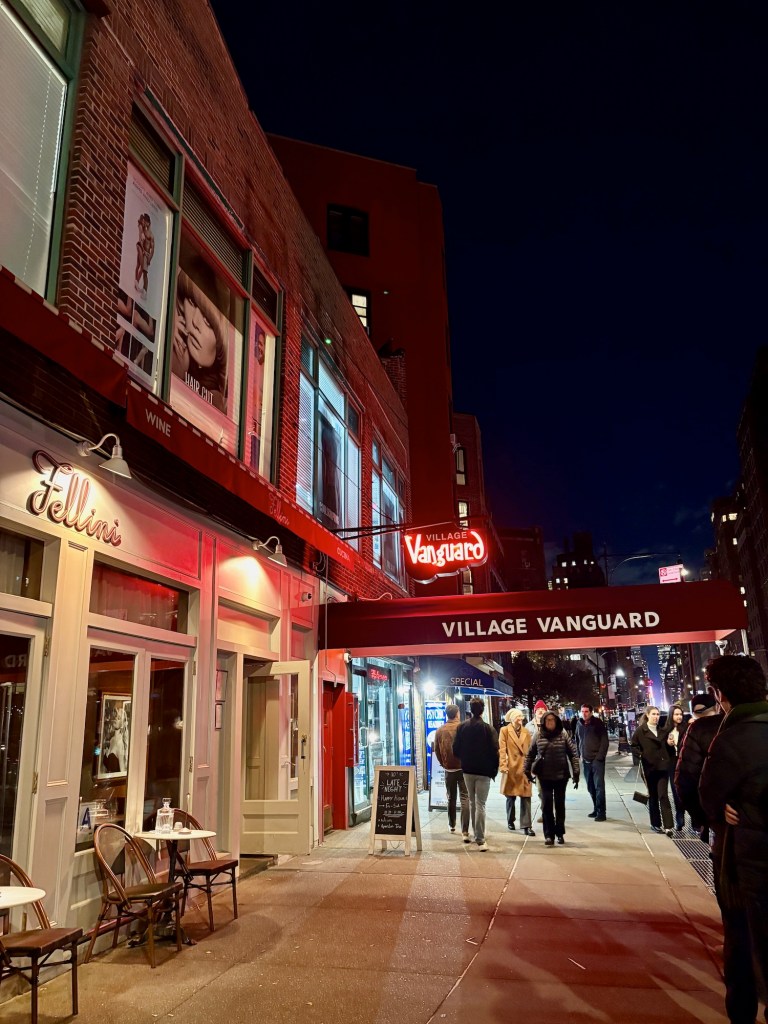
Teapot and timer at Little Hen in Greenwich VillageJefferson Market Library in Greenwich VillageVillage Vanguard
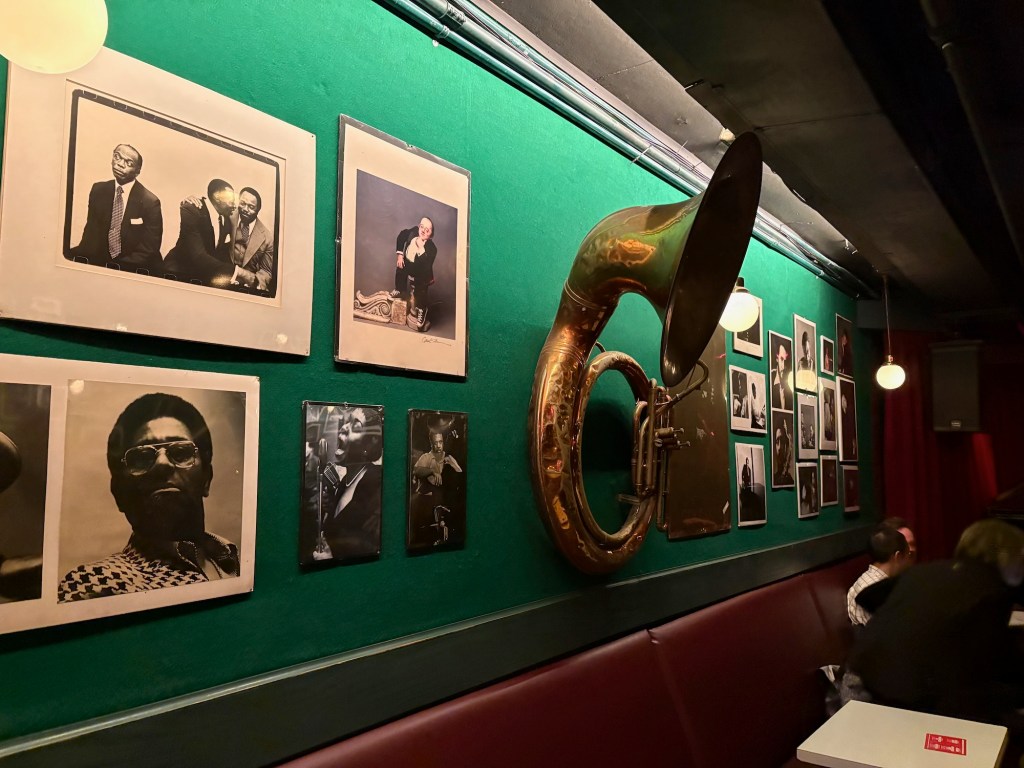
We made it to the Village Vanguard on this trip. We saw the Tyshawn Sorey Trio, who played without stopping, weaving one song into another, for over an hour. We, and all of the audience, were rapt. Witnessing creation, how the musicians interacted with one another, and listening as the music emerged felt like being inside an artist’s mind.
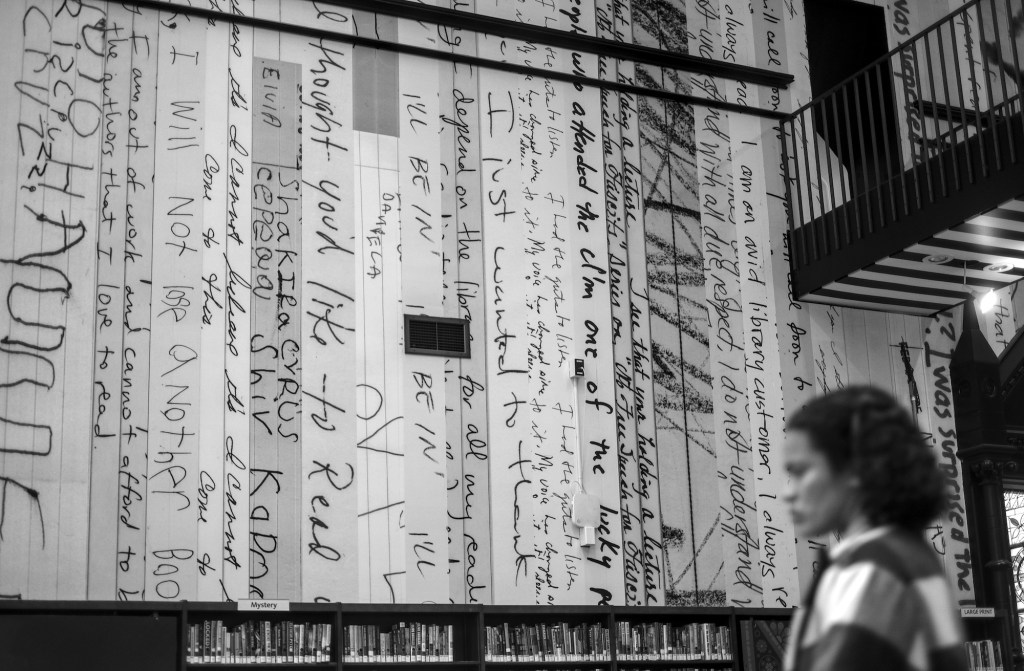
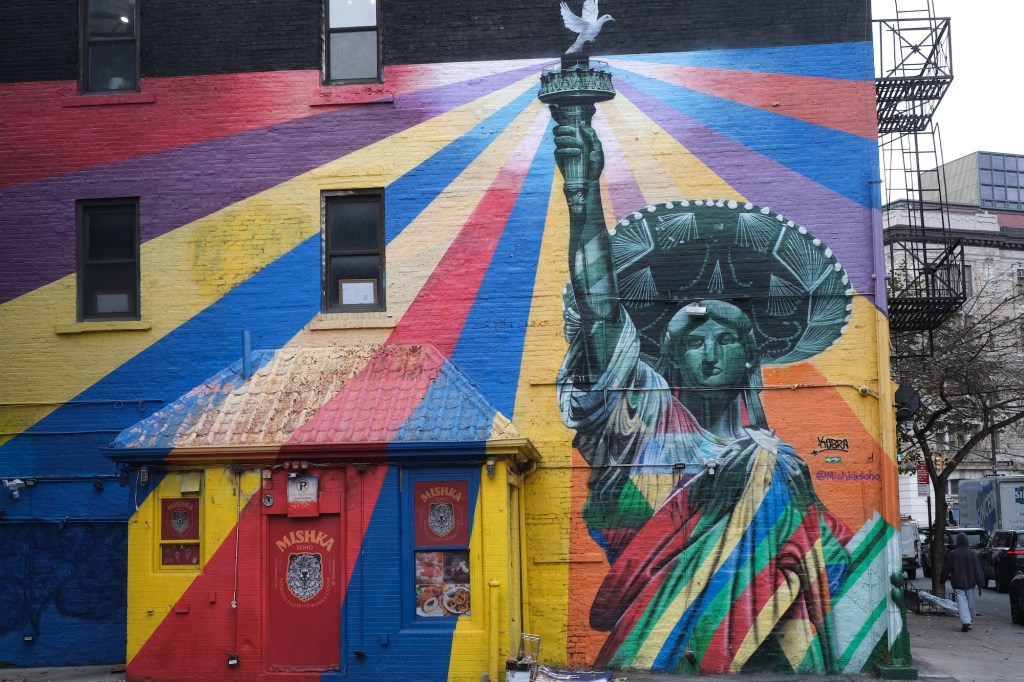
Flowers galore! Inside Little Hen teahouseUpstairs reading room at Jefferson Market Library in Greenwich VillageDictionary in basement reading room of Jefferson Market LibraryUpstairs reading room at libraryInterior Senza GlutenRainbow Liberty around the corner from our hotel
Bunnies snack on the leaves of my rudbeckia out front, but not enough to do any damage. The plants are still full, and the bright yellow flowers still bloom.
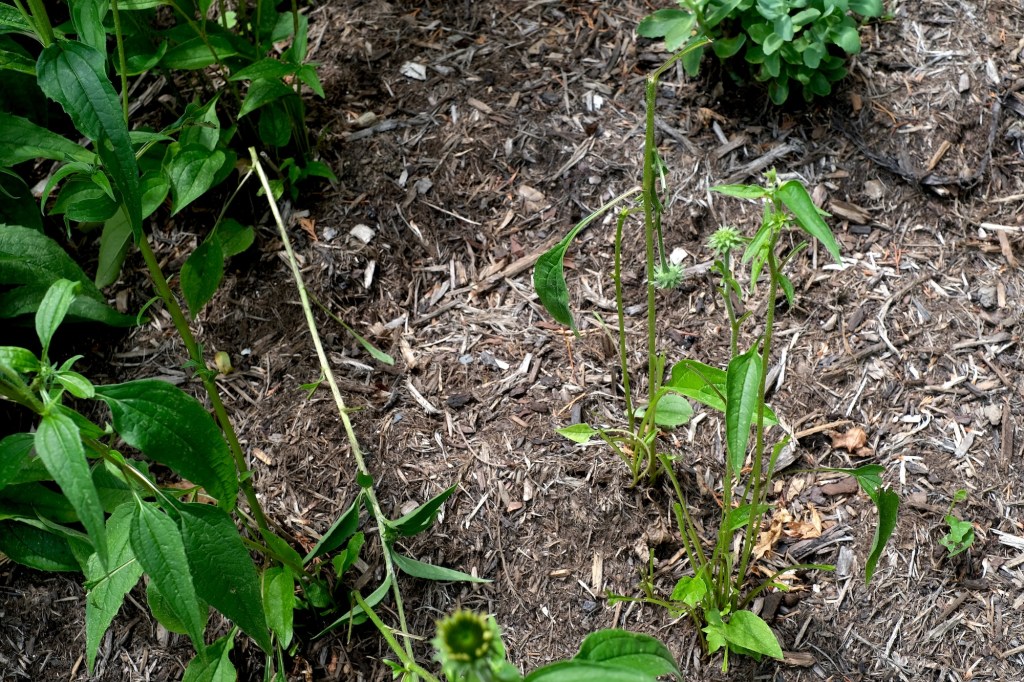
Out back is a different story. Out back, the five rudbeckia I planted at the beginning of my sabbatical are mowed to the ground; a few gnawed stems and a couple strips of leaf remain. There are no yellow flowers with black centers in sight.
When my friend Jessica visited last week, we spent a lot of time together watching the happenings in the back garden. In the mornings we’d see four deer — a doe, two speckled fawns, and a young buck with fuzzy antlers. The doe grazed at the platform feeder filled with seed for the birds, and the young buck looked right into my eyes as he bit a broad leaf off a hosta. He looked right into my eyes as he chewed it, then bit another leaf off.
When we ate inside, my friend and sat on the same side of the table so we could face the glass door and look out. We watched the cardinals and finches at the feeder. We laughed when the squirrel took his turn, and we’d get up to open the door to scare him off, and he’d leap to the nearby tree branch with all four legs spread like he was doing a belly flop, desperate to catch the leafy branch rather than fall to the far away ground.
When we were outside on the deck, we sat at the tall table so we could look out over the railing. We watched chipmunks dash, and hummingbirds drink. We watched bees bumble and bunnies nibble.
One day, we looked out and saw the tops of the echinacea swaying and shaking at the back of the patch. The plants are filled in with leaves now, so the creature rummaging around in there had good cover. We couldn’t see it to identify it. We had no idea what this animal could be — bunnies and chipmunks don’t create such a ruckus. I thought the only things eating my garden were the deer and the rabbits. This obviously wasn’t a deer, and if it was a rabbit, it was a mighty big one. We watched as the swaying moved towards the edge of the patch. I saw a patch of brown bristly fur on a substantial body. “Is it a raccoon?!” Then, a round brown groundhog emerged, pawing the echinacea stems to the ground, stripping leaves off, eating as it went.
“Eeeeeee! It’s so cute!!! Look how fat!”
We watched the groundhog decimate my echinacea plants, then squealed as it waddled off — faster than you’d expect! — fat rolling, its blubbery body low to the ground as it ran up the hill.
The garden has grown quite a bit since I finished mulching at the beginning of my sabbatical. Now the animals are mowing it back down. I’m not sure what all will survive them grazing at the buffet I’ve created, but I am certainly entertained by the tableau.
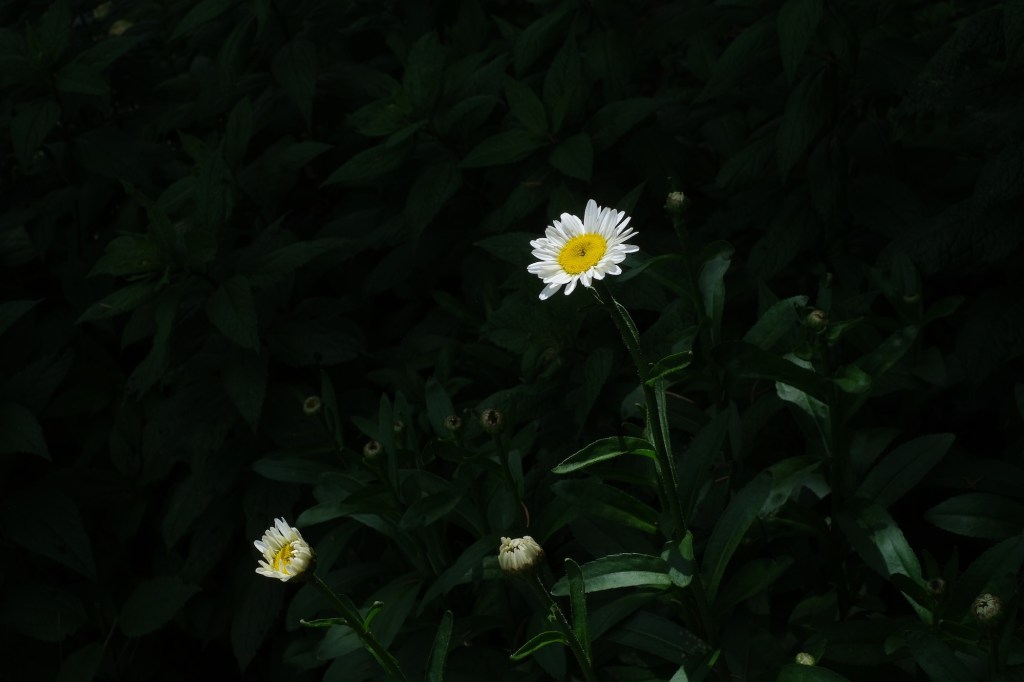
AprilJunePoor hostas. Three down, one to go.Gus the groundhog was here.Bees don’t do much damage.The back yard buffetThere’s still plenty of echinacea left.Nothing seems to be eating the daisies.
A pug is sitting at my feet looking up at me with pitiful eyes, hoping for a crumb of my iced lemon pound cake. The coffee shop is painted a soft green. A long cushioned bench upholstered in floral fabric lines the wall. The front window is framed by cascades of lilac and jasmine. In the back of the café is a flower shop. Two women chat in French as they strip leaves from stems under a ceiling of skylights. A sign on the wall above them says La Fleuriste. The espresso machine whirs. A demitasse spoon tinks in an espresso cup. A florist pours water into a pail and I hear it trickle like a faucet.
-June 11, 2025, Paris
Romantic is a soft, gauzy feeling. It is a blush, a glow. The ruffle of a petal or a skirt. It is the fall of light. It is the rush of love, the hope to create beauty, the glimmering of an ideal. Romantic cherishes what could be and softly, gently, attempts to make it real. In the attempt, it succeeds, if only for a moment.
I am prone to romanticizing. In my younger years, this romanticism could be painful. I wanted romance to last, whether the romance was that fluttery feeling of first being in love or the glowy feeling the golden glimmer of evening light gave. In my adult years, the ephemerality is part of its allure. Romance is special when it shows up.
When I was younger, I also could not square that romance could live alongside truths with harsher colors and harder lines — if the hard realities existed, and romance faded, then my romantic notions must be false. Boy was that a depressing thought. Now I know that life is made of both romance and the not so romantic, and that the hard elements make the romantic — which is just as real — that much more sublime.
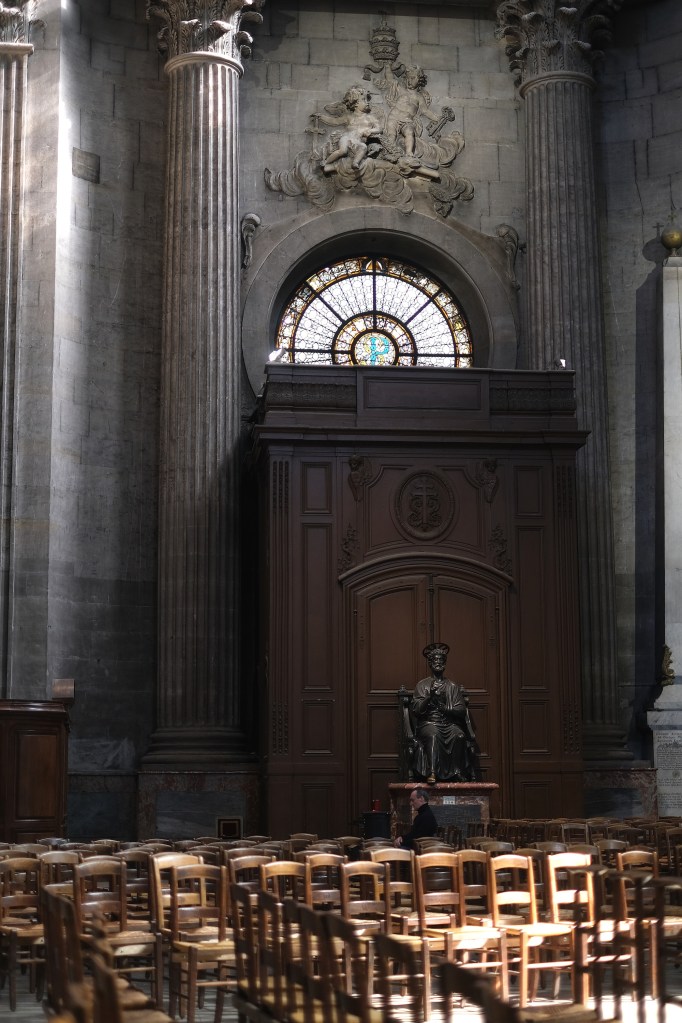
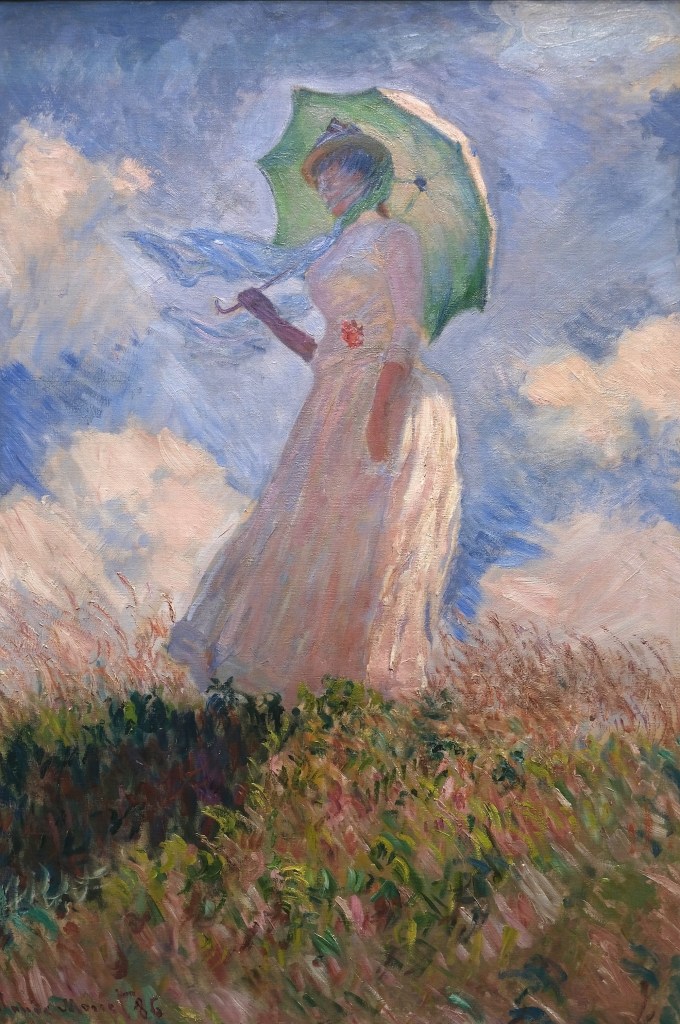
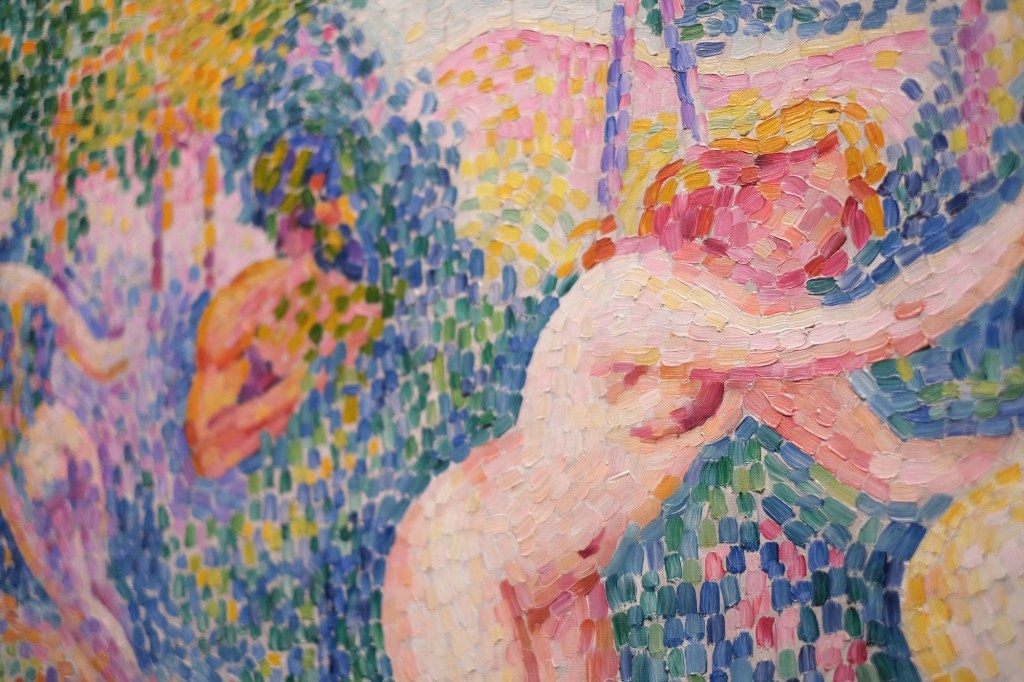
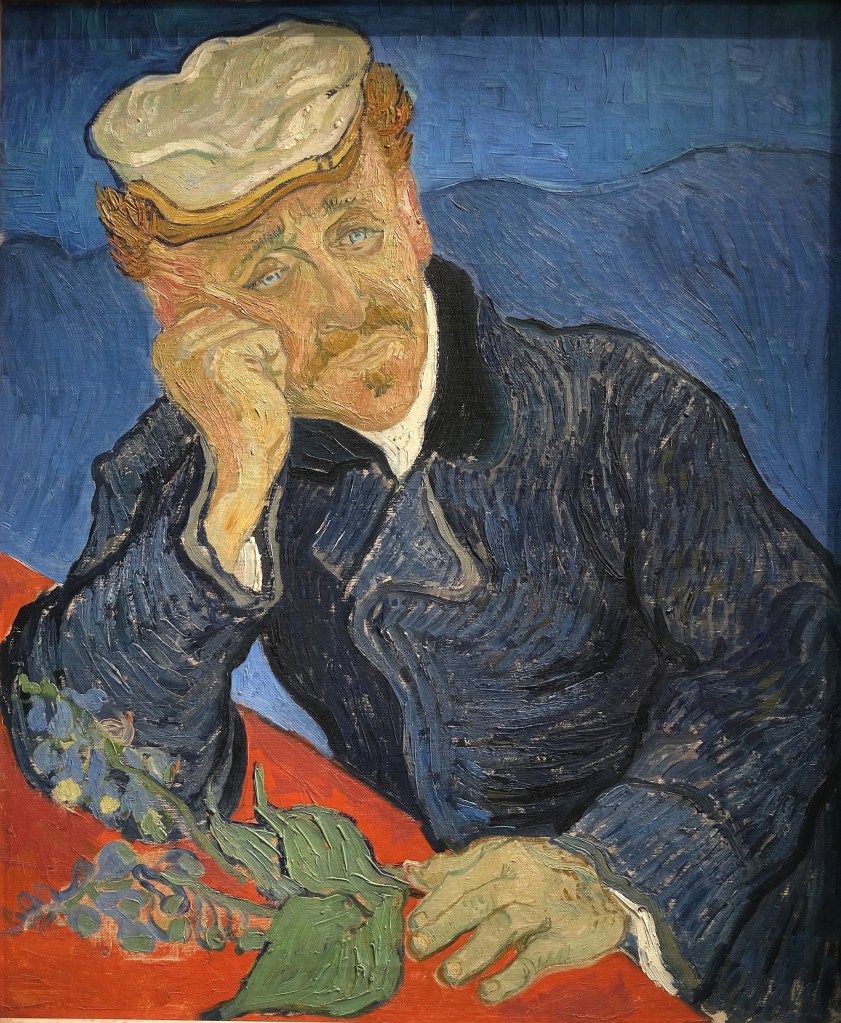
I savor the romantic when I’m lucky enough to experience it: the moment will likely be fleeting. Our days in France were full of romantic moments, including these on my final day alone in Paris, from the fall of light in St. Sulpice cathedral, to the soft floral shelter of Cordelia’s Coffee Flower Shop, to the bright blue door of the apartment where Hemingway wrote words that made me want to visit Paris, to the masterful impressions of mood and light in paintings at the Musée d’Orsay.
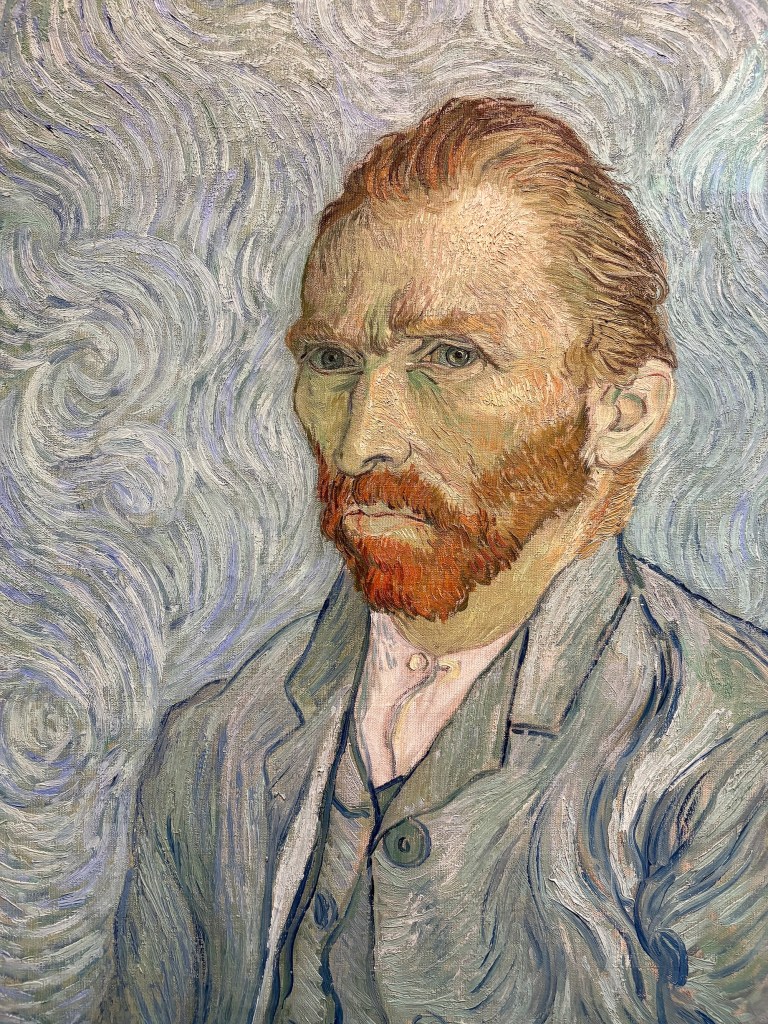
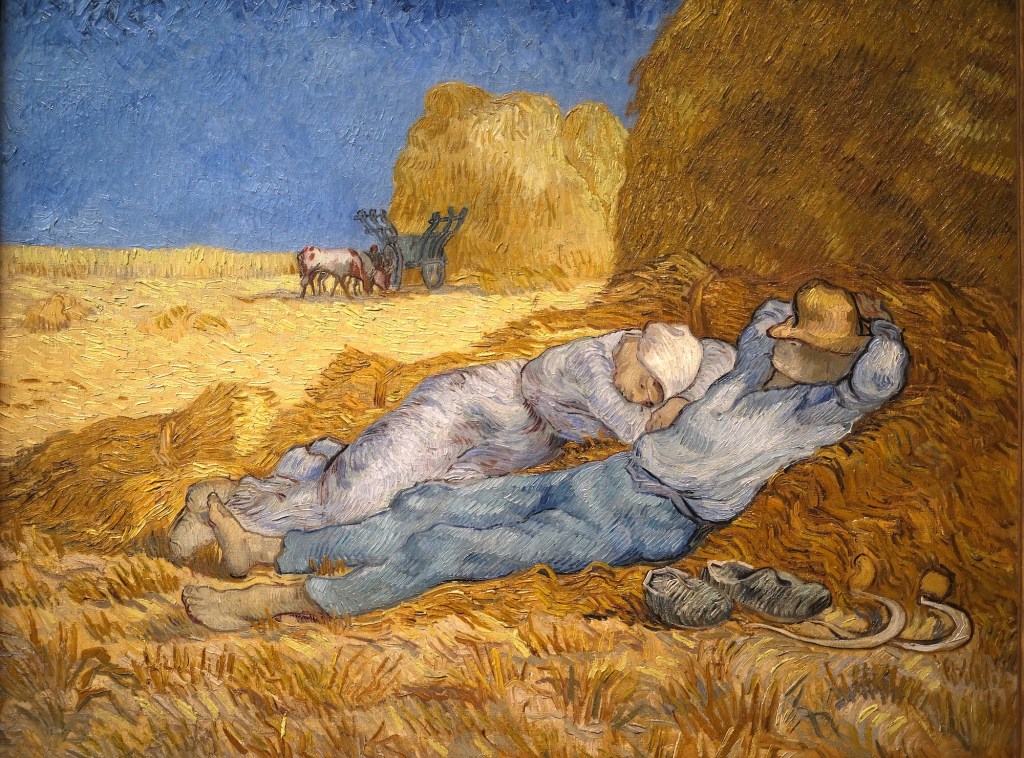
Light in St. SulpiceCordelia’s Coffee Flower ShopI love the wind and the light in these sketches of Woman with a Parasol by MonetAnna Boch, CuilletteDetail from Henri-Edmond Cross’s Flight of the NymphsSo sad. Doctor Paul Gachet by Vincent Van Gogh.Portrait of the Artist, Vincent Van GoghThe Siesta, Van Gogh74 Rue du Cardinal LimoineErnest and Hadley Hemingway lived on the 3rd floor above the blue door. Hemingway wrote about this apartment in A Moveable Feast, which introduced me to the romance of Paris, and he lived here when he started writing about the Lost Generation in The Sun Also Rises.
The streets were quiet when we arrived around 9 or 9:30, and we walked through a green city park with tall trees and butterfly beds at its entrances. The sky was gloomy and grey, but we brought our hats and umbrellas, so we were prepared. I carried my tote and didn’t bring my camera. I didn’t want to spend all my time photographing and I didn’t want to hurt my back carrying my camera and two lenses. I carried my notebook, Boox, hat, and umbrella instead. And I have no regrets. Not now anyway. I might when I look at my phone’s photos of the castle and wish they were higher quality.
-Saturday June 7, 2025
I do have regrets. Sort of. I wish my photos from Ghent were better. At the same time, I do remember how much I loved just being present in the moment while we were there, feeling the mist on my skin, gazing out over the ramparts, feeling the solidity of the castle stone, taking care in the slickness of the castle walkways, thinking about the puddles and the chill dampness of the castle’s interior, and how miserable it would be to live there, except for the glorious fireplace that was big enough for me to walk into. I wouldn’t mind scooting a chair next to a blazing fire in that with a book and a glass of port. Pulling out an iPhone to snap pictures requires less concentration than a real camera with settings and lenses and whatnot, so a phone makes it easier to be present (and is much lighter to carry), but the photos definitely are inferior, especially since I never remember to clean my lens. Oh well.
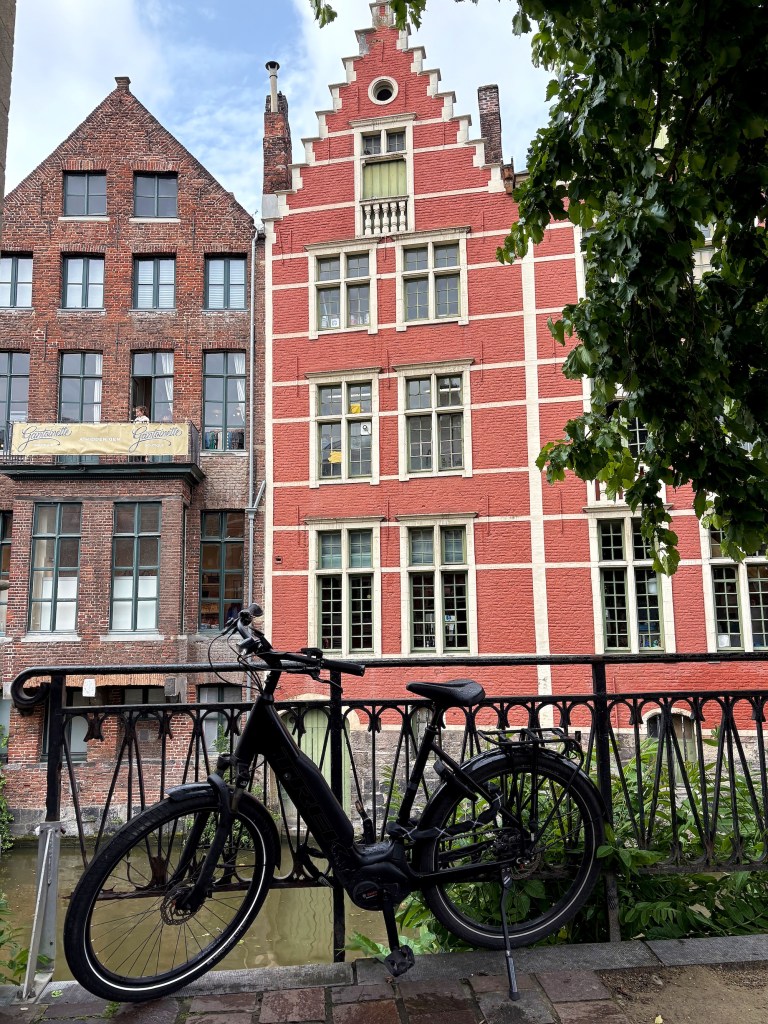
After our son left our Brussels Airbnb to go back home to the States, my husband and I took the train to Ghent. Several trains run the 30 minute route each day. When we disembarked at Ghent-Sint-Pieters, we went outside the station and gaped at a vast bicycle parking lot we’d seen from the train. Then we passed through the station to walk towards the historic part of town where the castle is, and we saw even more bicycles. The circular park outside the station was filled with bikes packed frame to frame to frame. The medians of the streets that ran out from the circle like spokes on a wheel were packed frame to frame with bicycles.
Bicycles in Ghent
Ghent’s outer portions, other than the medieval city center, look like any city, really. Roads, sidewalks, square-edged buildings not made from ancient stone. We noticed a big difference at street level, though, especially on the larger boulevards. In Ghent and various other places we visited, there is not only a cobbled sidewalk, but a side…bike? as well. A bike lane, I guess we’d call it in the US, except these were part of the raised sidewalk rather than on the street itself. Being raised makes a big difference because bike lanes in the US are often full of broken glass and litter of the road. In Ghent, raised off the road and of equal width to the grey-white paver sidewalk, is a brick-red paver thoroughfare for cyclists. So the dedicated space for walking and cycling takes up as much or more surface area as the space dedicated to motor vehicles. And most of the motor vehicles we saw were busses or taxis rather than individually owned cars.
It was refreshing to experience infrastructure that showed a clear value for non-motorized transportation. The hardest part as a pedestrian was to remember that the red-bricked portion of the sidewalk was specifically for bicycles. We frequently heard the polite ding of a bicycle bell trying to make its way through.
I loved the bicycles everywhere.
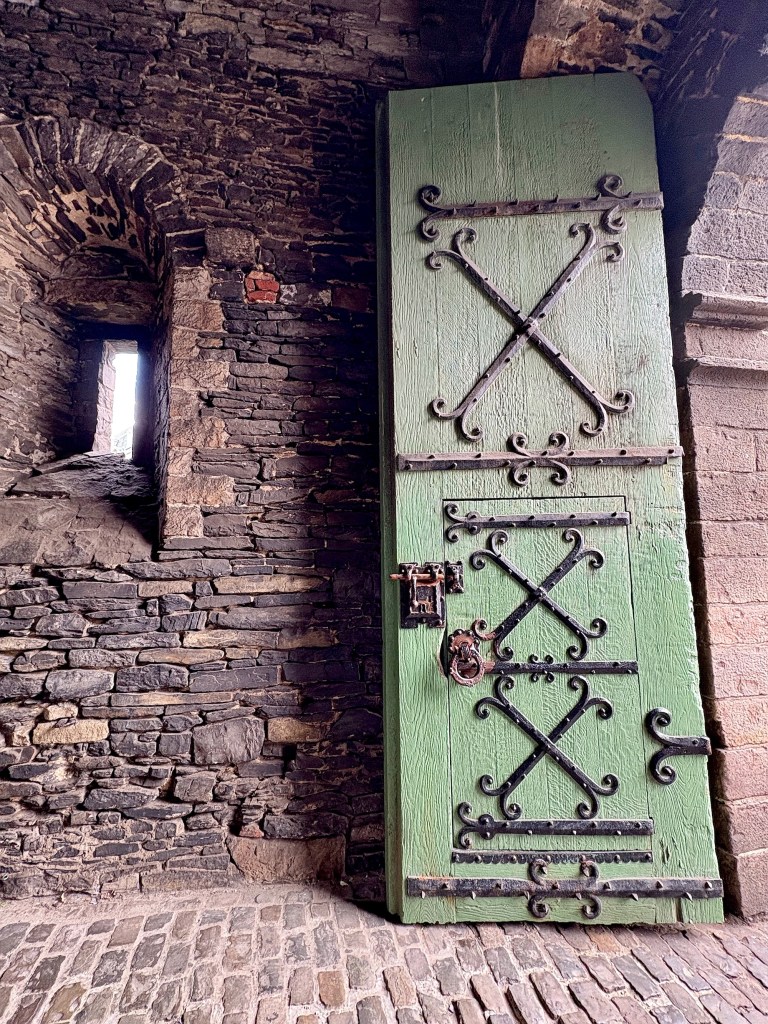
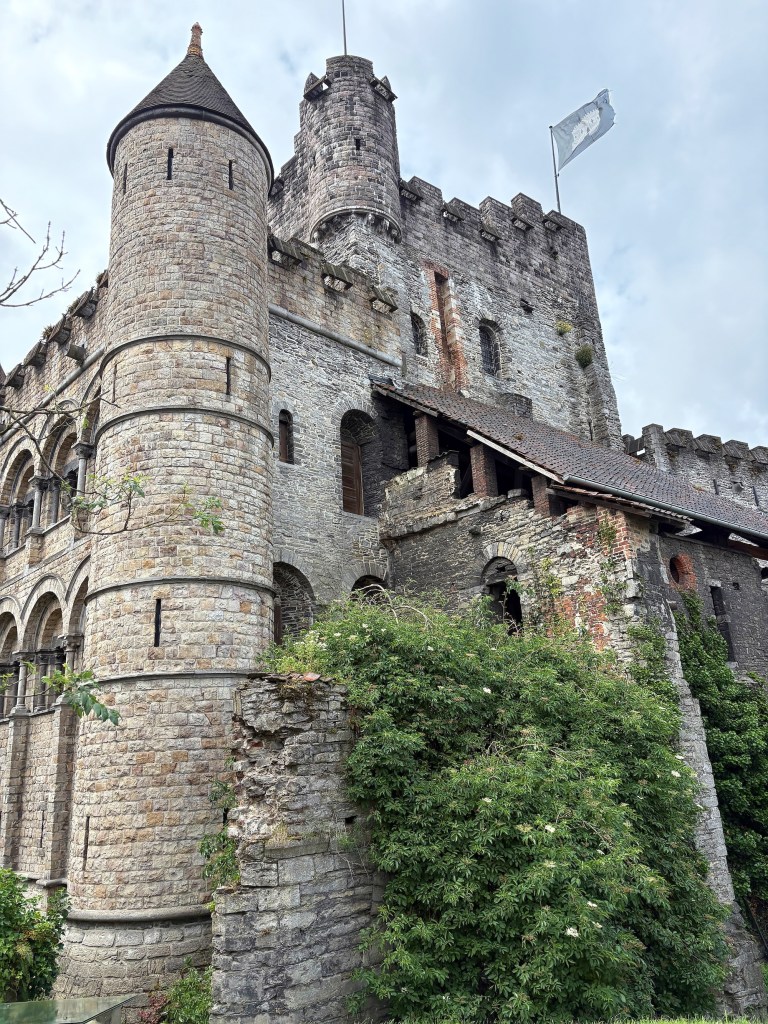
Our destination in Ghent was the Castle of the Counts, a medieval castle that dates back to 1180. We walked in the rain through the modern parts of the city to get to the historic center where the castle and cathedrals were.
The sky was still spitting when we entered the castle, and the air was cold and damp even though it was early June. I was happy to get inside the castle for shelter from the wetness, but the stone walls added no warmth, and wisps of hair around my face curled in the chill humidity inside. Being there gave me a chance to feel the cold dampness I’ve read described in so many novels that take place before electricity.
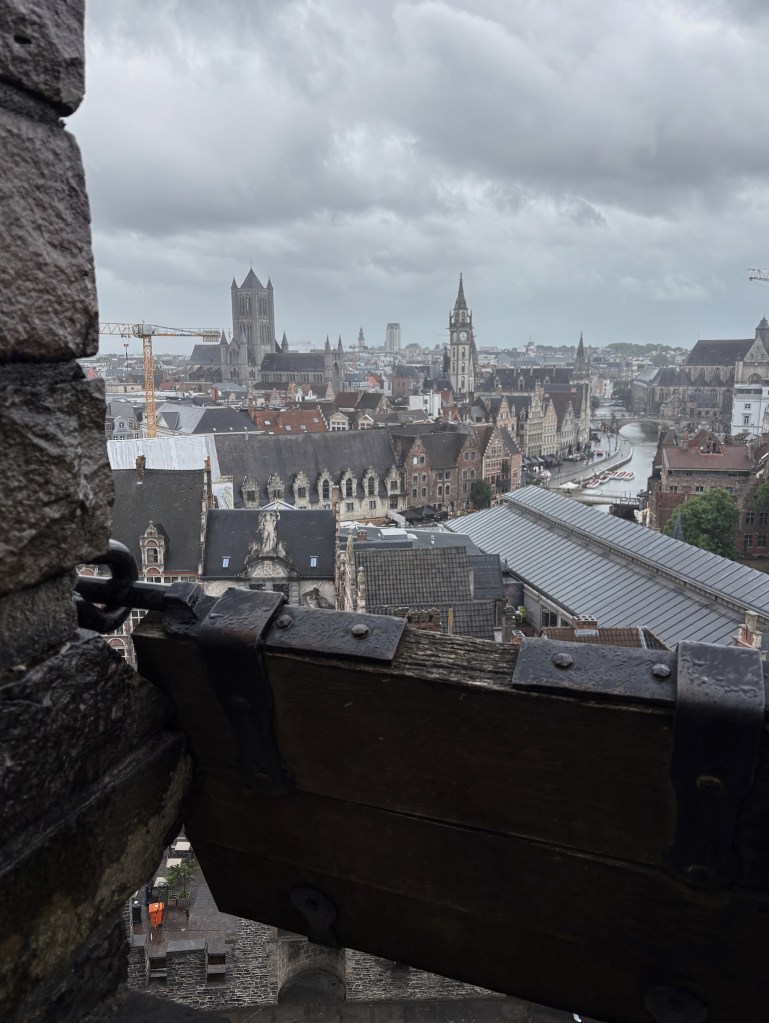
We climbed spiral stone stairs to the ramparts where we looked through the slits and weapon openings to see the skyline of Ghent. The stone pathways glistened in the rain and looked slick. I put my umbrella up and listened to rain tick against it while I tried not to slip and fall off the castle wall into the courtyard below. I looked out over the Northern Europe cityscape, all bundled up in my sweater, jacket, jeans, and hat on a June day in Belgium.
Castle of the Counts, Ghent
Before our trip to Belgium, I had read somewhere about something something medieval and something something torture chamber. I didn’t remember specifics, so I didn’t realize that was where we were until we entered a room with what looked like a well in the middle of it. It was a dungeon hole. I looked down into it, into the hole where prisoners would be held in this stone-walled pit, and was reminded of a scene in a post-apocalyptic book I’d recently read where the dad pried open a door to a cellar full of writhing people being held there to be eaten. Both the scene in the book and this very real dungeon pit were chilling.
We entered a room filled with armor and weapons of the day, including a two-handed sword that was taller than me, and maybe even taller than my 6′ husband. I wondered if I’d even be able to lift the sword, much less wield it. Especially wearing my body weight in metal armor. Seeing these suits of armor and weaponry in their natural habitat of a medieval castle instead of in the sanitized space of a museum made them feel much more real. I was struck that specimens like this, as well as art from each time period, are what make it possible for modern creators to craft realistic representations of warfare and medieval life in cinema and novels. So much of what we saw looked familiar from movies, but this was the real thing.
Throughout the castle are cartoonish depictions of what happened in the torture chambers, or what I assume were torture chambers since neither of us listened to the audio tour the castle staff really wanted us to listen to. Beheadings. Boiling in cauldrons. Pegs through the tongue. It’s all very gruesome.
Lots of gore in the Castle of the Counts
By the time we emerged from the castle, the rain had blown through, and the sky was a beautiful, scrubbed-clean blue. We walked the historic district along the river, popped into a couple of cathedrals, and headed back to the train station, trying to remember to stay on the grey-white pavers of the sidewalk instead of the brick-red ones.